Tuesday, December 25, 2018

Maricopa County: Living Here is Hazardous To Your Health

Ya know, dear readers, your MesaZona is really throwing one more RANT today about our Air Quality ....Ooops!!
Here's another one, but this time here are some links so that YOU, dear readers, CAN FOLLOW THROUGH to get your own daily updates . . . ask for more accountability.
Maricopa County consistently VIOLATES federal Clean Air Standards
Whose job is it anyway to ensure that Federal Clean Air Standards do not not get consistently violated here? It doesn't look like they are "Doing Their Job"!
Here's another Advisory for tomorrow: WHAT DO YOU WANT TO DO ABOUT IT????????
It's just NOT a Particulate Matter > Do you take it personally?
It's time to hold ADEQ accountable.
So: follow-up and start noticing the opening image for Sunday. Then there's this for Monday

The Arizona Department of Environmental Quality (ADEQ) is issuing a High Pollution Advisory (HPA) for fine particulate matter (PM-2.5) effective December 24 & 25, 2018 in Maricopa County. PM-2.5 is made up of small particles (soot) found in smoke.
ADEQ recommends that people limit outdoor activity while the HPA is in effect, especially children and adults with respiratory problems.
These alerts are for fine particulate matter (PM-2.5). PM-2.5 is made up of small particles (soot) found in smoke. ADEQ recommends that people limit outdoor activity while the HPA is in effect, especially children and adults with respiratory problems.
ADEQ Air Quality Hourly Forecast | View >
During an HPA, Maricopa County Air Quality Department (MCAQD) has declared a “No Burn Day”. Wood burning in residential fireplaces, chimineas, outdoor fire pits and similar outdoor fires is not permitted.    
Health Impacts
People most vulnerable to the impacts of air pollution include children, older adults, adults exercising outdoors and people with heart or lung disease and those suffering from asthma and bronchitis. Exposure can increase the number and severity of asthma attacks, cause or aggravate bronchitis or other lung disease and reduce the body’s ability to fight infection. Symptoms may include itchy eyes, nose, and throat, wheezing, coughing, shortness of breath, chest pain and upper respiratory issues. Long-term exposure is linked to premature death in people with heart or lung disease, nonfatal heart attacks, irregular heartbeat and decreased lung function.
Particulate Matter:
State and county agencies measure levels of particulate matter (PM) in the air.
PM is extremely small solid particles and liquid droplets that circulate in air.
PM comes from combustion (cars, industry, wood burning) or dust stirred up into the air. High levels of PM occur when air is especially stagnant or windy.
Two types of PM are measured:
PM-10, commonly called dust
PM-2.5, commonly called soot or smoke.
PM-10 is 10 microns or less in size
PM-2.5 is 2.5 microns or less in size.
(For perspective, one strand of human hair is 70-100 microns in size.)
_________________________________________________________________________
Forecast Discussion:       
We managed to narrowly avoid exceeding the health standard for PM2.5 yesterday, ending the day with a 90 AQI.
Unfortunately, we only expect PM2.5 concentrations to get higher today. Continued stable weather, along with an increase in fireplace activity due to it being Christmas Eve, means it is likely PM2.5 will reach into the Unhealthy for Sensitive Groups category. As a result, there is a PM2.5 High Pollution Advisory in effect for today.




Applying History in Real Time: A Tale of Two Crises - Niall Ferguson

Ferguson covers 2 topics
or frameworks with two recent crises - one military and one financial or in other words:
Security and Securities.
Vices in Silos: GroupThink & Subject Idiocy
This is about an hour-and-a-half.
Approach: Systematic Scenario Planning

Published on Oct 11, 2018
Views: 9,192


Historian Niall Ferguson on the roots of today's political polarization

Nothing to laugh at, but the American audience did just that, believing as Ferguson reprimands them that nothing before America started is important. . . . and he gives examples comparing what's happening now to The Reformation in the 16th and 17th centuries > a disruption of the public sphere that lasted more than 125 years. History, says Ferguson, happens 10x faster now after the Internet
[compared with the time after the widespread use of the printing press]
 
Published on Dec 18, 2018
Views: 7,674
Historian Niall Ferguson argues that today’s political polarization echoes the religious polarization of the Reformation. Both were brought about by technological disruption: The printing press, in the case of the Reformation; and the personal computer and internet, in the case of today.
From Niall Ferguson's Long Now Seminar “Networks and Power”:
http://longnow.org/seminars/02018/nov...

Check out more Seminars on Long-Term Thinking curated and hosted by Stewart Brand: http://longnow.org/seminars

The Long Now Foundation's monthly Seminars were started in 2003 to build a compelling body of ideas about long-term thinking; to help nudge civilization toward our goal of making long-term thinking automatic and common instead of difficult and rare.

> Like Long Now on Facebook:
https://www.facebook.com/longnow
> Follow Long Now on Twitter: https://www.twitter.com/longnow

> Subscribe to our channel: https://www.youtube.com/longnow

Monday, December 24, 2018

Noam Chomsky's Manufacturing Consent revisited | The Listening Post

Celebrating the anniversary of his book published more than 30 years ago - there are good reasons why Chomsky is one of the most cited intellectuals of our times.
Published on Dec 22, 2018
Views: 5,189
There is an exquisite and oft-quoted moment in an interview between BBC journalist Andrew Marr and Noam Chomsky in which Marr asks: "How can you know that I'm self-censoring?".

More of Noam Chomsky:
https://www.youtube.com/watch?v=pf-tQYcZGM4

Castle Films A CHRISTMAS CAROL Alistair Sim

DICKENS MAGIC brought from the pulp-page to black-and-white screens in 1946: The Short Version of The Conversion
The Castle Films editors carve the dickens (and most of the story) out of the classic Christmas tale of mean old miser Ebeneezer Scrooge in this one-reel version of A CHRISTMAS CAROL. Enjoy!!!

Sunday, December 23, 2018

A Take-Off From Jon Talton in Seattle: Hyper-Localizing + Aligning Opportunity Industries & Opportunity Zones Here In Mesa

Probably getting way-over my meager pay-scale, but your MesaZona blogger does admire fellow journalism colleague Jon Talton whose day-job is writing a column for The Seattle Times. He also has two alter egos in Arizona as The Rogue Columnist and a writer of fiction. Any reasonable person might ask other than Jon Talton what-the-hell do Seattle and Phoenix Metro [Mesa] have in common? One is progressive and the other is not.
One thing we do have in common is Boeing - and that might give you a cue . . .   
Two days ago Talton penned a piece on rotten jobs, based on a study by The Brookings Institution that examined Opportunity Industries.
There are some differences evident right away between Seattle Metro and Phoenix/Mesa Metro:
Mesa has a higher unemployment rate than the rest of the state of Arizona
Mesa is a "Right-to-Work" state
Behind the low unemployment rate, too many Americans are stuck in rotten jobs     

Relatively few jobs provide the pay and benefits that once were taken for granted. The biggest losers are people without college degrees.
Special to The Seattle Times
by Jon Talton
"Washington’s unemployment rate was 4.3 percent in November, a historic low. Seattle stood at 3.3 percent. Given the unsettling turbulence in the stock and bond markets and potential for a slowdown, this may be the closest to full employment we see in our lifetimes.
Yet not all the jobs are good ones, with at least middle-wage pay and benefits. This is especially true for those with less education and lacking high skills.
An analysis of employment in the nation’s 100 largest metropolitan areas by the Brookings Institution found that only one third of workers without bachelor’s degrees held good or promising jobs in 2017.

“Good” means middle-class pay and benefits, while “promising” jobs provide pathways to good ones.
The results are nearly flipped for those with a college degree. And the national data pretty much play out the same in Seattle-Tacoma-Bellevue. . .
Shareholder value” became a ruling force for public companies, redistributing wealth upward to shareholders and top executives at the expense of wages, job creation and investment in the future.
Union busting was endorsed by President Ronald Reagan, the only former union president to occupy the Oval Office.
Technology became the enemy of low-skilled and less-educated workers, too. . . Deregulation eliminated jobs by enabling industry consolidation and taking away secure employment in such sectors as telecommunications.
And globalization sent jobs overseas, including fields where America  once ruled, such as manufacturing everything from televisions to machine tools.
The result is a workforce where the better educated and highly skilled do well, while the rest lack the rungs up the ladder that once existed. By 2016, more than 33 percent of American adults held bachelor’s degrees. . .
Bottom line: America doesn’t create nearly enough good or promising jobs for its workforce without bachelor’s degrees. And even many industries that provide that work now are vulnerable to automation. (College grads won’t be safe from this, either.)
Brookings scholar Chad Shearer and research assistant Isha Shah argue that willingness to move and change jobs is essential for less-educated workers.
“Occupations that provide the best chances of obtaining a good job typically require specialized skills,” they write. “Yet few people follow a specific career pathway to get one. Instead, most people who obtain a good job do so by switching from an unrelated occupation …”
Read more >> https://www.seattletimes.com/business/economy
_________________________________________________________________________________
Let's get back to why this Take-Off on Jon Talton's Special to The Seattle Times:
From the Brookings Institution Research
LINK > https://www.brookings.edu/research/opportunity-industries/
Report
Opportunity Industries
Exploring the industries that concentrate good and promising jobs in metropolitan America
and
Right away there's this difference between Seattle and Mesa:
  • Mesa's unemployment is higher than the state average
  • Arizona is a Right-To-Work state 
Defining good and promising jobs
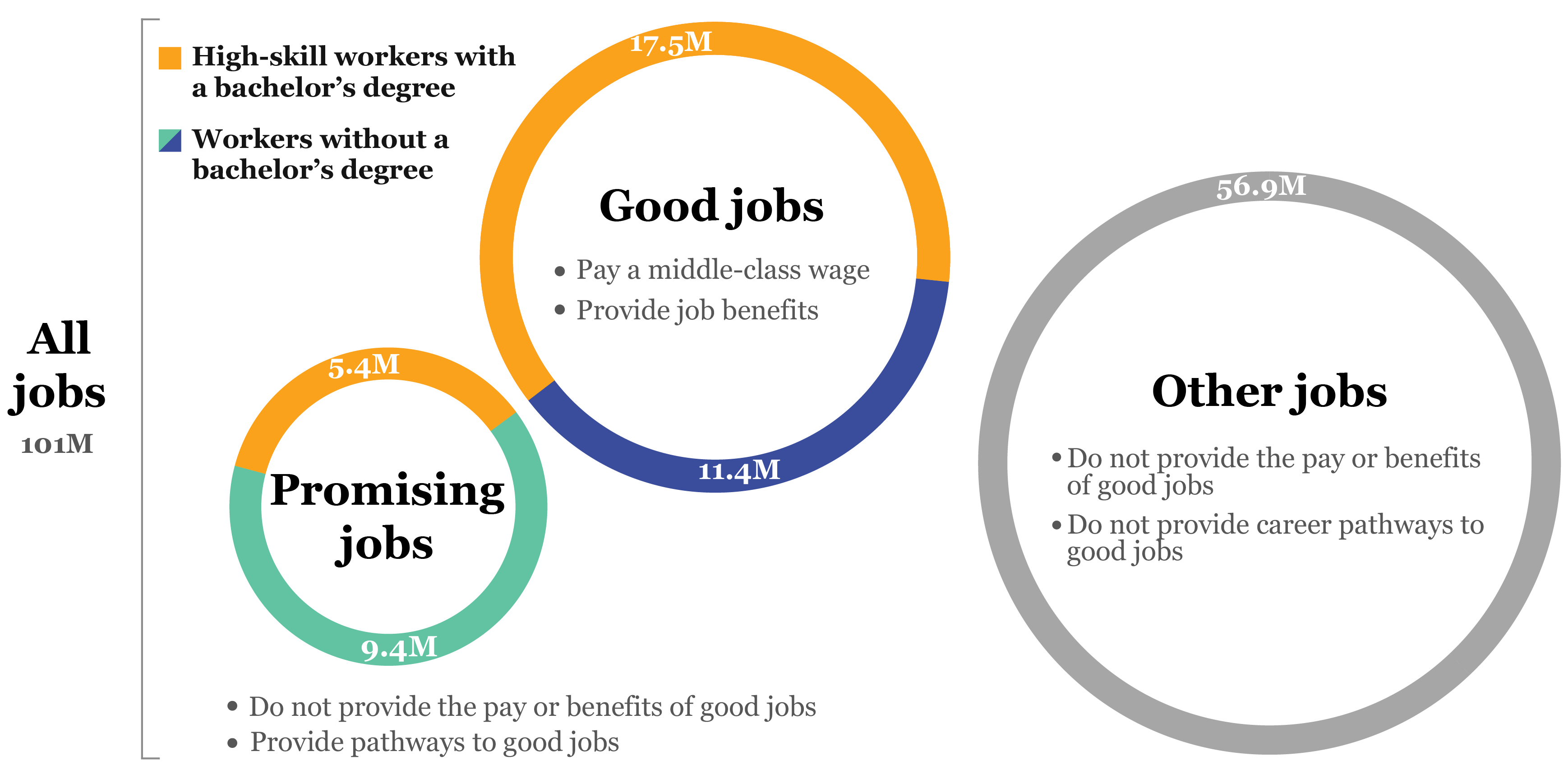
Our analysis defines three types of wage and salary jobs in each of the nation’s 100 largest metro areas:
  • Good jobs provide stable employment, middle-class wages and benefits
  • Promising jobs are entry-level positions from which most workers can reach a good job within 10 years
  • Other jobs do not provide decent pay, benefits, or pathways to good jobs
_________________________________________________________________________
Share of good jobs, promising jobs, and other jobs based on the 101 million total jobs in the nation’s 100 largest metropolitan areas
defining good jobs
_________________________________________________________________________________
What are the opportunity industries in each metro area?
NOTICE: The Preponderance of Gray areas
Select a metropolitan area


BLOGGER NOTE: You can use the interactive to scroll to:
Phoenix-Mesa-Scottsdale, AZ 
Percentage of jobs in each industry that are good, promising, high-skill, or other jobs
> Promising jobs Green
Held by workers without a bachelor's degree
> Good jobs Blue
Held by workers without a bachelor's degree
> High-skill jobs Orange
Good and promising jobs held by workers with a bachelor's degree
> Other jobs Gray
All other jobs
0%25%50%75%100%All jobs10.2%12.1%19.3%58.2%Construction8.7%31%8.3%52%Utilities49.1%27.4%21.2%Logistics8.3%28.3%13.4%50%Mining62%13.4%22.9%Manufacturing8%25.6%20.6%44.5%Wholesale10.2%13.6%21.1%54.8%Real estate, etc.13.9%8.6%13.7%63.8%Administrative14.7%6.2%12.4%66.5%Information7.3%17.8%31.4%43.2%Headquarters6.2%18.7%35.7%39.2%Government5.5%19.2%32.1%42.8%Finance9.4%9.9%27.4%53.3%Agriculture14.9%8.8%72.9%Local services12.8%6.5%11.9%68.7%Retail14.5%9.7%72.3%Professional15.7%39.2%39.5%Health care8.2%9.2%24.2%58.5%Arts/entertainment13.9%12.8%69.7%Hospitality14.3%81.2%Education8.2%30.2%57.7%
Note: Not all bars sum to 100%. These are indicated by undefined segments above
________________________________________________________________________________
Pathways to good jobs typically involve major career moves to different occupations
_________________________________________________________________________________
Occupation pathways
Select a metropolitan area


Select worker education level


Select starting occupation


 __________________________________________________________________________________
Share of jobs that are good, promising, high skill, or other
Select a metropolitan area

...
Good and promising jobs held by workers with a bachelor's degree
10.2% Promising jobs held by workers without a bachelor's degree
12.1% Good jobs held by workers without a bachelor's degree
19.3% Good and promising jobs held by workers with a bachelor's degree
58.2% Other jobs
Strategies to improve opportunity in metropolitan America
Nearly all metropolitan areas do not provide enough good and promising jobs for all the workers who need those opportunities. Yet metro labor markets are dynamic, with many workers switching occupations and industries in order to get ahead. This report identifies three strategies for leaders in cities and regions to enable workers’ mobility to better jobs and the middle class:
  • Refocus economic development on opportunity industries. Too often, scarce public resources are spent on incentivizing job growth or retention in industries that provide too little opportunity. Economic development should instead increase the share of good jobs in the local economy. Such jobs not only broaden access to opportunity, but industries that concentrate good jobs also tend to have a greater positive impact on the local economy.
  • Partner between government and business to improve job quality. A growing body of research shows that improving job quality—by treating labor as an asset rather than a cost—is good for the bottom line in some sectors that provide many “other” jobs, including retail, hospitality, health care, and education. Improving job quality means not only increasing wages and benefits, but also improving the visibility of pathways from low-quality jobs to better ones.
  • Retool education and workforce development for a dynamic labor market. The constant emergence of new technologies means workers may need to switch careers more often to access opportunity. Specific knowledge and skills remain essential to getting a job, but keeping that job or finding a better one may require workers and institutions to focus more on developing abstract cognitive abilities that enable people to think and learn by themselves, and to adapt to continuous change in the labor market.

Read about strategies local leaders can take to develop more good jobs on page 21 »
_________________________________________________________________________________

Try like the Dickens as yours truly might, one thing that's gone missing in the City of Mesa's 11 Opportunity Zones mainstream media over-kill is wealth-creation for "angel investors" (with $25-100K) and millionaire-investors is the 2017 Opportunity & Jobs Act that was supposed to go hand-in-hand with job-creation. So far it's been mostly all about rampant real estate speculation and long-term deferred capital gains taxes to attract millions in cash standing on-the-sidelines.
Where do these two components meet in Mesa's 11 OZones?
1. Downtown Mesa:
    Along the Valley Metro Light Rail Corridor
2. Northeast Mesa
3. Southeast Mesa
4. Southwest Mesa

OBSERVATION: Most of the job growth is concentrated in NE Mesa and SE Mesa