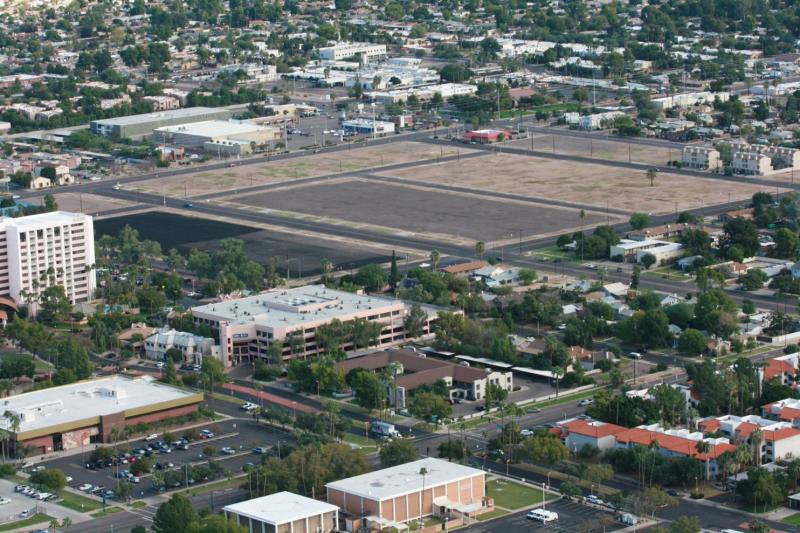
This is a reminder - a strong reminder and a call-to-action - to GET INVOLVED in fixing this 30-year old scar in the downtown landscape and to WATCH OUT for the Mesa Grande/ANA (Action Neighborhood Alliance)
 Here's an excerpt from a post on this blog site two years ago:
18 November 2016
Here's an excerpt from a post on this blog site two years ago:
18 November 2016
Who wants to go here to take Mesa to the next level? Is this what works for Mayor John Giles or is there another direction?
At tonight's Mesa City Council Study Session for Monday, Nov 21, 2016,one item stands out on the Final Agenda, but first some background to put things into perspective . . .
16 years later fast-forward to this Monday, November 21, 2016 where Director of Downtown Transformation, Jeff McVay, will be making a presentation of the results of months of online surveys and community meetings to a study session of the Mesa City Council. Real estate developers' perspectives are included also.
16 years ago demolition bulldozed the site, with reporter Gary Nelson calling the 30 acres " a vast scar of empty real estate" in an article from 3 years ago. . .
_________________________________________________________________________
It's the result of bad urban planning when city officials only listened to real estate developer speculation schemes that demolished more than 60 homes to destroy a neighborhood leaving 27 acres vacant, ugly and un-used and it's city-owned. City officials now own the damage done and have hired a group of consultants who tried to transform a part of downtown Gilbert's Heritage Area.
The history here on this infamous site - and all the problems - simply cannot be ignored now. . . Jeff McVay, the city's so-called "Director of Downtown Transformation" failed miserably two years wasting time-and-money on citizen input sessions that got nowhere.
Did the community already provide input on this site?
_________________________________________________________________________
BLOGGER NOTE: I only attended one of the workshops two years ago, observing the domination and control by the Mesa Grande/ANA (Action Neighborhood Alliance).
Likewise, once again, at the Steering Committee the same complaint was voiced for actions by the Mesa Grande/ANA (Action Neighborhood Alliance)
_________________________________________________________________________
Yes! There were two community meetings and a survey conducted in the summer of 2016. After those meetings, Mesa City Council asked that a consultant be hired to create conceptual master plans for the property with more community input. The consultant, Crandall Arambula, was hired in September 2018 and has received all of the input from 2016 for review.
This is their promise to fulfill the ____ contract:
“We will provide the Mesa community with maximum value for investment. We are passionate about assisting communities through our depth of experience and research, and we are committed to the long-term success of this project. The measure of that success will ultimately be the development of a vibrant community that is harmonious with greater Downtown Mesa. We look forward to working with you.”
________________________________________________________________
What makes your MesaZona blogger turn red is this statement just a few days ago made by Mesa Mayor John Giles:
"The city is not in the business of owning remnant, undeveloped pieces of properties, . . . "
WTF????
How wrong can Giles get spouting bullshit like that with blinders on when Site 17 has been an ugly eyesore for more than 30 years. He sees only what he wants to see and lacks any vision whatsoever unless it's fed to as bait.
_________________________________________________________________________
Some people who attended the first presentation have told me they were "disappointed" and that's putting it mildly to say the least!
Here's a link to the workshop six weeks ago where attendees were told to only submit written comments: https://www.mesaaz.gov/about-us/city-projects/downtown-transformation/university-mesa
Slick-and-slippery: The Process

________________________________________________________________________________
Results of Community Workshop 1
Nov. 13, 2018
You can access and download this 1.66MB 6-page Summary
Discussion Notes Total Response Sheet Results
Community Workshop 45 Response Sheets
Steering Committee Meeting 35 Response Sheets
Stakeholder Sessions 24 Response Sheets
Online Platform 15 Responses
TOTAL 119 Responses Received
_________________________________________________________________________________
1Workshop 1 Summary | November 13–14, 2018
The first project milestone and community engagement session was held November 13th and 14th of 2018.
During that period, the consultants presided over a total of 16 meetings with various community groups including the Steering Committee, individual stakeholder groups, and City Officials to discuss opportunities for the site as well as their issues and concerns.
Additionally, a Community Workshop was held to engage the residents and greater community of Mesa. The stakeholder and public issues and concerns identified in these meetings will become the reference point for creating the preliminary master plan concepts.
The Steering Committee and stakeholder meetings were held at the Save the Family conference building on Tuesday November 13, followed by the Community Workshop from 6:00pm to 8:00pm at Eisenhower Innovation Center Elementary.
Subsequent meetings with City Officials took place at the Mesa City Plaza offices at 20 E. Main Street.
The following pages include:
▫ Meeting Purpose & Description
▫ Response Sheet Results
▫ Issues & Concerns Summary
The purpose of the Workshop 1 meetings was to:
▫ Introduce the consultant team and project
▫ Present background information and analysis
▫ Identify key issues, concerns, and needs of the community, and opportunities for the site
Community Workshop November 13, 2018 6:00–8:00 pm
Eisenhower Innovation Center Elementary
The Community Workshop was attended by 89 people.
The consultant, Crandall Arambula, gave a 25-minute slideshow presentation to introduce the team, project schedule, public engagement process, and provide an initial assessment of background and existing conditions information.
Following the presentation, the community was asked to have discussion around their tables to identify opportunities and constraints for the Property as well as discuss their issues and concerns.
Response Sheets were provided for community members to list their top three issues and any additional comments. Additionally, each table was given a table map to illustrate areas of opportunity and/or concern. The workshop portion concluded with table summaries, presented by each group. The key points of each group were transcribed on a presentation-sized notepad and easel.
> A total of 45 Response Sheets and 11 table maps were collected at the close of the meeting.
The Steering Committee Meeting was attended by 45 people including local property and business owners, representatives from adjacent neighborhoods, community groups, local organizations, and key City staff.
Groups represented at the Steering Committee Meeting include the following: [see .pdf]
Stakeholder Sessions November 13, 2018 10:00 am–5:00 pm
Save the Family Conference Facility
The consultant met with eight focused stakeholder groups individually to gather additional background information and discuss the specific needs, issues, and concerns of these groups and individuals.
Meetings lasted 30–45 minutes, during which a brief 5-minute slideshow presentation was given to introduce the project, followed by discussion and annotation of the table maps. Groups represented in one-on-one stakeholder sessions include: Stakeholder Groups Glenwood Wilbur Historic Neighborhood
Escobedo Heritage Neighborhood
Mesa Grande/ANA (Action Neighborhood Alliance)
RAIL Mesa
Mesa Public Library
Historic Preservation Board
Mesa Fire Department
Mesa Police Department
Arizona State University
Meetings with City Officials November 14, 2018 7:30 am–11:30 am
Mesa City Plaza offices
The day following the Community Workshop, the consultant met individually with City elected officials and management to provide a project update and summary of previously held community and stakeholder meetings.
Additionally, officials provided their input and feedback.
Mesa City officials—including the mayor, vice mayor, councilmembers (from each of the 6 districts), and the city managers—will be involved in one-on-one meetings for the duration of the project.
The following meetings took place as part of Workshop 1 Engagement.
City Officials
Mayor Giles
Vice Mayor Luna*
Councilmember Glover
Councilmember Freeman
Councilmember Heredia
Councilmember Thompson*
Councilmember Whittaker*
Councilmember-Elect Duff*
City Manager, Chris Brady
Assistant City Manager, Keri Kent
Assistant City Manager, John Pombier
*Meetings held outside of the listed timeframe.
_________________________________________________________________________
City of Mesa, Arizona Government
Hey, Mesa! We want your help in transforming the southwest corner of University Dr. & Mesa Dr.
Join us on January 29th for the second Community Workshop!
Review 1st workshop and project details here
👉http://social.mesaaz.gov/dZ
_________________________________________________________________________