2 BIG Zoning Cases in District 6 Meeting Agendas can be located, downloaded and viewed here on the calendar
PLEASE NOTE THAT THE STREAMING VIDEOS ARE INSERTED IN THE POST AFTER THE INFORMATION AND ATTACHMENT LINKS IN THE MEETING DETAILS. IT DOES TAKE SOME TIME WELL-SPENT TO READ THE DETAILS
Planning and Zoning Board - Public Hearing Meeting Agenda - Final Wednesday, July 10, 2019 Lower Level Council Chambers 57 E. First Street Chair Michelle Dahlke [not present] Vice Chair Dane Astle Board members: Jessica Sarkissian Tim Boyle Shelly Allen Jeffrey Crockett Deanna Villanueva-Saucedo _________________________________________________________________________ PLEASE NOTE How well these P&Z Board Meetings are conducted Consent Agenda - All items listed with an asterisk (*) will be considered as a group by the Board and will be enacted with one motion. There will be no separate discussion of these items unless a Boardmember or citizen requests, in which the item will be removed from the consent agenda, prior to the vote, and considered as a separate item. Items on this agenda that must be adopted by ordinance and/or resolution will be on a future City Council agenda. Anyone interested in attending the City Council public hearing should call the Planning Division at (480) 644-2385 or review the City Council agendas on the City's website at www.mesaaz.gov to find the agenda on which the item(s) will be placed.
_________________________________________________________________________________ Call meeting to order. 1 Take action on all consent agenda items. Items on the Consent Agenda > 2 Approval of minutes from previous meetings. PZ 19086 Minutes from the June 26, 2019 study session and regular public hearing.*2-a PZ 19087 Minutes from the July 1, 2019 Special Meeting.*2-b
Page 1 City of Mesa Printed on 7/3/2019 July 10, 2019Planning and Zoning Board - Public Hearing Meeting Agenda - Final
3 Take action on the following zoning case: PZ 19083 ZON17-00597 District 2. 1961 South Val Vista Drive. Located on the northeast corner of Val Vista Drive and Baseline Road. 1± acres). Site Plan Modification. This request will allow for a multi-tenant commercial building with a drive thru. Brad Williams, Thomas English Real Estate, LLC, applicant; Leticia Martinez, Circle K Stores, Inc., owner. Planner: Wahid Alam Staff Recommendation: Approval with conditions *3-a
4 Discuss and make a recommendation to the City Council on the following zoning cases:
THIS IS ITEM 4a Blogger Note: the inserted graphics are for purposes of the post only. PZ 19084 ZON19-00436 District 6. The 5200 to 5300 blocks of South Ellsworth Road (east side), the 5300 through 6200 blocks of the South Crismon Road alignment (east and west sides), and the 10000 through 10200 blocks of the East Williams Field Road alignment (north and south sides). Located on the north side of the future State Route 24 freeway alignment between Ellsworth Road to approximately one-quarter mile east of the Crismon Road alignment (485± acres).
Major Amendment to the Pacific Proving Grounds North Community Plan, also known as the Cadence Community Plan. This request will remove Development Unit 5 from the Cadence Community Plan (20± acres at the southeast corner of the Crismon and Williams Field Road alignments). Paul Gilbert, Beus Gilbert, PLLC, applicant Pacific Proving, LLC, owner. Planner: Tom Ellsworth Staff Recommendation: Approval with conditions *4-a
THIS IS ITEM 4-B PZ 19085 ZON18-00951 District 6. The 6000 through 6400 blocks of the south Crismon Road alignment (east side), the 10000 to 10600 blocks of East Williams Field Road (south side) and the 6000 through 6400 blocks of South 222nd Street (west side). Located south of Williams Field Road and west of Signal Butte Road (182± acres). Rezone from AG and PC to PC. This request will establish the Avalon Crossing Community Plan.
Paul Gilbert, Beus Gilbert PLLC, applicant Pacific Proving, LLC, owner. (Continued from June 26, 2019) Planner: Tom Ellsworth Staff Recommendation: Approval with conditions *4-b
________________________________________________________________________________ Items not on the Consent Agenda 5 Other Business. Page 2 City of Mesa Printed on 7/3/2019 July 10, 2019Planning and Zoning Board - Public Hearing Meeting Agenda - Final 6 Adjournment. ________________________________________________________________________ PLANNING AND ZONING MEETING JULY 10, 2019 5 Minutes 4 Views at time of upload to this blog
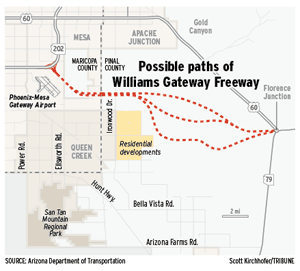
"It's important for economic development and it's important for congestion relief," said Mark Young, Queen Creek's intergovernmental liaison. But when will it be built? It doesn't appear that the money is there to bring the map to life.
Mesa officials are attempting yet again to round up the millions of dollars needed to design the freeway's first mile, to Ellsworth Road, and purchase the land needed for construction.
. . . There was an attempt to have the federal stimulus package pay for the design and right-of-way land purchases, but the project was deemed not "shovel-ready."
So Mesa is trying a different approach. "I don't know if this is Plan No. 10 or 11," quipped Scott Butler, the city's director of government relations. Today, the Maricopa Association of Governments' Regional Council will vote on a proposal that will allow Mesa to use $8 million in highway money to finance city-issued bonds. The $45 million raised by those bonds then will go toward design and land purchases.
"We think it's a great way to do it," Butler said.
. . . Federal funding could be tough to come by, especially since the freeway would travel through Rep. Jeff Flake's district - and Flake is not known for pursuing money for projects back home, Martyn said. "Eventually, our highway user revenue funds will pick up again and ADOT will have the ability to pick up and fund these projects . . ,"
. . . Meanwhile, Queen Creek has plans to create a direct connection between Signal Butte and Meridian roads to take advantage of the freeway, even though it won't enter the town's borders.
Signal Butte is expected to be the bigger interchange of the two in Mesa, but that road effectively stops at Rittenhouse. Meridian is expected to attract development farther south, hence the proposed connection. But that project, too, is contingent on development coming to the area.
Thanks to a social media by Scott Beyer, it sure looks like Mesa City Manager Chris Brady can't punch his way-out from reliable data, no matter if he's hitting low balls either above or below his high-salaried generous benefits package over his 15-year track record as the city's chief executive officer. There's a new batch of data just published today: SPOILER ALERT: #85 Mesa How Strong Are Your City's Finances? 116 US Cities Ranked January 9, 2017 https://www.thefiscaltimes.com/Authors/J/Marc-Joffe
To compile this Fiscal Health Index, we looked at 116 U.S. cities with populations greater than 200,000, using data from 2015 financial reports issued by the cities themselves. . . _________________________________________________________________________ Our scoring system is described in a new working paper Read the full methodology here. Click the table headers below to sort by ranking, city name, state or fiscal strength score. Click each city's name to get more details about its score [for fiscal strength score + ranking _________________________________________________________________________ For cities in Arizona with higher rankings, #17 Gilbert Score 85 #20 Chandler Score 84 #43 Phoenix Score 73 #77 Glendale Score 62 #81 Tucson Score 60 #84 Scottsdale Score 59 #85 Mesa Score 59
_________________________________________________________________________________ MORE DETAILS FOR MESA: https://www.thefiscaltimes.com/2017/01/09/Mesa-Arizona
Mesa, AZ
General Fund Balance as a Percentage of General Fund Expenditures
23.38%
Long Term Obligations as a Percentage of Total Revenues
235.09%
Actuarially Required Pension Contributions as a Percentage of Total Revenues
Marc Joffe, a senior policy analyst at the Reason Foundation, has written for the Mercatus Center at George Mason University and the Haas Institute at UC Berkeley.
Previously, he was the director of policy research for the California Policy Center and a senior director at Moody’s Analytics.
Spider-Man: Farm From HomeSource: Sony Pictures Entertainment
Box Office Hit from Bloomberg News CYBERSECURITY Spider-Man’ Scores $93.6 Million in Win for Sony’s A-List Hero
By Anousha Sakoui July 7, 2019 8:36 AM
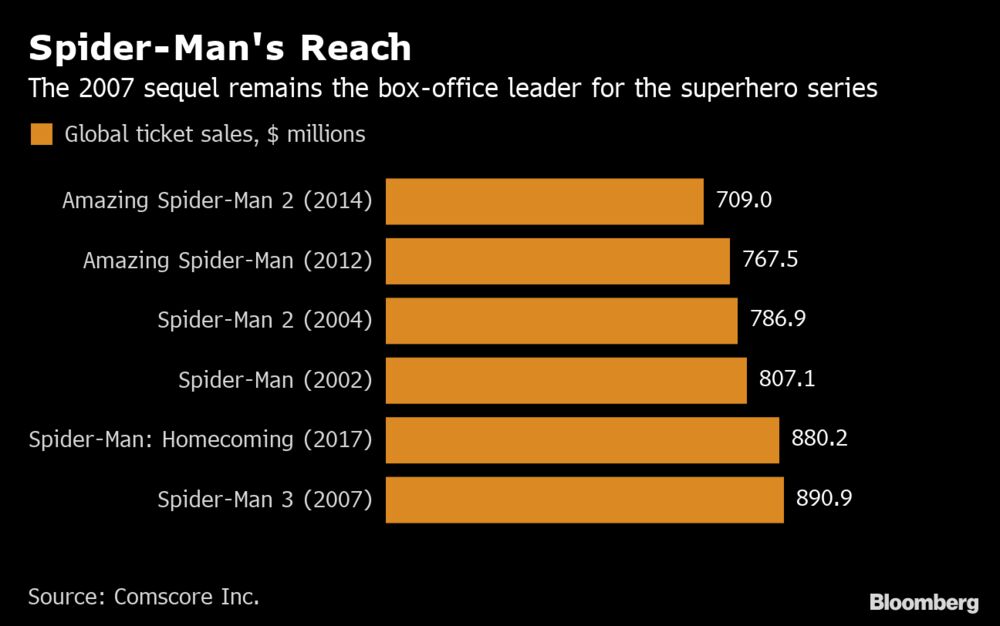
"Spider-Man swung into theaters this weekend, delivering a jolt to Sony Pictures Entertainment and the slumping box office. The second in a new series on the teen superhero and his alter-ego Peter Parker, “Spider-Man: Far From Home” opened July 2 in North America and led the box office with weekend sales of $93.6 million, Comscore Inc. estimated Sunday. That compared with analysts’ forecasts of as much as $97.4 million for Friday to Sunday.
The film will almost surely be among Sony’s biggest of 2019, lift the studio from fifth place at the box office and bolster a turnaround under new entertainment chief Tony Vinciquerra. Yet unlike Walt Disney Co. and Warner Bros., Sony doesn’t have a stable of A-list heroes beyond Spider-Man to drive ticket sales. It’s releasing an industry-leading 28 movies this year, many adult-oriented, and positioning itself to feed streaming companies like Netflix Inc., while rivals launch their own online services. . . NOTE: Operating margins for Sony Pictures rose to 6% in 2019 from 4.1% in fiscal 2017, and the company predicts 7% by 2021. The studio has also reduced its risk in film by bringing in co-finance partners like Tencent Holdings Ltd. and Perfect World Co.
ICE Used Facial Recognition to Mine State Driver’s License Databases
By Catie Edmondson
WASHINGTON — Immigration and Customs Enforcement officials have mined state driver’s license databases using facial recognition technology, analyzing millions of motorists’ photos without their knowledge.
In at least three states that offer driver’s licenses to undocumented immigrants, ICE officials have requested to comb through state repositories of license photos, according to newly released documents. At least two of those states, Utah and Vermont, complied, searching their photos for matches, those records show. . .
The documents, obtained through public records requests by Georgetown Law’s Center on Privacy and Technology and first reported on by The Washington Post, mark the first known instance of ICE using facial recognition technology to scan state driver’s license databases, including photos of legal residents and citizens.
Privacy experts like Harrison Rudolph, an associate at the center, which released the documents to The New York Times, said the records painted a new picture of a practice that should be shut down.
“This is a scandal,”Mr. Rudolph said.
“States have never passed laws authorizing ICE to dive into driver’s license databases using facial recognition to look for folks.”
ICE uses driver's license photos for facial recognition searches: Report
by Rebecca Falconer
"The FBI and Immigration and Customs Enforcement (ICE) have been using driver’s license photos for facial recognition searches without their owners' knowledge or consent, the Washington Postfirst reported Sunday.
Why it matters: This is the first known instance of ICE using facial recognition technology to scan state driver’s license databases, including photos of legal residents and citizens, notes the New York Times, which reviewed the details that Georgetown Law Center on Privacy and Technology obtained via public records requests.
In Utah, Vermont, and Washington, undocumented people come out of the shadows to get drivers licenses. ICE then asks those DMVs to run face recognition searches to find and deport them."
-- Center on Privacy & Technology founding director Alvaro Bedoya tweet
. . . The NYT notes that use of such technology by law enforcement is neither new nor rare, with more than 2 dozen states enabling them to request searches against driver’s license databases.
The House Homeland Security Committee, led by Representative Bennie G. Thompson, Democrat of Mississippi, will hold a hearing on Wednesday grilling Department of Homeland Security officials about their use of facial recognition. The chairman of the House Committee on Oversight and Reform, Representative Elijah E. Cummings of Maryland, has pledged to investigate the use of the rapidly expanding technology in the public and private sectors.
“This technology is evolving extremely rapidly, without any, really, safeguards, whether we are talking about commercial use or government use,” Mr. Cummings said at a hearing on the issue last month.
“There are real concerns about the risks that this technology poses to our civil rights and liberties, and our right to privacy.”
< OZones here in Mesa . . . there are 11 that qualify
"The Opportunity Zones policy was designed to benefit low-income communities, and the residents of those communities must have a voice in the process.
An impact framework must have clear and accessible avenues for communities to provide input."
- Federal Reserve Bank of New York, August 2018
Let's be very clear why that citation from the New York Federal Reserve Bank is prominently featured here today. Just two reasons: 1. John Williams is now the President of the NYFRB 2. John Williams knows Downtown Mesa He was invited here by Terry Benelli, President/CEO of LISC Phoenix (Local Initiatives Support Corporation) for an on-site visit three years ago. Not much has changed on ground-zero downtown since then, except for the TCAJA 2017 that created Opportunity Zones. OZONES for short or just OZ.
--------------------------------------------------------------------------------------------------------------------------
INPUT: Up on the rooftop at City Hall, we can see MesaMayor John Giles and ASU President Michael Crow making plans for new construction of one building and one renovation of an existing building - Price Tag: $100M, and all paid for by hikes in sales/use taxes.3rd person is unknown. As the data make clear Opportunity Zones are deeply distressed communities Blogger Note: That's not the same as "vibrant and exciting" Some investors - like John Giles and his closely-connected cohorts of friends-and-family in the Finance, Insurance, and Real Estate Industries are here for their own private wealth-creation: They snatched-up buying eight downtown commercial properties on Main Street before the end of December 2017 to gamble on rampant real estate speculation. One is The Caliber Wealth Development Fund (scroll down to read more)
The Opportunity Zones Reporting Framework is a project of the U.S. Impact Investing Alliance and the Beeck Center for Social Impact + Innovation at Georgetown University.
Let's not skip down that Yellow Brick Road again off-to-see the wizard in that shining green city over the rainbow The Economic Innovation Group (EIG) developed a Distressed Community Indexto measure economic well-being across long-neglected low-income contiguous zip codes. The data should demonstrate if Opportunity Zones are moving toward parity with better-off places There is a huge need for more community engagement in understanding needs and ensuring that communities are poised to benefit from investment.
IN THE SPOTLIGHT HERE IN DOWNTOWN MESA
11 Feb 2019 Phoenix, Ariz. – CBREannounced today that the firm was awarded the exclusive leasing assignment for eight historic urban retail properties on Main Street in Mesa, Ariz., that consist of nearly 110,000 square feet. The properties were acquired in February 2018 by Caliber Wealth Development Fund, who plans to re-develop the buildings as part of the city of Mesa’s downtown revitalization plans. . . This redevelopment is among several proposed and announced projects in downtown Mesa.
> In June 2018, the city of Mesa announced that ASU will add a new downtown Mesa campusto house its film, media and gaming programs, bringing an estimated 750 students to the area.
> Additionally, The Church of Jesus Christ of Latter-day Saintsis undergoing a two-year renovation of its 75,000-square-foot Mesa temple and surrounding grounds. No financial deals, however, were ever disclosed from news reports in MormonLand. It was disclosed that For-Profit affiliates of The Church had been working with city official for years.
What do we know? Reference: https://medium.com/new-york-fed-framework "One approach is to combine metrics that capture performance over time and across dimensions. Economic Innovation Group (EIG) developed a Distressed Community Indexto measure economic well-being across zip codes. Kenan Fikri, Director of Research at EIG, noted that relative indices allow us to “control for what’s happening in the macro environment,” adding that the data should demonstrate if Opportunity Zones are moving toward parity with better-off places
Another approach is to create a detailed, data-driven profile for each low-income community. This is the goal ofOpportunity 360, a tool from Enterprise Community Partners that aggregates 200 data points to identify characteristics of opportunity by census tracts. Some states used this tool in deciding zone nominations. “What we’re exploring now is: how can we pivot and iterate on this data?
Participants also stressed that using data is only one lens of many for understanding needs. Truly finding the opportunity in Opportunity Zones requires conversations with the community. Kevin Boes, President and CEO of New Markets Support Corporation at the Local Initiatives Support Corporation (LISC), has toured designated zones to identify gaps and how investors can fill them. Boes emphasized that “there is a huge need for more community engagement” in understanding needs and ensuring that communities are poised to benefit from investment.
The families living in these areas and community-based organizations serving them are in the best position to identify the needs, priorities, and opportunities to invest for strong community outcomes. But their engagement is not baked into the Opportunity Zones legislation, so it will fall to local leaders and private actors to create space for community voices in the market.
Establishing Evidence of Outcomes for Communities in Need
> Gathering baseline data on Opportunity Fund investments will allow policymakers, researchers, and community development practitioners to assess the short- and long-term impact of these flows of capital to underserved communities. Tracey Hsu, Director at Social Finance, pointed out the importance of having a shared understanding of what improvement looks like in a particular Opportunity Zone — not only to assess impact, but also to align this incentive with existing community development programs.
> Nick Fritz, Senior Associate for Sorenson Impact, suggested that a best practice may be to establish “impact measurement” milestones at the five-, seven-, and 10-year marks
tracking progress by reporting on specific yearly data points
also recording and reporting on specific metrics each year.
These metrics could build off of transaction-level data (location of investments, investment size, type of project or enterprise, etc.) to determine alignment with community needs and with an Opportunity Fund’s investment thesis.
> In the same way that community voices will help to determine need, Opportunity Zone residents will also help to contextualize data on outcomes and raise awareness of unintended consequences. “The great thing about the Opportunity Zones is that we are talking about place, but more importantly we are talking about people in place. A bottom-up approach is where we start to win”, said Frank DiGiammarino, a Senior Fellow at the Beeck Center.
> DiGiammarino also highlighted the importance of transparency, saying, “investment tends to be a black box,” but openly discussing what investments are being made in Opportunity Zones will help ensure that the benefit is effective. And as early movers will shape the market, he urged participants to act swiftly and cautioned that “perfect is the enemy of the good”. Endlessly discussing the “right” data to gather may dampen the interest of investors from contributing to the development of the market place.
Existing Frameworks for Evaluating Impact with a View Toward Investor Demand
Participants discussed key considerations when developing tools that help funds and investors to quantify impact and maximize opportunities. This will also require collection of impact data from recipients of Opportunity Fund investments, which may include start-ups and other local businesses.
First, the development of these market-facing tools has been driven by investor demand. Institutional and high-net worth investors have become increasingly aware of the ways that their financial decisions can align with their values. Greater market transparency enables investors to better understand risk and opportunity, ultimately helping them to make better decisions and improve returns. Amanda Kizer, Director of Impact Management at B Lab, spoke specifically about “a frame of maximizing stakeholder value rather than viewing impact through the lens of compliance.”
Second, business owners are seeing the benefit of collecting and reporting data. “Impact occurs at the point where an enterprise touches the people in the community,” said Brian Trelstad, Partner at Bridges Fund Management and representing the Impact Management Project. Understanding impact as a business owner is fundamentally a matter of understanding your customers and your market. Learning to glean and interpret these insights also develops skills and expertise in entrepreneurial ventures, preparing them to succeed and grow.
But powerful as these benefits can be, participants in the roundtable underscored the need for flexibility. Impact reporting should focus on data that is both material to impact goals and responsive in nature, allowing businesses to adapt if they aren’t meeting community needs. It should also be practical from the standpoint of collection, according to Paige Chapel, President and CEO of Aeris, who noted that “impact accountability and transparency shouldn’t serve as an undue burden to those Opportunity Fund managers who are explicitly and intentionally centered on community impact.”
Building the necessary environment to ensure effective reporting about investments in Opportunity Zones will take sustained effort, and a collaborative approach will help shape the market in these critical early stages.
Next Steps
The day-long meeting ended with a clear call to action: develop a shared understanding of how to measure impact in Opportunity Zones and how to help shape the nascent market for Opportunity Funds. A growing number of investors now acknowledge that incorporating impact metrics into their strategy can serve as an important risk management tool and produce better results. How do we build consensus and the necessary community to enable that action?
First, the Opportunity Zones legislation should lead to the creation of a market where there really wasn’t one — investing in communities that have otherwise been overlooked. The hallmark of a healthy marketplace is transparency. Investors and communities need access to baseline, transactional data about Opportunity Zones to enable targeted investment. Transparency will also produce data to observe the effectiveness of this new incentive and demonstrate accountability.
Second, a framework for impact will require authentic community engagement. The Opportunity Zones policy was designed to benefit low-income communities, and the residents of those communities must have a voice in the process. An impact framework must have clear and accessible avenues for communities to provide input.
Further, we must expand the conversation. This first roundtable was meant to articulate the potential for a shared impact framework, understand the existing tools at our disposal, and establish the impetus to act. Carrying the conversation forward will require input from actors across this new market, weaving together the diverse expertise of each stakeholder — policy makers, academics, researchers, investors, wealth advisors, fund managers, businesses, and, of course, the communities themselves.
Finally, we need to be prepared to learn and grow over time. “This policy is in a state of becoming,” was a common refrain, underscoring the need to move swiftly to shape it for the highest community benefit. But with the market developing at a heady pace, a lack of consensus regarding a successful impact framework cannot stand in the way. Rather, we should look at this as an opportunity to enable the flow of capital to the places most in need and also those most ready to use it. _______________________________________________________________
The Beeck Center mobilizes talent to drive social impact at scale by taking a systematic approach to delivering exponential outcomes that leverages the tools of data, technology, policy, and finance to improve people’s lives. The Beeck Center incubates and spreads cutting edge ideas; creates unique and unconventional networks of government, private and social sector leaders who come together through to solve complex problems; and equips and trains students, practitioners, and executives with the mindset and tools necessary to take action.
The U.S. Impact Investing Alliance is a field-building organization committed to raising awareness of impact investing in the United States, fostering deployment of impact capital across asset classes, and working with stakeholders, including government, to help build the impact investing ecosystem. Its vision is to catalyze a movement that will transform finance by putting measurable social and environmental impact, alongside risk and financial return, at the core of investment decisions.
The New York Fed works within the Federal Reserve System and with other public- and private-sector institutions to foster the safety, soundness, and vitality of our economic and financial systems. The New York Fed’s Community Development Finance initiative (CoDeFi) helps community organizations, banks, and investors work together to increase the effectiveness of the community development investments in low- and moderate-income communities.
The views expressed in this post are those of the contributing authors and do not necessarily reflect the position of the New York Fed or the Federal Reserve System.
New York Fed content is subject to our Terms of Use.
New York Fed
We welcome engagement and discussion on the New York Fed’s Medium pages. We reserve the right to remove any profane, repetitive, commercial or off-topic comments or posts that are inconsistent with Medium’s Rules or Terms of Service.
Impact.
We are committed to evaluating and amplifying the long-term outcomes benefiting those living and working in Opportunity Zones today.