Saturday, November 02, 2019

Holiday Jingles: "They Know When You've Been Sleeping. . .They Know When You're Awake ,,,and They Know When You Get On-Line

The medium is the message:
Watching 50% of Humanity Go Online Over a Single Day is ... Mesmerizing
https://medium.com › insights-monash-university-ip-observatory › watchin...
Apr 14, 2019 - We present and analyse visualisations from the Monash University IP Observatory of internet connectivity through a single pseudo-24 hour day ...
 
Watching 50% of Humanity Go Online Over a Single Day is Pretty Mesmerizing
And it turns out that everyone, everywhere, eventually switches off and goes to bed.
Well, almost.
The Monash IP Observatory
Apr 14 · 8 min read
 
"Here at the Monash University IP Observatory, we handle hundreds of millions of observations of internet connectivity and quality every day. While most of our time is spent providing communities around the world with near real-time monitoring of the internet during major natural disasters or periods of intense concern for political and online freedoms, every so often, we allow ourselves a chance to push the chair back, head over to the big monitor on the wall, and toggle the zoom knobs on the dash to planetary mode.
I guess classical astronomers did the same thing every once in a while. For them, the task was actually pretty trivial, but no less awe inspiring. Just the simple act of lifting their eye from the view-finder, descending the ladder, and stepping out into the cool air of the mountain top was all it took for them to see their beloved stars in universe mode. What a job.
Today, at the IP Observatory, we had one of those days. And we couldn’t help but share.
In this piece, we present visualisations that cycle through a single pseudo-24 hour day created by collapsing our entire set of global observations during March 2019 into average readings for each hour of the day at over 10,000 sub-national regional locations world-wide.
In all, that comes to making sense of over 1.3 billion observations.
. . . What’s sort of mesmerizing is the way that you can see the diurnal cycle of night and day sweep over the face of the map.
To be clear, this isn’t us overlaying the day/night cycle on the map, the periodic rise and fall of colours is generated directly from the variations of internet connectivity in our measurements
_________________________________________________________________________________
GO TO THIS LINK TO SEE THE VISUALIZATIONS >
_________________________________________________________________________
This is so much more 5 days ago from https://www.pewresearch.org
28 Oct 2019
Experts Optimistic About the Next 50 Years of Digital Life
1. Themes about the next 50 years of life online
"When the 530 participants in this study shared wide-ranging insights about the future, most of their responses were tied to hopes and concerns over human evolution in light of technological change.
A share of their comments referred to technological advances such as
  • brain-computer interfaces
  • virtual immersive experiences that will teach and entertain users
  • pervasive connectivity linked to artificial intelligence (AI) that helps people navigate the world and understand it better and predictive
  • personalized applications that make life easier and more enjoyable.
A few predicted space-based interactions.
The respondents pushed for an array of reforms in laws, international treaties, technology systems and educational processes to try to lessen the known harms that digital technologies already create.
The next sections of this report briefly describe the most common themes from respondents and include remarks by Internet Hall of Fame members and other internet pioneers.
After that, several additional chapters cover the broad theses of hundreds of other responses, bunched into broad categories.
Some answers have been lightly edited for clarity.
Creating a fair and equitable digital future

Theme 1: Humanity’s responsibility.
Digital life will continue to be what people make of it. For a better future, humans must make responsible decisions about their partnership with technology
 
Theme 2: Public policy and regulation.
The age of a mostly unregulated internet will come to an end. Elected officials and technology leaders will move ahead with regulatory frameworks aimed at protecting the public good. The lawless alternative has caused dangerous disruptions across society.
 
Theme 3: Internet of everything.
In 50 years, internet use will be nearly as pervasive and necessary as oxygen. Seamless connectivity will be the norm, and it may be impossible to unplug.
 
Theme 4: Visions of the future.
From amazing advancements to dystopian developments, experts imagine a wide array of possible scenarios for the world 50 years in the future.
__________________________________________________________________________________
Hopeful visions of 2069
Theme 1: Living longer and feeling better.
Internet-enabled technology will help people live longer and healthier lives. Scientific advances will continue to blur the line between human and machine.
 
Theme 2: Less work, more leisure.
Artificial intelligence (AI)-driven tools will take over repetitive, unsafe and physically taxing labor, leaving humans with more time for leisure.
 
Theme 3: Individualized experiences.
Digital life will be tailored to users
 
Theme 4: Collaboration and community.
A fully networked world will enhance opportunities for global collaboration, cooperation and community development, unhindered by distance, language or time.
 
Theme 5: Power by the people.
Expanded internet access could lead to further disruption of existing social and political power structures, potentially reducing inequality and empowering individuals.
 
Worrisome visions of 2069
Theme 1: Widening divides.
The divide between haves and have-nots will grow as a privileged few hoard the economic, health and educational benefits of digital expansion.
 
Theme 2: Internet-enabled oppression.
A powerful elite will control the internet and use it to monitor and manipulate, while providing entertainment that keeps the masses distracted and complacent.
 
Theme 3: Connected and alone.
The hyper-connected future will be populated by isolated users unable to form and maintain unmediated human relationships.
 
Theme 4: The end of privacy.
Personal privacy will be an archaic, outdated concept as humans willingly trade discretion for improved health care, entertainment opportunities and promises of security.
 
Theme 5: Misallocated trust.
Digital life lays you bare. It can inspire a loss of trust, often earns too much trust and regularly requires that you take the plunge even though you have absolutely no trust.
 
Theme 6: There is no planet B.
The future of humanity is inextricably connected to the future of the natural world.
Without drastic measures to reduce environmental degradation, the very existence of human life in 50 years could be in question.
__________________________________________________________________________________
Experts Optimistic About the Next 50 Years of Digital Life
Fifty years after the first computer network was connected, most experts say digital life will mostly change humans’ existence for the better over the next 50 years.
However, they warn this will happen only if people embrace reforms allowing better cooperation, security, basic rights and economic fairness

"The year 1969 was a pivot point in culture, science and technology.
>On Jan. 30, the Beatles played their last show.
> On July 20, the world watched in awe as Neil Armstrong and Edwin “Buzz” Aldrin become the first humans to walk on the moon.
> Less than a month later, nearly half a million music fans overran a muddy field near Woodstock, New York, for what Rolling Stone calls the “greatest rock festival ever.”
But the 1969 event that had the greatest global impact on future generations occurred with little fanfare on Oct. 29, when a team of UCLA graduate students led by professor Leonard Kleinrock connected computer-to-computer with a team at the Stanford Research Institute. It was the first host-to-host communication of ARPANET, the early packet-switching network that was the precursor to today’s multibillion-host internet . . .
 

Downtown Mesa's One-Square Mile Grid: GROUND ZERO for Not-Taking Innovation To The Streets

Note 2 Public Plazas
What a long strange trip it's been for your MesaZona blogger in the sixth year of a swift sixth decade of life by time and circumstance to be living here in Downtown Mesa.
That's after years living in big and old, dense and highly-populated urban East Coast cities like Washington D.C., Philadelphia, Boston and New York City, but always in their small dense active thriving neighborhoods.
In Washington it was Georgetown, in Philadelphia it was Logan Circle and South Street, in Boston it was The North End and Fort Point Channel, in New York it was first in Greenwich Village. All those 'neighborhoods" were integral low-rise parts of the high-rise urban cityscape that sprang-up and later developed around them.
What you see in the opening image is the original street grid plan for the "New City of Zion" - an orderly layout for a utopia of sorts. Over time, however and somehow, Mesa City came to be called and known as "the city of wide streets and narrow minds".
___________________________________
BLOGGER NOTE: It's a good time to take a look again at a $40,000 city-funded symposium staged here in DTMESA one year and ten months ago to change that narrative. . . did it work? Or did the Think-Tank Brookings Institution and ASU speakers miss the mark on their 4-year old program?
__________________________________________________________________________
Let's leave that on the back-burner for the time being, and take a look at an article published yesterday by Richard Florida in City Lab
The Particular Creativity of Dense Urban Neighborhoods
 
A new study finds evidence that Jane Jacobs was right about the dynamic and innovative qualities spurred by living in dense, urban neighborhoods 
"Long ago, Jane Jacobs showed us how dense, diverse urban neighborhoods filled with short blocks and old buildings were catalysts of innov ation and creativity.
But when economists and urbanists measure innovation they typically look at big geographic areas like metros. Yet, what Jacobs was talking and writing about was the micro-geographic texture of much smaller neighborhoods like her own Greenwich Village.
A new study, forthcoming in the Review of Economics and Statistics, takes a close look at the effect of small urban neighborhoods—and in particular on key characteristics of their physical layout—on innovation.
The study, by Maria P. Roche, a doctoral student at the Georgia Institute of Technology’s Scheller College of Business, examines the effect of certain neighborhood characteristics on innovation.
The study compares the rate of innovation (based on patents granted between 2011 and 2013) to two key neighborhood characteristics that capture older more compact, neighborhoods built before the mass onset of the automobile:
(1) street density (based on the total miles of streets shared by cars and pedestrians)
(2) percentage of housing stock built before 1940.
The study finds that neighborhood form—in particular the density and layout of its streets—has a considerable effect on innovation.
> This suggests that neighborhoods with denser streets help facilitate greater knowledge exchange and higher levels of interaction over the ideas they generate, . .

> The study also finds population, employment, and amenities like bars and restaurants to be positively associated with neighborhood level innovation.

__________________________________________________________________________________
Roche sees these as factors that work together with the layout of streets and neighborhood form to spur interaction between people—the exchange of knowledge and ideas that ultimately generate new innovations.
For too long, we’ve seen innovation as something that takes place in corporate R&D (research and development) centers, university laboratories, and suburban office parks.
But as Jane Jacobs long ago said, new innovations are more likely to come from the density and diversity of urban neighborhoods.
> These Jacobs-identified factors have tended to elude economists and urbanists, who have lacked the kinds of detailed neighborhood-level data and analysis needed to track and identify them.
Until now, most studies of the geography of innovation have tracked innovations or startup companies broadly across cities and metro areas.
Roche’s study uses detailed data to help us better understand how factors of urban form interact with density to shape geographic micro-clusters of innovation at the neighborhood level.
Not only does innovation turn on the presence of universities or concentration of talent or human capital, but on physical characteristics like street layout and form of the neighborhood.
________________________________________________
Taking Innovation to the Streets:
Microgeography, Physical Structure and Innovation                                                        


Review of Economics and Statistics
ABSTRACT
In this paper, we analyze how the physical layout of cities affects innovation by influencing the organization of knowledge exchange. We exploit a novel data set covering all Census Block Groups in the contiguous United States with information on innovation outcomes, street infrastructure, as well as population and workforce characteristics. To deal with concerns of omitted variable bias, we apply commuting zone fixed effects and construct instruments based on historic city planning. The results suggest that variation in street network density may explain regional innovation differentials beyond the traditional location externalities found in the literature.

Thursday, October 31, 2019

Ba-Da-Ding! Bad-Da-Boom! COMMERCIAL REAL ESTATE BOOM IN MESA

HEADLINE: Mesa thrives in the center of the commercial real estate boom
Real Estate | 4 hours ago |
The Mesa community is comprised of several master-planned communities including Taylor Morrison, Shea Homes, Maracay Homes, Meritage Homes, Pulte Homes, Woodside Homes, and ranked once again at No.7 in the nation and No.1  in Arizona is Eastmark by RCLCO, Top-Selling Master-Planned Communities.
This development is one of the largest residential developments in the nation. 
It is a community that was built on rich connections and creativity that continues to evolve - around the outskirts of what was once the center of commercial activity.
Downtown Mesa has been neglected for more than 40 years while investors and developers have 'moved-on' to expanding suburban sprawl to the Inner Loops and Outer Loops and tech corridors.
Maricopa County is now the fastest-growing county in the country.
IT'S THE RIGHT TIME: investors and developers can capitalize Big Time and enjoy the cyclical Boom-and-Bust while it lasts.
Fast times and fast growth could be the breeding-ground for scandals - make no doubt about that even for "Family Guys."
Maricopa County Assessor was nabbed by The Feds in a joint operation coordinated with the states of Utah and Arizona. There was a quick 3-day internal audit by The Board of Supervisors. They tried to clean-up that adoption/human trafficking commotion real quick, put Petersen on a 120-day leave and suspension - and appointed a temporary replacement from the Arizona Department of Environmental Quality. An odd selection to say the least.
_________________________________________________________________________
According to Wallethub, Mesa was recognized as
“The best Big City to Live In” based on affordability, economy, education, health, safety, and quality of life.
Niche ranked Mesa #7 among the “Best Suburbs for Millennials in Arizona.” 
It is 3rd most populated city in Arizona on is the 35th largest city in the United States. 
The city boasts a highly skilled workforce which has contributed to its economic expansion, rapid growth and numerous development activities within the City of Mesa. 
Director of Retail Leasing & Sales Investments with SVN Desert Commercial Advisors, Rommie Mojahed stated in an interview from 2017, that the “southeast valley would be fueled by the rise of employment and developers moving into the area to build.” 
True fact, indeed!
Since 2017, there have been several major economic projects that have come to fruition. 

“With the leadership of former Mayor Smith and current Mayor John Giles, Mesa has grown with the redevelopment of the Fiesta District, Downtown Mesa, and the Phoenix-Mesa Gateway airport,” stated Rommie Mojahed
“As a Mesa native, it’s great to see all the progress.” 
The Economic Development of Mesa, a smart location for intelligent companies such as Apple, Boeing, Bridgestone, Dexcom, Fujifilm, Mitsubishi, and the new $1B Google Data Center to name a few, all have significant operations in Mesa.
________________________________________________________________________ 
The area has created a
  • A sustainable economy,
  • An educated workforce and
  • A promising partnership between government and industry. 
________________________________________________________________________
> “A few years ago, we developed a vision to take an under-utilized stretch of Elliott Road and create the Elliot Road Technology Corridor,” said Mayor John Giles
The mayor continued to state,This was a deliberate attempt to diversify the economy in the area by attracting tech companies.” 
> A development that was in the works for over one year was named “Project Red Hawk” due to the confidentiality of the project. 
> In July of 2019, the Mesa City Council approved the plan to build the $1B Google data center at the northwest corner of Elliot and Sossaman Roads. 

“The investment and infrastructure is in place and the City of Mesa has a tremendous amount of resources,said Bill Jabjiniak, the Economic Development Director.  
__________________________________________________________
> Phoenix-Mesa Gateway Airport one of the fastest-growing airports in the U.S serves 45 destinations around the country. 
 
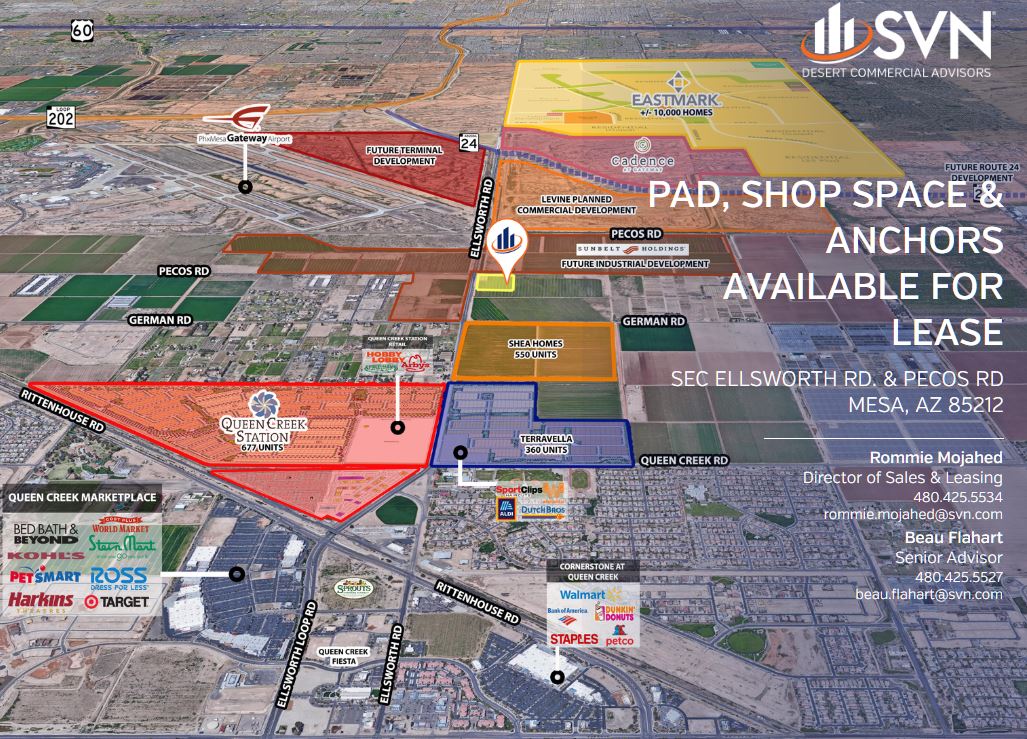
> SVN’s Mojahed said, “We hope to add to Mesa’s growth/employment at our 72 acres of land at Ellsworth and Pecos, just south of the Phoenix-Mesa Gateway airport.

 
> Mayor Giles added, “The Gateway area is a 35 square-mile developing aerotropolis that is ideal for international companies, aerospace/aviation and defense firms, high-tech manufacturers, large industrial users, research and development, data centers, and educational systems. 
> Case in point, the vision of having ASU Polytechnic, Pecos Advanced Manufacturing Zone, Elliot Road Technology Corridor and now SkyBridge in the area has boosted the national visibility for the City of Mesa.
> The Economic Development Director Jabjiniak added, “We are now starting to see the tech companies come into play.” 
The airports all serve a different purpose and the investors and developers can capitalize on its purpose
With Falcon Field, a corporate aircraft and general aviation, we are positioned for future advantages. We took strategic efforts in the Falcon district to support the diversity in the growth around it,” said Jabjiniak.
> Just north of their developments is also the new industrial complex, Landing 202 announced by Marwest Enterprises.
In addition, Falcon Field is the busiest aviation airports in the United States with over 700+ aircraft based at Falcon Field with over 270K flight operations annually has made traveling into the State of Arizona much easier
< Just recently, the long-awaited four-story, 64,000 square-foot Hilton hotel broke ground for the Home2 Suites Hilton Hotel near by the airport. 

NO DUST COMPLAINTS PLEASE!
_______________________________________________________________
The city’s economic development efforts are also centered on healthcare
> The city is home to Banner Desert Medical Center, the largest comprehensive hospital in the East Valley. 
> California-based WageWorks also leased 150,000 square-feet at Lincoln’s Property Co.’s new office park in Mesa as its main U.S. operating location, providing jobs for 500 current employees and adding another 500 new jobs at the site according to reports from Lincoln Property Co. Executive Vice President, David Krumweide. 
> The first building at Union development project is located in the heart of Mesa’s Riverview mixed-used district; the epicenter of District 1. 
With an accelerated amount of growth, it may raise some concern about the investment laid down for the groundwork for the thriving growth in the area. 
"Our residents understand the needs of growing communities and have recently passed bonds for public safety, transportation, parks and cultural amenities,” said Mayor Giles.  The City of Mesa will be adding 65 new police officers and 45 new firefighters that the public safety bond project entails. 
> SRP has also been heavily involved in developing the new electric infrastructure that is required to support the growing technology industry in the area.  In August of 2019, SRP began to inform the public of the upcoming development on the 187-acre parcel
Starting in November, there will a series of SRP public hearings to address the CEC (Certificate of Environmental Compatibility) Line Siting requirements as well. 
_________________________________________________________________________
Inevitably the diverse aerospace and technology companies have been a thriving economic engine for the entire City of Mesa.  The pandemonium of the economic development has attracted more than half a dozen Fortune 50 companies into the area that continues to create employment for the Mesa, southeast communities.
Retail Director, Rommie Mojahed has over 6.1M square feet of development, industrial and retail opportunity in between Falcon Field and the Phoenix-Mesa Gateway airports to fill. 
With the additional tax incentives for the Opportunity Zone parceled land, Mayor Giles stated, “We expect to see many more companies invest in Mesa.”


Twitter CEO Jack Dorsey Bans Political Ads in Swipe at Facebook

Opportune time . . . Dorsey
makes a moral stance on Free Speech
Published on Oct 31, 2019
Views: 495+
Oct.31 -- Twitter Inc. Chief Executive Officer Jack Dorsey tweeted Wednesday that the site will ban all political ads, delivering a jab to Facebook Inc., which has come under fire for the way it’s handled advertising by candidates.
Bloomberg's Kurt Wagner reports on "Bloomberg Technology."

Why 5G's Future Depends on Spectrum Access | WSJ


Published on Oct 30, 2019
Views: 75,070+
In the global race for 5G, U.S. telecom firms have a unique disadvantage: limited access to the “goldilocks” band of radio frequencies.
That's pushing U.S. firms toward a less practical version of 5G.
WSJ explains the science and its implications.
Illustration by Carlos Waters / The Wall Street Journal
More from the Wall Street Journal:
Visit WSJ.com:
http://www.wsj.com
Visit the WSJ Video Center: https://wsj.com/video
On Facebook: https://www.facebook.com/pg/wsj/videos/
On Twitter: https://twitter.com/WSJ
On Snapchat: https://on.wsj.com/2ratjSM
#WSJ #5G

PRIVATE EQUITY :: Investors Desperate To Boost Returns

Private equity is an alternative investment class and consists of capital that is not listed on a public exchange. Private equity is composed of funds and investors that directly invest in private companies, or that engage in buyouts of public companies, resulting in the delisting of public equity.
The Returns Are Spectacular. But There Are Catches
• Returns can be gamed
• The value of private investments is hard to measure
_________________________________________________________________________________
Here are excerpts from Bloomberg Business Week
Everything Is Private Equity Now
Spurred by cheap loans and investors desperate to boost returns, buyout firms roam every corner of the corporate world
‎October‎ ‎3‎, ‎2019‎ ‎1‎:‎00‎ ‎AM Corrected
The business has made billionaires out of many of its founders. Funds have snapped up businesses from pet stores to doctors’ practices to newspapers.
PE firms may also be deep into real estate, loans to businesses, and startup investments—but the heart of their craft is using debt to acquire companies and sell them later. . .
> In the best cases, PE managers can nurture failing or underperforming companies and set them up for faster growth, creating outsize returns for investors that include pension funds and universities.
> One of PE’s superpowers is that it’s hard for outsiders to see and understand the industry, so we set out to shed light on some of the ways it’s changing finance and the economy itself. —Jason Kelly
The Magic Formula Is Leverage ... and Fees
PE invests in a range of different assets, but the core of the business is the leveraged buyout
The Returns Are Spectacular. But There Are Catches
For investors the draw of private equity is simple: Over the 25 years ended in March, PE funds returned more than 13% annualized, compared with about 9% for an equivalent investment in the S&P 500, according to an index created by investment firm Cambridge Associates LLC 
• Returns can be gamed
• The value of private investments is hard to measure
• The best returns might be in the rearview mirror

-------------------------------------------------------------------------------------------------------------------------
PRIVATE EQUITY TITANS QUIETLY DISCOVER HOW TO GET RICHER
Published on Oct 29, 2019
Views: 2,180+
Oct.29 -- Vista Equity Partners' Robert Smith is one of the world’s richest people with a $6 billion fortune. He sold about 30% of the company he founded. His first deal with Dyal Capital Partners in 2015 helped popularize sales of minority stakes, upending the conventional wisdom that only weaker businesses would sell a piece of themselves. Bloomberg's Tom Metcalf and Lisa Abramowicz discuss this trend.
 ______________________________________________________________________________
The following extracted information is taken from Forbes 30 Oct 2019
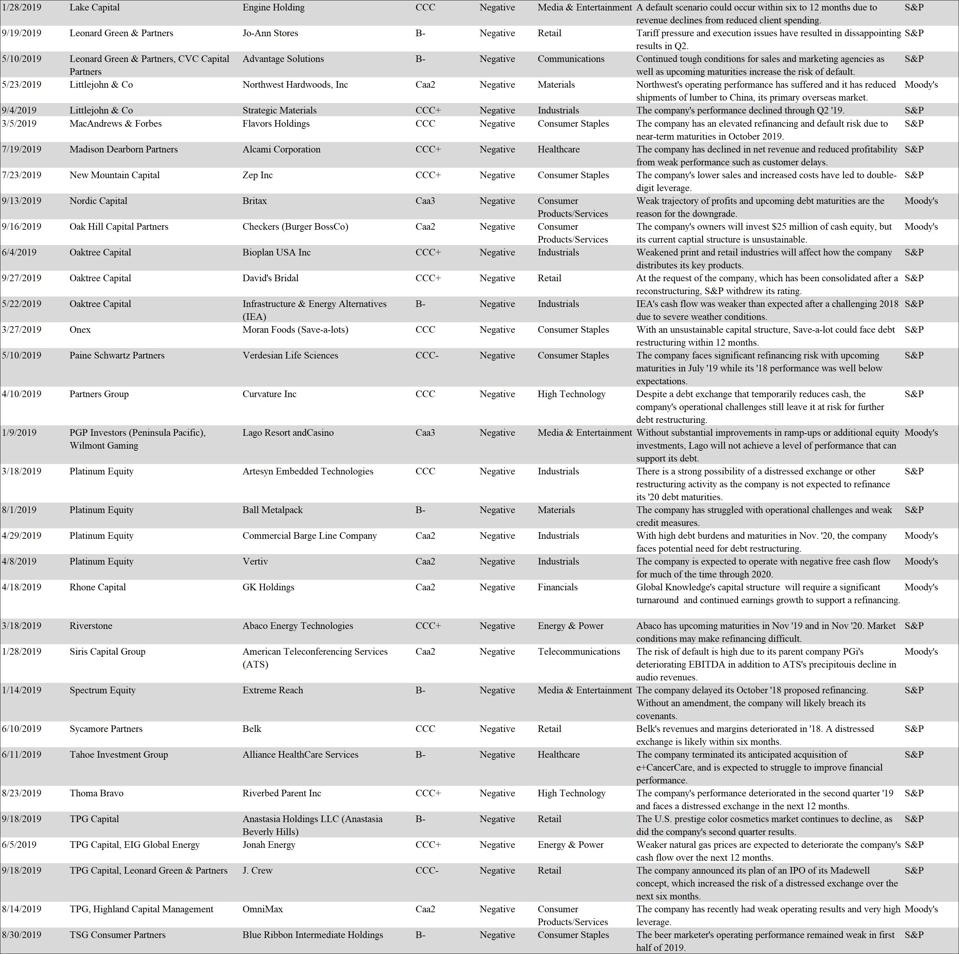
Private Equity Firms Have Caused Painful Job Losses And More Are Coming
Mayra Rodriguez Valladares


Wednesday, October 30, 2019

Culture of Consumption: The Biggest Part of The American Economy

Power to The Shoppers!
When in doubt in volatile uncertain times, what do ya do?
Consume more . . . GO SHOPPING!
The Fed’s preferred underlying inflation measure, the personal consumption expenditures price index excluding food and energy, rose at a 2.2% annual pace in the quarter, about in line with policy makers’ 2% objective.
On a year-over-year basis, GDP increased 2% during the quarter, the weakest pace of Trump’s presidency and putting his goal of 3% annual growth further out of reach for the full year, following 2.5% in 2018.
Still Spending
U.S. consumers saved the day again, offsetting business weakness

Source: U.S. Commerce Department
Note: Figures show contributions to percent change in real GDP

________________________________________________________________________
What Bloomberg’s Economists Say
“The most important question lingering over the growth outlook for the next few quarters is whether consumers will be able to adequately shoulder the burden, as business investment and exports languish in response to economic uncertainty, trade tensions and dollar strength. As of the third quarter, consumers were holding up adequately; this is not surprising to Bloomberg Economics, given the resilience of consumer attitudes and relative health of the labor market.”
_________________________________________________________________________
"As the longest U.S. expansion on record shows more signs of cooling, in part because of the fading effects of the 2018 fiscal stimulus, different parts of the world’s largest economy are giving mixed signals.
The unemployment rate has fallen to a half-century low, underpinning consumers and keeping sentiment readings near historical highs. Today’s report showed disposable incomes after inflation increased an annualized 2.9% after a 2.4% pace in the prior quarter.
The weakness in business investment was led by structures and equipment, which both dropped the most in more than three years. Structures contracted at a 15.3% rate, shaving nearly a half a percentage point from growth, driven by a decrease in oil and gas exploration. Computers and aircraft led the decrease for equipment.
_________________________________________________________________________
Read more:
economics                     

U.S. Economy Holds Up With 1.9% Growth on Consumer Strength
 ,     

  • Third-quarter expansion beats estimates for slowdown to 1.6%

  • Consumer spending tops forecasts and remains key growth driver

BEA News: Gross Domestic Product by State and Personal Income by State, 3rd Quarter 2025

  BEA News: Gross Domestic Product by State and Personal Income by S...