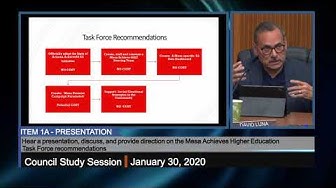
Minutes of a meeting are usually approved at the beginning of the next scheduled meeting... so why the delay in making the 'approved minutes' available many weeks after the fact? Here's a dump of five - the first from January 30, 2020 AGENDA ITEM 2
< Watch this! Barely a Quorum present - 3 Councilmembers absent - with Hizzoner John Giles, the presiding officer, making sure at the start than District 2 CouncilmemberJeremy Whittaker is on-the-phone "in beautiful stereo sound all over the room." The streaming video YouTube upload has attracted less than 25 views at the time of this insert on Sunday, March 15th. ________________________________________________________________________
Some readers might ask why your MesaZona blogger is so tenacious to bring these meetings to your attention It's very simple: whether you exercise it or not YOU HAVE THE RIGHT-TO-KNOW WHAT THE CITY OF MESA GOVERNMENT IS DOING A big part of that is open government where residents - and the elected officials who are chosen to represent the interests of their constituents - are frequently put into the position of asking for transparency and accountability from city officials when they don't provide it, even when requested.
As you can see if you are some of the few members of the public paying attention and staying informed, it takes a lot of diligence and persistence to keep a watchful eye on city government. Most people have been conditioned not to give a damn or care by years of feeling that they have no control, Unless something impacts them directly about money, taxes and expenses - Jeremy Whittaker is on that We can go back to 2016 if you want as a milestone, when Whittaker was the second candidate to defy-the-odds at get elected to the Mesa City Council over the hand-selected opposition to his campaign by the political establishment that has dominated the City of Mesa for generations. That was a hard-fought break-through that faces resistance when city officials "circle the wagons" to defend their operating practices and accounting standards. That was all clearly in evidence - and very visible - last Thursday when Giles tried to understate the long-simmering issues saying, "There are a few items with questions . . ." as he constantly looks over to the left to City Manager Chris Brady (seen with cellphone in hand at the opening) to provide the back-up banter for the hearing and discussion uninitiated by the voice on-the-phone "in beautiful full stereo all over the room". It looks like Brady is struggling and has not produced the data requested - on utilities and the calculation of "gross revenues" and "pass-alongs" and cash-flow statements into and out of the city's Enterprise Fund... but he makes a promise for an abundance of clarity**that clearly has not been forthcoming in previous years of accounting
(It's only about 20 minutes)
** RE: "ABUNDANCE OF CLARITY > We have been waiting since January 30, 2020
Hear a presentation, discuss, and provide direction on a proposed ordinance to replace Mesa City Code Title 3, Chapter 3, with new language that would include the creation of a Utility Assistance Program, the permitted uses for the utility system revenues, and the permitted transfer of Utility Fund’s primarily for Public Safety.
" Deputy City Manager Mike Kennington displayed a PowerPoint presentation and discussed the key concepts in the proposed ordinance. (See Attachment 2)
Mr. Kennington stated the first concept is the public assistance concept which would formalize the ability for City Council to offer utility public assistance, and highlighted examples of programs. (See Page 2 of Attachment 2)
Mr. Kennington explained the franchise fee concept, which typically are charged to utility, telecommunication and cable companies to use city-owned streets and other rights-of-way. He described in lieu of the franchise fee, the proposed ordinance would have a right-of-way usage charge consisting of 3% for the gas and electric revenues and 5% for the water and wastewater revenues. (See Pages 3 and 4 of Attachment 2)
Mr. Kennington presented the final concept as the Public Safety and General Use Transfers, which would allow for a transfer of up to 25% of utility revenues to the General Fund for public safety use and an additional 5% may be transferred for general use.
(See Page 5 of Attachment 2)
City Manager Christopher Brady remarked the intent of the ordinance is to create a formal policy regarding management of contributions from the utility fund in a manner that does not impact the delivery of City services.
He stated the formula was applied looking backwards as well as looking forward and comparing the projections.
. . .He remarked the City has long-term agreements for right-of-way use and the revenues from franchise fees goes to the General Fund.
Councilmember Thompson suggested instead of limiting the transfer amount, creating a policy that states the City will not leverage Enterprise dollars for a City project without full consent of Council so that future Councils will not be restricted when reacting to changing market conditions.
Mr. Brady advised discussions have taken place regarding requiring a certain number of Councilmembers agreeing to expenditures that fall outside of operational costs, and stated that Council can consider other options to establish controls.
In response to a series of questions from Councilmember Whittaker, City Attorney Jim Smith replied he would have to look into whether Council can adopt such an ordinance. He stated the Charter requires four affirmative votes from Council are needed to take action. He added there are certain circumstances under state law that require a supermajority vote.
NOTE Mayor Giles indicated support for establishing the ordinance to ensure clarity on the policies and processes followed by the City.
> In response to a question from Councilmember Whittaker, Mayor Giles explained the process would involve placing the item on the agenda and then the ballot.
> In response to a question from Vice Mayor Freeman, Mr. Kennington reported the estimate for the franchise fee would be approximately $12 million.
> In response to a series of questions from Vice Mayor Freeman, Mr. Brady stated the percentage of the franchise fee is based on revenues.
He added the recession did affect the utility revenues due to foreclosures, but the impact from sales tax had a greater effect. He stressed the General Fund, sales tax collection and the utility transfer contribution are all needed to cover the cost of Public Safety, which does not include any other operating expenses for the City.
Councilmember Whittaker commented on the difference in the language of the initiative which gives ratepayers the ability to challenge unreasonable rates, and the modified ordinance which states the City has the ability to set the rates to be deemed reasonable.
> In response to a question from Councilmember Whittaker, Mr. Smith replied in order to adopt an ordinance, four Councilmembers must vote in favor. He remarked to change an ordinance that has previously passed requires the process of introduction, hearing and community participation.
He stated Mesa is one of the few cities that require introduction of an ordinance before a vote, which gives residents two opportunities to discuss an item with a minimum of one week between meetings.
He recalled the cap to the Enterprise Fund at a certain percentage based on inflation is not an ordinance but a Council policy.
Ms. Cannistraro verified the 3% cap was adopted by Council after the recession to gain stability in the Enterprise Fund, then was set to the Consumer Price Index (CPI), which has been followed for several years.
Councilmember Whittaker detailed if state shared revenue and sales tax were taken into account as a source for the budget, that would be equal to the sales tax and Enterprise Fund transfer, and that Public Safety funds could come from other sources of revenue.
Mr. Brady commented additional resources for Public Safety salaries and adding officers has come from the transfer. He stated the policy of Council for many years has been to consider the transfer as a source for Public Safety.
Don't believe what's written in the post if you want to do that.
But DO WATCH-AND-LISTEN to find out for yourself what's goin' on in here. Even if you have no idea what's on this study session's agenda, it could get "dodgy" . . .
Take your pick of whatever city officials here in Mesa, AZ have chosen to call it, but the bare fact remains that NO FINANCIAL DETAILS WERE EVERY DISCLOSED TO THE PUBLIC over the "Temple Area Transformation" It's one thing to claim an exemption for "a non-profit" status organization but when a for-profit religion is in the business of real estate development - and uses public taxpayers municipal funds to for all the underground infrastructure - it is time way over due to provide both "an abundance of clarity" and accountability.
Especially when development officers in City Creek Reserve, Inc. have stated publicly that they've been talking with city officials for years and buying up more than 90 properties around the Mesa LDS Temple Area neighborhood for a Massive Mormon Make-Over on the eastern fringe of downtown to transform Mesa into a satellite of Salt Lake City. That's no secret. It's a smaller-scale 10-acre version of the 23-acre project called City Creek Mall in Temple Square.
< "City Creek Center Lite"@ SEC Main/Mesa Drive
The complaint alleges a series of payments from EPA totaling $1.4 billion to help construct the City Creek Center mall in Temple Square in downtown Salt Lake City, Utah, which features a retractable roof, luxury storefronts and simulated creek with live trout. The LDS Church and its developers aimed to create a new urbanism in downtown Salt Lake City. The success of that expenditure of billions is open to conflicting opinions.
The mall was developed by Property Reserve, Inc., which is a commercial real estate division of the Corporation of the President of the Church of Jesus Christ of Latter-day Saints and retail manager Taubman Centers Inc. according to a press release from the LDS Church on Oct. 3, 2006. . .
...City Creek Center is being developed by Property Reserve Inc., the church’s real-estate development arm, and its money comes from other real-estate ventures. . .
The whistleblower complaint alleges that $1.4 billion of funding from EPA did go toward the mall project and came from a funding pool that included tithing dollars
> The mall opened in 2012 with 100 stores in more than 700,000 square feet of retail space and is part of downtown Salt Lake City revitalization plans that includes office space and residential towers.
> One member of the Corporation of the Presiding Bishopric and an executive in the LDS for-profit businesses, Keith McMullin, told Bloomberg BusinessWeek in 2012 that tithes do not go to the church’s for-profit endeavors and did not go to City Creek Center.
The whistleblower complaint to the IRS raises the question of whether church leaders such as McMullin made honest or false public statements about financing sources for the mall project both before and after construction of the mall. Here in Mesa, apparently no one ever asked - the entire project in two phases that doubled the initial proposal - was fast-tracked through the development process and approval by the Mesa City Council.
When asked about tithe funds being used in the City Creek project contradicting what the church leaders said, LDS Church spokesman Eric D. Hawkins sent language from a church statement that said the City Creek development is a way “the Church enhanced the environs of Temple Square and underscored a commitment to Salt Lake City, Utah, where it is headquartered.”
Mormon Inc. LDS members in the resulting nearly two centuries have founded companies, become elected to federal offices, state and local governments, and control major holdings in finance, insurance, real estate and finance, as well as media. Here in Mesa, it's a generations-old political machine supported by members of a network of stakes and wards, the public school system, and the police and fire/medical departments. And, in the early days, LDS Church leaders set up hundreds of businesses in Utah and states like Arizona using "cooperatives" to help build a functioning economy. Early efforts to force church members to patronize LDS-owned businesses led to the U.S. Congress passing the Edmunds-Tucker Act in 1887 to limit vertical integration and monopolies by the LDS Church. _________________________________________________________________________
Whistleblower Alleges $100 Billion Secret Stockpile By Mormon Church
NEW YORK — A whistleblower complaint filed at the Internal Revenue Service in November by a knowledgeable church member alleges that a non-profit supporting organization controlled by the Church of Jesus Christ of Latter-day Saints used member tithes to amass more than $100 billion in a set of investment funds and the Church misled members about uses of the money.
The complaint may be the most important look at LDS finances in decades, a window into one of the wealthiest religious organizations in the United States and the world.
Details of the IRS filing reveal financial assets largely hidden from the church’s membership (often known as “Mormons”) and the public view.
Ensign Peak Advisors' articles of incorporation confirm Ensign Peak is an arm of the Church of Jesus Christ of Latter-day Saints. As registered under section 509(a)3 of the Internal Revenue Code, Ensign Peak Advisors, Inc. (EPA) is a “supporting organization” of the Church under article 3 in its registration document. Upon dissolution, all Ensign Peak assets go the Church or affiliated organizations according to article 5 and that article cannot be changed without “the written consent of The First Presidency” of the Church. Because Ensign Peak Advisers is a support organization to a church it is not subject to disclosure requirements that other non-profit organizations are required to make.
A former Church member in Minnesota named Lars Nielsen published a 74-page document filed with the IRS that makes several allegations.
The whistleblower document alleges that EPA has given away $0 to religious, educational or charitable purposes.
Non-profit experts such as Rieman note that EPA’s registration as a 509(a)3 supporting organization to the LDS Church could protect it from having to make charitable distributions because churches are not required to disclose finances to the public.
“The Church of Jesus Christ of Latter-day Saints pays all taxes that are required by law,” says an LDS Church statement about its tax status.
In response to Religion Unplugged’s questions about financial disclosure, the church media relations department sent links to statements on the Church web site.
“While the Church chooses not to publish the details of its finances, the Church does provide public information on the financial principles it follows, the financial controls in place to protect Church funds and the source and use of these funds,”
_________________________________________________________________________________ Bloomberg News estimatedthe net worth of LDS church assets at around $40 billion in 2012. The whistleblower estimates a closer net-worth figure of the church could be $200 billion or more when you include EPA along with vast agricultural and property holdings. A church-managed investment portfolio represents a newer area for the church.
When asked to confirm or deny the whistleblower allegation that the Church has amassed more than $100 billion in owned assets under management, the LDS Church spokesman pointed again to online statements from the church such as:
“The Church’s reserves are overseen by Church leaders and managed by professional advisers, consistent with wise and prudent stewardship and modern investment management principles. Ultimately, all funds earned by the Church’s investments go back to supporting its mission to invite souls to come unto Christ."
__________________________________________________________________________________ > TIME reported in 1997 that $5.2 billion flowed into the LDS Church in 1996, dwarfing the pace of contributions received by other denominations. It noted that the LDS Church sees tithes not just as tools for paying church staff and expenses but, rather, as venture capital to build new temples (normal activity for religious organizations) and also to invest in stocks and bonds as well as for-profit companies in agriculture, travel and real estate. . .
Brunson notes that some other churches are trying to improve financial disclosure.
The Evangelical Council for Financial Accountability (ECFA) accredits churches that prepare accurate financial statements to be reviewed by an independent certified public accountant and which make their financial statements available upon written request.
“The LDS Church similarly has the option to make financial disclosure, whether or not the law demands it. Even without a secular obligation to disclose, the Church might view itself as subject to a divine disclosure mandate,”Brunson writes.
“But such a mandate does not explicitly exist in canonized Mormon scripture, and the evidence is strong that Church leaders have never believed they were under such a divine mandate, even at the beginning of the Church.”
A cloak of secrecy > Please continue looking into it
The whistleblower complaint alleges that the EPA universe of assets grew by $90 billion between 2009 and 2019 and a large part of that growth came as run-off from tithing income to the church.
Religion Unplugged reached out to several former employees of EPA to hear their perspective on the firm and their response to allegations raised in the whistleblower complaint . . .
__________________________________________________________________________________ From Religion Unplugged:
The filing to the IRS alleges that EPA has made zero religious, educational or charitable distributions in 22 years.
According to tax experts, that may not be a problem for a 509(a)3 organization, depending on more nuanced details of its registration which are not publicly available on the IRS website or the organizations 990-t annual filings.
“EPA is the reserve of the reserves,”a whistleblower is quoted as saying in the document. It suggests tithing surplus flows to EPA where it is “merged, sliced and diced into portfolios and limited liability companies designed to fly under radars and reporting limits.”
The document obtained byReligion Unpluggedmakes several additional allegations about EPA.
The 74-page document filed with the IRS and obtained by Religion Unplugged shows that Ensign Peak Advisors, Inc. (EPA) owned assets under management grew to more than $100 billion from $10 billion in the past 22 years, fueled by a mix of investment strategy and tithe money from church members.
Religion Unpluggedreached EPA’s managing director Roger Clark by phone on Monday, offering to explain key parts of this story and to ask questions for EPA to give a response.“We don’t really answer questions with the public press. So thanks,” he said, before hanging up the phone.
Ensign Peak Advisors' articles of incorporation confirm Ensign Peak is an arm of the Church of Jesus Christ of Latter-day Saints. As registered under section 509(a)3 of the Internal Revenue Code, Ensign Peak Advisors, Inc. (EPA) is a “supporting organization” of the Church under article 3 in its registration document. Upon dissolution, all Ensign Peak assets go the Church or affiliated organizations according to article 5 and that article cannot be changed without “the written consent of The First Presidency” of the Church. Because Ensign Peak Advisers is a support organization to a church it is not subject to disclosure requirements that other non-profit organizations are required to make.
. . . The whistleblower worked with Nielsen on a two-month research project to research and explain the inner workings of EPA.
> The complaint (Form 211) was filed with the IRS whistleblower office on Nov. 15, 2019 and received by the IRS on Nov. 22, 2019.

 Here's a dump of five - the first from January 30, 2020