Virtual Platform ATTENTION: Proposed 2020 Mesa Moves Transportation Bond Program Thu 04 June 2020 7:30 AM
Roll Call 1 Presentations/Action Items: 20-0648 Hear a presentation, discuss, and provide direction on a Mesa CARES
program that will provide remote learning through technology for Mesa's K-6
students.
1-a
Hear a presentation, discuss, and provide direction on a Mesa CARES program that will provide remote learning through technology for Mesa's K-6 students.
20-0629 Hear a presentation, discuss, and provide direction on an update of the Mesa
CARES Small Business Assistance Reemergence Program, focusing on the
results and award recommendations of the Mesa CARES Financial Assistance
Grant Program. 1-b
Hear a presentation, discuss, and provide direction on an update of the Mesa CARES Small Business Assistance Reemergence Program, focusing on the results and award recommendations of the Mesa CARES Financial Assistance Grant Program.
Carlyle Group acquires 4 Mesa mobile home parks for $230M
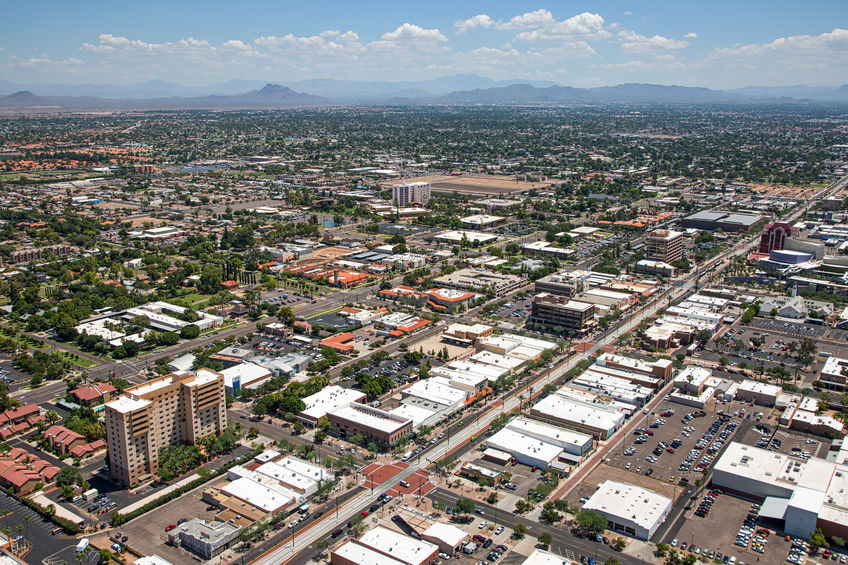
Above: Aerial view of Main Street in downtown Mesa, Arizona.REAL ESTATE | 11 hours ago | STEVE BURKS
The Carlyle Group made a huge splash in Mesa, acquiring four mobile home parks in the city for a total of $230 million, according to the real estate tracking website Vizzda.com. The portfolio sale consists of a total of 1,583 mobile home stalls on 187 acres, for an average of $145,293 per unit. The seller of the portfolio was Arizona Communities Ltd.
The four Mesa mobile home parks involved in the sale are
the Citrus Gardens Mobile Home Park at 4065 E. University Dr.;
the El Mirage Mobile Home Park at 305 S. Val Vista Dr.;
the Mesa Shadows Mobile Home Park at 205 S. Higley Rd.; and
the Aspenwood Mobile Home Park at 245 S. 56th St.
Here is a breakdown of the four parks involved in the transaction:
Incarcerated on the West Coast by the U.S. Government, Thousands Were Then Given ‘Work Leave’ to Resettle in the Midwest
by LAURA McENANEY
In March 1943, Kaye Kimura left the “Manzanar War Relocation Center” in California and boarded the same train that had brought her there in 1942, when President Franklin D. Roosevelt had sent 120,000 Japanese Americans to wartime prisons. ...
A Zócalo/Huntington-USC Institute on California and the West Event
Moderated by Nathan Rott, National Desk Correspondent, NPR
Historical ecologist Jared Dahl Aldern, CSU Long Beach American Indian Studies professor Theresa Gregor, and Fernanda Santos, The Fire Line author and Professor of Practice at the Walter Cronkite School of Journalism and Mass Communication, visit Zócalo to examine how and whether human beings can coexist with megafires.
As COVID Collapses Budgets, It’s Up to Children to Save Their Schools
by JOE MATHEWS
Dear California Kids,
Don’t let us adults destroy your futures! This time of “distance learning” and COVID-19 chaos is the opportunity of a generation—maybe a century—to fix what’s so very wrong with how California treats you. And right now, ...
LISC stands in unity with the protests that are sweeping our country, and their core message—that every life is sacred, says Maurice A. Jones, LISC’s president and CEO, in a video message. We are committed, he affirms, to continuing the work to dismantle structural racism and create an equitable America for all.
One of my fondest memories from my childhood is a refrain that I used to always hear from my grandfather whenever I would ask him for something. For example, if he were drinking lemonade, I would say, “Grandpa, can I have a sip of your lemonade?” He would look at me and respond immediately. “Everything I have is yours. Of course you can have my lemonade.” “Everything I have is yours” was a refrain I heard throughout my upbringing from my grandfather. It was, for me, the most powerful lesson in sharing that I received. And it's a lesson that I still try to live into.
Unfortunately, I think it's the greatest struggle. The greatest unrealized aspiration of our American experiment: You see from day one there has been a belief, particularly among those empowering our country, that if you do not share my race or my religion or my gender or my sexual orientation, you do not share my humanity. And at best, I can treat you as a second class citizen. And at worst, I don't respect the sacredness of your life.
That shameful theme throughout the American experiment is what we're still struggling with today. It's the reason why a young black man can be out for a jog and could be shot down like it's hunting season. It's the reason why a young man can be arrested and killed in broad daylight, by a police officer who kneels on his neck until he suffocated. It is the American struggle for us to internalize in our systems, in our institutions like our police, the belief that all people share in the human family's journey.
It is what at the end of the day, our work is about at LISC. The reason why we put together coalitions to make sure that folks have affordable quality housing. The reason why we work to help people get prepared for jobs that pay a living wage. The reason why we work with partners to make sure that people can actually have small businesses in their communities we believe that you do not have to share my race or my ideology or my religion to be accorded my humanity, that all people deserve to be treated with respect and dignity.
It's at the core of our work. It's what we want to do more of, it is the invitation that we feel and that I believe the country right now is feeling. The protests that are going on at the end of the day are about people demanding that all people, without any threshold qualifications or prerequisites, that all people should be treated as first class citizens, as the kings and queens that we are we want to affirm the request behind the protest.
At the same time, the violence and the destructiveness are a small part of these protests. We need to wipe [that] out. We need to keep the central message, that those who do not share my race, do not share my religion, do not share my gender, still share my humanity. That I will treat them with the sacredness that their humanity deserves.
We look forward to making that principle, that creed, deeper and deeper a part of our institutions and our journey. So thanks to all who are acting on this, and let's keep the faith. Many people before us acted on that belief and made progress. Not linear, there've been good days and bad days. We're in tough days now, but let's stay faithful to that principle, to that belief. And let's keep fighting the good fight. We need to do it. America needs us to do it. And all the people who have an experience of being second class citizens need us to keep fighting the fight. Thank you.
The Department of Public Health released new town-by-town data for coronavirus cases on Wednesday, the latest set of such data showing how the virus has ravaged individual communities throughout Massachusetts.