The entire 10-page notice is inserted below for your access to view the entire .PDF document provided.
There is also a brief overview of what an attorney for The Rose Law Group considers some of the new notable provisions provided in the guidance from the Internal Revenue and the U.S. Treasury Department.
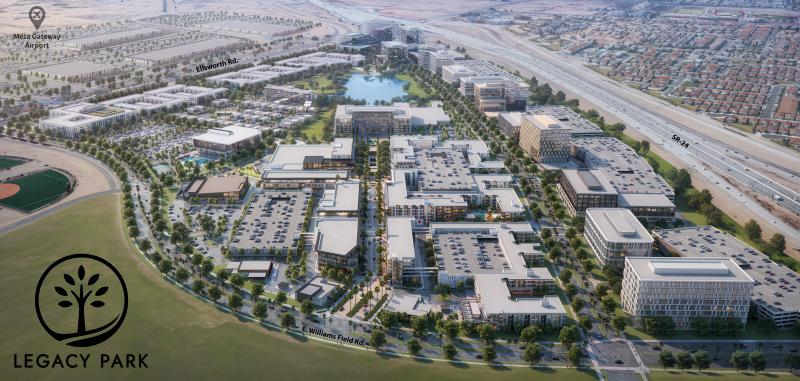
(Readers of this blog will note the potential impacts and timing for economic development in the 6 federally-approved OZones here in the City Mesa are closely matched)
DRAFTING INFORMATION: The principal author of this notice is Kyle C. Griffin of the Office of Associate Chief Counsel (Income Tax and Accounting).
For further information regarding this notice, you may call the COVID-19 Disaster Relief Hotline at (202) 317-5436 (not a tollfree number).
_________________________________________________________________________

BLOGGER NOTE:
There are multiple posts on this blog on the subject of Opportunity Zones, OZones, QOFs and any number of related content, including Opportunity Zones here in The City of Mesa on more than a few occasions starting back in December 2017.
_________________________________________________________________________
Notable new provisions include:
1. 180 Day Contribution Period Extended.
Prior to Notice 2020-39, a taxpayer who sold property for an eligible capital gain generally had 180 days to contribute all or a portion of that capital gain in a QOF.
Now, if a taxpayer’s 180-day contribution period was set to expire between April 1, 2020 and December 30, 2020, the contribution period is automatically extended to December 31, 2020.
2. 90% Asset Test Temporarily Relaxed.
A QOF is required to hold at least 90% of its assets in qualified opportunity zone property. Generally, failure to meet the 90% threshold results in a monetary penalty for each month the QOF fails to meet the 90% threshold.
The new guidance relaxes this standard temporarily.
Specifically, if a QOF fails to meet the 90% asset test on any of the QOF’s testing dates which fall between April 1, 2020 and December 31, 2020, the entity will not fail to qualify as a QOF and will not be subject to the generally applicable statutory penalties.
3. Working Capital Safe Harbor Extension.
As a result of the asset tests within the opportunity zone program, a QOF can generally hold only insignificant amounts of cash on hand.
However, by meeting certain requirements, a QOF, through a subsidiary, can hold working capital without violating the 90% asset test for 31 months, provided the QOF remains otherwise qualified.
Notice 2020-39 automatically extends this 31-month period to 55 months (approximately 4.5 years), so long as the QOF qualified for the safe harbor before December 31, 2020 and the QOF is located in a federally declared disaster area.
As a result of President Trump’s March 12, 2020 coronavirus emergency declaration, all qualified opportunity zones qualify as federally declared disaster areas.
4. Substantial Improvement Requirement Extended.
Generally, a QOF must substantially improve property it acquires within 30 months of acquisition unless the original use of that property commenced with the QOF.
Under the new guidance, a QOF can disregard the period of April 1, 2020 through December 31, 2020 when calculating their substantial improvement period.
In effect, a QOF may tack on 9 months to its substantial improvement period.
Reference: Rose Law Group Reporter
There are multiple posts on this blog on the subject of Opportunity Zones, OZones, QOFs and any number of related content, including Opportunity Zones here in The City of Mesa on more than a few occasions starting back in December 2017.
_________________________________________________________________________
Notable new provisions include:
1. 180 Day Contribution Period Extended.
Prior to Notice 2020-39, a taxpayer who sold property for an eligible capital gain generally had 180 days to contribute all or a portion of that capital gain in a QOF.
Now, if a taxpayer’s 180-day contribution period was set to expire between April 1, 2020 and December 30, 2020, the contribution period is automatically extended to December 31, 2020.
2. 90% Asset Test Temporarily Relaxed.
A QOF is required to hold at least 90% of its assets in qualified opportunity zone property. Generally, failure to meet the 90% threshold results in a monetary penalty for each month the QOF fails to meet the 90% threshold.
The new guidance relaxes this standard temporarily.
Specifically, if a QOF fails to meet the 90% asset test on any of the QOF’s testing dates which fall between April 1, 2020 and December 31, 2020, the entity will not fail to qualify as a QOF and will not be subject to the generally applicable statutory penalties.
3. Working Capital Safe Harbor Extension.
As a result of the asset tests within the opportunity zone program, a QOF can generally hold only insignificant amounts of cash on hand.
However, by meeting certain requirements, a QOF, through a subsidiary, can hold working capital without violating the 90% asset test for 31 months, provided the QOF remains otherwise qualified.
Notice 2020-39 automatically extends this 31-month period to 55 months (approximately 4.5 years), so long as the QOF qualified for the safe harbor before December 31, 2020 and the QOF is located in a federally declared disaster area.
As a result of President Trump’s March 12, 2020 coronavirus emergency declaration, all qualified opportunity zones qualify as federally declared disaster areas.
4. Substantial Improvement Requirement Extended.
Generally, a QOF must substantially improve property it acquires within 30 months of acquisition unless the original use of that property commenced with the QOF.
Under the new guidance, a QOF can disregard the period of April 1, 2020 through December 31, 2020 when calculating their substantial improvement period.
In effect, a QOF may tack on 9 months to its substantial improvement period.
Reference: Rose Law Group Reporter
______________________________________________________________________

Affected by Ongoing Coronavirus Disease 2019 Pandemic
Notice 2020-39
I. PURPOSE
This notice provides relief under section 7508A(a) of the Internal Revenue Code (Code) for qualified opportunity funds (QOFs) and their investors in response to the ongoing Coronavirus Disease 2019 (COVID 19) pandemic.
This notice also addresses the application of certain relief provisions in the Income Tax Regulations under section 1400Z-2 of the Code (section 1400Z-2 regulations).
Part III of this notice (i) provides relief for certain failures by a QOF to meet the 90-percent investment standard and (ii) postpones the time periods for satisfying certain other requirements.
Part IV of this notice confirms that (i) the 24-month extension for the working capital safe harbor and (ii) the 12-month extension for QOFs to reinvest certain proceeds, both as provided under the section 1400Z-2 regulations, are available to otherwise qualifying QOFs and qualified opportunity zone businesses.
II. BACKGROUND
A. Emergency Declaration and Prior Grants of Relief On March 13, 2020, the President of the United States issued an emergency declaration under the Robert T. Stafford Disaster Relief and Emergency Assistance Act (Stafford Act) (42 U.S.C. 5121 et seq.) in response to the ongoing COVID-19 pandemic
2
(Emergency Declaration1). The Emergency Declaration instructed the Secretary of the Treasury “to provide relief from tax deadlines to Americans who have been adversely affected by the COVID-19 emergency, as appropriate, pursuant to 26 U.S.C. 7508A(a).” Subsequent to the Emergency Declaration, the President issued major disaster declarations under the authority of the Stafford Act with respect to all 50 states, the District of Columbia, and 5 territories
(Major Disaster Declarations).2 The Major Disaster Declarations declared that, beginning on January 20, 2020, major disasters existed in each of these jurisdictions, within which is located every population census tract designated as a qualified opportunity zone under section 1400Z-1 of the Code. See Notice 2018-48, 2018-28 I.R.B. 9 (Nov. 21, 2018), and Notice 2019-42, 2019-29 I.R.B. 352 (October 10, 2019) (which collectively list every designated qualified opportunity zone). Section 7508A provides the Secretary of the Treasury or his delegate (Secretary) with authority to postpone the time for performing certain acts under the internal revenue laws for a taxpayer determined by the Secretary to be affected by a Federally declared disaster, as defined in section 165(i)(5)(A) of the Code. See section 165(i)(5)(A) (defining “Federally declared disaster” to mean “any disaster subsequently determined by the President of the United States to warrant assistance by the Federal Government under the Robert T. Stafford Disaster Relief and Emergency Assistance Act”). Pursuant to section 7508A(a), a period of up to one year may be disregarded in
1 See March 13, 2020, letter from the President to Secretaries of the Departments of Homeland Security, the Treasury, and Health and Human Services and the Administrator of the Federal Emergency Management Agency, available at https://www.whitehouse.gov/wp-content/uploads/2020/03/LetterFromThePresident.pdf. 2 See https://www.fema.gov/coronavirus/disaster-declarations.
3
determining whether the performance of certain acts is timely under the internal revenue laws.
On April 9, 2020, the Department of the Treasury and the Internal Revenue Service issued Notice 2020-23 to provide relief under section 7508A(a) to taxpayers affected by the COVID-19 emergency by postponing due dates with respect to certain taxpayer and government acts. See generally Part III of Notice 2020-23 (providing relief for certain time-sensitive actions due to be performed on or after April 1, 2020, and before July 15, 2020), amplifying Notice 2020-20, 2020-16 I.R.B. 660 (April 13, 2020) and Notice 2020-18, 2020-15 I.R.B. 590 (April 6, 2020), and modifying Rev. Proc. 201442, 2014-29 I.R.B. 192 (July 1, 2014).
B. 180-Day Investment Requirement for QOF Investors Section 1400Z-2(a)(1)(A) provides that, if a taxpayer has “gain from the sale to, or exchange with, an unrelated person of any property held by the taxpayer” the taxpayer may elect to exclude from gross income for the taxable year “so much of such gain as does not exceed the aggregate amount invested by the taxpayer in a [QOF] during the 180-day period beginning on the date of such sale or exchange” (180-day investment requirement). Section 1.1400Z2(a)-1 provides definitions and rules to implement the 180-day investment requirement. One of the time-sensitive acts postponed by Notice 2020-23 was the making of “an investment at the election of a taxpayer due to be made during the 180-day period described in section 1400Z-2(a)(1)(A) of the Code” (180-day investment period). See Notice 2020-23, Part III.A and C. Specifically, Notice 2020-23 postponed to July 15,
4
2020, any deadline for the 180-day investment requirement that otherwise would have occurred on or after April 1, 2020 and before July 15, 2020. See id., Part III.C.
C. 90-Percent Investment Standard for QOFs Section 1400Z-2(d)(1) defines a QOF as any investment vehicle organized as a corporation or a partnership for the purpose of investing in qualified opportunity zone property (other than another QOF). This definition also requires a QOF to hold at least 90 percent of its assets in qualified opportunity zone property, determined by the average of the percentage of qualified opportunity zone property held by that QOF as measured (i) on the last day of the first 6-month period of the taxable year of the QOF, and (ii) on the last day of the taxable year of the QOF. See section 1400Z-2(d)(1). The requirement that the average percentages of the QOF’s qualified opportunity zone property on these two dates (semi-annual testing dates) must equal at least 90 percent of the QOF’s assets is referred to as the 90-percent investment standard. See section 1400Z-2(f). Section 1.1400Z2(d)-1 provides definitions and rules to implement the 90percent investment standard. If the average of the percentages of the qualified opportunity zone property held by a QOF on these semi-annual testing dates fails to meet the 90-percent investment standard, section 1400Z-2(f)(1) provides a general rule that the QOF must pay a penalty for each month that the QOF fails to meet that standard. However, section 1400Z2(f)(3) provides that no such penalty is imposed “with respect to any failure if it is shown that such failure is due to reasonable cause.”
5
D. Working Capital Safe Harbor for Qualified Opportunity Zone Businesses An entity must meet certain requirements to be a qualified opportunity zone business, including the requirement of section 1397C(b)(8) that less than 5 percent of the average of the aggregate unadjusted bases of the entity’s property be attributable to nonqualified financial property, as defined in section 1397C(e). Section 1397C(e) excludes from nonqualified financial property reasonable amounts of working capital that are held in cash, cash equivalents, or debt instruments with a term of 18 months or less. See § 1.1400Z2(d)-1(d)(3)(iv). The section 1400Z-2 regulations provide qualified opportunity zone businesses with a safe harbor for treating an amount of working capital as reasonable for purposes of section 1397C(e) if certain requirements are satisfied (working capital safe harbor). See § 1.1400Z2(d)-1(d)(3)(v) (providing the scope of the working capital safe harbor and conditions for eligibility). One of those requirements is that there is a written schedule consistent with the ordinary start-up of a trade or business for the expenditure of the working capital assets within 31 months of the receipt by the business of the assets. See § 1.1400Z2(d)-1(d)(3)(v)(B). A qualified opportunity zone business may extend the working capital safe harbor period to a maximum 62-month period under § 1.1400Z2(d)-1(d)(3)(vi) if certain additional requirements are met. If such qualified opportunity zone business is located in a qualified opportunity zone within a Federally declared disaster (as defined in section 165(i)(5)(A)), the qualified opportunity zone business may receive not more than an additional 24 months to expend its working capital assets, as long as the qualified opportunity zone business otherwise meets the requirements of the working capital safe harbor. See
6
§ 1.1400Z2(d)-1(d)(3)(v)(D). Therefore, a qualified opportunity zone business may, if each applicable requirement of § 1.1400Z2(d)-1(d)(3)(v) and (vi) is satisfied, have up to a maximum 86-months to expend working capital assets if the qualified opportunity zone business is located in a qualified opportunity zone within a Federally declared disaster.
E. 30-Month Substantial Improvement Period for QOFs Section 1400Z-2(d)(2)(D)(i) provides that tangible property is treated as qualified opportunity zone business property if the tangible property is used in a trade or business of the QOF and satisfies three general requirements. One of these requirements is that the original use of post-2017 acquired tangible property in the qualified opportunity zone must begin with the QOF (referred to as the “original use requirement”), or the QOF must substantially improve that property (substantial improvement requirement). See section 1400Z-2(d)(2)(D)(i)(II). The substantial improvement requirement is met only if, during any 30-month period beginning after the date of acquisition of the post-2017 acquired tangible property, there are “additions to basis with respect to such property” held by the QOF that, in the aggregate, exceed the QOF’s adjusted basis of that property as of the beginning of that 30-month period (30month substantial improvement period). See section 1400Z-2(d)(2)(D)(ii). Section 1.1400Z2(d)-2(b)(4) provides rules to implement the substantial improvement requirement. F. 12-Month Reinvestment Period for QOFs The section 1400Z-2 regulations provide generally that, if (i) a QOF sells or disposes of some or all of its qualified opportunity zone property or if a distribution with
7
respect to the QOF’s qualified opportunity zone stock is treated as a return of capital in the QOF’s hands, and if (ii) the QOF reinvests some or all of the proceeds in qualified opportunity zone property by the last day of the 12-month period beginning on the date of the distribution, sale, or disposition, then the proceeds, to the extent that they are so reinvested, are treated as qualified opportunity zone property for purposes of the 90percent investment standard. See § 1.1400Z2(f)-1(b)(1). This treatment is available to a QOF only to the extent that, prior to the reinvestment in qualified opportunity zone property, the reinvested proceeds are continuously held in cash, cash equivalents, or debt instruments with a term of 18 months or less. See id. If the QOF's plan to reinvest some or all of the above-described proceeds in qualified opportunity zone property is delayed due to a Federally declared disaster (as defined in section 165(i)(5)(A)), the QOF may receive not more than an additional 12 months to reinvest the proceeds, provided that the QOF invests the proceeds in the manner originally intended before the disaster. See § 1.1400Z2(f)-1(b)(2).
III. GRANTS OF RELIEF FOR QOF INVESTORS AND QOFS
A. 180-Day Investment Requirement for QOF Investors If the last day of the 180-day investment period within which a taxpayer must make an investment in a QOF in order to satisfy the 180-day investment requirement falls on or after April 1, 2020, and before December 31, 2020, the last day of that 180day investment period is postponed to December 31, 2020. This relief is automatic; taxpayers do not have to call the IRS or send letters or other documents to the IRS to receive this relief. However, a taxpayer will still need to make a valid deferral election in accordance with the instructions to Form 8949, complete Form 8997, and file the
8
completed Form 8949 and Form 8997 with a timely filed Federal income tax return (including extensions) or amended Federal income tax return for the taxable year in which the gain would be recognized if section 1400Z-2(a)(1) did not apply to defer recognition of the gain. For additional information, see https://www.irs.gov/form8949 and https://www.irs.gov/form8997.
B. 90-Percent Investment Standard for QOFs In the case of a QOF whose (i) last day of the first 6-month period of the taxable year or (ii) last day of the taxable year falls within the period beginning on April 1, 2020, and ending on December 31, 2020, any failure by that QOF to satisfy the 90-percent investment standard for that taxable year of the QOF is-- (1) due to reasonable cause under section 1400Z-2(f)(3); and (2) disregarded for purposes of determining whether the QOF or any otherwise qualifying investments in that QOF satisfy the requirements of section 1400Z-2 and the section 1400Z-2 regulations for any taxable year of the QOF. This relief is automatic; QOFs do not have to call the IRS or send letters or other documents to the IRS to receive this relief. However, a QOF must accurately complete all lines on Form 8996 filed with respect to each affected taxable year EXCEPT that the QOF should place a “0” in Part IV, Line 8 (Penalty). The accurately completed Form 8996 must be filed with the QOF’s timely filed Federal income tax return (including extensions) for the affected taxable year(s). For additional information, see https://www.irs.gov/form8996
9
C. 30-Month Substantial Improvement Period for QOFs and Qualified Opportunity Zone Businesses For purposes of the substantial improvement requirement with respect to property held by a QOF or qualified opportunity zone business, the period beginning on April 1, 2020, and ending on December 31, 2020, is disregarded in determining any 30month substantial improvement period (that is, the 30-month substantial improvement period is tolled during the period beginning on April 1, 2020, and ending on December 31, 2020). IV. REGULATORY EXTENSIONS FOR WORKING CAPITAL SAFE HARBOR AND QOF REINVESTMENT PERIOD DUE TO FEDERALLY DECLARED DISASTERS A. Working Capital Safe Harbor for Qualified Opportunity Zone Businesses As a result of the Emergency Declaration (that is, the declaration of a Federally declared disaster for purposes of section 165(i)(5)(A)), all qualified opportunity zone businesses holding working capital assets intended to be covered by the working capital safe harbor before December 31, 2020, receive not more than an additional 24 months to expend the working capital assets of the qualified opportunity zone business, as long as the qualified opportunity zone business otherwise meets the requirements of § 1.1400Z2(d)-1(d)(3)(v) (that is, the requirements to qualify for the working capital safe harbor). See § 1.1400Z2(d)-1(d)(3)(v)(D) (providing such 24-month extension due to a Federally declared disaster). B. 12-Month Reinvestment Period for QOFs If any QOF’s 12-month reinvestment period includes January 20, 2020 (that is, the date of the disaster identified in the Major Disaster Declarations), that QOF receives
10
up to an additional 12 months to reinvest in qualified opportunity zone property some or all of the proceeds received by the QOF from the return of capital or the sale or disposition of some or all of the QOF’s qualified opportunity zone property, provided that the QOF satisfies the requirements of § 1.1400Z2(f)-1(b)(1) and invests the proceeds in the manner originally intended before January 20, 2020. See § 1.1400Z2(f)-1(b)(2) (providing such 12-month extension due to a Federally declared disaster).
V. EFFECT ON OTHER DOCUMENTS Notice 2020-23 is modified.
VI. DRAFTING INFORMATION
The principal author of this notice is Kyle C. Griffin of the Office of Associate Chief Counsel (Income Tax and Accounting).
For further information regarding this notice, you may call the COVID-19 Disaster Relief Hotline at (202) 317-5436 (not a tollfree number).
For further information regarding the application of this notice to section 1400Z-2 and the section 1400Z-2 regulations, please contact Mr. Griffin at (202) 317-4718 (not a toll-free call).