First
Recent Developments
- Federal Reserve Board announces revised pricing for its Municipal Liquidity Facility
Press Release - 8/11/2020
Industrial Production and Capacity Utilization - G.17
Current Release PDF ASCII RSS Data Download
Release Date: August 14, 2020
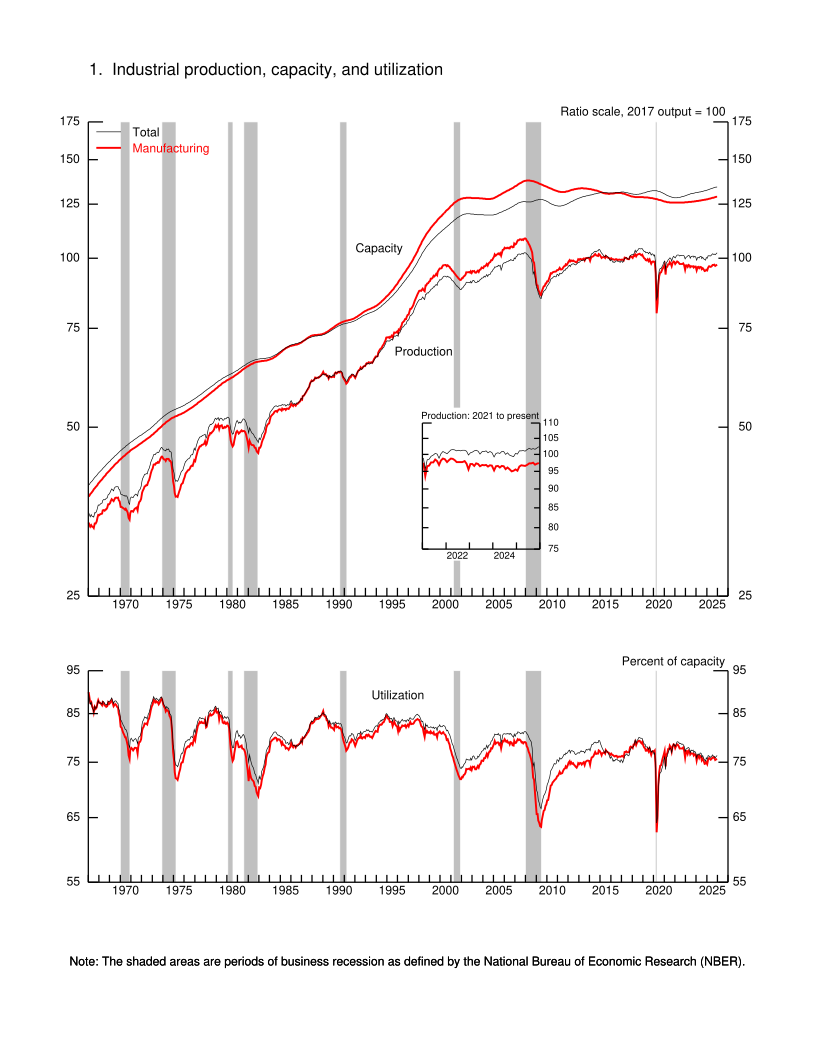
Total industrial production rose 3.0 percent in July after increasing 5.7 percent in June; even so, the index in July was 8.4 percent below its pre-pandemic February level.
Manufacturing output continued to improve in July, rising 3.4 percent. Most major industries posted increases, though they were much smaller in magnitude than the advances recorded in June.
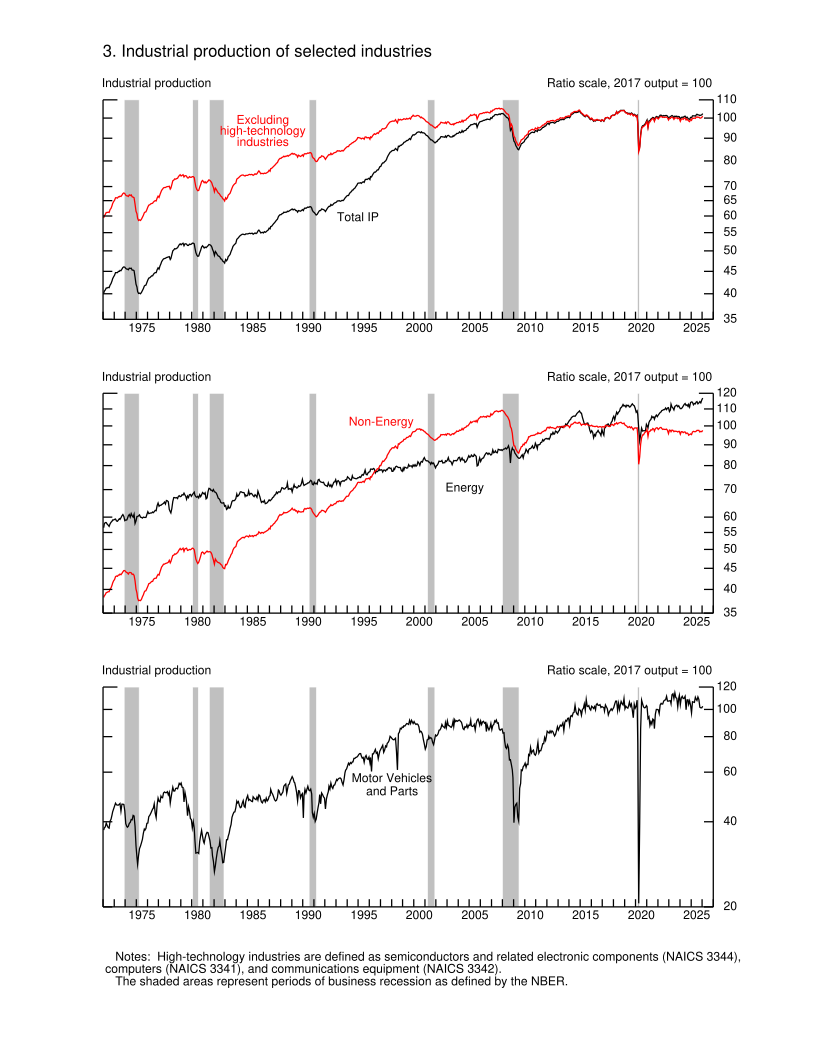
The largest gain in July—28.3 percent—was registered by motor vehicles and parts; factory production elsewhere advanced 1.6 percent. Mining production rose 0.8 percent after decreasing for five consecutive months. The output of utilities increased 3.3 percent, as unusually warm temperatures increased the demand for air conditioning. At 100.2 percent of its 2012 average, the level of total industrial production was 8.2 percent lower in July than it was a year earlier. Capacity utilization for the industrial sector increased 2.1 percentage points in July to 70.6 percent, a rate that is 9.2 percentage points below its long-run (1972–2019) average but 6.4 percentage points above its low in April.
Industrial Production and Capacity Utilization: Summary
Seasonally adjustedMake Full Screen
| Industrial production | 2012=100 | Percent change | |||||||||||
|---|---|---|---|---|---|---|---|---|---|---|---|---|---|
| 2020 | 2020 | July '19 to July '20 | |||||||||||
| Feb.[r] | Mar.[r] | Apr.[r] | May[r] | June[r] | July[p] | Feb.[r] | Mar.[r] | Apr.[r] | May[r] | June[r] | July[p] | ||
| Total index | 109.3 | 104.6 | 91.2 | 92.0 | 97.2 | 100.2 | .1 | -4.3 | -12.8 | .9 | 5.7 | 3.0 | -8.2 |
| Previous estimates | 109.3 | 104.5 | 91.2 | 92.5 | 97.5 | .1 | -4.4 | -12.7 | 1.4 | 5.4 | |||
| Major market groups | |||||||||||||
| Final Products | 102.7 | 96.8 | 82.0 | 85.6 | 93.0 | 97.2 | .8 | -5.8 | -15.3 | 4.4 | 8.6 | 4.5 | -5.9 |
| Consumer goods | 105.8 | 100.1 | 87.3 | 90.9 | 98.7 | 103.2 | 1.2 | -5.4 | -12.8 | 4.1 | 8.6 | 4.6 | -2.2 |
| Business equipment | 98.0 | 90.2 | 69.1 | 74.0 | 82.7 | 86.9 | -.4 | -8.0 | -23.3 | 7.1 | 11.7 | 5.0 | -13.9 |
| Nonindustrial supplies | 109.8 | 104.7 | 92.2 | 93.9 | 96.4 | 97.9 | .3 | -4.6 | -11.9 | 1.8 | 2.8 | 1.5 | -9.3 |
| Construction | 120.1 | 115.6 | 101.8 | 104.8 | 106.2 | 106.7 | -.3 | -3.7 | -12.0 | 2.9 | 1.4 | .4 | -8.0 |
| Materials | 114.6 | 111.3 | 99.1 | 96.9 | 100.8 | 103.0 | -.6 | -2.9 | -11.0 | -2.2 | 4.0 | 2.2 | -9.8 |
| Major industry groups | |||||||||||||
| Manufacturing (see note below) | 104.9 | 99.7 | 83.8 | 87.0 | 93.4 | 96.5 | .0 | -5.0 | -16.0 | 3.8 | 7.4 | 3.4 | -7.7 |
| Previous estimates | 104.9 | 99.6 | 83.8 | 87.0 | 93.3 | .0 | -5.1 | -15.9 | 3.8 | 7.2 | |||
| Mining | 133.0 | 130.9 | 121.8 | 108.0 | 107.6 | 108.5 | -1.6 | -1.6 | -7.0 | -11.3 | -.3 | .8 | -17.0 |
| Utilities | 102.2 | 99.1 | 101.0 | 100.4 | 102.5 | 105.9 | 3.6 | -3.1 | 1.9 | -.5 | 2.0 | 3.3 | .6 |
Make Full Screen
[r] Revised. [p] Preliminary.
| Capacity utilization | Percent of capacity | Capacity growth | |||||||||||
|---|---|---|---|---|---|---|---|---|---|---|---|---|---|
| Average 1972- 2019 | 1988- 89 high | 1990- 91 low | 1994- 95 high | 2009 low | 2019 July | ||||||||
| 2020 | July '19 to July '20 | ||||||||||||
| Feb.[r] | Mar.[r] | Apr.[r] | May[r] | June[r] | July[p] | ||||||||
| Total industry | 79.8 | 85.1 | 78.8 | 85.0 | 66.7 | 77.4 | 76.9 | 73.6 | 64.2 | 64.8 | 68.5 | 70.6 | .8 |
| Previous estimates | 76.9 | 73.5 | 64.2 | 65.1 | 68.6 | ||||||||
| Manufacturing (see note below) | 78.2 | 85.5 | 77.3 | 84.6 | 63.7 | 75.3 | 75.2 | 71.4 | 60.0 | 62.3 | 66.9 | 69.2 | .5 |
| Previous estimates | 75.2 | 71.3 | 60.0 | 62.3 | 66.9 | ||||||||
| Mining | 87.2 | 86.3 | 84.3 | 88.6 | 78.3 | 88.9 | 89.1 | 87.8 | 81.8 | 72.8 | 72.7 | 73.5 | .4 |
| Utilities | 85.2 | 93.2 | 84.7 | 93.2 | 78.2 | 76.9 | 73.5 | 71.1 | 72.3 | 71.7 | 73.0 | 75.2 | 2.9 |
| Stage-of-process groups | |||||||||||||
| Crude | 86.2 | 87.8 | 84.7 | 90.0 | 76.4 | 86.8 | 87.6 | 86.4 | 80.1 | 73.8 | 74.3 | 74.9 | .3 |
| Primary and semifinished | 80.3 | 86.4 | 78.1 | 87.8 | 63.9 | 75.6 | 75.0 | 71.3 | 62.7 | 63.9 | 67.2 | 68.9 | .8 |
| Finished | 76.7 | 83.3 | 77.3 | 80.6 | 66.5 | 74.8 | 74.0 | 70.2 | 58.5 | 61.4 | 67.0 | 70.1 | .9 |
Market Groups
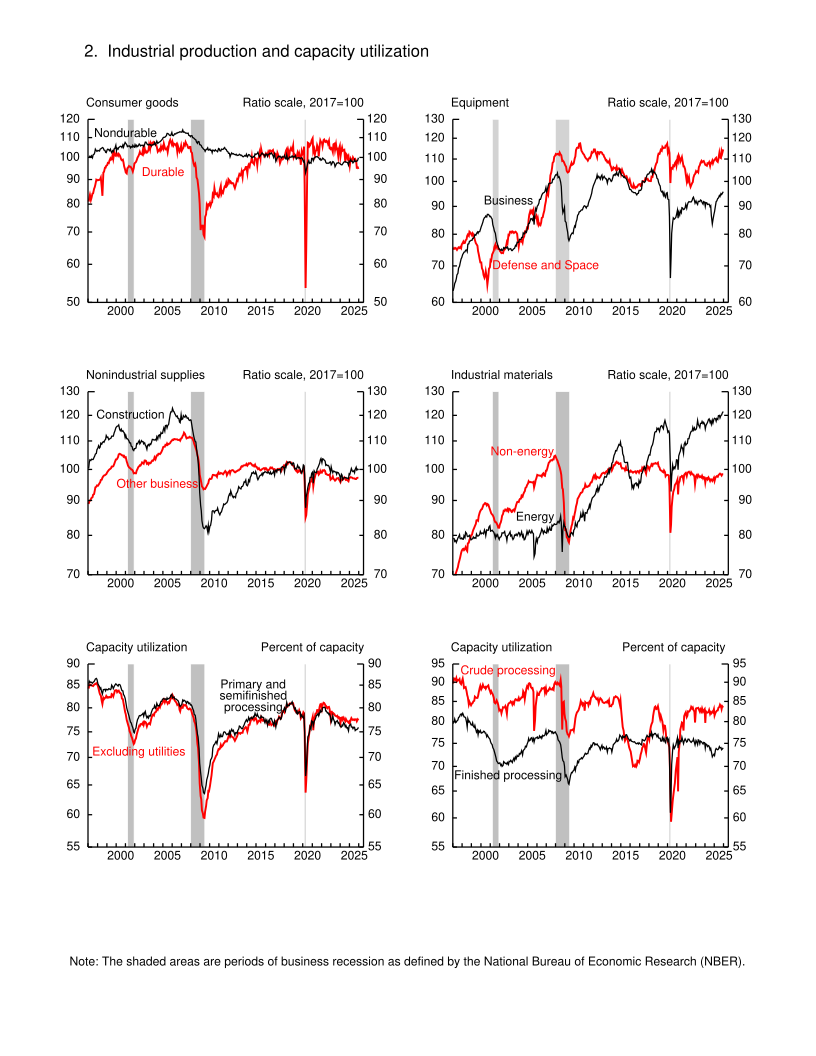
The indexes for all of the major market groups advanced in July, though by less than in June. The strength in motor vehicles contributed to increases in the indexes for consumer durables (14.6 percent), business equipment (5.0 percent), and durable materials (3.7 percent). Consumer energy products, business supplies, and defense and space equipment also posted gains of more than 2 percent.
Industry Groups
Manufacturing output increased 3.4 percent in July, but it was still about 8 percent below its pre-pandemic February level. The index for durable manufacturing rose 5.5 percent in July. In addition to the large advance for motor vehicles and parts, increases of more than 6 percent were recorded by aerospace and miscellaneous transportation equipment and by miscellaneous manufacturing. Substantial gains in the past three months have pushed the output of motor vehicles and parts to nearly its February level. The index for nondurables rose 1.3 percent in July, with gains of more than 3 percent for textile and product mills, for printing and support, and for petroleum and coal products. The output of other manufacturing (publishing and logging) increased 1.5 percent.
The output of utilities rose 3.3 percent in July, largely reflecting strength in electric utilities. Mining output increased 0.8 percent. Gains were concentrated primarily in crude oil extraction and coal mining but also were recorded by most other types of mining. In contrast, the index for oil and gas well drilling fell 8.0 percent and was about 70 percent below its year-earlier level.
Capacity utilization for manufacturing was 69.2 percent in July, 9.2 percentage points higher than its trough in April and 5.5 percentage points above its recession trough of June 2009. The operating rates for durable and nondurable manufacturing increased to 68.1 percent and 71.5 percent, respectively. The rate for durables was about 14 percentage points above its April low but still about 7 percentage points below its pre-pandemic February level; the rate for nondurables has risen 4.2 percentage points since April but was still about 5 percentage points below February. The operating rate for mining rose to 73.5 percent in July. However, a downward revision to crude oil extraction in May left the utilization rates for mining in May, June, and July lower than any previous rates in the history of the series (since 1967).
Revision of Industrial Production and Capacity Utilization
The Federal Reserve Board plans to issue its annual revision to the indexes of industrial production (IP) and the related measures of capacity utilization in the second half of 2020. New annual benchmark data for manufacturing for 2017 and 2018 will be incorporated, as well as other annual data, including information on the mining of metallic and nonmetallic minerals (except fuels). The weights for market-group splits of the industry-level indexes will be updated with information from the 2012 benchmark input-output accounts from the U.S. Bureau of Economic Analysis. The updated IP indexes will include revisions to the monthly indicator (either product data or input data) and to seasonal factors for each industry. In addition, the estimation methods for some series may be changed. Any modifications to the methods for estimating the output of an industry will affect the index from 1972 to the present.
Capacity and capacity utilization will be revised to incorporate data for manufacturing through the fourth quarter of 2019 from the U.S. Census Bureau's Quarterly Survey of Plant Capacity Utilization, along with new data on capacity from the U.S. Geological Survey, the U.S. Department of Energy, and other organizations.
Release Dates for 2021
In 2021, the G.17 release on Industrial Production and Capacity Utilization will be published at 9:15 a.m. on January 15, February 17, March 16, April 15, May 14, June 15, July 15, August 17, September 15, October 18, November 16, and December 16.
G.17 Release Tables:
- Summary: Industrial Production and Capacity Utilization
- Chart 1: Industrial Production, Capacity, and Capacity Utilization
- Chart 2: Industrial Production and Capacity Utilization
- Chart 3: Industrial Production of Selected Industries
- Table 1: Industrial Production: Market and Industry Groups (percent change)
- Table 2: Industrial Production: Special Aggregates and Selected Detail (percent change)
- Table 3: Motor Vehicle Assemblies
- Table 4: Industrial Production Indexes: Market and Industry Group Summary
- Table 5: Industrial Production Indexes: Special Aggregates
- Table 6: Diffusion Indexes of Industrial Production
- Table 7: Capacity Utilization: Manufacturing, Mining, and Utilities
- Table 8: Industrial Capacity: Manufacturing, Mining, and Utilities (percent change)
- Table 9: Industrial Production: Gross Value of Products and Nonindustrial Supplies
- Table 10: Gross-Value-Weighted Industrial Production: Stage-of-Process Groups
- Table 11: Historical Statistics for IP, Capacity, and Utilization: Total Industry
- Table 12: Historical Statistics for IP, Capacity, and Utilization: Manufacturing
- Table 13: Historical Statistics for IP, Capacity, and Utilization: Total Industry excluding Selected High-Technology Industries
- Table 14: Historical Statistics for IP, Capacity, and Utilization: Manufacturing excluding Selected High-Technology Industries
- Table 15: Industrial Production: Reliability Estimates
Last Update: August 14, 2020