•Oct 8, 2020
Thursday, October 08, 2020
THEY'RE BACK! THE Virtual Remote Edition Mesa Morning Live October 2020: Full Episode
Empty Mesa 11 studio with only the channel staff. . . this could be as exciting as ever
No views
Harvard Study: President Trump Harnesses Mass Media to Spread Dis-Information
Media on Internet is the message - from primary sources and traditional broadcasters to trolls, to 24-hour news channels and local syndicated news there are "influencers" that are analyzed and explained in this study.
What can the press do . . .
Mail-in voting has been a tried and tested part of America's electoral system for decades. Yet in recent months, it's been the target of a coordinated disinformation campaign propagated not by Russia, but President Trump and his Republican allies.
A new Harvard study led by Yochai Benkler examines how the president harnesses mass media to disseminate and reinforce disinformation about mail-in voter fraud.
Benkler joins Hari Sreenivasan to explain his findings. Originally aired on October 7, 2020.
6,468 views
What can the press do . . .
Mail-in voting has been a tried and tested part of America's electoral system for decades. Yet in recent months, it's been the target of a coordinated disinformation campaign propagated not by Russia, but President Trump and his Republican allies.
A new Harvard study led by Yochai Benkler examines how the president harnesses mass media to disseminate and reinforce disinformation about mail-in voter fraud.
Benkler joins Hari Sreenivasan to explain his findings. Originally aired on October 7, 2020.
•Oct 7, 2020
-----------------------------------------------------------------------------------------------------------------------------------------
Subscribe to the Amanpour and Company. channel here: https://bit.ly/2EMIkTJ
Subscribe to our daily newsletter to find out who's on each night: http://www.pbs.org/wnet/amanpour-and-...
For more from Amanpour and Company, including full episodes, click here: https://to.pbs.org/2NBFpjf
Like Amanpour and Company on Facebook: https://bit.ly/2HNx3EF
Follow Amanpour and Company on Twitter: https://bit.ly/2HLpjTI
Watch Amanpour and Company weekdays on PBS (check local listings).
Amanpour and Company features wide-ranging, in-depth conversations with global thought leaders and cultural influencers on the issues and trends impacting the world each day, from politics, business and technology to arts, science and sports. Christiane Amanpour leads the conversation on global and domestic news from London with contributions by prominent journalists Walter Isaacson, Michel Martin, Alicia Menendez and Hari Sreenivasan from the Tisch WNET Studios at Lincoln Center in New York City.
#amanpourpbs
QUESTION: Does This Do It To Remove Ambiguities By "Refining Text-Related" Development Standards For Residential Uses In Commercial Districts??

Readers of this blog might wonder what this tangential topic is all about. It certainly deserves more attention that it has attracted so far - and judging by some future scheduling not yet posted on the city government's Calendar of Events (http://mesa.legistar.com/Calendar.aspx ) there are Upcoming Public Hearings
UPCOMING HEARINGS
Planning & Zoning Board 10/28/20
City Council Introduction November
City Council Consideration December
__________________________________________________________________________________
HOW IT STARTED > A Zoning Board of Appeal regarding proposals for that old vacant 10-acre toxic entire city-block eyesore where Brown & Brown Chevrolet occupied the site for 85 years.
The topic was on the agenda for the Mesa City Study Session earlier this month
| File #: | 20-0982 |
| Type: | Presentation | Status: | Agenda Ready |
| In control: | City Council Study Session |
| On agenda: | 10/1/2020 |
| Title: | Hear a presentation and discuss proposed text amendments to Chapters 2, 5, 6, 7, 8, 31, 33, 86, and 87 of Title 11 of the Mesa Zoning Ordinance including: 1) modifying certain development standards for assisted living facilities, including distance separation from major roadway intersections; 2) refining text-related development standards for residential uses in commercial districts to remove ambiguity; and 3) adding definitions for mixed-use developments, and boat and recreational vehicle storage. |
| Attachments: | 1. Presentation |
__________________________________________________________________________________
MISCELLANEOUS ZONING CODE AMENDMENTS
Kusi Appiah, Planning Director
Rachel Prelog, Senior Planner
RESIDENTIAL USES IN COMMERCIAL DISTRICTS (Slide 7)
EXISTING PROVISIONS
• Table 11-6-2
• Section 11-31-31
ISSUES
• Ambiguity in requirements
• Revisions proposed to clarify the process and when a CUP is required
RESIDENTIAL USES IN COMMERCIAL DISTRICTS (See Slide 8)
PUBLIC OUTREACH (See Slide 10)
Special Projects Website -June thru current
General Plan & Zoning Ordinance Text Amendment Open House
•August 18th •27 participants
Virtual Open House •August 18 -September 1 •157 views
TechDirt Exposes Implausible Denial for Police Use of Facial Recognition Software
That's been the same frequent focus for some posts on this blog. Let's take a look at those first as a preamble to yesterday's report by Tim Cushing in https://www.techdirt.com/.
18 May 2019
Should We Worry About What's Next Here In Mesa?

From Fortune Magazine yesterday:
San Francisco Bans Facial-Recognition Tools for Its Police and Other City Departments
By Kartikay Mehrotra and Bloomberg May 14, 2019
(It all started with automated License-Plate Readers)
_________________________________________________________________________
"Concerned that some new surveillance technologies may be too intrusive, San Francisco became the first U.S. city to ban the use of facial-recognition tools by its police and other municipal departments.
The Board of Supervisors approved the Stop Secret Surveillance ordinance Tuesday, culminating a re-examination of city policy that began with the false arrest of Denise Green in 2014. Green’s Lexus was misidentified as a stolen vehicle by an automated license-plate reader. She was pulled over by police, forced out of the car, and onto her knees at gunpoint by six officers. The city spent $500,000 to settle lawsuits linked to her detention.
Since then, San Francisco officials determined flaws in the license-plate reader were just part of a wider potential for abuse with Big Brother-type surveillance capabilities. With new technologies increasingly making it possible to identify people, places, and objects, the city decided to impose a higher bar for snooping tools. . .

The U.S. Department of Justice said the technology is not always accurate and that implementation poses significant challenges to civil rights.
“The potential for misuse of face recognition information may expose agencies participating in such systems to civil liability and negative public perceptions,” according to a December 2017 report on face recognition by the Bureau of Justice Assistance...
__________________________________________________________________________
TECHDIRT:
After Years Of Claiming It Doesn't Use Facial Recognition Software, The LAPD Admits It Has Used It 30,000 Times Since 2009
from the we-regret-the-repeated-errors dept
The Los Angeles Police Department apparently loves using facial recognition tech. It doesn't like talking about its love for this tech, though. It told the Georgetown Law Center on Privacy and Technology it had nothing to give the Center when it asked for its facial recognition tech documents.
The Los Angeles Police Department has repeatedly announced new face recognition initiatives—including a “smart car” equipped with face recognition and real-time face recognition cameras—yet the agency claimed to have “no records responsive” to our document request.
The LAPD flatly denied using the tech as recently as 2019.
"We actually do not use facial recognition in the Department," Rubenstein told the LA Times in 2019, adding an exception of "a few limited instances" where outside agencies used it during joint investigations.
Here's what the LA Times has discovered, thanks to public records that the LAPD finally decided to stop withholding.
The Los Angeles Police Department has used facial recognition software nearly 30,000 times since 2009, with hundreds of officers running images of suspects from surveillance cameras and other sources against a massive database of mug shots taken by law enforcement.
The new figures, released to The Times, reveal for the first time how commonly facial recognition is used in the department, which for years has provided vague and contradictory information about how and whether it uses the technology.
There's some technically true stuff in the LAPD's obfuscation. The LAPD does not have its own software. This makes it easier to claim it does not use the tech "in the Department." But the Department definitely uses the tech . . .
 Unmasking the Realities of Facial Recognition
What is facial recognition?
Facial recognition is a method of using computer programs to identify individuals based on the features of their faces. Facial recognition systems create a unique “face print” (similar to a fingerprint) based on a pre-identified photo (or set of photos) for an individual. These systems can then rapidly scan an image of an unknown face against all the faceprints in their databases, and provide an identification if there is a match. These databases can contain millions of photos and programs can scan through them to identify a match in less than a second.
Facial recognition is also a looming privacy threat. If cameras were placed near sensitive locations such as houses of worship, political rallies, protests, or doctors’ offices, facial recognition could effortlessly catalog the intimate details of individuals’ lives.
Is this something coming in the future, or is it being used now? . . .
___________________________________________________________________________
26 October 2018
China: facial recognition and state control | The Economist
Here in America same
Published on Oct 24, 2018
China is the world leader in facial recognition technology. Discover how the country is using it to develop a vast hyper-surveillance system able to monitor and target its ethnic minorities, including the Muslim Uighur population.
Click here to subscribe to The Economist on YouTube: https://econ.st/2xvTKdy
Improving lives, increasing connectivity across the world, that's the great promise offered by data-driven technology - but in China it also promises greater state control and abuse of power.
This is the next groundbreaking development in data-driven technology, facial recognition. . .
Click here to subscribe to The Economist on YouTube: https://econ.st/2xvTKdy
Improving lives, increasing connectivity across the world, that's the great promise offered by data-driven technology - but in China it also promises greater state control and abuse of power.
This is the next groundbreaking development in data-driven technology, facial recognition. . .
_____________________________________________________________________________
The Salt Lake City VP Sit-Down Debate: Cracking The Cluster of Carefully-Crafted Questions
Civilized it was. A Smack-Down it wasn't when Moderator Susan Page, print journalist and Washington D.C. Bureau Chief for USA Today, was close to losing time-control of the answers and staying on topic for Loyal-Soldier Mike Pence using more minutes than the debate rules allowed with challenger Kampala Harris consistently asking for equal time.
Readers of this blog can get more details of the back-and-forth for the 9 topics in this second prime time coverage of the 2020 Presidential Election Campaign where voting has already started. If looks are anything - and you know they are - here's an image taken from an article in https://www.axios.com/ with the headline "VP debate brings back normal politics.
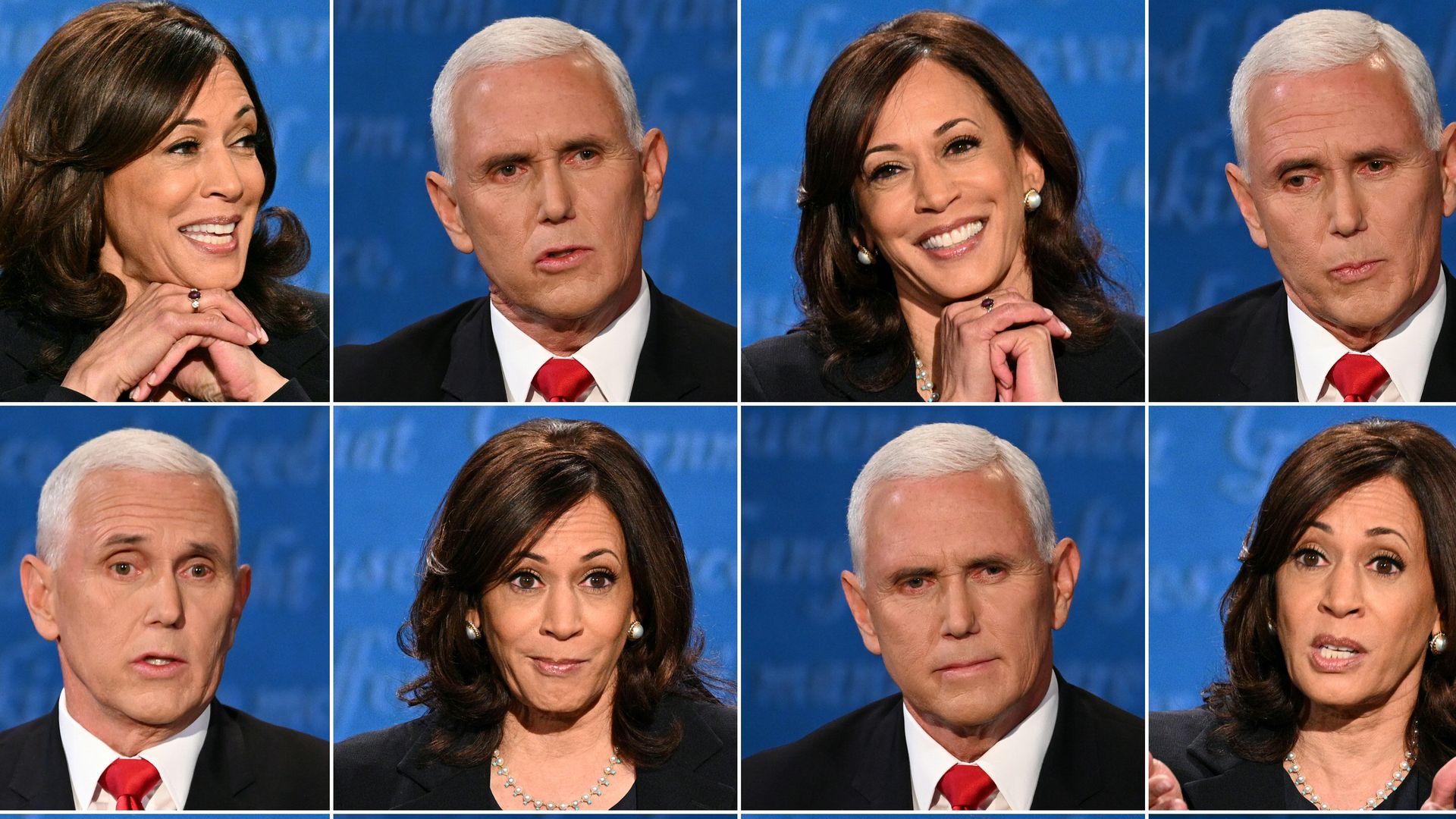
Here's part of what Mike Allen wrote: "
Toward the end, the vice presidential debate in Salt Lake City got personal — about President Trump, a reminder of what this election will ultimately come down to.
Sen. Kamala Harris flashed back to last week's raucous presidential debate, arguing that Trump's "stand back and stand by" answer to a question about white supremacists "is part of a pattern."
- She brought up Trump's response to "Neo-Nazis carrying tiki torches shouting racial epithets" in Charlottesville in 2017.
- "This is who we have as the president of the United States, and America, you deserve better," the California senator said. "Joe Biden will be a president who brings our country together and recognizes the beauty in our diversity."
Vice President Pence responded by sketching a very different worldview.
- Pence told the moderator, USA Today's Susan Page: "I think this is one of the things that makes people dislike the media so much in this country, Susan, is that you selectively edit — just like Sen. Harris did — comments that President Trump and I and others on our side of the aisle make."
- Turning to Harris, he said: "You're concerned that he doesn’t condemn Neo-Nazis? President Trump has Jewish grandchildren."
- Later, Pence said directly to viewers: "Don't assume that what you're seeing on your local news networks is synonymous with the American people."
Harris' advisers studied research about the different ways men and women are judged in public speaking. The former California attorney general repeatedly stood up for herself:
Wednesday, October 07, 2020
Mesa Chamber Orientation (1/5)-An Introduction to the Chamber
Ooops! NO VIEWS
The Mesa Chamber of Commerce exists for what?
The Mesa Chamber of Commerce exists for what?
Subscribe to:
Posts (Atom)
Believe it or not > This is severa degrees above the daily "normal" for summer temperatures...remainder of the week a degree or two warmer :)
US National Weather Service Phoenix Arizona t͏ o͏ r͏ o͏ S͏ d͏ n͏ p͏ e͏ s͏ 5͏ 3͏ 8͏ c͏ u͏ 5͏ a͏ 6͏ 1͏ t͏ f͏ 2͏ c͏ 6͏ m͏ g͏ 4͏ u͏ i͏ 1͏ 5͏...

-
 Flash News: Ukraine Intercepts Russian Kh-59 Cruise Missile Using US VAMPIRE Air Defense System Mounted on Boat. Ukrainian forces have made ...
 -
A nor’easter is about to hit the Northeast in May. That’s very unusual.

