Saturday, February 20, 2021

Press Release and Recent Developments: Federal Reserve Bank

Press Release

February 18, 2021

Federal Reserve Board announces final rule intended to reduce risk and increase efficiency in the financial system by applying netting protections to a broader range of financial institutions

For release at 12:00 p.m. EST

LINK > https://www.federalreserve.gov/newsevents/pressreleases/bcreg20210218a.htm                                                     

The Federal Reserve Board on Thursday announced a final rule that is intended to reduce risk and increase efficiency in the financial system by applying netting protections to a broader range of financial institutions.

The final rule amends Regulation EE (Financial Institution Netting) to apply netting provisions of the Federal Deposit Insurance Corporation Improvement Act of 1991 (FDICIA) to certain new entities including swap dealers. The rule would also make minor clarifications to the existing activities-based test in Regulation EE to clarify how the activities-based test applies following a consolidation of legal entities.

Sections 401-407 of FDICIA validate netting contracts among financial institutions. Parties to a netting contract agree that they will pay or receive the net, rather than the gross, payment due under the netting contract. FDICIA provides certainty that netting contracts will be enforced, even in the event of the insolvency of one of the parties.

Regulation EE currently includes an activities-based test pursuant to which an entity can qualify as a financial institution for purposes of FDICIA's netting provisions if it is a market intermediary and, during the previous 15-month period, it engaged in financial contracts exceeding specified numerical thresholds. Consistent with FDICIA's goals of reducing systemic risk and increasing efficiency in the financial markets, the Board's final rule expands the definition of financial institution to ensure that certain entities qualify as financial institutions, including swap dealers and security-based swap dealers; major swap participants and major security-based swap participants; nonbank systemically important financial institutions; certain financial market utilities; foreign banks; bridge institutions; qualifying central counterparties; the Bank for International Settlements; foreign central banks; and Federal Reserve Banks.

The final rule also clarifies that, following a consolidation of legal entities, the surviving entity can determine whether its financial contracts exceeded the numerical thresholds in the activities-based test by considering the aggregated financial contracts of the consolidated persons during the previous 15-month period.

The Board's Federal Register notice is attached.

For media inquiries, call (202) 452-2955

Council Study Session - 2/11/2021 [and a Make-Over of sorts]

The Power of One Vote In Government: In The Nation's Capitol, In The State of Arizona, In The City of Mesa

There is A New Reality In Politics for Strict Party-Line Voting and Evenly-Split Votes on Policy.
Yesterday we saw that here in Mesa during an almost two-hour City Council Study Council to provide direction on the proposed draft for a new Anti-Discrimination Code when District 6 Councilmember Kevin Thompson was absent for 'medical reasons' (waiting for a kidney stone removal operation) while the other six members heard and discussed the exclusions, sending it all back - with a 3:3 even split -  for alterations by the City Attorney's Office to be scrutinized again on Monday.
Image result for the power of one vote
____________________________________________________________________________
Let's skip the AZ State House for the time being and get to surprising rifts in Democratic Party unity - two "hold-outs", one a man and one a woman, Kirsten Sinema (who's the only Congress member openly declared as bisexual).
This is not about gender-orientation > she's come out against pending legislation to establish a federal $15 per hour minimum wage.
The article reference is from Politico published 02.12,2021 and makes the statement the 44-year old Democrat is one of the most quirky and interesting members of the stodgy Senate

The most influential Democrat you never hear from

Kyrsten Sinema's defense of the Senate’s age-old rules is likely to frustrate progressives eager to use every tool at their disposal to advance their priorities.

Despite being one of the youngestmembers of the chamber, Kyrsten Sinema holds views that can be as old-school as any of the Senate’s long-timers'.

Kyrsten Sinema doesn’t often make big policy pronouncements. But when she does, Democrats had better listen.

Take the $15 hourly minimum wage that Democratic leaders want to add to a $1.9 trillion coronavirus relief package. Sinema, who became thefirst Democrat to win a Senate race in once deep-red Arizona in 30 years, is crystal clear: She’s against including it.

“What’s important is whether or not it’s directly related to short-term Covid relief. And if it’s not, then I am not going to support it in this legislation,” Sinema said in a telephone interview this week. “The minimum wage provision is not appropriate for the reconciliation process. It is not a budget item. And it shouldn’t be in there.”

Sinema’s opposition is a blow to Democrats’ hopes of bumping up the federal minimum wage through budget reconciliation to avoid a GOP filibuster, complicating follow-through on a campaign promise from Democrats and President Joe Biden. And her defense of the Senate’s age-old rulesis likely to frustrate progressives eager to use every tool at their disposal to advance their priorities in a Senate where one wayward Democrat can mean the difference between a policy breakthrough and utter failure.

Her breaks with her liberal colleagues are both a reflection of her state, which she won by a narrow margin in 2018, and her temperament. Butthe former state legislator, House member and now first-term senator has literally never served in the majority before — so she feels the minority’s pain.

It’s just one of the things that makes the 44-year-old Democrat one of the most quirky and interesting members of the stodgy Senate. . .

“She’s not someone who cares about convention and the way things were,” said Sen. Mitt Romney (R-Utah), a friend and ally. “She recognizes the real tradition of a Republic, which is that we are elected not to put our finger in the air to determine the direction of the wind.”

Despite being one of the youngest, and let’s face it, hippest members of the chamber, Sinema holds views that can be as old-school as any of the Senate’s long-timers'. Not only does she want to keep the filibuster, she wants to rebuild it. And the end-around idea of overruling the parliamentarian to jam whatever Democrats want to in a budget reconciliation bill is not going to happen on Sinema’s watch either. . .

Sinema’s stance largely aligns with Sen. Joe Manchin (D-W.Va.), another senator who has narrowed Democrats’ ambitions since they won the Senate last month. Their styles diverge from there.

When Vice President Kamala Harris appeared in Manchin’s home state on TV pushing the coronavirus relief bill, Manchin retorted: “That’s not a way of working together.” Sinema was similarly unhappy, according to people that spoke with her afterward.

She decided to deal with it privately.She explained that people in her state “don't really want me to spend my time weighing in on controversies or palace intrigue. They don't care about that.” And attempts at trying to force Sinema’s hand will not go anywhere, she insists.

. . .As one of a handful of moderates in a caucus that may need lockstep unity to move Biden’s agenda, there’s plenty of political pressure on Sinema even if she chooses to ignore it. She and Manchin may have to be the deciding votes on Neera Tanden, Biden’s nominee to be White House budget chief and perhaps the toughest confirmation the new president will have to steer through the Senate in his first 100 days.

_____________________________________________________________________________________

BLOGGER NOTE: OK Bi-Sexual (no one knows if she's in a relationship of any kind or even dating) and >

“Bipartisanship is always my first choice,” she said. “I also want to make sure that we're getting stuff done for Arizonans. They need help … and I don't want to see a process that gets bogged down in petty partisanship, like you did last year for much of the year.”


SCIENCE FIGHT - Magnetic Pole Flip Extinctions | S0 News Feb.19.2021

Triggering Cold, Gamma Ray Lightning, Older Mammoths | S0 News Feb.18.2021

Friday, February 19, 2021

Here in Mesa We're Never Far From Where We Were

There was a presentation yesterday in front of the Mesa City Council. . .
LET'S GET RIGHT TO THE POINT AND SPOTLIGHT
RELIGION: WHAT STATES THAT DON'T PROTECT LGBTQ WORKERS HAVE IN COMMON
Note: Originally published by The Conversation, 08.21.2019, under the terms of a Creative Commons Attribution/No derivatives license.
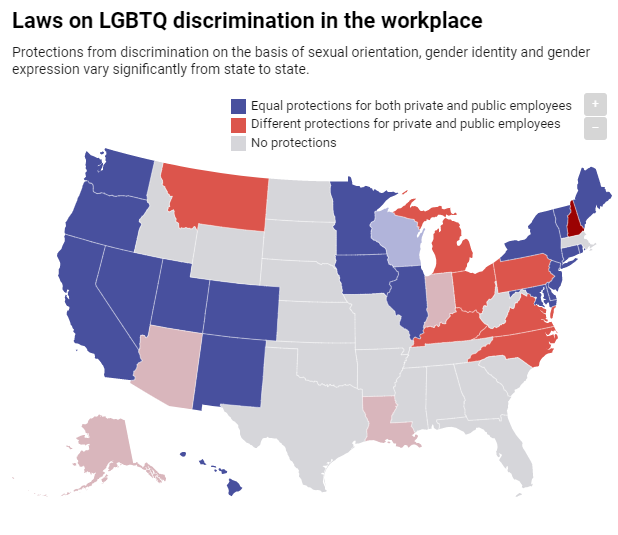
In many ways, the patchwork pattern of state-level protection from discrimination for LGBTQ employees is similar to states which allowed same-gender marriage before 2015.


Location, location, location

Nationwide, 19 states had adopted same-gender marriage legislation, civil unions or other spousal rights before U.S. v. Windsor in 2013. An important predecessor to marriage equality, U.S. v. Windsor was significant in ruling that states must honor same-gender marriages performed in other states, and for overturning part of the Defense of Marriage Act.

I wanted to know if the characteristics of these states that were early supporters of marriage equality were similar to states that have been early adopters of legislation protecting LGBTQ workers.

In my study, I looked at the 2010 census for the geographic, social and economic characteristics of all 50 states. . .

A major legal conflict

Charges of discrimination are regulated by federal law. However, workers may also pursue legal action under state law, which is why state protections are important.

In 2012 and 2015, the Equal Employment Opportunity Commission issued administrative rulings to enforce federal law and accept charges of discrimination by LGBTQ employees under the protected class of “sex.”

These EEOC rulings are not legally binding on federal courts, which has led to a legal conflict between the 2nd, 11th and 6th Circuit Courts of Appeals. The 2nd Circuit is in the Northeast, the 6th Circuit is in the Midwest, and the 11th Circuit is in the South.

This Circuit Court split is intriguing, given my study’s finding of the role of a state’s geographic location in predicting its likelihood to adopt protections for LGBTQ employees. Currently, most LGBTQ workers in the South and Midwest regions have little to no state protections from employment discrimination.