Friday, March 12, 2021

ETHICAL HACKING EXPOSES FLAWS + IRRESPONSIBLE VULNERABILITIES: Insecure Cloud Video Security Cam Surveillance

Why? There's now one more example of Cyber Risk - This time with Verkada for a warning sign to the public over the dangers of exponential expansion of “smart” video surveillance networks.
Camera Recording GIF by South Park - Find & Share on GIPHY
 
___________________________________________________________________________

Thousands Of Security Cameras, Archived Footage Exposed After Surveillance Company Verkada Is Hacked

from the unsecured-security-cameras-are-the-best-security-theater dept

Put enough cameras up and pretty soon they become tasty targets for malicious hackers.

A group of hackers say they breached a massive trove of security-camera data collected by Silicon Valley startup Verkada Inc., gaining access to live feeds of 150,000 surveillance cameras inside hospitals, companies, police departments, prisons and schools.

Some of the more notable targets include Tesla factory cameras and security cameras deployed by Cloudflare. . .

The hackers involved here claim to be operating somewhat altruistically.

The data breach was carried out by an international hacker collective and intended to show the pervasiveness of video surveillance and the ease with which systems could be broken into, said Tillie Kottmann, one of the hackers who claimed credit for breaching San Mateo, California-based Verkada. Kottmann, who uses they/them pronouns, previously claimed credit for hacking chipmaker Intel Corp. and carmaker Nissan Motor Co. Kottmann said their reasons for hacking are “lots of curiosity, fighting for freedom of information and against intellectual property, a huge dose of anti-capitalism, a hint of anarchism -- and it’s also just too much fun not to do it.”

Add to that list "too easy. . .

More >> There’s widespread concern that video cameras will use facial recognition software to track our every public move. Far less remarked upon — but every bit as alarming — is the exponential expansion of “smart” video surveillance networks.
Private businesses and homes are starting to plug their cameras into police networks, and rapid advances in artificial intelligence are investing closed-circuit television, or CCTV, networks with the power for total public surveillance. The Rise of the Video Surveillance Industrial Complex
 
In the not-so-distant future, police forces, stores, and city administrators hope to film your every move — and interpret it using video analytics.
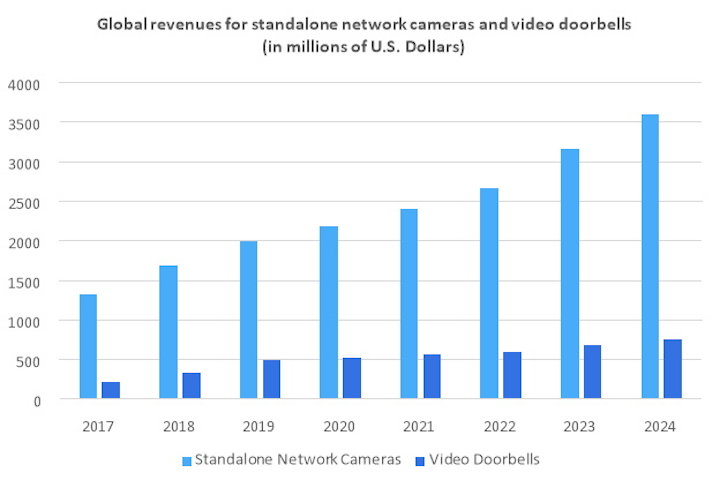
The rise of all-seeing smart camera networks is an alarming development that threatens civil rights and liberties throughout the world. Law enforcement agencies have a long history of using surveillance against marginalized communities, and studies show surveillance chills freedom of expression — ill effects that could spread as camera networks grow larger and more sophisticated Report: DIY camera market to experience exponential growth | Security Info  Watch

The Rise of Smart Camera Networks, and Why We Should Ban Them

Police are using cameras at private businesses and homes, along with AI, to expand their video surveillance — raising privacy concerns.

 
__________________________________________________________________________
More
22157.jpg

Global Surveillance Camera Market Report 2021: Insights, Covid-19 Impact, Competition and Forecasts, 2016-2020 & 2021-2026

Dublin, March 11, 2021 (GLOBE NEWSWIRE) -- The "Global Surveillance Camera Market: Analysis By Product Type, End User, By Region, By Country (2021 Edition): Market Insights, Covid-19 Impact, Competition and Forecast (2021-2026)" report has been added to ResearchAndMarkets.com's offering.

The Global Surveillance Camera Market was valued at USD 26.41 Billion in the year 2020.

The report presents the analysis of Surveillance Camera market for the historical period of 2016-2020 and the forecast period of 2021-2026.

The global Surveillance Camera market is observing lucrative growth owing to stringent regulatory standards regarding environment conservation, supportive government policies, as well as growing consumer awareness security. . .

A surveillance camera system is a surveillance system that captures images and videos, which can be compressed, stored, or sent over communication networks. It can be used in any environment. Security and surveillance are required for all organizations worldwide. Governments, enterprises, financial institutions, and healthcare organizations are expected and required to have a certain level of security and monitoring measures. As a result, there has been a dramatic increase in the demand for security applications such as video surveillance to monitor and record borders, ports, corporate houses, educational institutes, public places, buildings, and others. . .


READ MORE https://www.globenewswire.com/news-release/2021/03/11/2191146/0/en/Global-Surveillance-Camera-Market-Report-2021-Insights-Covid-19-Impact-Competition-and-Forecasts-2016-2020-2021-2026.html


Lipps, Inc. - Funkytown - 1980

Thursday, March 11, 2021

DTMesa's Ersatz "Arts District" on a 10-Acre Hazmat Site

Gary Nelson can sure spin a slippery and lofty story, with little to tell about its toxic 85-year history as Brown & Brown Chevrolet that generated tons of sales tax revenues before they got a better offer to abandon downtown leaving a Brownfield behind.
Tax break helps heal downtown Mesa scar
Minneapolis-based Opus Group to build about 334 upscale rental units on the old Brown & Brown site.
Gary Nelson, Tribune Contributor
East Valley Tribune | 2021-03-09
It was a point of pride in downtown Mesa for generations – a Chevy dealership that sent thousands of beaming customers motoring off in their new dreammobiles.But as with almost all the historic businesses that used to line Main Street, Brown & Brown Chevrolet eventually motored off itself, leaving behind an almost 10-acre scar in the heart of the city.
Now, with some help from taxpayers, the old car lot could begin to see its resurrection as soon as this summer in the form of a development called the Mesa Arts District Lofts.
City Council on March 1 approved a development agreement with Minneapolis-based Opus Group to build about 334 upscale rental units and up to 25,000 square feet of commercial space on the Brown & Brown site, which sits immediately east of the Mesa Arts Center.
A key element in the deal is a Government Property Lease Excise Tax (GPLET) agreement that will allow Opus to escape most property taxes on the project for eight years. . .
Under a GPLET, a local government can assume ownership of a project and lease it back to the developer. Because the government is exempt from property taxes, those taxes are largely abated during the life of the lease agreement.
State law requires that before accepting such a deal, a city must hire a third-party analyst to determine whether it’s in the taxpayers’ best interest.
Mesa hired a Phoenix consulting firm named Applied Economics for that job.
“The Mesa Arts District Lofts meet the requirements for a GPLET because the development will increase the value of the property by more than 100 percent and the benefits to state and local governments would exceed the value to the prime lessee (Opus) during the term of the agreement,” a report from Applied Economics said.

Specifically, the report said:

  The project is projected to generate $8.8 million in revenues to local and state governments between 2022 and 2030. This would significantly eclipse the $5.1 million in tax abatements offered under the GPLET.

  Mesa is expected to reap $1.5 million in direct revenues from the project over that same span, more than offsetting the $465,000 it would lose in property taxes.

  The commercial portions of the project could generate $63.9 million in various economic benefits to Mesa by 2030, with 95 jobs created in retail and restaurant venues.

Mindful that the deal could negatively affect school revenues, the developer has agreed to pay just over $200,000 to Mesa Public Schools, Maricopa Community Colleges and the East Valley Institute of Technology. That sum represents what the districts would have received in property taxes were the site to remain vacant for the next eight years.

Mesa’s deal with Opus requires that the company:

  Build 389,000 square feet of market-rate rental property in 334 units that include live-work townhomes, one- to three-bedroom units and studio apartments.

  Provide a 6,200-square-foot clubhouse with a pool, spa, fitness center and other amenities.

  Build 25,000 square feet of ground-floor commercial space on the north end of the two buildings that will front Main Street.

Provide central thoroughfares with north-south and east-west public access through the project, and a 3,300-square-foot landscaped pedestrian plaza on the north end. Permanent easements will protect these public areas in perpetuity.

There is a potential for a Phase 2 within five years of completion, which would add buildings in what initially will be parking areas on the east and west sides of the development.

The amount of commercial space in the project created some concern among City Council members during their Feb. 25 study session. . .

Mayor John Giles praised the Opus project during the Feb. 25 meeting.

“I feel for the developer,” Giles said. “It’s tough to develop a project that’s literally outside the window of the entire City Council and on such a strategic piece of property that we all have so much affection for.”

He added, “We’ve been talking about this project for years. I’m very proud of what we see here today. Is it perfect? No – but it’s pretty good.”


20 of Bloomberg Philanthropies’ Biggest Achievements in 2020

U Go Utah! Kinda Salty Just Like Arizona

From Techdirt Today

Utah Legislature Wraps Up Session By Passing Two Unconstitutional Internet Bills

from the nice-work,-everyone dept

Last week we wrote about the many, many, many constitutional problems with a bill proposed in Utah to try to tell internet companies how they can moderate content. As we noted, the bill clearly violates the 1st Amendment, the Commerce Clause, and is also pre-empted by Section 230.

So, of course, it passed.

The Salt Lake Tribune report has a stunning set of paragraphs that demonstrate that supporters of the bill not only ignored many, many experts telling them the constitutional problems with the bill, but they then pretended no one notified them of those concerns (this is blatantly false):

“What we are talking about here are large, private forums that are free to moderate themselves and to put up what they want to put up and censor and kick off those people they choose to,” added House Minority Leader Brian King, D-Salt Lake City. “If we pass this bill, the Utah taxpayers are going to pay large amounts of money to defend the constitutionality of this bill against a lot of large entities that have many resources.”

Brammer shot back that he was not made aware of any constitutional issues with the legislation. However, a legal analysis from the Office of Legislative Research and General Counsel shared with The Salt Lake Tribune raises several potential constitutional and legal problems.

Legislative attorneys advised that HB228 may violate the First Amendment by compelling speech through requiring these companies to provide information about their moderation practices, although that may not be an impermissible burden given their vast resources.

The memo also warns the bill could violate the Constitution by placing an “undue burden on interstate commerce.”

Finally, the legislation might be unenforceable because of provisions in the federal Communications Decency Act.

It's one thing to ignore me -- I'm just a loud mouth blogger. But to flat out ignore the points raised by legislative attorneys, making it clear that you're going to waste a ton of taxpayer money? That's just obnoxious. Rep. Brady Brammer should be ashamed.

And that wasn't the only unconstitutional tech-related bill the Utah legislature passed as it wrapped up its session. It also passed a porn filter bill that would mandate a porn filter on any phone, computer, tablet or other electronic device.

Just like the many, many, many other attempts at such bills, this one is also blatantly unconstitutional. In the key case that made all of the Communications Decency Act (minus Section 230) unconstitutional, Reno v. ACLU, the Supreme Court (with a 9-0 vote) made it quite clear that governments cannot mandate the blocking of pornographic material online. In that case, the Supreme Court went through many reasons why governments don't get to mandate filters for indecent content.

Utah's legislators haven't even attempted to address any of those concerns. Incredibly, the Salt Lake Tribune quotes even those who voted for the bill as saying that the bill has serious problems and will require follow up legislation to fix. . .

more >
“As much as the intentions of this bill are good, logistically it just won’t work,” Anderegg, R-Lehi, said. “And I think if we pass this bill, it sends a good message. ... But we absolutely will be back here at some point in the future, maybe even in a special session to fix this.”
 
Anderegg ultimately voted in support of the bill, saying that while he has “a lot of trepidation” about the bill, he doesn’t “want to be the guy” who opposes an attempt to shield children from graphic content.
Incredible. Admitting you voted for a bill that you know won't work.. and saying you have to to protect the children, is quite an admission. The bill not only won't work, it's unconstitutional. And that's not the kind of thing you fix in a "special session." You just don't pass unconstitutional bills.

And if the goal is not to have children looking at porn, why not... let parents do their jobs and if they want to install a filter, let them do so. Remember "personal responsibility"?

Filed Under: content moderation, filters, free speech, internet, porn, porn filters, social media, utah

Attacks on Voting Rights a "Racist, Sexist, Classist Power Grab by the GOP

Krystal and Saagar: Arizona Voters REJECT Sinema's Filibuster Stance