Saturday, July 31, 2021
MAZEL TOV : You Go Guys! Ben & Jerry Guys of Principle
Supported by
Guest Essay
We’re Ben and Jerry. Men of Ice Cream, Men of Principle.

Bennett Cohen and
Mr. Cohen and Mr. Greenfield founded Ben & Jerry’s Homemade Holdings in 1978.
We are the founders of Ben & Jerry’s. We are also proud Jews. It’s part of who we are and how we’ve identified ourselves for our whole lives. As our company began to expand internationally, Israel was one of our first overseas markets. We were then, and remain today, supporters of the State of Israel.
But it’s possible to support Israel and oppose some of its policies, just as we’ve opposed policies of the U.S. government. As such, we unequivocally support the decision of the company to end business in the occupied territories, which a majority of the international community, including the United Nations, has deemed an illegal occupation.
While we no longer have any operational control of the company we founded in 1978, we’re proud of its action and believe it is on the right side of history. In our view, ending the sales of ice cream in the occupied territories is one of the most important decisions the company has made in its 43-year history. It was especially brave of the company. Even though it undoubtedly knew that the response would be swift and powerful, Ben & Jerry’s took the step to align its business and operations with its progressive values.
That we support the company’s decision is not a contradiction nor is it anti-Semitic. In fact, we believe this act can and should be seen as advancing the concepts of justice and human rights, core tenets of Judaism.
Ben & Jerry’s is a company that advocates peace. It has long called on Congress to reduce the U.S. military budget. Ben & Jerry’s opposed the Persian Gulf war of 1991. But it wasn’t just talk. One of our very first social-mission initiatives, in 1988, was to introduce the Peace Pop. It was part of an effort to promote the idea of redirecting 1 percent of national defense budgets around the world to fund peace-promoting activities. We see the company’s recent action as part of a similar trajectory — not as anti-Israel, but as part of a long history of being pro-peace.
In its statement, the company drew a contrast between the democratic territory of Israel and the territories Israel occupies. The decision to halt sales outside Israel’s democratic borders is not a boycott of Israel. The Ben & Jerry’s statement did not endorse the Boycott, Divestment and Sanctions movement.
The company’s stated decision to more fully align its operations with its values is not a rejection of Israel. It is a rejection of Israeli policy, which perpetuates an illegal occupation that is a barrier to peace and violates the basic human rights of the Palestinian people who live under the occupation. As Jewish supporters of the State of Israel, we fundamentally reject the notion that it is anti-Semitic to question the policies of the State of Israel.
When we left the helm of the company, we signed a unique governance structure in the acquisition agreement with Unilever back in 2000. That structure is the magic behind both Ben & Jerry’s continued independence and its success. As part of the agreement, the company retained an independent board of directors with a responsibility to protect the company’s essential brand integrity and to pursue its social mission.
We believe business is among the most powerful entities in society. We believe that companies have a responsibility to use their power and influence to advance the wider common good. Over the years, we’ve also come to believe that there is a spiritual aspect to business, just as there is to the lives of individuals. As you give, you receive. We hope that for Ben & Jerry’s, that is at the heart of the business. To us, that’s what this decision represents, and that is why we are proud that 43 years after starting an ice cream shop in a dilapidated gas station in Burlington, Vt., our names are still on the package.
Bennett Cohen and Jerry Greenfield founded Ben & Jerry’s Homemade Holdings in 1978.
The Times is committed to publishing a diversity of letters to the editor. We’d like to hear what you think about this or any of our articles. Here are some tips. And here’s our email: letters@nytimes.com.
Follow The New York Times Opinion section on Facebook, Twitter (@NYTopinion) and Instagram.
Yes You Can Help Determine The Shape and Boundaries for Re-Districting The Mesa City Council
"In the U.S., there’s a big redistricting cycle every 10 years after new Census data is released. In most states, elected representatives in the state legislature are responsible for drawing the lines—including the districts for their own re-election. This time around, many states will have redistricting commissions for the first time, putting a bit more distance between the legislature and the process. And many states will be experimenting with collecting more and richer public input than ever before.
Try your hand at redistricting! Make plans of your own and share them widely—in some cases, you can submit them as public input in your state.
Districtr is a free, public web tool for districting and community identification, brought to you by the MGGG Redistricting Lab.
Origin Story
The goal of Districtr is to put the tools of redistricting in the hands of the public, with an emphasis on meeting the needs of civil rights organizations, community groups, and redistricting commissions.
Districtr came about from a conversation with Lawyers for Civil Rights (LCR), the Boston arm of the national Lawyers’ Committee for Civil Rights Under Law. LCR was describing their work with community members in Lowell, MA, who were frustrated about not having a voice in the city council. In those conversations, a few places kept coming up...
> Like Clemente Park, a much-loved meeting point for the city’s Asian and Latinx populations, which felt unsafe at night because the city had not provided lighting...
> And Lowell High School, the city’s only public high school, which serves over 3000 students. The city announced plans to move it from its traditional downtown location, but without sufficient outreach to communities around the city about possible new sites.
Our idea was to create a mapping tool whose fundamental principle is to ask the community what matters. With maps that build COIs around relevant zones and landmarks, paired with community narratives, we can start to see local interests come to life
Help shape our democracy!

Redistricting is dividing up a jurisdiction (like a state, county, or city) into pieces that elect representatives. Where and how the lines are drawn influences everything from who has a shot at getting elected to how resources get allocated. Since the founding of the U.S. as a representative democracy, we’ve had the ideal that districts should be a way to communicate very local interests to our wider governing bodies.
This only works if districts are built around communities of shared interest.
Accessibility. Participating in the redistricting process should be approachable for everyone. Districtr is engineered for maximum accessibility. It’s entirely in-browser with no login and no downloads, it works on tablets as well as computers, and we assign each plan its own web address for easy sharing.
Openness and transparency. The entire project is open source, with permissive licenses. We don’t collect any information about users. All of the underlying shapefile data is freely available, with the fullest documentation we can provide. We tell you where we get our data, how we’ve processed it, and why it’s the best available.
Maps not metrics. We don’t think that good maps can be measured in one-size-fits-all metrics, so we’ve built a more lightweight mapping experience that doesn’t put scores front and center. You can export maps from Districtr in forms that can be read in the other major redistricting software.
All politics is local. We’ve got 720,000-person congressional districts and 13,000-person city council districts, and every scale in between: county commissions, school zones, sanitation districts—you name it, we map it.
Responsiveness to the community. We aim to highlight specific local rules, principles, and priorities whenever possible. You can request a custom module for your locality. We also build event pages for organizers so they can see an overview of maps from the group at a glance.
=======================================================================
Still have questions?
If you’d like a custom module for your locality, fill out our request form. If you are interested in partnering with us or sponsoring a voting rights project, reach out to us at Districtr@mggg.org.

The Epic of Gilgamesh - one of the world’s oldest works of literature from The Middle East before The Christian Era
Ancient Gilgamesh tablet seized from Hobby Lobby by US authorities
The craft store had acquired the 3,600-year-old artefact for its Bible museum, but court says it had been smuggled and should be returned to Iraq

Hobby Lobby Forfeits Rare Gilgamesh Tablet Smuggled From Iraq
The arts and crafts chain is once again under scrutiny for its collecting practices
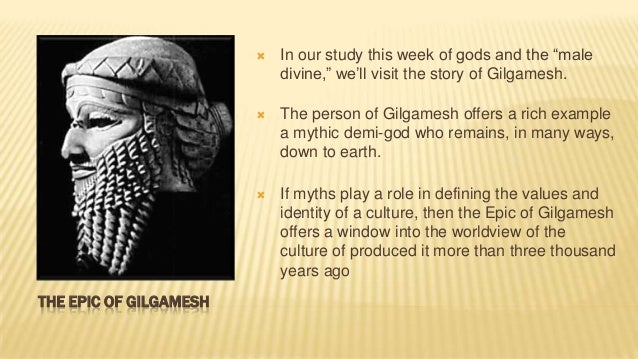
Known as the “Gilgamesh Dream Tablet,” the artifact is inscribed in the Akkadian language and details a dream sequence from the ancient epic, according to Agence France-Presse (AFP). It is around 3,500 years old and originated in modern-day Iraq.
Hobby Lobby's Illegal Antiquities Shed Light On A Lost, Looted Ancient City In Iraq
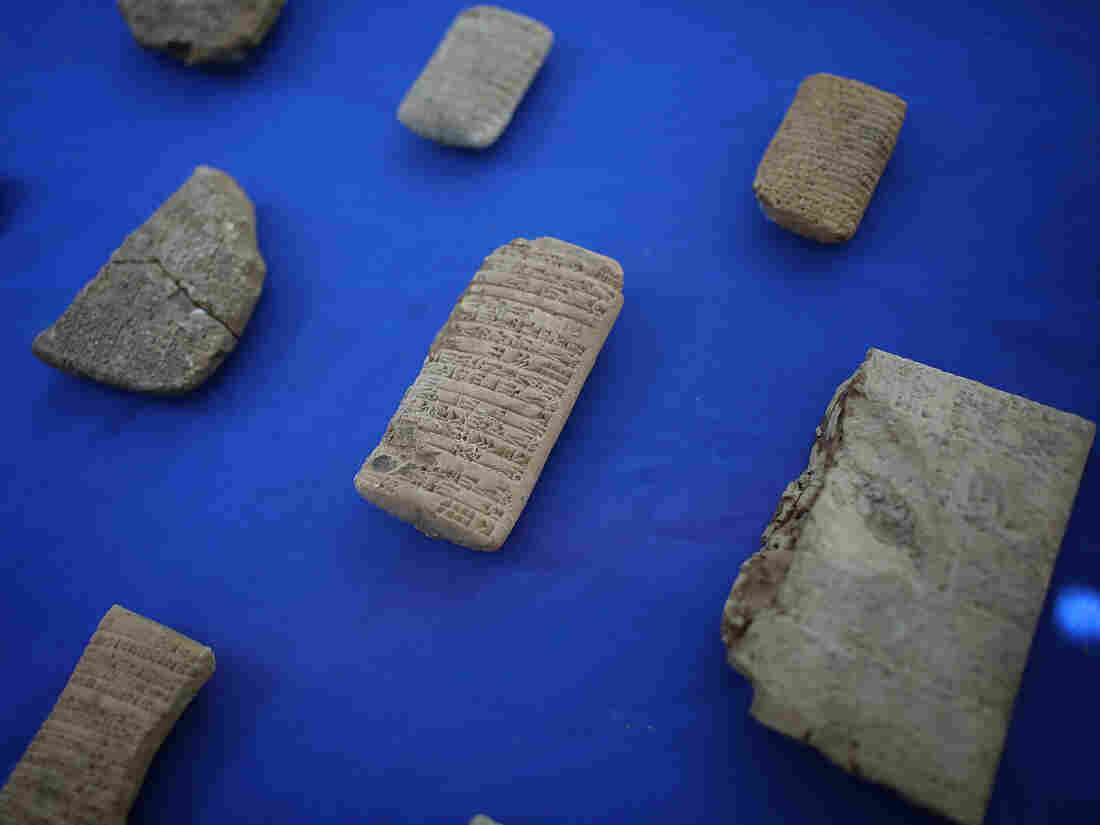
Ancient artifacts seized from Hobby Lobby are shown at a May 2 event returning the artifacts to Iraq in Washington, D.C. The seized artifacts include cuneiform tablets from the little-known ancient city of Irisagrig. Win McNamee/Getty Images
Archaeologist Eckart Frahm didn't have much time to determine where the 4,000-year-old clay tablets had come from. Homeland Security officials had given him just 2 1/2 days in a dimly lit New York warehouse to pore over the cuneiform inscriptions etched into the fragile, ancient pieces and report back.
"They were not in great shape. They had infestations of salt in them, so it's not that I could say I had been able to read everything," says the Yale University professor. "My main goal was to provide a general assessment from when and where did these tablets actually originate."
Frahm determined the tablets at the center of a federal case against the Oklahoma-based Hobby Lobby arts and crafts chain were from a place few had ever heard of — an ancient Sumerian city called Irisagrig.
"You could argue that this is a lost city because this place has never been properly excavated and you don't even know exactly where it is," Frahm tells NPR.
But looters know. The roughly 250 tablets Frahm examined in 2016 were among 5,500 objects, including ancient cylinder seals and clay seal impressions known as bullae, smuggled into the U.S. starting in 2010. Shipped from the United Arab Emirates and Israel without declaring their true Iraqi origin, some of them were marked "ceramic tiles" or "clay tiles (sample)."
They'd been purchased by Hobby Lobby for $1.6 million.
In a settlement last year with the Justice Department, Hobby Lobby agreed to forfeit the objects and paid a $3 million fine. In May, about 3,800 objects were handed back to the Iraqi government at a ceremony at its Washington, D.C., embassy, and will be returned to Iraq later this year.
Last November, Hobby Lobby president Steve Green, the son of the craft store chain's founder David Green, opened a Museum of the Bible in Washington, D.C., which contains another $201 million worth of ancient artifacts tied to Hobby Lobby. . .
Those tablets marked the first time archaeologists were known to have seen the name Irisagrig. According to one of the cuneiform tablets, it took four days to tow boats upstream from Umma, a better-known ancient Sumerian city, giving Molina a rough probable location of the lost city in the south of the country.
Umma itself is one of the most heavily looted of all known ancient sites in Iraq. Thieves dug hundreds of holes into the tells — the mounds under which the ancient city is buried — after security collapsed following the 2003 U.S. invasion.

The remains of thousands of other ancient towns and cities likely exist under other mounds, archaeologists believe.
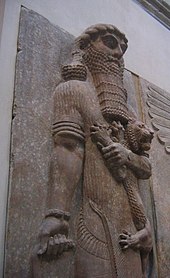 "Don't forget, even if we take only ancient Iraq, it's 3,000 years — so they didn't live in just one or two cities," says Lamia al-Gailani, a British-Iraqi archaeologist with the Iraq Museum in Baghdad and the University of London's School of Oriental and African Studies. . .
> Frahm says apart from the Irisagrig archive, the Hobby Lobby artifacts that are being returned to Iraq also include tablets dating from about 2500 BCE (an alternative to "B.C." commonly used by scholars to denote "before the common era") with incantations to the gods, Babylonian letters from between 1900 and 1700 BCE and hymns from several hundred years BCE.
Frahm describes the incantations as some of the most important pieces in the collection. The tablets, about 300 years older than the Irisagrig tablets, invoke three Mesopotamian gods. He says another text from the first millennium BCE is written in both Babylonian and Emesal, a dialect of Sumerian he says was originally a language used only by women.
TONIGHT 8-11PM: Live Music Angel Robles
ANGEL ROBLES is k nown for an eclectic set list that spans multiple genres, . . He utilizes loop pedals, acoustic guitars, and backing...

-
 Flash News: Ukraine Intercepts Russian Kh-59 Cruise Missile Using US VAMPIRE Air Defense System Mounted on Boat. Ukrainian forces have made ...
 -
A nor’easter is about to hit the Northeast in May. That’s very unusual.

