Monday, August 02, 2021
On Language: The word 'WOKE'
How has the meaning of the word “woke” evolved?
“WOKEISM, MULTICULTURALISM, all the -isms—they’re not who America is,” tweeted Mike Pompeo in 2019 on his last day as secretary of state. Until a few years ago “woke” meant being alert to racial injustice and discrimination. Yet in America’s fierce culture wars the word is now more likely to be used as a sardonic insult. How did the word turn from a watchword used by black activists to a bogeyman among conservatives?
In 1938 singer Huddie Ledbetter warned black people they “best stay woke, keep their eyes open” going through Scottsboro, Alabama, the scene of a famous mistrial involving nine young black men.
> The word was first defined in print by William Melvin Kelley, a black novelist, in an article published in the New York Times in 1962. Writing about black slang, Mr Kelley defined it as someone who was “well-informed, up-to-date”. Black people used it in reference to racism and other matters for decades, but the word only entered the mainstream much later.
> When the Black Lives Matter movement grabbed global attention during anti-racism protests after the killing in 2014 of Michael Brown, an unarmed black teenager, it was inseparable from the phrase “stay woke”.

As the word spread into internet culture, thanks in part to the popular #staywoke hashtag, its usage quickly changed.
It began to signify a progressive outlook on a host of issues as well as on race. And it was used more often to describe white people active on social media than it was by black activists, who criticised the performatively woke for being more concerned with internet point-scoring than systemic change.
> Piggybacking corporations, such as Pepsi and Starbucks, lessened the appeal to progressives. Woke’s usage went from activist to passé, a common fate of black vernacular that makes it into the mainstream (other recent victims include “lit” and “on fleek”, two terms of praise).
Almost as soon as the word lost its initial sense it found new meaning as an insult—a linguistic process called pejoration.
> Becoming a byword for smug liberal enlightenment left it open to mockery. It was redefined to mean following an intolerant and moralising ideology.
> The fear of being cancelled by the “woke mob” energised parts of the conservative base. Right-wing parties in other countries noticed that stoking a backlash against wokeness was an effective way to win support.
Another semantic conflict is brewing. . ."
READ MORE > The Economist | Jul 30th 2021
Sunday, August 01, 2021
Internal Combustion Engine No More: Here's A Cost-Benefit Analysis
Electric cars have much lower life cycle emissions, new study confirms
In the US, life cycle emissions for EVs are already 60-68% lower than gasoline.
"If you listen to electric vehicle naysayers, switching to EVs is pointless because even if the cars are vastly more efficient than ones that use internal combustion engines—and they are—that doesn't take into account the amount of carbon required to build and then scrap them. Well, rest easy because it's not true. Today in the US market, a medium-sized battery EV already has 60–68 percent lower lifetime carbon emissions than a comparable car with an internal combustion engine. And the gap is only going to increase as we use more renewable electricity.
That finding comes from a white paper (.pdf) published by Georg Bieker at the International Council on Clean Transportation. The comprehensive study compares the lifetime carbon emissions, both today and in 2030, of midsized vehicles in Europe, the US, China, and India, across a wide range of powertrain types, including gasoline, diesel, hybrid EVs (HEVs), plug-in hybrid EVs (PHEVs), battery EVs (BEVs), and fuel cell EVs (FCEVs). (The ICCT is the same organization that funded the research into VW Group's diesel emissions.)
The study takes into account the carbon emissions that result from the various fuels (fossil fuels, biofuels, electricity, hydrogen, and e-fuels), as well as the emissions that result from manufacturing and then recycling or disposing of vehicles and their various components. Bieker has also factored in real-world fuel or energy consumption—something that is especially important when it comes to PHEVs, according to the report. Finally, the study accounts for the fact that energy production should become less carbon-intensive over time, based on stated government objectives. . .
Assuming the four regions stick to officially announced decarbonization programs, 2030 will see the gap widen in favor of BEVs. The study even accounts for more efficient engine technologies and fuel production. In Europe, the gap is predicted to be 74–77 percent; in the US, 62–76 percent; in China, 48–64 percent; and in India, 30–56 percent. Bieker writes that the wide spread is due to "a large uncertainty... in how the future electricity mix develops in each region."
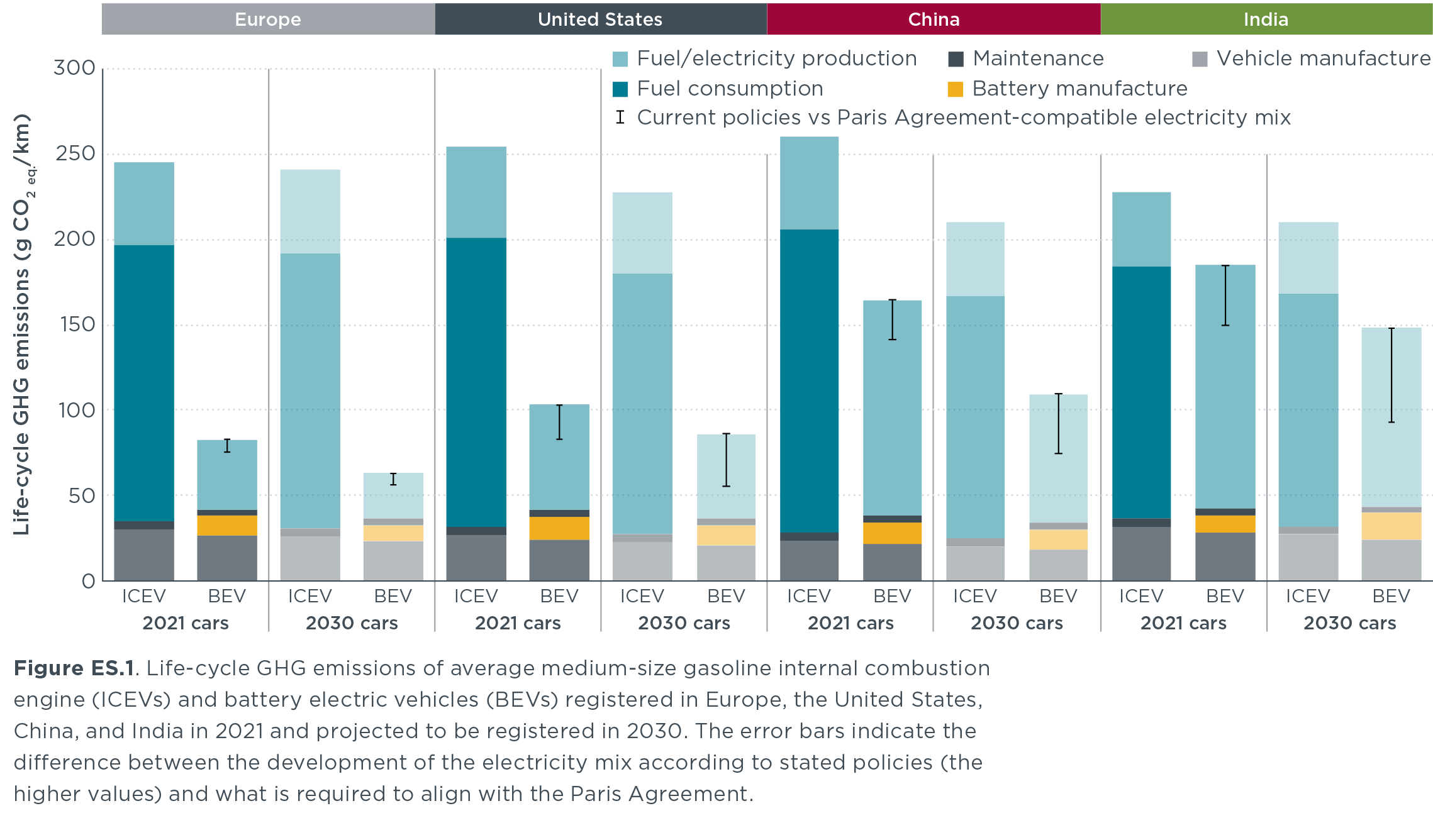
There's some good news for hydrogen hounds in the paper, too. Currently, FCEVs are only abut 26–40 percent less carbon-intensive than a comparable gasoline vehicle. But if hydrogen was produced using renewable energy rather than steam reformation of natural gas, that number would jump to 76–80 percent—even better than a BEV's numbers.
But Bieker's analysis says that there is no future for internal combustion engine vehicles if we are to actually decarbonize. . .Even the introduction of biofuels will not help the internal combustion engine stay relevant. Bieker writes that "the registration of new combustion engine vehicles should be phased out in the 2030–2035 time frame" if we want to meet the targets of the Paris Agreement.
READ more > https://arstechnica.com/cars/2021/07/electric-cars-have-much-lower-life-cycle-emissions-new-study-confirms/
__________________________________________________________________________
Jonathan M. Gitlin Jonathan is the automotive editor at Ars Technica, covering all things car-related. Jonathan lives and works in Washington, D.C.
THE MANLIEST MEN: This Modern World | Monday, August 24, 2026 at 5:30 AM MST
Cartoon The manliest men by Tom Tomorrow follow Follow "Tom Tomorrow" to receive notifications about new pages on "Tom Tomo...

-
 Flash News: Ukraine Intercepts Russian Kh-59 Cruise Missile Using US VAMPIRE Air Defense System Mounted on Boat. Ukrainian forces have made ...
 -
A nor’easter is about to hit the Northeast in May. That’s very unusual.

