Thursday, August 05, 2021
On Language: JAWBONING

Techdirt Podcast Episode 292: The Problem Of 'Jawboning'
Thank you for reading this Techdirt post. With so many things competing for everyone’s attention these days, we really appreciate you giving us your time. We work hard every day to put quality content out there for our community.
Techdirt is one of the few remaining truly independent media outlets. We do not have a giant corporation behind us, and we rely heavily on our community to support us, in an age when advertisers are increasingly uninterested in sponsoring small, independent sites — especially a site like ours that is unwilling to pull punches in its reporting and analysis.
While other websites have resorted to paywalls, registration requirements, and increasingly annoying/intrusive advertising, we have always kept Techdirt open and available to anyone . . .

‘Jawboning’ Definition: Threat or Rational Talk
The word “jawboning,” as used by most Government officials and businessmen these days, refers to public exhortations and/or implied threats by the Administra tion as a means of convinc ing business or labor to adopt certain attitudes and policies.
This definition, however, seems to be a far cry from the original use of the slang expression. In the Dictionary of American Slang, edited by Harold Wentworth and Stuart Berg Flexner, the first definition given for the in transitive verb “jawbone” is: “To carry on sincere, rational talk that leads to establish ing financial credit or trust.”
Perhaps the modern usage of the term is derived from the slang word “jaw.” Went worth and Flexner define the verb as “to talk” and “to lecture a person; to give a long reprimand.”
---- May 27, 1970 This is a digitized version of an article from The Times’s print archive, before the start of online publication in 1996. To preserve these articles as they originally appeared, The Times does not alter, edit or update them

Description
"Jawboning", or "moral suasion," in economics and politics is an unofficial technique of public and private discussions and arm-twisting, which may work by the implicit threat of future government regulation. Wikipediafrom the the-formalities-of-informal-coercion dept

"Most people are pretty clear on the fact that the First Amendment prevents the government from making rules about speech — but what about when government officials make informal demands or threaten retaliation related to speech? Such actions have been ruled to violate the First Amendment, but this practice — dubbed "jawboning" by this week's guest — raises messy legal edge-cases and grey areas. We're joined by University of Chicago Law Professor Genevieve Lakier, who recently authored an article for Lawfare on the subject, to discuss the legal history and status of jawboning and the problem of informal government coercion.
Follow the Techdirt Podcast on Soundcloud, subscribe via Apple Podcasts, or grab the RSS feed. You can also keep up with all the latest episodes right here on Techdirt.

Thank you for reading this Techdirt post. With so many things competing for everyone’s attention these days, we really appreciate you giving us your time. We work hard every day to put quality content out there for our community.
Thank you for reading this Techdirt post. With so many things competing for everyone’s attention these days, we really appreciate you giving us your time. We work hard every day to put quality content out there for our community.
Techdirt is one of the few remaining truly independent media outlets. We do not have a giant corporation behind us, and we rely heavily on our community to support us, in an age when advertisers are increasingly uninterested in sponsoring small, independent sites — especially a site like ours that is unwilling to pull punches in its reporting and analysis.
While other websites have resorted to paywalls, registration requirements, and increasingly annoying/intrusive advertising, we have always kept Techdirt open and available to anyone. But in order to continue doing so, we need your support. We offer a variety of ways for our readers to support us, from direct donations to special subscriptions and cool merchandise — and every little bit helps. Thank you.
–The Techdirt Team
Filed Under: first amendment, free speech, jawboning, podcast
Wednesday, August 04, 2021
What's In A Name Anyway ROBINHOOD: Market Cap Boost
Robinhood Billionaire Cofounders’ Fortunes Nearly Double In Two Days Amid Stock’s Wild Rally

Shares of popular stock trading app Robinhood skyrocketed on Wednesday, extending a two-day rally that has doubled the company’s market capitalization and made its billionaire cofounders even richer.
Robinhood shares jumped 50% during trading on Wednesday, after surging 24% on Tuesday. That pushed up the net worths of the company’s two cofounders, Vlad Tenev, 34, and Baiju Bhatt, 36,by $1.4 billion and $1.6 billion, respectively.
Based on Wednesday’s closing price of $70.39, Tenev is now worth $4.3 billion, while Bhatt is worth $4.9 billion, according to Forbes’ calculations. (Tenev and Bhatt began the day worth an estimated $2.9 billion and $3.3 billion, respectively.)
The pair took the company public on the Nasdaq
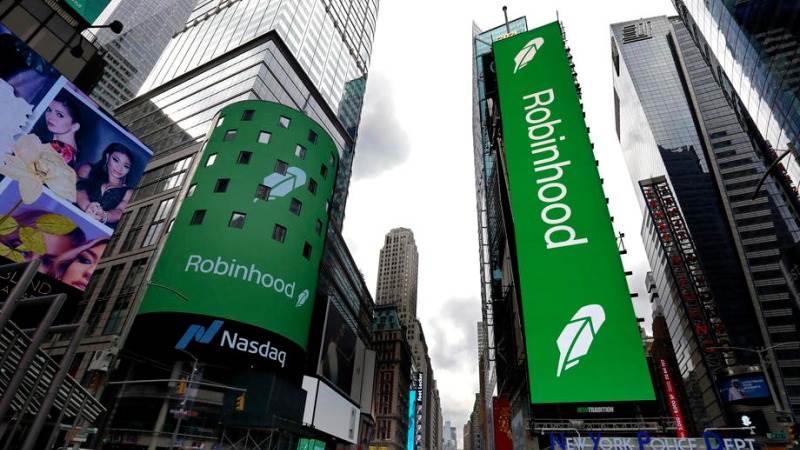
Robinhood shareholders can thank a vote of confidence from one of Wall Street's most popular tech investors, followed by bullish sentiment from Reddit traders.
Cathie Wood’s endorsement—along with other high-profile Wall Street figures such as CNBC host Jim Cramer, who recently gave Robinhood his stamp of approval—has led to large amounts of retail investors buying up the stock. Trading of options on Robinhood stock also began on Wednesday, fueling further volatility in the stock price.
_____________________________________________________________________________________

Say Aloha! Here's "Spot", Thanks to Spending COVID-19 Relief Funds (Coming soon to a park near you)
Here's the new robot - the Robo-Cop AI watchdog already used in other places around the world. . .The expensive machine arrived with little public notice or explanation, public officials said, and was deployed to already over-policed public housing. . .
Caitlin Johnstone: How long before we humans are being policed by robots?
- "On-the-ground robot policing is becoming normalized today under the justification of Covid-19 precautions in the same way police around the world have normalized the use of drones to police coronavirus restrictions, at the same time police departments are rolling out dystopian systems for predicting future criminality using computer programs and databases.
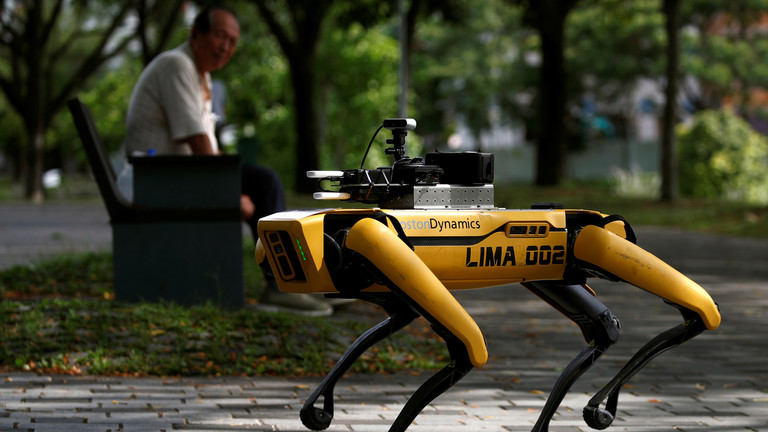
Hawaii police are defending their use of pandemic relief funds for a robotic “police dog” made by Boston Dynamics which scans homeless people’s eyes to see if they have a fever.
“If you’re homeless and looking for temporary shelter in Hawaii’s capital, expect a visit from a robotic police dog that will scan your eye to make sure you don’t have a fever,” a new report from AP says. “That’s just one of the ways public safety agencies are starting to use Spot, the best-known of a new commercial category of robots that trot around with animal-like agility.”
“Acting Lt. Joseph O’Neal of the Honolulu Police Department’s community outreach unit defended the robot’s use in a media demonstration earlier this year,” AP reports. “He said it has protected officers, shelter staff and residents by scanning body temperatures between meal times at a shelter where homeless people could quarantine and get tested for COVID-19. The robot is also used to remotely interview individuals who have tested positive.”
This has understandably elicited criticism from civil rights advocates.
“Because these people are houseless it’s considered OK to do that,” Hawaii ACLU legal director Jongwook Kim told AP. “At some point it will come out again for some different use after the pandemic is over.”
. . .
“‘Spot’ is made by Boston Dynamics, which sells the device for US$74,500. Winnipeg police are spending $257,000 to acquire and use Spot. The 32-kilogram robot ‘has the ability to navigate obstacles, uneven terrain (and) situations where our traditional robot platforms can’t go into,’ said Insp. Brian Miln at a news conference Wednesday.”
Months earlier, the New York Police Department cancelled its lease of the same type of robot they obtained last year following public outcry. More from AP:
“The expensive machine arrived with little public notice or explanation, public officials said, and was deployed to already over-policed public housing. Use of the high-tech canine also clashed with Black Lives Matter calls to defund police operations and reinvest in other priorities.”
The company that makes the robots, Boston Dynamics, says it’s learned from the New York fiasco and is trying to do a better job of explaining to the public – and its customers – what Spot can and cannot do. That’s become increasingly important as Boston Dynamics becomes part of South Korean carmaker Hyundai Motor Company, which in June closed an $880 million deal for a controlling stake in the robotics firm.
To be absolutely clear, there is not actually any legitimate reason for any normal person to refer to these machines as a ‘robotic dog’, or a ‘high-tech canine’, or by a cutesy cliché name for a pet. These are robots. Robots that are being used by police forces on civilian populations. If the robots being used had two legs, or eight, they would not be able to apply such cuddly-wuddly labels, and public alarm bells would be going off a lot louder.
THE MANLIEST MEN: This Modern World | Monday, August 24, 2026 at 5:30 AM MST
Cartoon The manliest men by Tom Tomorrow follow Follow "Tom Tomorrow" to receive notifications about new pages on "Tom Tomo...

-
 Flash News: Ukraine Intercepts Russian Kh-59 Cruise Missile Using US VAMPIRE Air Defense System Mounted on Boat. Ukrainian forces have made ...
 -
A nor’easter is about to hit the Northeast in May. That’s very unusual.

