Sunday, August 08, 2021
SUNDAY INSIGHT: This Perspective on American Extremism will Take Some Time-To-Process

Dimensions of national culture - Hofstede Insights
The Pros and Cons of America’s (Extreme) Individualism (Ep. 470)


According to a decades-long research project, the U.S. is not only the most individualistic country on earth; we’re also high on indulgence, short-term thinking, and masculinity (but low on “uncertainty avoidance,” if that makes you feel better). We look at how these traits affect our daily lives and why we couldn’t change them even if we wanted to.
The 6-D model of national culture
Geert Hofstede, assisted by others, came up with six basic issues that society needs to come to term with in order to organize itself. These are called dimensions of culture. Each of them has been expressed on a scale that runs roughly from 0 to 100.
The dimensions explained

For each dimension here is a brief description and a ten-minute video in which Geert Hofstede explains that dimension.
Hofstede's Globe
Dimension maps of the world: Individualism
Each dimension has been derived by comparing many, but not all, countries in the world. The findings can be summarized into six world maps of the distribution of that dimension. Of course, in reality there can be quite a bit of within-country variation; these maps should be seen as rough 'climate maps' of culture.
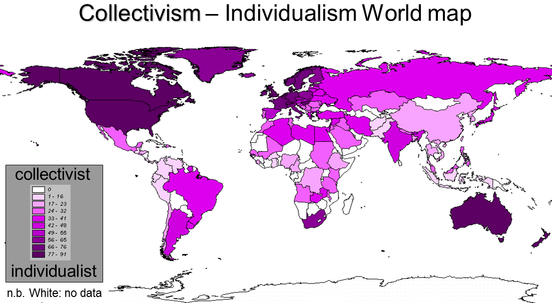
Individualism
_____________________________________________________________________
Dimension maps: Power Distance
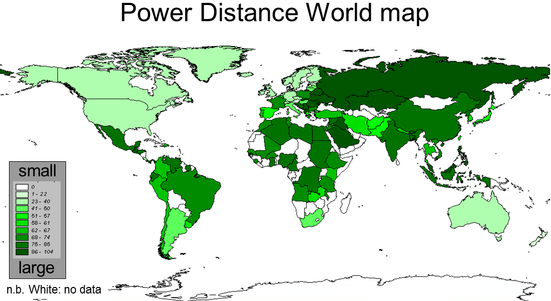
Power Distance
_________________________________________________________________________
Dimension maps: Femininity / Masculinity
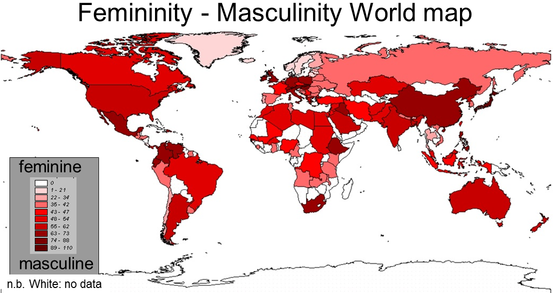
_____________________________________________________________________
Dimension maps: Uncertainty Avoidance
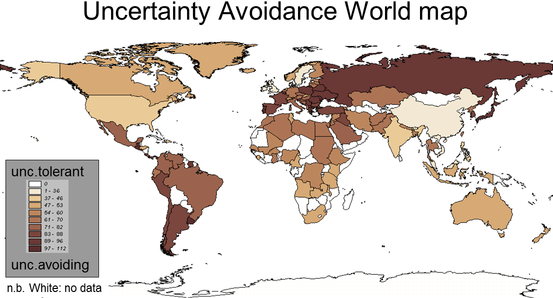
Dimension maps: Long-term Orientation
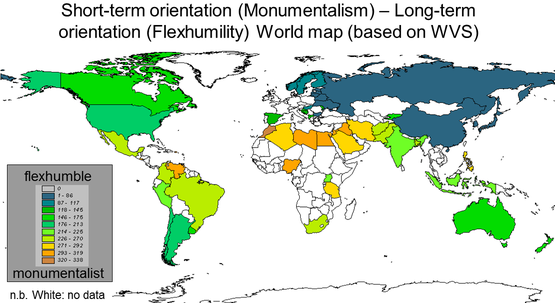
Long-term orientation
_________________________________________________________________________
Dimension maps: Indulgence
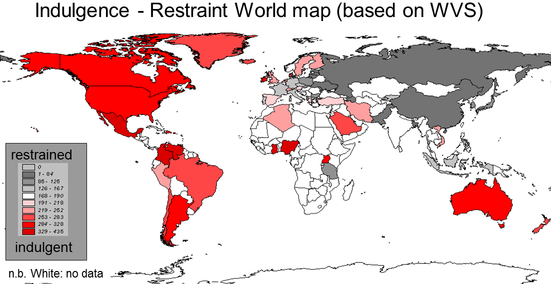
Indulgence
________________________________________________________________________
IN SPANISH
"Soy bastante optimista con el futuro de Europa, los jóvenes ven lo que está sucediendo"
Gert Jan Hofstede vive preocupado por la caída del sentimiento de comunidad. Un problema que este profesor de la Universidad de Wageningen, multidisciplinar e impulsor del concepto de la "socialidad artificial", recomienda abordar dando más importancia a los espacios comunes.
A pesar de la creciente ansiedad y populismo, el hijo del psicólogo social holandés Geert Hofstede mantiene un moderado optimismo, por el paso adelante que están dando los jóvenes para tratar los problemas de todos.
¿En qué tonos pinta el cuadro para la próxima década?
Creo que las cosas empeorarán un poco, antes de que puedan mejorar. Vemos algunas buenas intenciones, pero no las llevamos a cabo. A veces nos estancamos, porque no existe un sentimiento de urgencia para actuar. Pero cuando suceda, la gente reaccionará. Lo único que realmente podría detenernos es si los países se preocupan demasiado por sí mismos.
"Lo que los líderes deben hacer acercarse a los ciudadanos y crear una conexión. Antes los políticos hablaban al corazón y alma de la gente"
THE DIMENSIONS EXPLAINED IN A SERIES OF 10-MINUTE VIDEOS
_____________________________________________________________________________
IN HINDSIGHT LAST WEEK: More Biggs Buffoonery / Desperately Fighting For The Freedom Caucus


_0.png "BiggsBanner_red_(1)_0.png")
| ||||
|


STICK-A-LABEL-ON-IT: "Instagram Creatives" Using Built-In Analytic Tools To Assess Impact and Sales
Why Instagram’s creatives are angry about its move to video
The social media platform was once a favourite of artists and photographers, but a shift towards TikTok-type videos and shopping could leave them looking for a new home online
This confirmed Binding’s hunch that although most people believe that Instagram is a place to share photos and Twitter is a place to share words, that may no longer be the case. When it launched in 2010, Instagram courted the artistic community, inviting respected designers to be among its initial users and naming its very first filter X-Pro II, after an analogue photo-developing technique. In her 2020 book No Filter: The Inside Story of Instagram, technology reporter Sarah Frier documents how Instagram co-founder Kevin Systrom wanted Instagram to be an outlet for artists (in a high-school essay, Systrom wrote that he liked how photography could “inspire others to look at the world in a new way”).
Photograph: Matt Winkelmeyer/Getty Images for Wired
But Facebook bought Instagram in 2012. Systrom departed as CEO in 2018. And three weeks before Binding uploaded his lavender pics, the new head of Instagram, Adam Mosseri, posted a video to his personal social media accounts. “I want to start by saying we’re no longer a photo-sharing app.”
Click on Instagram today and you will still see plenty of photos, but you’ll also be confronted with a carousel of short, vertical videos (known as “Reels”) as well as the more-than-occasional ad. In his video, Mosseri explained that “the number one reason people say that they use Instagram in research is to be entertained” and the app was going to “lean into that trend” by experimenting with video. Citing TikTok and YouTube as competition, Mosseri said Instagram would “embrace video” and users could expect a number of changes in the coming months.
The move has the artistic community seeing Pantone 032. Though there’s no way of knowing how many artists, architects and photographers have left the app, many are at least threatening to. . .
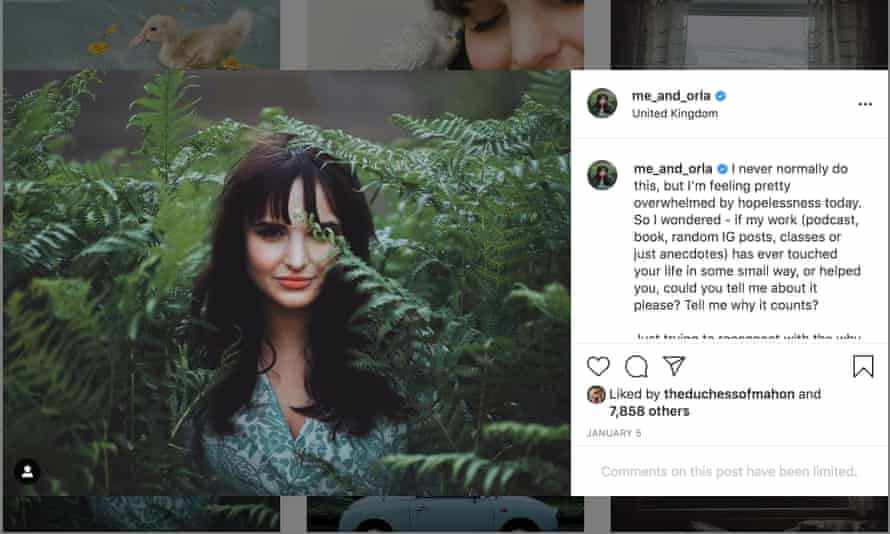
Sara Tasker, an Instagram and creative business coach and author of Hashtag Authentic: Finding Creativity and Building a Community on Instagram and Beyond, says her inbox was “immediately flooded” with creatives “terrified that this meant they would be left behind”. The 37-year-old says video is time-consuming, has a steeper learning curve and can be a challenge for those who are self-conscious in front of the camera.
“The idea that they have to dance for their audience – literally – just to make sales or have their art seen is a kick in the teeth to those who have been sharing and connecting on these platforms for years,” says Tasker, who has more than 220,000 followers on her @me_and_orla account.
ANGEL ROBLES LIVE MUSIC TONIGHT: 8-11PM in Fountain Hills
ANGEL ROBLES is k nown for an eclectic set list that spans multiple genres, . . He utilizes loop pedals, acoustic guitars, and backin...

-
 Flash News: Ukraine Intercepts Russian Kh-59 Cruise Missile Using US VAMPIRE Air Defense System Mounted on Boat. Ukrainian forces have made ...
 -
A nor’easter is about to hit the Northeast in May. That’s very unusual.

