Thursday, September 16, 2021
Larry Elder said He Worked Hard To Be "The Black Face for White Supremacy"

A Guide to Larry Elder, the Right-Wing Extremist Who Could Be the Next Governor of California
After a circus of a summer spent hearing appeals from a motley crew of gubernatorial candidates, Californians will decide on Tuesday whether to recall Gavin Newsom. If they do, the man who replaces him will probably be Larry Elder, a libertarian radio host who rose to the top of a crowded field of small-time Republicans, including a guy who has been touring the state with a live Kodiak bear (we weren’t kidding about the circus).
The problem with the 69-year-old Elder is that he’s no better equipped to run a state of 40 million than the man-bear duo, and more dangerous to California’s future than either of them. Current polling indicates Newsom will prevail, but to have someone as inexperienced, regressive, and bigoted as Elder come this close to assuming control the nation’s most populous state is a terrifying prospect for the people of California — and for the rest of the nation.
How close is this close? Californians will be asked two questions on Tuesday: Should Newsom be recalled and, if so, who should replace him?
Current polling indicated Newsom will prevail, but to have someone as inexperienced, regressive, and bigoted as Elder come this close to assuming control the nation’s most populous state is a terrifying prospect for the people of California — and for the rest of the nation.
________Related Stories
Elder’s rap sheet, which we’ve broken down for you below:
He’s said he wouldn’t have voted for the Civil Rights Act
The self-proclaimed “Sage of South Central,” Elder made a career as a Black man espousing conservatives views in a liberal state. He’s railed against Black Lives Matter. He’s claimed repeatedly that racism doesn’t exists, or at least that it’s not a problem in America. He’s said the idea of voter suppression is a Democratic con job. He’s argued Barack Obama had less to overcome in running for president than did white candidates like Mitt Romney and John McCain, and that police are more inclined to shoot white Americans than Black Americans.
He’s also said that if he were in the Senate in the 1960s, he would have voted against the Civil Rights Act, the landmark anti-discrimination bill passed in 1964. “To the extent that those laws mandate any kind of interference in the private sector, I would have voted against it,” Elder said at a Libertarian convention in 1998.
📣 Leading recall candidate Larry Elder said he would have voted AGAINST the Civil Rights Act of 1964. pic.twitter.com/Ac0d0dOGBj
— Resist Programming 🛰 (@RzstProgramming) September 11, 2021
Elder’s speech didn’t end there. He transitioned from bashing the Civil Rights Act into bashing the Americans With Disabilities Act, saying he was “upset” that it exists. In August, Media Matters pointed out several other instances in which Elder has criticizes the law that prevents employers from discriminating against qualified individuals with disabilities. Elder has called the ADA “hideous,” said it creates “dependency” that impinges upon “our freedoms,” and says he felt “double-crossed” when George H.W. Bush signed it.
His record on women’s rights … isn’t great
In a 1996 ad promoting his radio show, Elder says this about women: “Glass ceiling? Ha! What glass ceiling? Women, women exaggerate the problem of sexism.” Not great, which is why a hand proceeds to slap him across the face in the ad, which was uncovered by CNN. He then says that Black people “exaggerate the significance of racism” and that “Medicare should be abolished,” with each line eliciting a new slap. “What’d I say?” he says at the end of the ad, a grin on his face.
Elder wasn’t joking about his lack of respect for women. He argued in a 2000 piece for Capitalism Magazine that “women know less than men about political issues, economics, and current events,” citing the results of a questionnaire. Elder went on to argue that the Democratic Party was hindered by its fidelity to “SHE issues” like Social Security, health care, and education, and that those pushing these issues — namely women, with Elder citing how Bill Clinton lost the male vote in 1992 and 1996 — were “ill-informed.”
Media Matters also pointed out that in his 2002 book, Elder railed against the Equal Employment Opportunity Commission and the Family and Medical Leave Act, positing that employers should be able to discriminate against women based on pregnancy.
KEY ISSUES
Here’s a brief rundown on where he stands:
- Covid-19: It’s not shocking that, as a libertarian, Elder would be opposed to vaccine and mask mandates. As governor, he would abolish them before he has his “first cup of tea,” he’s said. He’s also pushed his share of vaccine misinformation, claiming that the science isn’t “settled” on whether young people should get the vaccine or wear masks in school. (The CDC, FDA, and American Academy of Pediatrics have all recommended the vaccine for young people.)
- The climate crisis: Elder has said he’s “not sure” climate change is to blame for the wildfires torching California at a historic rate. For him, this counts as progress. In 2008, he called climate change a “crock.”
- Minimum wage: Not only does Elder opposed an increase to the minimum wage, he opposes the very idea of a minimum wage. “The ideal minimum wage is $0.00,” he told the McClatchy editorial board.
- Gun control: No way. He’s a libertarian, remember?
- Abortion: Again, he’s a libertarian, so he support a woman’s right to choo— Wait, what’s that? OK, sorry. Elder very much opposes a woman’s right to choose. He’s also said that sex education “has no role in school.”
- Health care: Elder has for years opposed anything resembling medical welfare. “Grandfather everyone currently on Medicaid, and then admit no more people and end the program at the federal level,” he wrote in 2010. “Charity is not allowed by the Constitution, and it should be left to the states — even better, left to the private and nonprofit sectors.”
- Immigration: Elder has advocated denying education and emergency care to undocumented immigrants
$5 BILLION...HUD OPENS ACCESS TO $5 BILLION IN AMERICAN RESCUE PLAN GRANTS TO PREVENT AND END HOMELESSNESS
U.S. Department of Housing and Urban Development – Marcia L. Fudge, Secretary
Office of Public Affairs, Washington, DC 20410
HUD No. 21-143
HUD Public Affairs
202-708-0685
HUD OPENS ACCESS TO $5 BILLION IN AMERICAN RESCUE PLAN GRANTS TO PREVENT AND END HOMELESSNESS
WASHINGTON – The U.S. Department of Housing and Urban Development today issued the HOME-ARP Implementing CPD Notice, Requirements for the Use of Funds in the HOME-American Rescue Plan Program (“the Notice”). The new HOME-ARP notice is a critical step taken by HUD to expeditiously allow communities to begin accessing funds from the nearly $5 billion funds allocated from
“With rates of COVID-19 transmission still high, there is no time to wait to assist the more than half a million Americans on any given night who are enduring this pandemic in crowded shelters or on the streets,” said Secretary Marcia L. Fudge. “Today’s release of guidance opens up access to the critically needed American Rescue Plan funds that will help communities provide the safety and security of a stable home to more Americans.”
In April, HUD announced the American Rescue Plan funding allocations and broad contours of how the funds can be used. Today, this notice sets forth specific program requirements that participating jurisdictions or grantees must meet to begin planning for their use of their HOME-ARP funds in earnest. Under the regular HOME program, grantees must wait until their allocation plans are completed and approved by HUD in order to access funds. Given HOME-ARP’s focus on addressing the urgent needs of people experiencing and at-risk of homelessness, HUD is providing grantees with
The $4.925 billion in HOME-ARP funding will play a critical role in developing housing to address homelessness and homelessness risk among extremely low-income households. The funding also gives risk of experiencing homelessness, including through the development of affordable housing and permanent supportive housing, the provision of tenant-based rental assistance, the delivery of supportive services, and acquisition and development of non-congregate shelter units.
###
HUD's mission is to create strong, sustainable, inclusive communities and quality affordable homes for all.
More information about HUD and its programs is available on the Internet
at www.hud.gov and http://
You can also connect with HUD on social media and follow Secretary Fudge on Twitter and Facebook or sign up for news alerts on HUD's Email List
SAY WHAT? AZCC 2nd REVISED 09-21-2021 Water Preparedness Workshop > SPECIAL OPEN MEETIG NOTICE OF THE ARIZONA CORPORATION COMMISSION
 __________________________________________________________________________
RELATED CONTENT ON THIS BLOG
25 May 2019
Troubled Waters Here In The East Valley: Who Ya Gonna Call?

It's not just about Johnson Utilities in Queen Creek and the newly-incorporated city of San Tan Valley. There are many more dots to connect that have been slow-dripping in the spigot of what gets published.
What does put this topic at the top-of-the-list are serious. So far few reporters have feared to go there - diving deep into the culture here of politics and corruption that permeate nearly every level of government in the East Valley landscape in most municipalities: where finance, and real estate interests are entangled with corruption at the highest levels. . .

 An Info-Graphic: Half-Full or Half-Empty?
 Denials aside, and meeting last-minute deadlines not met by the Arizona State House, let's step back from the political-wranglings in Phoenix of the most precious commodity here in the desert: Water.
There's a new report published today from the Yale School of Forestry & Environmental Studies:Part IV of Crisis On The Colorado: ". . . The fate of the Hohokam holds lessons these days for Arizona, as the most severe drought since their time has gripped the region. But while the Hohokam succumbed to the mega-drought, the city of Phoenix and its neighbors are desperately scrambling to avoid a similar fate — no easy task in a desert that gets less than 8 inches of rain a year. . . "
The reports cites a two-decade drought earlier in the history of the Salt River Valley:
"The Hohokam were an ancient people who lived in the arid Southwest, their empire now mostly buried beneath the sprawl of some 4.5 million people who inhabit modern-day Phoenix, Arizona and its suburbs. Hohokam civilization was characterized by farm fields irrigated by the Salt and Gila rivers with a sophisticated system of carefully calibrated canals, the only prehistoric culture in North America with so advanced a farming system.
Then in 1276, tree ring data shows, a withering drought descended on the Southwest, lasting more than two decades. It is believed to be a primary cause of the collapse of Hohokam society. . . "
Supplying enough water to sustain the Suburban Sprawl of a Metro Region this size in the desert has long been controversial
2nd REVISEDN O T I C E
SPECIAL OPEN MEETIG NOTICE OF THE ARIZONA CORPORATION COMMISSION
Water Preparedness 2021
Docket No. W-99999A-21-0265
Stakeholder Meeting and Workshop
Tuesday, September 21, 202110:009:00 A.M.
Hearing Room One
1200 W. Washington St.
Phoenix, AZ 85007
This shall serve as notice of an open meeting at the above location for consideration and discussion of the items on the agenda and other matters related thereto. Commissioners may attend the proceedings in person, or by telephone, video, or internet conferencing,and may use this open meeting to ask questions about the matters on the agenda. The parties to the matters to be discussed or their legal representatives are requested, though not required, to attend telephonically. The Commissioners may move to executive session, which will not be open to the public, for the purpose of legal advice pursuant to A.R.S. § 38-431.03 (A) (3) on the matters noticed herein.
Because of the Covid-19 pandemic, only essential Commission staff will attend in person. The public is strongly discouraged from attending in person. The public will be able to participate by either watching and listening to the meeting online or listening to the meeting via telephone. Participants will be invited to and may attend by video or internet conferencing. For those wishing to enter an appearance or provide public comment, please use the dial in phone numbers. Once the item for which you are appearing or providing public comment is concluded, please hang up and watch the live stream.
Persons with a disability may request reasonable accommodations by contacting the Commission Secretary listed above at least 48 hours prior to the scheduled commencement of the Open Meeting.
Agendas are also available online at: azcc.gov/agendas
Dial-in Phone Number:1-866-705-2554 Passcode to Speak: 241497
This meeting will be available online at: http://www.azcc.gov/live
AGENDA
- Opening Remarks - Commissioners (ITEM ADDED)
- Introductions - Staff (ITEM ADDED)
- Arizona Department of Water Resources (“ADWR”)
- Central Arizona Project (“CAP”) and Central Arizona Water Conservation District (“CAWCD”)
- EPCOR/Rio Verde Utilities
- Arizona Water Company
- Global Water-Santa Cruz Water Company (ITEM ADDED)
- Liberty Utilities ((Litchfield Park Water and Sewer, Bella Vista Water, and Rio Rico Water and Sewer)
- Robson Communities (Lago Del Oro Water Company, Pima Utility Company, Quail Creek Water Company, and Picacho Water Company)
- Far West Water & Sewer, Inc.
- Sahuarita Water Company L.L.C.
- Community Water Company of Green Valley
- Bermuda Water Company, Inc.
- Doney Park Water
- Vail Water Company
- Valley Utilities Water Company, Inc.
- Sunrise Water Company
- Avra Water Cooperative, Inc.
- Pueblo Del Sol Water Company
- Big Park Water Company
- Camp Verde Water System, Inc.
- Valley Pioneer's Water Company, Inc.
- Rose Valley Water Company
- Farmers Water Company
- Goodman Water Company
- Morenci Water and Electric Company
- Ray Water Company, Inc.
- Utility Source, LLC
- Graham County Utilities, Inc.
- Closing Remarks - Commissioners and Staff (ITEM ADDED)
NOTE: NO VOTES ON ANY SUBSTANTIVE MATTER WILL BE TAKEN DURING THIS MEETING.
COURTESY POST; 2 Efforts to Do What? "Make Mesa a more vibrant, prosperous, and thriving city for generations to come."
 Looks like a second-try from an earlier fizzled-out public relations campaign that got no traction or any interest at all.
The City of Mesa is seeking your input in two planning efforts to create Mesa’s Footprint for the Future. Both efforts seek to develop a collective vision on how to make Mesa a more vibrant, prosperous, and thriving city for generations to come. The aligned effort will ensure efficiency and effectiveness in the process for research, community engagement, and staff resources.
We invite you to visit one of the upcoming community workshops to provide your feedback on the needs and priorities for developing Mesa’s Footprint for the Future. The workshops are from 6:00-7:30pm, see the dates and locations below:
Wednesday, September 15: Mesa Aquatics, Parks & Sports Field Maintenance (6945 E. Decatur St.)
Thursday, September 16: Hale Elementary School Multipurpose Room (1425 N. 23rd St.)
Tuesday, September 21: Eastmark Community Center “The Mark” (10100 E. Ray Rd.)
Wednesday, September 22: Eagles Community Center (828 E. Broadway Rd.)
Thursday, September 23: Dobson Ranch Library (2425 S. Dobson Rd.)
All workshops have an "open house" style. Drop in and leave at your convenience. Mesa is your home, share your voice and help shape its future!
Visit our interactive website for more information as well as surveys, forums, recorded virtual meetings, and other engagement elements to share your ideas and vision for Mesa’s future.
PUBLIC HEALTH HERE IN THE CITY OF MESA: Toxic Contaminated Air Pollution (a By-Product of Car-Driven Culture in Endless Suburban Sprawl)


This High Pollution Advisory is due to ozone levels expected to accumulate enough to exceed the federal health standard for ozone
========================================================================
4 years ago 2017
Danger Zone > Maricopa County Another High Pollution Alert

Opportunity to Provide Feedback | Air Pollution Control Rules | Five Year Rule Review
 |
Five Year Rule ReviewFeedback WelcomeThe Arizona Department of Environmental Quality (ADEQ) is required to review its rules at least once every five years and prepare and obtain the Governor’s Regulatory Review Council’s (GRRC's) approval of a written report.1 As part of this process, ADEQ would like your feedback on the Air Pollution Control rules in the Arizona Administrative Code (AAC), specifically Title 18, Chapter 2, Article 13 (State Implementation Plan Rules for Specific Locations). These rules were developed to comply with the federal Clean Air Act, including, but not limited to, Titles I and V of the Clean Air Act. Your comments will be included in ADEQ’s Five Year Rule Review Report to GRRC. Please submit comments no later than 5 p.m. on Oct. 16, 2021, to dorn.zachary@azdeq.gov, or by mail to: Zachary Dorn, Air Quality Division Click Here to Review AAC Title 18, Chapter 2, Article 13 >What are Five Year Rule Reviews? | Click here to learn more > Thank you for your time and participation. 1Pursuant to Arizona Revised Statutes § 41-1056 About ADEQUnder the Environmental Quality Act of 1986, the Arizona State Legislature established the Arizona Department of Environmental Quality in 1987 as the state agency for protecting and enhancing public health and the environment of Arizona. For more information, visit azdeq.gov. ADEQ will take reasonable measures to provide access to department services to individuals with limited ability to speak, write or understand English and/or to those with disabilities. Requests for language translation, ASL interpretation, CART captioning services or disability accommodations must be made at least 48 hours in advance by contacting the Title VI Nondiscrimination Coordinator, Leonard Drago, at 602-771-2288 or Drago.Leonard@azdeq.gov. For a TTY or other device, Telecommunications Relay Services are available by calling 711. ADEQ tomará las medidas razonables para proveer acceso a los servicios del departamento a personas con capacidad limitada para hablar, escribir o entender inglés y/o para personas con discapacidades. Las solicitudes de servicios de traducción de idiomas, interpretación ASL (lengua de signos americano), subtitulado de CART, o adaptaciones por discapacidad deben realizarse con al menos 48 horas de anticipación comunicándose con el Coordinador de Anti-Discriminación del |
CREEPY SURVEILLANCE FROM THE GROUND-UP...Even your DNA

EFF Publishes New Research on Real-Time Crime Centers in the U.S.
EFF has published a new report, "Surveillance Compounded: Real-Time Crime Centers in the United States," which profiles seven surveillance hubs operated by local law enforcement, plus data on dozens of others scattered across the country.
Researched and written in collaboration with students at the Reynolds School of Journalism at the University of Nevada, Reno, the report focuses on the growth of real-time crime centers (RTCCs). These police facilities serve as central nodes and control rooms for a variety of surveillance technologies, including automated license plate readers, gunshots detection, and predictive policing. Perhaps the most defining characteristic of a RTCC is that a network of video cameras installed in the community that analysts watch on a wall of monitors, often in combination with sophisticated, automated analytical software.
As we write in the report:
RTCCs are similar to Fusion Centers, to the extent the terms are sometimes used interchangeably. We distinguish between the two: fusion centers are technology command centers that function on a larger regional level, are typically controlled by a state-level organization, and are formally part of the U.S. Department of Homeland Security's fusion center network. They also focus on distributing information about national security "threats," which are often broadly interpreted. RTCCs are generally focused on municipal or county level activities and focus on a general spectrum of public safety issues, from car thefts to gun crime to situational awareness at public events.
The term “real-time” is also somewhat misleading: while there is often a focus on accessing data in real-time to communicate to first responders, many law enforcement agencies use RTCC to mine historical data to make decisions about the future through "predictive policing," a controversial and largely unproven strategy to identify places where crime could occur or people who might commit crimes.
We identified more than 80 RTCCs in the U.S. in 29 states, with the largest number concentrated in New York and Florida. The report includes case studies of RTCCs in: Albuquerque, NM; Atlanta, GA; Detroit, MI; Miami Gardens, FLA; New Orleans, LA; Ogden, UT; and Sacramento,CA. We have also included a profile of the Fresno Real-Time Crime Center, which was suspended prior to publication of our report.
These profiles break down the costs, what technology is installed in neighborhoods, and what type of equipment and software is accessible by RTCC staff.
We also document controversies that have arisen in response to the creation of these RTCCs.
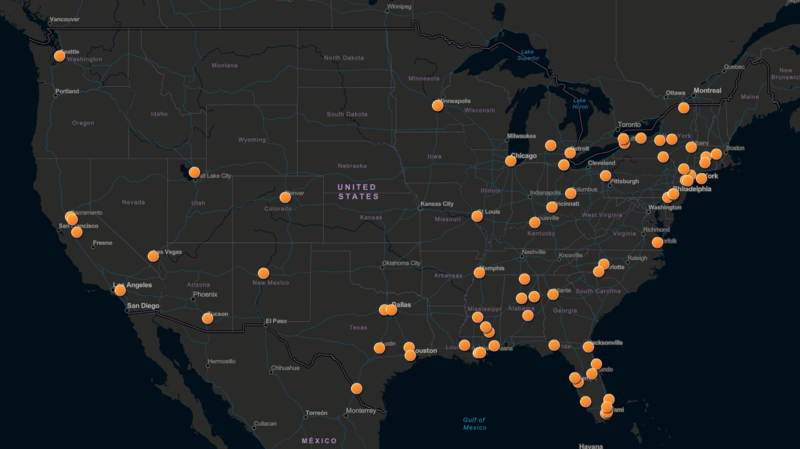
"Surveillance Compounded" is part of the Atlas of Surveillance project, an ongoing collaboration with the Reynolds School of Journalism that aims to build a central database and map of police technologies using open source intelligence.
This is the second such report, following 2019 "Atlas of Surveillance: Southwestern Border Communities," which documented surveillance technology in the 23 U.S. counties that border Mexico.
As of November 15, 2020, the Atlas contains more than 6,100 data points related to automated license plate readers, drones, body-worn cameras, cell-site simulators, and other law enforcement technologies.
Visit the Atlas of Surveillance.
Related Issues

That was 50 years ago, probably before many readers of this site were born. Fast-forward to now to see that the distinguished author and Professor of International Relations at George Washington University is moderating a forum of Civil Dialogues in Washington DC.
The first one tackles critical choices - a relevant topic today.

Civil Dialogues Series Starts March 2018
To provide an opportunity to engage in civil discourse about social and political issues, and will demonstrate-with the goal-that people of diverse viewpoints can have fruitful dialogues with one another.
(Please see links to more information and a link to the first forum streaming video on CSpan below)
There are knowledgeable panelists from a range of backgrounds and points of views
_________________________________________________________________________
The first forum is not too academic, scholarly or wonk. Etzioni is almost prophetic when the chosen subjects of this public discourse have hit the news now - Facebook/Cambridge Analytics, encryption technology and email privacy, GPS/Geo-tech tracking, data merchants, surveillance without borders and others. The hour-and-a-half go by quickly when your attention span is extended.
One item grabbed my attention when brought up by the moderator: Clear Choice.
_________________________________________________________________________________
Modern Surveillance Privacy on CSpan | 26 March 2018
1 https://www.c-span.org/video/?443054-1/lawyers-discuss-privacy-concerns-modern-era
2 https://archive.org/details/CSPAN_20180328_054600_Modern_Surveillance__Privacy
_______________________________________________________________________________
Arena Forum: Civil Dialogues Series Starts March 2018
The conversations seek to provide an opportunity for members of the Washington, D.C. community to engage in civil discourse about social and political issues, and will demonstrate-with the goal-that people of diverse viewpoints can have fruitful dialogues with one another. Each Arena Forum will have a group of prominent Dialogue Starters and will be moderated by Amitai Etzioni, a University Professor at The George Washington University and author.
The first Arena Forum on March 26 will tackle 'exploring the thesis that surveillance is excessive and privacy is endangered by both the government and by private corporations.' The Dialogue Starters that evening will include Julie Brill, ?Corporate Vice President and Deputy General Counsel at Microsoft and former Commissioner of the U.S. Federal Trade Commission; Matthew Olsen, Harvard Law School and former General Counsel for the National Security Agency?; Jeffrey Rosen?, President and CEO of the National Constitution Center and former legal editor the New Republic; Gabe Rottman, Washington director for PEN America and former Legislative Counsel and Policy Advisor at the American Civil Liberties Union; and Peter Swire?, Professor of Law and Ethics at the Georgia Tech Scheller College of Business and former White House coordinator.
more information : www.arenastage.org/forum
_________________________________________________________________________________
RELATED CONTENT:


-
 Flash News: Ukraine Intercepts Russian Kh-59 Cruise Missile Using US VAMPIRE Air Defense System Mounted on Boat. Ukrainian forces have made ...


