Tuesday, November 30, 2021

The Word CONCERNED...We Do A Lot of That!

It's just one of those overdone over-usages where someone expresses 'a concern' about almost anything these days, sort of making a signal that the problem is acknowledged, that it could and probably will get worse.
Greeking out —

Why Omicron quickly became a variant of concern

The WHO lets Omicron skip over variant of interest, go straight to concern.

THAT'S A LOT OF MUTATIONS!That's a lot of mutations.
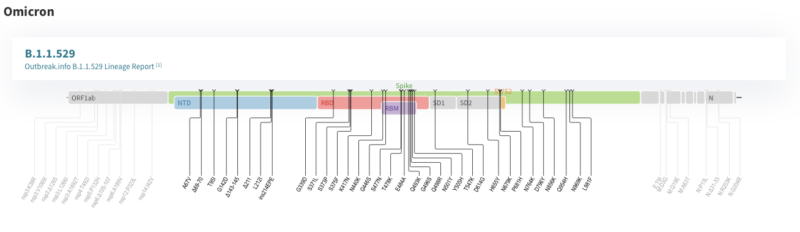
Here's a recent example, "On Friday, the World Health Organization officially named a new version of the SARS-CoV-2 virus a variant of concern and attached the Greek letter omicron to the designation. The Omicron variant is notable for the sheer number of mutations in the spike protein of the virus.
> While Omicron appears to have started spreading in Africa, it has already appeared in European countries like Belgium and the UK, which are working to limit its spread through surveillance and contact tracing.
As of now, the data on the variant is very limited; we don't currently know how readily it spreads compared to other variants, nor do we understand the degree of protection against Omicron offered by vaccines or past infections.
The new designation, however, will likely help focus resources on studying Omicron's behavior and tracing its spread. . ."
AND SO THEY DO

". . .Many changes

While the Delta variant's version of spike has nine changes compared to the virus that started the pandemic, Omicron has 30 differences. While many of these haven't been identified previously, a number of these have been seen in other strains, where they have a variety of effects. These include increasing infectiousness of the virus, as a number of the changes increase the affinity between the spike protein and the protein on human cells that it targets when starting a new infection.

Other changes in the spike occur in areas of the protein that are frequently targeted by antibodies that neutralize the virus. Changes here can mean that an immune response generated to vaccines or earlier versions of the virus are less able to target Omicron.

While these mutations are suggestive, understanding how they and the previously undescribed mutations in Omicron alter its behavior will depend on getting real-world data on its spread. Right now, however, we just don't have much of that.

We are lucky in the sense that it's relatively easy to detect Omicron. According to the WHO, some of the large collection of mutations in the gene that encodes the spike protein interfere with the gene's recognition by common versions of PCR tests. Those tests continue to recognize the presence of the virus by also targeting other areas of the genome. So a PCR test that comes back spike-negative but virus-positive is suggestive of the presence of Omicron, which can then be confirmed by genome sequencing.

These tests have shown Omicron is spreading rapidly within a number of countries in Southern Africa, although the total cases in Botswana and South Africa remain relatively low at the moment, so the significance of this spread is unclear. . .

READ MORE: https://arstechnica.com/science/2021/11/why-omicron-quickly-became-a-variant-of-concern/

Since it's the Future (South Park Post COVID)

Yikes! INTIMIDATION NOW GOES WITH THE TERRITORY FOR JOURNALISTS (Mike Masnick report in TechDirt)

When The FBI Shows Up At Your Door About Your Reporting, That's Intimidation

from the yikes dept

Having the government show up at your door to ask some questions about your reporting can be extremely unnerving. Zack Whittaker, the top notch cybersecurity reporter for TechCrunch got to experience the fun of that when the FBI showed up at his door over a year after he had published a story about a hacker dumping thousands of Mexican embassy documents from Guatemala after the Mexican embassy left the data exposed online.

As with many situations involving reporting on hacks and leaks, rather than focus on those actually responsible (often those who left the information exposed), law enforcement and the powers that be... often target the journalists. We saw that recently in Missouri where the governor called reporters hackers (and "fake news") for ethically disclosing that the state's elementary school agency had left teacher and administrator social security numbers exposed -- something the Department of Elementary and Secondary Education apologized for weeks later (though it didn't apologize to the journalists).

For Whittaker, the experience was reasonably concerning:

I contacted Mexico’s consulate in New York for comment, as is standard practice when reporting a story. A spokesperson said the Mexican government took the matter “very seriously.” We published our story, and that seemed to be the end of it.

The FBI knock at my door a year later suggested it wasn’t. I declined to speak with the agents and closed the door.

After we published our story the Mexican government requested the help of the U.S. Department of Justice through diplomatic channels to investigate the hack and presumably try to identify the hacker. Because I had contact with the hacker, that must have made me a subject of interest to the Mexican authorities, hence the visit a year on.

A month after the house call, the Mexican government provided the FBI with a list of written questions it wanted us to answer, many of which were already answered in the story. Our response to the DOJ declined to provide anything more than what we had already published.

However, as Zack notes, even if he knew he hadn't done anything wrong, all of this is incredibly unnerving. Legal threats (unfortunately, and often ridiculously) now come with the territory of being a journalist, but the intimidation factor is very real -- and that can be super damaging for better informing the public. Indeed, it's often why the powerful -- be they governments or just wealthy people and companies -- make use of such intimidation tactics all the time:

We’ve rebuffed spurious legal demands before, but having federal agents on your doorstep simply for doing your job is certainly a new one for me. There has been no suggestion of wrongdoing, though it’s unsettling not knowing what view Mexico would take if I ever stepped foot on its soil.

But it’s the legal threats and demands that don’t make it to print that can have the most damage. Legal demands inherently have a silencing effect. Sometimes they succeed. Journalism can be risky and the newsrooms don’t always win. Left unchecked, legal threats can have a chilling effect that stifles both security research and journalism by making it legally toxic to work. That means the world is less informed and sometimes less secure.

Filed Under: fbi, intimidation, journalism, mexico, reporting, zack whittaker
Companies: techcrunch

Bloomberg Studio 1.0: Alphabet CEO Sundar Pichai

What a lack of sunlight really does to our brains - BBC REEL

BEA News: Gross Domestic Product by State and Personal Income by State, 3rd Quarter 2025

  BEA News: Gross Domestic Product by State and Personal Income by S...