Friday, December 03, 2021
READING THE ROOM: EPISODE 1 OF DECEMBER'S "CHRIS BRADY'S SHOW" in The Lower Chambers...Mesa Council Study Session - 12/1/2021
READING THE ROOM: EPISODE 2 DECEMBER 2021: Mesa City Council Meeting - 12/1/2021
Thursday, December 02, 2021
MESA CITY COUNCIL Thu 12.01.2021

"The Mesa City Council believes that its people, not leaders, are what makes a City great and actively works to encourage citizen participation in the decision-making process. Whether it is through neighborhood meetings, advisory boards and committees, telephone calls and letters, or email, the Mesa City Council sets policies based on the input and needs of its citizens."

 STUDY SESSION
 Where do you want to start?
Try > click here .
That will bring you to the official city information source for City Council Meetings
You can find all the Agendas & Minutes by hitting the following link for the calendar
http://mesa.legistar.com/Calendar.aspx
| Meeting Name: | City Council Study Session | Agenda status: | Final |
| Meeting date/time: | 12/1/2021 4:00 PM | Minutes status: | Draft |
| Meeting location: | Lower Council Chambers | ||
| Published agenda: |  Agenda Agenda | Published minutes: | Not available | |
| Meeting video: |
| Attachments: |

|
| Meeting Name: | City Council | Agenda status: | Final |
| Meeting date/time: | 12/1/2021 5:45 PM | Minutes status: | Draft |
| Meeting location: | Council Chambers | ||
| Published agenda: | Agenda |
 Number of Records on the Final Agenda for the City Council Regular Meeting = 24
 | File #: | 21-1267 |
| Type: | Contract | Status: | Agenda Ready |
| In control: | City Council |
| On agenda: | 12/1/2021 |
| Title: | Use of a Cooperative Contract for a Two-Year Term and Renewal Options for IDEMIA LiveScan Workstations and Equipment (Replacement) for the Mesa Police Department (Sole Source) (Citywide) The Police Department first purchased these types of machines in 2004 and replaced them in 2012. The equipment is used in the booking process, for identification purposes, and other criminal justice functions. The current software used in these machines will no longer be supported by Arizona Department of Public Safety (AZDPS). AZDPS has only approved IDEMIA software to capture photos and communicate with law enforcement agencies. IDEMIA provides a fully integrated LiveScan solution including an AFIS interface, digital image capture, compliance with AZ-DPS AFIS, FBI IAFIS/NGI EBTS, and ANSI/NIST image standards. The initial purchase will be three LiveScan workstations for the Holding Unit and the Department has requested additional capacity to purchase more units as funds are identified. The Police... |
| Attachments: | 1. Council Report |
| File #: | 21-1001 |
| Type: | Minutes | Status: | Agenda Ready |
| In control: | City Council |
| On agenda: | 12/1/2021 |
| Title: | Approval of minutes of previous meetings as written. |
| Attachments: | 1. September 30, 2021 Study.pdf, 2. October 14, 2021 Study.pdf, |
 Contracts Item 4. . .There are 7 4a - 4g
 Most Viewed Last 7 Days
- There's a helluva to do and get done before the end of the Calendar Year For the Mesa City Council - your elected government - there a...
- The Juggernaut for unrestrained fast-growth is fast approaching the expansive final stages of the end-game working its way and accelerating


TIME TRAVEL: Maybe, like, time doesn’t even exist, dude. Maybe it’s a construct of our human consciousness as a way to organize and synchronize our sensory inputs
Why the [expletive] can’t we travel back in time?
If the inability to time travel were a fundamental part of our Universe, you’d expect equally fundamental physics behind that rule.
 The reasons really seem random; there is nothing fundamental we can point to, no law or equation or concept that definitively explains why thou shalt not travel into the past. And that’s pretty frustrating. It’s obvious that the Universe is telling us something important… we just don’t know what it’s saying. . .Perhaps, however, time travel into the past is, indeed, allowed, but your actions are constrained. Maybe the past already exists and is completely set in stone.
 Maybe, like, time doesn’t even exist, dude. Maybe it’s a construct of our human consciousness as a way to organize and synchronize our sensory inputs. Maybe we’re imposing some deep, fundamental preconceived notion on a Universe that doesn’t care, and so this whole discussion is moot.
This is all part of very legit discussions of philosophy. But let’s see if physics can take a crack at it. After all, if we could (even theoretically) build a time machine, then that would settle a lot of late-night bar bets.
So can we?
Closed time-like curves
Physicists use a very particular language when trying to build time machines: the language of gravity, given to us by old Albert himself in the form of general relativity. That’s because the language of gravity as interpreted in GR is a story of the bending and warping of spacetime. GR is a theory of motion in our Universe and how that motion is tied to the underlying four-dimensional fabric of spacetime.
In GR, matter tells spacetime how to bend, and the bending of spacetime tells matter how to move.
To determine whether we can build a time machine, physicists want to know if it’s possible to construct a spacetime—to find a particular and peculiar arrangement of matter—that allows one to travel into the past.
The goal is to find “closed time-like curves,” or CTCs.
“Curve” means exactly what you think it does—a path through space and time. “Time like” means no cheating—at no point are you allowed to travel faster than light. “Closed” means that the curve meets up back with itself—imagine traveling in one direction, always moving forward, never exceeding light speed. Yet at the end of your journey, you find you’ve arrived in your own past.
That’s a time machine. That’s a CTC.
The weird thing is, CTCs exist! Over the decades we have managed to uncover many solutions of general relativity that allow for backward time travel:
- The (in)famous mathematician Kurt Gödel (yes, that Kurt Gödel) discovered if a universe is filled with uniform dust that was slowly rotating, you could find trajectories in that universe that wind up in their own past.
- You know wormholes, right? Those shortcuts through space? They can also act as time machines. The trick is to take one end of the wormhole and hold it still. Then take the other and accelerate it close to the speed of light. Keep it at that speed for however long you want. Now bring that end back to the original one. The two ends of the wormhole now no longer have synchronized clocks because of the time dilation effects of the near-lightspeed travel. Since one end is in the past of the other end, you can just hop on in and travel back in time.
- Let’s say you had an infinitely long cylinder (maybe you pick it up at your local home improvement store). Rotate that cylinder to nearly the speed of light. If you follow a careful, corkscrew path around the rotating cylinder, then, by golly, you’ll wind up in the past.
- The inside of a rotating black hole is a pretty interesting place, where the competing countercurrents of gravitational and centrifugal forces meet to open a throat in the center of a black hole, creating the possibility of CTCs.
READ MORE -- https://arstechnica.com/science/2021/11/why-the-expletive-cant-we-travel-back-in-time/
ENTRENCHED CULTURES: It's Never "Just A Few Bad Apples"...A Damning Indictment of Law Enforcement's Unwillingmess To Police Themselves
The Bad Apples Control The Bunch: USA Today Report Details Law Enforcements Punishment Of Good Cops
from the mediocre-cops-aren't-helping-out-either dept
Those who enforce this code – the blue wall of silence – have stuffed dead rats and feces into fellow officers’ lockers. They’ve issued death threats, ignored requests for backup, threatened family members and planted drugs on the officers who reported wrong.
Department leaders often condone these reprisals or pile on by launching internal investigations to discredit those who expose misconduct. Whistleblowers have been fired, jailed and, in at least one case, forcibly admitted to a psychiatric ward.
An Illinois police union on Wednesday ousted from its membership an officer facing criminal charges for exposing a squad car video that showed his fellow officers slapping and cursing a man dying of a drug overdose.
The case of Sgt. Javier Esqueda, a 27-year veteran of the Joliet Police Department, was featured in September as the first installment of the USA TODAY series “Behind the Blue Wall,” an investigation involving more than 300 cases of police officers over the past decade who have spoken out against alleged misconduct in their departments.
Esqueda was one of 30 police officers who signed a letter to congress this summer urging lawmakers to pass protections for police whistleblowers.
 Thirty. Out of nearly 700,000. Saying you're for police accountability means nothing if you're not willing to even sign your name to a letter asking federal legislators to stand by those who report wrongdoing.
If you need a better argument for defunding police agencies, this is it.
When a culture is so entrenched it can't be rooted out with gradual reforms, perhaps the better solution is to burn it to the ground and rebuild with better policies and protections in place."
Filed Under: bad apples, blue wall of silence, law enforcement, police, police misconduct
Wednesday, December 01, 2021
SOUND-AND-LIGHT SHOW: Cenotaph for Josephine Baker Entry Into The Pantheon in Paris
Josephine Baker, music hall star and civil rights activist, enters Panthéon

 >> Later, as a civil rights activist, she was the only woman to speak at the 1963 March on Washington before Martin Luther King’s “I have a dream” speech. She was wearing her French military uniform. In France, she also waged a fight against discrimination, adopting 12 children from different ethnic backgrounds and countries across the world to form what she called a “rainbow” family, who she raised at her chateau in the Dordogne region. She said she hoped their lives would show that “racial hatred is not natural. It’s an invention of man.”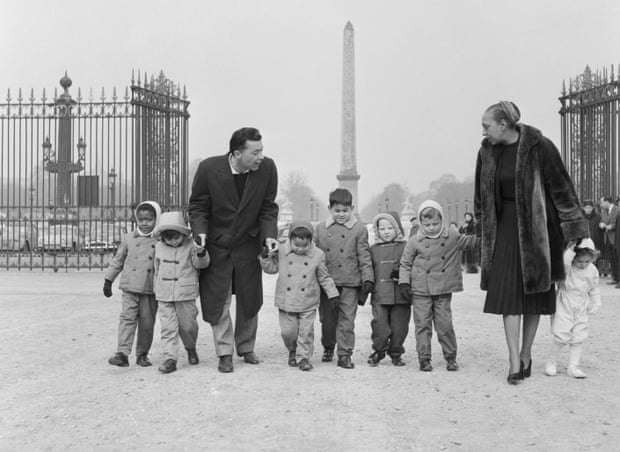
The ceremony – led by Macron, who chose to give Baker France’s highest honours after her supporters and families had petitioned for years – is seen as a move of political symbolism regarding France’s role as an inclusive society. The debate ahead of next spring’s presidential election has been dominated by hard-right rhetoric over national identity and immigration. The far-right TV pundit Éric Zemmour, who holds convictions for inciting racial hatred, has declared he will run for president to “save” France from being destroyed by immigration.
> Macron’s office said it was a sign of the universal affection for Baker in France that there was complete political consensus around her honours.
Baker died from a brain haemorrhage days after a final smash-hit cabaret show in Paris celebrating her half-century on the stage. She had told a French TV interviewer:
"I don’t like the word hatred … We weren’t put on Earth for that, more to understand and love each other.”
RELATED CONTENT
Josephine Baker Becomes First Black Woman Inducted Into France’s Tomb of Heroes

President Emmanuel Macron hailed the American-born dancer and French resistance fighter as a symbol of unity in a time of sharp division.
PARIS — Josephine Baker, born in Missouri and beloved of France, whose life spanned French music-hall stardom and American civil rights activism, on Tuesday became the first Black woman to be inducted into the Panthéon, the nation’s hallowed tomb of heroes.
On a gray afternoon, 46 years after her death in Paris, soldiers from the Republican Guard bore a flag-draped coffin up the red-carpeted stairs of the Panthéon, where Ms. Baker joined 75 men and five women, including the author Émile Zola, the scientist Marie Curie, and the resistance hero Jean Moulin. . ."
Josephine Baker is first Black woman inducted into France’s Panthéon
PARIS — More than four decades after her death, American-born French singer and dancer Josephine Baker made history on Tuesday as the first Black woman to be inducted into the Parisian Panthéon.
In a symbolism-laden procession, soldiers lifted her cenotaph, draped with the French flag, and carried it along a red carpet to the country’s national mausoleum. The coffin contained soil from St. Louis, where she was born; Paris, which she adopted as her home; and Monaco, where she is buried.
Thibault Camus/AFP/Getty Images
Addressing audiences watching on TV and in person, President Emmanuel Macron honored Baker as a woman who was “devoted to our ideals” and stood out as a “war heroine, fighter, dancer, singer, a Black person defending Black people, but first and foremost a woman defending humans.”
Even though Baker was “born American,” Macron said, at heart there is no one “more French than you.” . . .

-
 Flash News: Ukraine Intercepts Russian Kh-59 Cruise Missile Using US VAMPIRE Air Defense System Mounted on Boat. Ukrainian forces have made ...
 -
A nor’easter is about to hit the Northeast in May. That’s very unusual.

