Sunday, December 05, 2021
ZOOM: Class-Action Lawsuit: The plaintiffs allege Zoom failed to prevent Zoombombing
Zoom might pay you $25 as part of a class-action settlement
A lot of people may be eligible to receive some kind of payment
/cdn.vox-cdn.com/uploads/chorus_image/image/70221526/acastro_200331_1777_zoom_0001.0.0.jpg)
Saturday, December 04, 2021
LITERATURE IS ALLOWED TO BE FUN
Is Superman Circumcised?, a study of the superhero’s Jewish influences, has resoundingly won the competition to be named “oddest book title of the year”.

Is Superman Circumcised? wins oddest book title of the year award
The Diagram prize, which is run by The Bookseller magazine and voted for by the public, pitted six titles against each other this year, from Curves for the Mathematically Curious to Hats: A Very Unnatural History.
Despite competition from second-placed The Life Cycle of Russian Things: From Fish Guts to Fabergé, Is Superman Circumcised? took 51% of the public vote to win the award. More than 11,000 people cast a vote in this year’s competition.
The title, which follows in the footsteps of former winners including How to Avoid Huge Ships and The Big Book of Lesbian Horse Stories, sees author Roy Schwartz explore the creation of the “Mensch of Steel” by Jewish immigrants Jerry Siegel and Joe Shuster.
Schwartz argues that Superman’s origin story is based “on Moses, his strength on Samson, his mission on the golem, and his nebbish secret identity on themselves”, and that Krypton’s society is based on Jewish culture.
The Bookseller’s managing editor Tom Tivnan said: “Following on from 2019’s champ, The Dirt Hole and its Variations, and 2020’s A Dog Pissing at the Edge of a Path: Animal Metaphors in Eastern Indonesian Society we’ve seen once again that Diagram voters are pulled to titles that are just wee bit naughty.”
“Let me also raise a glass to Is Superman Circumcised? publisher McFarland & Company which gets its first ever win on its inaugural shortlisting. But I have a sneaky feeling that with other sublime titles on its list like Mr Sulu Grabbed My Ass and Other Highlights from a Life in Comics, Novels, Television, Films and Video Games and Gag Reflections: Conquering a Fear of Vomit Through Exposure Therapy this will not be the last contribution by McFarland to the Diagram.”
The inaugural Diagram prize went to Proceedings of the Second International Workshop on Nude Mice in 1978. The winner does not receive anything, but the nominator of the winning entry traditionally receives a “passable bottle of claret”.
“The competition was stiff, but I’m glad I was able to rise to the challenge,” said Schwartz. “I’m sincerely honoured to receive this august literary prize. It’s a great reminder that even serious literature is allowed to be fun.”
SCIENCE: Vast networks of underground fungi – the “circulatory system of the planet” – are to be mapped for the first time
Pre-Note: Jeremy Grantham, a billionaire financier and funder of climate research who is funding the project with $3.5m (£2.6m), said: “Just below our feet lies an invaluable ally in mitigating climate change: vast hidden fungal networks. Billions of tonnes of carbon dioxide flow annually from plants to fungal networks. Yet these carbon sinks are poorly understood. In working to map and harness this threatened but vital resource for life on earth, SPUN is pioneering a new chapter in global conservation.”
World’s vast networks of underground fungi to be mapped for first time
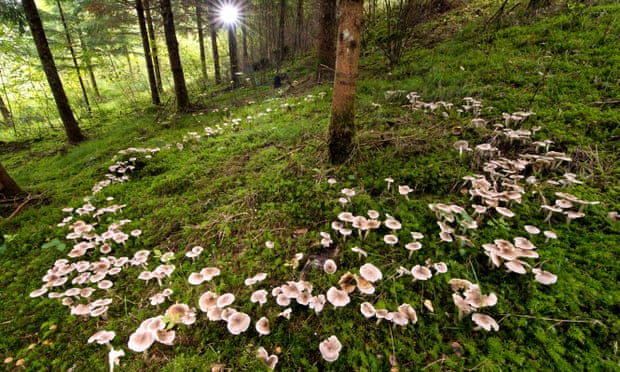
Project aims to help protect some of trillions of miles of the ‘circulatory system of the planet’
Vast networks of underground fungi – the “circulatory system of the planet” – are to be mapped for the first time, in an attempt to protect them from damage and improve their ability to absorb and store carbon dioxide.
Fungi use carbon to build networks in the soil, which connect to plant roots and act as nutrient “highways”, exchanging carbon from plant roots for nutrients. For instance, some fungi are known to supply 80% of phosphorus to their host plants.
Underground fungal networks can extend for many miles but are rarely noticed, though trillions of miles of them are thought to exist around the world. These fungi are vital to the biodiversity of soils and soil fertility, but little is known about them.
Many hotspots of mycorrhizal fungi are thought to be under threat, from the expansion of agriculture, urbanisation, pollution, water scarcity and changes to the climate.
The new project, from the Society for the Protection of Underground Networks (SPUN), will involve the collection of 10,000 samples around the world, from hotspots that are being identified through artificial intelligence technology.
Jane Goodall, the conservationist, who is advising the project, said: “An understanding of underground fungal networks is essential to our efforts to protect the soil, on which life depends, before it is too late.”
The Society for the Protection of Underground Networks comprises scientists from the Netherlands, Canada, the US, France, Germany and the University of Manchester in the UK.
The first collections will take place next year in Patagonia, and continue for about 18 months, to create maps of potential underground mycorrhizal fungi that can be used for further research. Using the maps, the scientists hope to pinpoint the ecosystems facing the most urgent threats, and partner with local conservation organisations to try to create “conservation corridors” for the underground ecosystems.
This is believed to be the first major effort to map an underground ecosystem in this way. Climate science has focused on above-ground ecosystems, and although we know that fungi are essential for soil structure and fertility, and the global carbon cycle – as ecosystems with thriving mycorrhizal fungi networks have been shown to store eight times as much carbon as ecosystems without such networks – much of the role of fungi in the soil nutrient cycle remains mysterious.
Mark Tercek, former CEO of the Nature Conservancy, and a member of the governing body for SPUN, said: “Fungal networks underpin life on Earth. If trees are the ‘lungs’ of the planet, fungal networks are the ‘circulatory systems’. These networks are largely unexplored.”
Mycorrhizal fungi create tough organic compounds that provide structure to the soil, and store carbon in their necromass, the networks that are no longer active, but remain woven into the soil.
Modern industrial agriculture adds vast quantities of chemical fertiliser which interrupts the dynamics of exchange between plants and fungi, scientists warn. Without thriving fungal networks, crops require more chemical inputs and are more vulnerable to drought, soil erosion, pests and pathogens. Mechanical ploughing in modern agriculture also damages the physical integrity of fungal networks.
There is also increasing evidence that some combinations of fungi can enhance productivity more than others, so guarding these is critical, according to soil scientists.
Ten hotspots have been identified by the scientists involved, including: Canadian tundra; the Mexican plateau; high altitudes in South America; Morocco; the western Sahara; Israel’s Negev desert; the steppes of Kazakhstan; the grasslands and high plains of Tibet; and the Russian taiga. . ."

-
 Flash News: Ukraine Intercepts Russian Kh-59 Cruise Missile Using US VAMPIRE Air Defense System Mounted on Boat. Ukrainian forces have made ...
 -
A nor’easter is about to hit the Northeast in May. That’s very unusual.

