Sunday, December 05, 2021

MARICOPA COUNTY BOARD OF SUPERVISORS General Information + Meetings

Here's some general all-purpose information to start
Maricopa County Seal

Formal Meeting

Formal meetings typically occur on Wednesdays and are included on the annual posting notice (PDF). The formal meeting includes action agenda items from the various county departments and districts and often includes items from planning and development.  Formal meeting are open to the public.

Agendas that include "Call to the Public" accommodate comments addressed to the Board of Supervisors. A completed Speakers Form must be submitted to the Clerk before "Call to the Public" begins.

Informal Meeting

Informal meetings typically occur on Mondays and are included on the annual posting notice (PDF). Often this meeting is comprised of presentations to the board but may also include items that require board action.  Informal meetings are open to the public.

Special Meeting

Special meetings are announced via a special public notice, which can be found in the meetings and agenda section.  Special Meetings, with the exception of Special Executive Meetings, are open to the public.

Executive/Special Executive Meeting

The Board of Supervisors and/or the referenced Boards of Directors may vote to recess into executive session for the purpose of obtaining legal advice from the board’s attorney on any matter listed on an agenda pursuant to ARS §38-431.03 (a)(3), or for any other matter authorized under ARS §38-431.03, which has been specifically listed on the meeting agenda identifying the statutory basis for executive session consideration. Executive meetings are included on the annual posting notice (PDF) or may be posted as special meetings; however, the executive meetings are not open to the public.

Agendas

Agendas contain information that is reasonable and necessary to inform the public of the matters to be discussed or decided, the time and place of the meeting, and must be available at least 24 hours prior to a scheduled meeting.  Agendas may include supportive documentation, if provided, as a hyperlink to the agenda item title, and are subject to change.  These documents are not fully executed documents.  To obtain a copy of the fully executed document after the Board has acted upon the item, please submit a Public Records Request, or contact the Office of the Clerk of the Board.

  • The Draft agenda and supportive documentation are often available 3 days before the meeting for a Formal Meeting.  This version is subject to change.
  • The Final agenda and supportive documentation are available at least 24 hours before a Meeting.  This version may be modified at the meeting itself.
  • Formal Meeting agenda items that were added to the Final agenda after the Draft agenda was published will be placed in the Addendum section of the Final agenda.  Amended agenda items are notated on the Final agenda through the use of strike-add.
  • Informal and Special Meeting agendas are often posted only as Final agendas; no Draft agenda may be published for these meetings

=======================================================================

Board of Supervisors Meeting Information

Meetings

The five (5) member Board meets each month as defined in the Annual Posting Notice. Additional meetings throughout the year are listed in the Special Posting Notice.  Use the Meetings & Agendas table below to locate information related to a particular meeting. If you are unsure of the date on which a particular item was heard, you may also click on the Meetings link (next to the Home link below) to find an item based upon key words and/or a date range. (NOTE:  If using Internet Explorer, the Meeting link will require opening a new window, by clicking "Open this content in a new window".  Please close that window to return to this web page.)  

UPDATE:  December 6, 2021 2:45 pm Board of Supervisors  Special Meeting     

  • Following CDC guidelines regarding recommendation to limit social gatherings, no residents will be allowed in the Board of Supervisors‘ meeting rooms.
  • Residents can submit comments related to the Board Meeting agenda before 8:00 am on Monday, November 16th by emailing Agenda.Comments@Maricopa.Gov or calling 602-506-3766.
  • Residents wishing to speak on a Public Hearing item, may list the agenda item # and request a speaker form at Agenda.Comments@Maricopa.Gov
  • Residents can watch the Board meeting live-streamed at Maricopa.Gov or Maricopa.Gov/324 at the time of the meeting.
  • Residents can also watch via GoToWebinar.com.  Pre-registration may be done via this link: https://attendee.gotowebinar.com/register/8502845993972009484 and entering the webinar meeting ID 873-100-659. 
  •  Residents may listen to the Webinar by dialing 1(415) 655-0052, and entering the Audio Access code 584-442-545#. Long distance charges may apply.  
  • No Audio PIN is needed to listen only. 

UPDATE:  December 8, 2021 9:30am Board of Supervisors  Formal Meeting     

  • Following CDC guidelines regarding recommendation to limit social gatherings, no residents will be allowed in the Board of Supervisors‘ meeting rooms.
  • Residents can submit comments related to the Board Meeting agenda before 5:00 pm on Tuesday, December 7th by emailing Agenda.Comments@Maricopa.Gov or calling 602-506-3766.
  • Residents wishing to speak on a Public Hearing item, may list the agenda item # and request a speaker form at Agenda.Comments@Maricopa.Gov
  • Residents can watch the Board meeting live-streamed at Maricopa.Gov or Maricopa.Gov/324 at the time of the meeting.
  • Residents can also watch via GoToWebinar.com.  Pre-registration may be done via this link:https://attendee.gotowebinar.com/register/2366592545627779084 and entering the webinar meeting ID 428-949-403. 
  •  Residents may listen to the Webinar by dialing 1 (914) 614-3221, and entering the Audio Access code 469-111-563#. Long distance charges may apply.  
  • No Audio PIN is needed to listen only. 

 NOTE:  Webinar meeting IDs and access codes will change each meeting.  Check back for the most current codes for future meetings.

To leave comments for the Board of Supervisors, please send them to agenda.comments@maricopa.gov

Meetings on the Clerk of the Board website are available online beginning July 2008. To request meeting information prior to July 2008, please submit a Public Records Request to the Office of the Clerk of the Board.

Instructions for searching Board of Supervisor's agendas for meetings prior to those listed on this page and since 7/1/2008,.  For the best experience, please use Chrome when conducting searches.


Meetings & Agendas

Showing 4 Meeting(s)
Showing 15 Meeting(s)

How Electricity Gets to You

COMMERCIAL ENTERPRISE IN LOW-EARTH ORBIT: Competition by NASA for Russia and China

There are two recent reports
 
1 One written by Eric Berger on December 3 at 08:37 a.m.

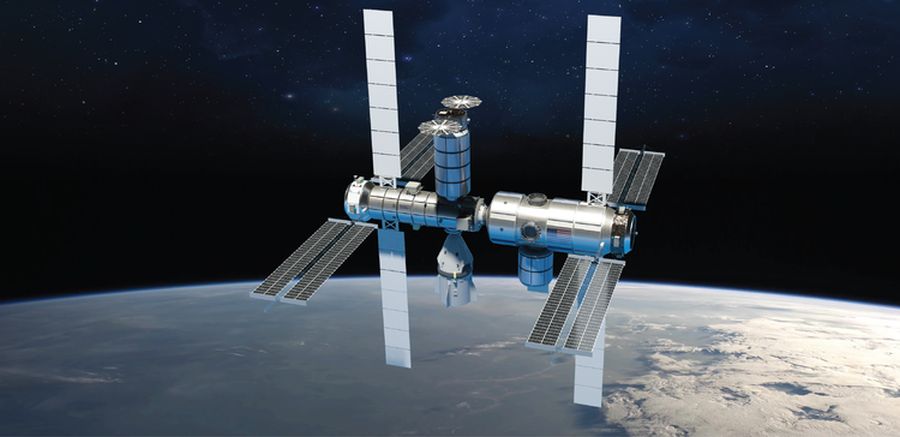
NASA sets sail into a promising but perilous future of private space stations

NASA selects a mix of large and small US companies, and old and new players.

 
"On Thursday afternoon, NASA announced that it had awarded three different teams, each involving multiple companies, more than $100 million apiece to support the design and early development of private space stations in low Earth orbit.
This represents a big step toward the space agency's plan to maintain a permanent presence in space even after the aging International Space Station, which can probably keep flying through 2028 or 2030, reaches the end of its life. NASA intends to become an "anchor tenant" by sending its astronauts to one or more private stations in orbit starting in the second half of the 2020s.
The total estimated award amount for all three funded Space Act Agreements is $415.6 million.
Rendering of Blue Origin's Orbital Reef station in an initial configuration and fully constructed.
The individual award amounts, with links to each concept, are:
  • Blue Origin, $130 million, leading a team including Sierra Space, Boeing, and Redwire Space
  • Nanoracks, $160 million, leading a team including Lockheed Martin and Voyager Space
  • Northrop Grumman, $125.6 million, leading a team including Dynetics

Rendering of Nanoracks' Starlab in low Earth orbit.

Each of these space station concepts is a "free flyer" in the sense of launching independently of any other facility. Previously, in February 2020, as part of a separate competitive procurement process, NASA awarded Axiom Space a $140 million contract to develop a habitable commercial module for the International Space Station. The award gives Axiom the right to attach its module to the station's Node 2 forward point.

At this stage, Axiom would appear to have some advantages in the competition for future NASA private station awards. In addition to providing the benefit of power, breathing air, and crew time through its initial attachment to the space station, Axiom is ahead in the design and construction of its facility. Axiom completed the cumbersome "preliminary design review" for its station in September, a process the free-flying stations are unlikely to finish before 2025.

But now, the "free flyer" competitors have some funding to try to catch up. . .

> Will Congress fund it?

The prevailing plan from Congress for some time has been to fly the International Space Station for as long as possible—the program has provided benefits across the country and is a reliable source of jobs at the major NASA field centers in Texas, Alabama, and Florida. . .So NASA has now "awarded" more than $550 million for private space stations, but Congress has yet to provide the funding for any of these grants. Asked what would happen if NASA does not receive the funding it needs for these stations, McAlister said the program would have to slow down. . .

> When will the ISS actually end?

The current agreement between NASA, Russia, and its international partners calls for the operation of the International Space Station through 2024. NASA's director for the International Space Station, Robyn Gatens, said Thursday that NASA has been working with US leaders to build support for an extension. . .The US government would then have to negotiate an extension with Russia and the other international partners to 2028 or 2030. There is general support for this, but recent Russian actions—such as shooting down its own satellite and putting debris into the orbital path of the space station—raise questions about the viability of the US-Russia partnership that has persisted so well for so long. . .Finally, there are concerns about the structure of the space station itself. It is aging, and there are small cracks starting to appear in the Russian module. Can the ISS safely fly for another seven to 10 years? Probably, but it's not a certainty.

> Can the private companies deliver?

The private companies who have won awards from NASA face a challenging road ahead. First, they must demonstrate technical competence to NASA as they design and build their facilities with an eye toward future funding. In a few years, NASA aims to provide a second, and more substantial, round of money to the providers it deems most credible. . .But NASA funding will only cover a fraction of the development costs. During Thursday's call, none of the awardees would answer a question about the total costs to design, build, and launch their space stations. . .Even as they're proving their technical chops to NASA, the private companies must work to raise private funding to complete their projects.

Asked about this during the Thursday news conference, Nanoracks chairman Jeff Manber pushed back. "I can't believe that a decade after commercial cargo was launched, folks are still questioning the robustness and ingenuity and flexibility of the commercial pathway," he said. "Sure, there are challenges going forward, but as Phil said, we have a multiplicity of providers working on this, and so this is exactly the right way to go forward."

One possible translation of this is that, whenever the International Space Station does fly its final orbit with humans on board, NASA is hoping that one of these commercial teams makes it. Should two or more make it, the agency would be both surprised and delighted."


2 One written by Jasmine Hicks on  December 3 later in the day

NASA funds three companies to develop commercial space stations

The initiative will help maintain NASA’s presence in low-Earth orbit

NASA announced the selection of three US companies that will receive government funding to furtherdevelop private space stations on Thursday. From a set of 11 proposals, NASA selected Blue Origin, Nanoracks LLC, and Northrop Grumman to receive over $400 million in federal funds through three separate Space Act Agreements.

NASA began seeking proposals in July for its Commercial Low Earth Orbit Development (CLD) program, which aims to support the development of commercial space stations. It is a part of a bigger plan to eventually replace the International Space Station (ISS) with commercial space stations. Through this model, NASA would be a customer of the commercial space industry, allowing it to save on costs and focus on basic research and exploration.

MORE DETAILS:

Blue Origin is set to receive $130 million to develop Orbital Reef, a free-flying space station concept the company first announced in October. Orbital Reef is being developed in partnership with Sierra Space, maker of the winged spaceplane Dream Chaser. Blue Origin says the stationwill be operational by the second half of the decade.

Nanoracks LLC is receiving $160 million for its Starlab station concept. Also announced in October, Starlab is a collaboration with Voyager Space and Lockheed Martin. Designed to hold up to four astronauts and conduct advanced research on biology, materials science and more, Starlab is targeted for launch in 2027 on a single flight, according to the NASA press release.

Northrop Grumman’s $125.6 million award will give it the opportunity to develop a commercial space station using existing technologies like its Cygnus spacecraft, which currently ferries cargo to the ISS. Northrop is working with Dynetics on its concept for a modular space station, with other partners to be announced in the future.

Axiom Space, a Houston company that was the first awarded funds in January 2020 to develop its commercial module to be added to the ISS, said in a statement on Twitter that it did not bid to receive one of the CLD awards.

IT HAPPENED! Elon Musk JUST REVEALED SpaceX’s INSANE NEW Nuclear Reactor

MISSION: To develop and drive the adoption of technologies for open and decentralized public conversation

Bluesky

Building a Social Web

The web. Email. RSS feeds. XMPP chats. What all these technologies had in common is they allowed people to freely interact and create content, without intermediaries.

We're focusing on re-building the social web by connecting disconnected silos and returning control of the social experience to users. Our mission is to develop and drive the adoption of technologies for open and decentralized public conversation.

We're recruiting a small team of developers and technologists for this first stage, starting with a protocol developer and a web developer. Email your resumes and ideas to join@blueskyweb.org.

Or participate in our contest.

We'll have more to say soon! Follow the bluesky Twitter account for updates.

Excited to get involved?


Read our ecosystem review, or learn about the existing bluesky community.