Friday, December 10, 2021
SPYCRAFT: There will be no more coming in from cold
Disrupting Spycraft: Always-On Surveillance Is Prompting Massive Changes In Covert Operations
from the move-fast-and-break-your-own-stuff dept
Disrupting Spycraft: Always-On Surveillance Is Prompting Massive Changes In Covert Operations
There Are Spying Eyes Everywhere—and Now They Share a Brain
Security cameras. License plate readers. Smartphone trackers. Drones. We’re being watched 24/7. What happens when all those data streams fuse into one?

Thursday, December 09, 2021
From Aljazeera VISUALIZING GLOBAL AIR TRAVEL
Visualising the global air travel industry
While air travel picked up in 2021, passenger numbers are still down by roughly half of pre-pandemic levels.

Though economies around the globe have been recovering this year, the number of international air passengers is still down by roughly half of pre-pandemic levels, according to the International Civil Aviation Organization’s (ICAO) latest report [PDF].
[...]
The world’s busiest airports
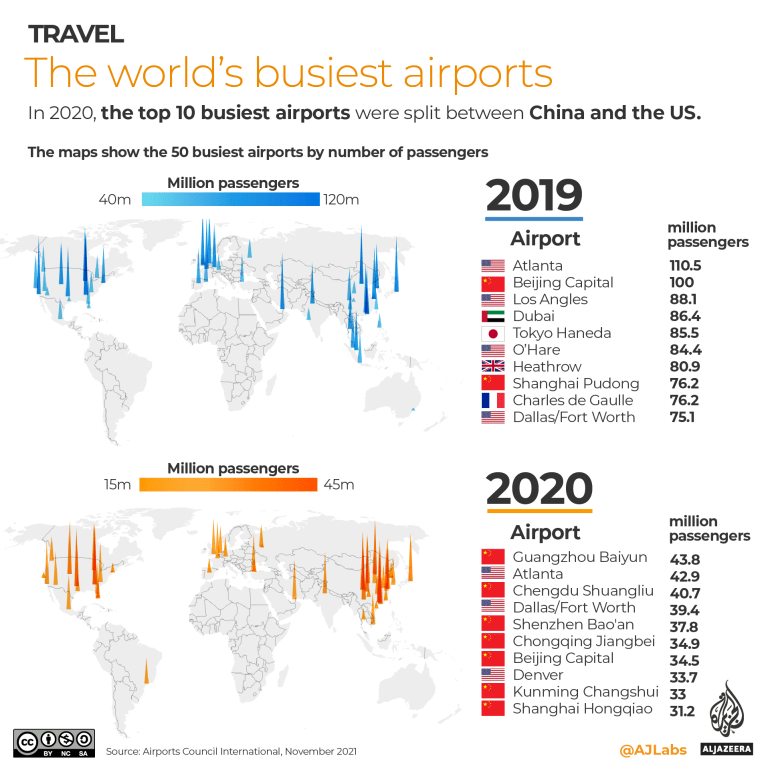
Prior to the pandemic, the world’s busiest airports by the number of passengers were spread across North America, the Middle East, Asia and Europe. However, in 2020, the top 10 busiest airports were split between China and the United States.
Guangzhou Baiyun International Airport, located in the south Chinese province of Guangdong, was the busiest airport in 2020, with more than 43.8 million passengers travelling through the airport, according to Airports Council International (ACI).
> Atlanta Airport in Georgia, US, had the second-highest number of passengers with 42.9 million people using the airport. However, this was a 61 percent decrease from 2019, when it was ranked the busiest airport in the world.
Seven of the 10 busiest airports in 2020 were situated in China.
 (Al Jazeera)
Financial losses
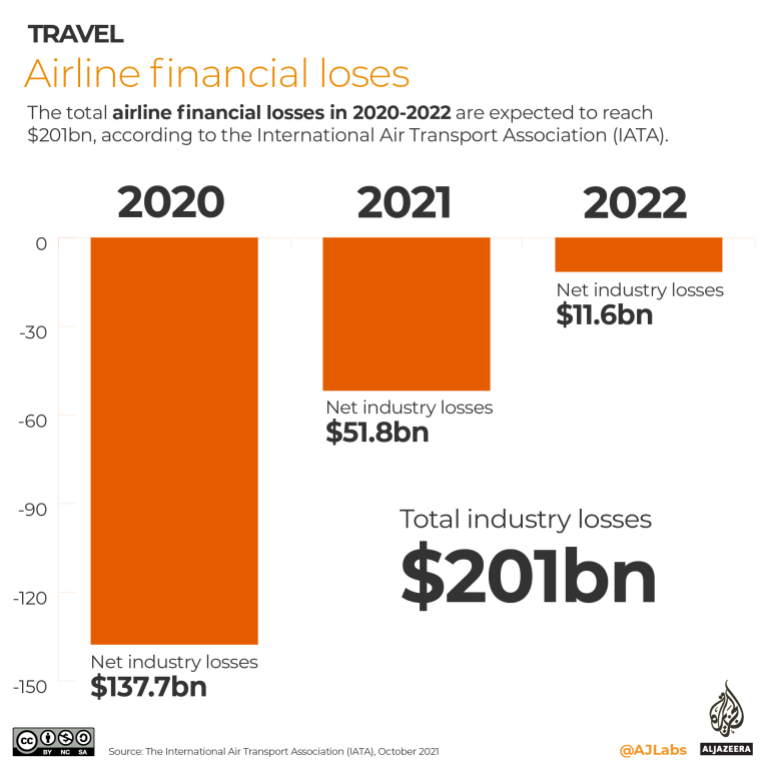
Total air travel industry losses during 2020-22 are expected to reach $201bn, according to the International Air Transport Association (IATA).
In 2020 alone, the industry lost upwards of $137bn with losses expected to reduce to $11.6bn in 2022.
 (Al Jazeera)
Global air travel during the pandemic
In 2019, some 4.5 billion passengers took 42 million flights worldwide. That is an average of 115,000 commercial flights every day, according to FlightRadar24.
Then on March 11, 2020, COVID-19 was declared a global pandemic by the World Health Organization (WHO). Over the course of just one month, passenger air travel dropped by more than 75 percent, reaching a low of 23,926 flights on April 12, 2020.
With lockdowns and quarantines sweeping the globe for most of 2020, many people cancelled or postponed travel plans. By the end of the year, 2.7 billion fewer people travelled by air compared with 2019, according to the ICAO.
Though international and domestic flights picked up in 2021, the number of total air passengers still stands at about half of 2019 levels.
THERE ARE MORE DETAILS -- Reference: https://www.aljazeera.com/economy/2021/12/9/visualising-the-global-air-travel-industry-interactive

Federal agents at Polling Places: Arizona Immigration advocates are building an interactive map to alert people
AZ Immigration advocates build map to show federal agents at polls By Brittany Gibson email (opens in new window) sms (opens in new window)...

-
 Flash News: Ukraine Intercepts Russian Kh-59 Cruise Missile Using US VAMPIRE Air Defense System Mounted on Boat. Ukrainian forces have made ...
 -
A nor’easter is about to hit the Northeast in May. That’s very unusual.

