| |||||||||||||||||||||||||||||||||||||||
|
| |||||||||||||||||||||||||||||||||||||||
|

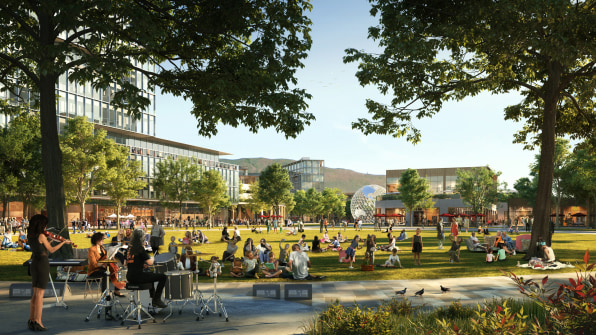
"In Paris, one of the first cities to champion the idea of the 15-minute city—urban planning that makes it possible to take care of most everyday errands with a short walk or bike ride—it was already fairly easy to get around without a car even before the current mayor started making changes. In a typical sprawling American suburb, it’s harder to transform streets designed for driving. But in Draper, Utah, a suburb of Salt Lake City, a new neighborhood is being designed from the ground up to help residents avoid the need for cars.
Unlike another new development under construction in suburban Phoenix, which calls itself car-free, the Utah project, called The Point, isn’t assuming that residents will give up cars completely, just that they’ll drive much less. “One of our goals is to create what we’ve termed a one-car community,” says Alan Matheson, executive director of The Point of the Mountain State Land Authority, the government agency leading the project, which is happening on state-owned land. “We know there will be those who want more than one vehicle, but we think we can design this in a way where they wouldn’t need it.”
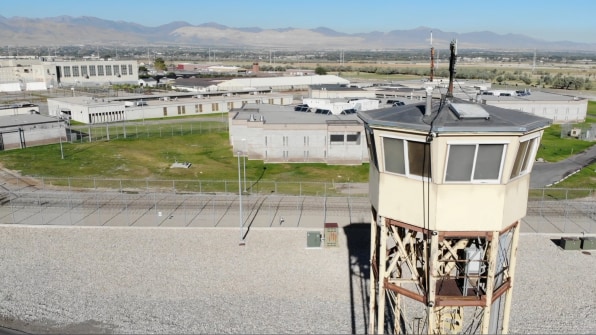
The site, which currently houses a state prison that will be demolished this summer, is large, a little more than 600 acres. (That’s bigger than the entire country of Monaco, or about 70% of Central Park in New York City.)
It’s also the perfect size for the 15-minute city concept. “From the center to the edge is about a 10-minute walk or so, a 15-minute walk, depending on how fast you walk,” says Peter Kindel, an urban design and planning principal at Skidmore, Owings & Merrill, the global design and engineering firm that developed a framework plan to be used to build the neighborhood, which will contain 7,400 households.
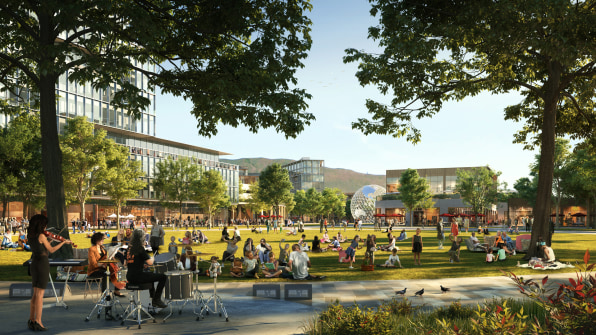
The plan calls for a network of open spaces so residents can walk through car-free linear parks to different parts of the neighborhood to reach offices, schools, or stores, all built in mixed-use zones. “You can move through the whole project in the open space system and have access to almost every single parcel in the project,” Kindel says. Streets will allow cars, but will also prioritize space for bike lanes and wide sidewalks. People living in the neighborhood will be able to ride on a bus rapid-transit system to nearby cities Salt Lake City or Provo. A small shuttle, which may run autonomously, will circle through the neighborhood for those who need to quickly run an errand and don’t want to walk or bike. Mobility hubs will offer shared cars, bikes, and scooters.
A pathway will also lead through the site on a new pedestrian bridge over a freeway to a recreational trail next to the river.
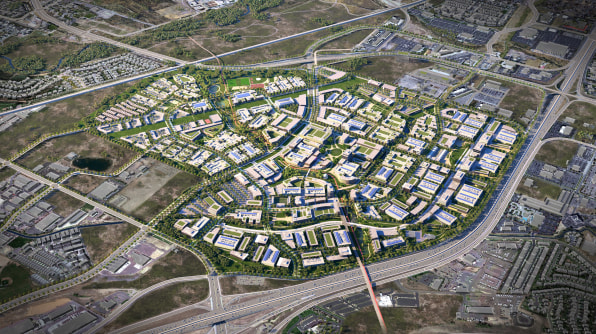
On the other side of the neighborhood, it will link to hiking or biking in the mountains. “I think that’s where a lot of urban design and the future of cities is headed—this idea of ‘biomorphic urbanism,’ where people want connection to nature, and they want connection to each other,” Kindel says. “And they don’t want to spend their whole day in a car commuting.” The path that reconnects the river and mountains will also help wildlife move between the open spaces.
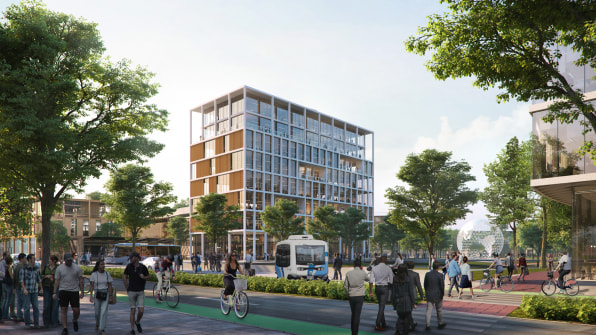
Because the land is owned by the state, the government went through a long process of asking the community how they wanted it to be developed. “We heard loud and clear from them that the principles of having more convenient, less car-focused development, and a little more compact and amenity-rich community, would be appealing,” says Matheson. Utah’s population has been quickly growing, and “people here are concerned about what that growth means,” he says. “How will it impact our enviable quality of life? I think increasingly, they’re open to looking at ways that we can grow more thoughtfully, that preserve the beauty of the area and improve our air quality, and that minimize traffic congestion.”
It’s likely that some residents will forego car ownership. “The idea here is that it’s an economic driver for the state to attract younger workers who are in the tech sector or the science sector, and we know that they don’t want to live in the suburbs, oftentimes, as the suburbs are currently configured,” says Kindel. “They want more urban features, they want to know their neighbors, they want to be part of a community. They don’t want to spend their day driving.”
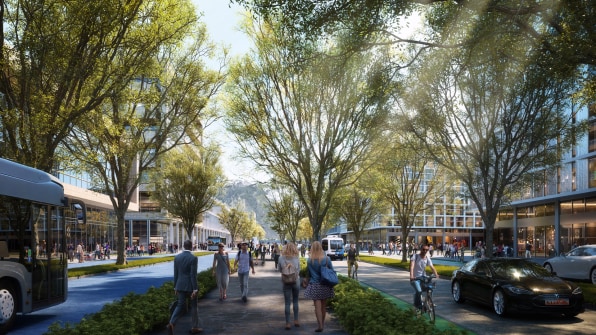
Although the site is unique—and may be the first true 15-minute city to be built in the U.S.—he says that the ideas can be replicated in other cities. “We do think it could be a prototype for other American suburbs,” he says. “Specifically, you know, in the West, where the cities are newer, and there may be more sprawl, cities like Denver, and Dallas. In many of these cities, there’s underutilized lands, old industrial sites, that may not be 600 acres contiguous, but may be 100 acres or 200 acres. So, we do think the concept is transferable to other cities. But cities need to make a commitment to walkability, to open space, to rethinking their street design.”
| ||||||
|
==============================================================
[...] The disease is caused by fungi in the genus Coccidioides that are found in soil and dust, and can easily become airborne and inhaled by people. In 2019, 39 Arizonans died from Valley fever, and in 2021 more than 11,000 people in the state were diagnosed with the illness. In recent years, Arizona has had the highest rate of Valley fever infections in the nation, my reporting showed.
My recent reporting also explored how scientific research—old and new—indicates that the most serious form of the disease, known as disseminated Valley fever, tends to manifest disproportionately in people of color, meaning there are indicators that genetics could play a part in severity of disease symptoms for specific groups of people.
Recently, a vaccine for the disease was shown to be effective in dogs. This new research paves the way for the development of a human version of the vaccine. But according to Dr. John Galgiani, the director of the University of Arizona Valley Fever Center for Excellence, getting to the “finish line” of a human vaccine could take another $200 million.
The legislation now making its way through Congress would provide $20 million each year for five years for epidemiological and clinical research on fungal diseases. The funding, which would pass through the National Institutes of Health, would include research on both treatments and vaccines for Valley fever. Additional funding would also be used to support activities such as a fungal disease working group composed of federal members, doctors, scientists and patients.
I will continue to follow any developments with this legislation as it makes its way through Congress. As always, I welcome your tips and feedback on this topic or any other health issue in Arizona that has caught your attention at shaena.montanari@azcir.org.
Thanks for following my work,
Shaena Montanari
Investigative Reporter — Health
Arizona Center for Investigative Reporting