Thursday, January 20, 2022

OVER-ARCHING TRENDS: Sustainable Workplaces as Tools for Change

Intro: No doubt all-too-the-positive good for Google in these forms following a function to accomplish a pledge: The firm says the finished buildings will have 90,000 tiles which form a “solar skin” roof, which its designers have named “dragonscale” and estimate will generate almost 7 megawatts of energy or 40% of the electricity needs of the campus. It sees this as part of its efforts to hit the pledge made by CEO Sundar Pichai that Google will run every data center and campus on carbon-free energy by 2030.
But as the author points out, ". . .With its pledge to become carbon free, Google is attempting a bold feat. The goal is a steep one, especially since it’s not only responsible for the output of its campuses, but massive data centers housing its servers. It’s worth noting that Google’s plan does not account for the company’s scope 3 emissions – emissions that tie back to the company, but that the company may not control. . ."

Google’s ‘dragonscale’ solar-powered roof signals growing demand for sustainable workspaces

<div class=__reading__mode__extracted__imagecaption>The finished building in Mountain View will have an estimated 90,000 tiles forming a ‘solar skin’.Photograph: YouTube/Google Real Estate<br>The finished building in Mountain View will have an estimated 90,000 tiles forming a ‘solar skin’.Photograph: YouTube/Google Real Estate</div>

"Tightening regulations and a growing eco-conscious workforce are major factors in heralding green office campuses.

About 40 miles south of San Francisco, three futuristic structures rise from the earth. With sloping roofs clad in thousands of overlapping tiles, the buildings could be mistaken for the world’s most architecturally advanced circus tent.

They are, in fact, part of Google’s new Bay View campus, which is due to welcome employees this year – pandemic allowing – and is situated a few miles east of its existing HQ campus in Mountain View. . .

[...]

Corporations have never been under more pressure to follow through and make meaningful progress on carbon emissions from regulators and amid greater scrutiny around “greenwashing” from environmentalists – and their own employees.

Demand for low-emission offices is larger than it ever has been, according to several US architects the Guardian spoke to. That’s especially true in California, where manifestations of the climate crisis are obvious: hotter summers, drought and an annual wildfire season.

“Buildings are awful for the environment,” said Eric Corey Freed, the sustainability director at architecture firm CannonDesign. “If we’re going to solve climate change, we have to fix our buildings.”

Workers constructing the ‘solar skin’ roof in Mountain View, California. Photograph: Bloomberg/Getty Images

In the US, buildings consumed around 40%of the country’s electricity in 2020, according to data from the US Energy Information Administration, and are also one of the planet’s biggest emitters of greenhouse gasses, accounting for 37% of the world’s energy-related CO2 emissions. That’s not including all the emissions from refrigerants – chemicals that maintain air conditioning systems and refrigerators – which have a global warming potential that’s hundreds to thousands of times higher than carbon dioxide.

Designers must consider the “operational carbon” of running the building and the “embodied carbon” of creating it, such as the emissions from producing materials, constructing the project and transporting waste offsite. . ."

> NOTE: “There are carbon emission laws where building owners are being required to essentially increase their carbon efficiency … and if they don’t, they’re being fined,” said Chatto, the architect at ZGF.

These signals are changing how investors think about their buildings. “At least some of our clients are recognizing they’re going to hold on to the building for 10 years. Then when they want to sell and recoup and make a profit on their investment, it could be a very, very different world 10 years from now,” he said.

> NOTE: With its pledge to become carbon free, Google is attempting a bold feat. The goal is a steep one, especially since it’s not only responsible for the output of its campuses, but massive data centers housing its servers. It’s worth noting that Google’s plan does not account for the company’s scope 3 emissions – emissions that tie back to the company, but that the company may not control. These include the manufacturing, production materials, and transport of Chromebooks and Pixel, according to Grist.

Though this isn’t foul play, it’s a shortcoming of the net-zero metric and applies to companies across the board. . ."

OPEN NARRATIVE: Finding Common Ground in Historical Contradictions @ Davos World Economic Forum 2022

Intro: Readers of this blog can find the Chinese President's entire speech in an earlier post.
PLEASE NOTE: Excerpts in this post scratch the surface of details outlined by the author, Bradley Blankenship. You are encouraged to access the source in the provided below.
The statements, views and opinions expressed in this column are solely those of the author and do not necessarily represent those of RT.
Despite attempts by Washington to alienate China, Beijing is leading the world economic recovery. It’s time Western countries take China’s positions on the most important issues seriously in order to expedite humanity’s progress.
He quoted a famous Chinese saying, “The momentum of the world either flourishes or declines; the state of the world either progresses or regresses" – and that history flows by means of contradictions. In this vein, he brought up three crucial points for the world that are based on fundamental contradictions and put forward a solution on how to address them. 
> The first is obviously the pandemic
> Secondly, he said that the world has to cooperate on the global economic recovery. This means working together on emerging supply chain crises and surging energy costs, which are inflating prices around the world. 
> Xi also called on major economies to resist the urge to slam on the brakes economically by making a U-turn in monetary policy that could destabilize the global financial environment, disproportionately hurting developing countries.
> The Chinese leader also called on countries to lean into globalization and seek further integration rather than decoupling, again clearly aimed at Washington. He said that the existing global trade system, led by the World Trade Organization (WTO), should adopt new rules for the growing digital economy and create an “open, just and non-discriminatory environment” for innovation. 
> Finally, Xi called on bridging the development gap. He noted that the human development index (HDI) declined for the first time in 30 years and that the world’s poor population has increased by 100 million, plus nearly 800 million people live in hunger. . .He mentioned climate change as a specific issue, . .
> Xi also mentioned that zero-sum approaches to international relations that create blocs, polarize the world and over-stretch the definition of national security to hold back other countries is contrary to history. Instead, he called on peaceful development and win-win cooperation. 

The West shouldn't dismiss Xi Jinping’s WEF speech

<div class=__reading__mode__extracted__imagecaption>Klaus Schwab listen Chinese President Xi Jinping seen on the TV screen speaking remotely at the opening of the WEF Davos Agenda virtual sessions at the WEF's headquaters in Cologny near Geneva on January 17, 2022. © Fabrice COFFRINI / AFP

"Chinese President Xi Jinping recently gave a speech to the World Economic Forum. This time, he wasn’t just representing the world’s second-largest economy, but the world’s global economic recovery engine.

Chinese President Xi Jinping gave a keynote speech on January 17 during the World Economic Forum’s (WEF) latest online summit, sharing an optimistic appraisal of the future during an otherwise dark time.

Xi’s speech comes in the context of a slew of economic data from the Chinese government that makes it clear that Beijing is leading the world’s economic recovery, giving a ton of weight to Xi’s words to the WEF. .."

About the author: Bradley Blankenship is a Prague-based American journalist, columnist and political commentator. He has a syndicated column at CGTN and is a freelance reporter for international news agencies including Xinhua News Agency. Follow him on Twitter @BradBlank_

Reference: https://www.rt.com/op-ed/546321-xi-xinping-world-economic-forum/

All-in-The-Game

Two ways - taken from Techdirt
1

Daily Deal: The Complete GameGuru Unlimited Bundle

from the good-deals-on-cool-stuff dept

GameGuru is a non-technical and fun game maker that offers an easy, enjoyable and comprehensive game creation process that is designed specifically for those who are not programmers or designers/artists. It allows you to build your own game world with easy to use tools. Populate your game by placing down characters, weapons, and other game items, then press one button to build your game, and it's ready to play and share. GameGuru is built using DirectX 11 and supports full PBR rendering, meaning your games can look great and take full advantage of the latest graphics technology. The bundle includes hundreds of royalty-free 3D assets. It's on sale for $50.

Note: The Techdirt Deals Store is powered and curated by StackCommerce. A portion of all sales from Techdirt Deals helps support Techdirt. The products featured do not reflect endorsements by our editorial team.

Filed Under: daily deal


2

Join Our Game Jam In An Hour With The Help Of Story Synth

from the easy-peasy dept

Gaming Like It's 1926: The Public Domain Game Jam

Randy Lubin is a game designer who partners with Techdirt and The Copia Institute on many of our game-related projects, including our public domain game jam. He's also the developer of Story Synth, a free and easy to use platform for building narrative games. Story Synth makes it easy for even inexperienced designers to quickly build a game, so it's a perfect way to get involved in the jam. We invited Randy to share some details on how the platform works and what you can do with it.

We’re in the middle of our fourth annual public domain game jam: Gaming Like It’s 1926. If you’re thinking about designing a game, Story Synth is a free platform on which you can design a browser based game in under an hour, with no technical skill or prior experience needed. In this post, I’ll give a quick overview of what Story Synth is and how to design a game with it.


With Story Synth, you can design prompt-driven storytelling games by authoring the content in a Google Sheet and then uploading the sheet at storysynth.org. The platform then automatically builds your game, complete with a homepage for your game that you can share online. The platform has live multiplayer: players in the same session will see the same prompts at the same time.

Story Synth supports a wide variety of formats inspired by tabletop RPGs such as The Quiet Year and For the Queen. Other formats enable players to generate collections of random prompts and to explore a map of hexagons. You also have plenty of options to customize your game, from tweaking the visual appearance to adding on extensions such as dice rollers, editable lists, shared journals, and more. You can learn more about all of this in the Story Synth guide, or the video tour.

You can get started with your design by copying a template Google Sheet. You can grab a link for the format you want at the Story Synth Formats page. Once you make a copy, start editing and adding prompts in the numbered rows. When you’re ready to upload your game, set the Sheet to publicly viewable and then paste the sheet URL in the Story Synth homepage and the site will build your game. Once your game is built, you can launch a new session and test it out; when you refresh the page, Story Synth reloads the content from your Google Sheet; that means that you can keep editing your sheet and immediately testing the changes.

If you’re making a game for the Gaming Like It’s 1926 jam, then you can create an Itch.io page that links to your game on Story Synth and then submit it to the jam. Here are more detailed instructions for publishing Story Synth games on Itch.

For inspiration on works entering the public domain, check out Duke University’s overview. To get a sense of what Story Synth games are like, try playing fantasy travel game Around the Realm and Seven Samurai inspired Clash at Ikara, or browse the gallery for more options.

If you have any questions, feel free to drop by the Story Synth Discord.

Filed Under: game jam, story synth

World Economic Forum: COVID-19: What’s Next? | Davos Agenda 2022

Wednesday, January 19, 2022

HOP TO IT

Ready?

New White Rabbit ransomware linked to FIN8 hacking group

"A new ransomware family called 'White Rabbit' appeared in the wild recently, and according to recent research findings, could be a side-operation of the FIN8 hacking group.

FIN8 is a financially motivated actor who has been spotted targeting financial organizations for several years, primarily by deploying POS malware that can steal credit card details.

A simple tool to deliver double-extortion

The first public mention of the White Rabbit ransomware was in a tweet by ransomware expert Michael Gillespie, seeking a sample of the malware.

In a new report by Trend Micro, researchers analyze a sample of the White Rabbit ransomware obtained during an attack on a US bank in December 2021.

The ransomware executable is a small payload, weighing in at 100 KB file, and requires a password to be entered on command line execution to decrypt the malicious payload.

A password to execute the malicious payload has been used previously by other ransomware operations, including Egregor, MegaCortex, and SamSam.

Once executed with the correct password, the ransomware will scan all folders on the device and encrypt targeted files, creating ransom notes for each file it encrypts.

For example, a file named test.txt would be encrypted as test.txt.scrypt, and a ransom note would be created named test.txt.scrypt.txt.

While encrypting a device, removable and network drives are also targeted, with Windows system folders excluded from encryption to prevent rendering the operating system unusable.

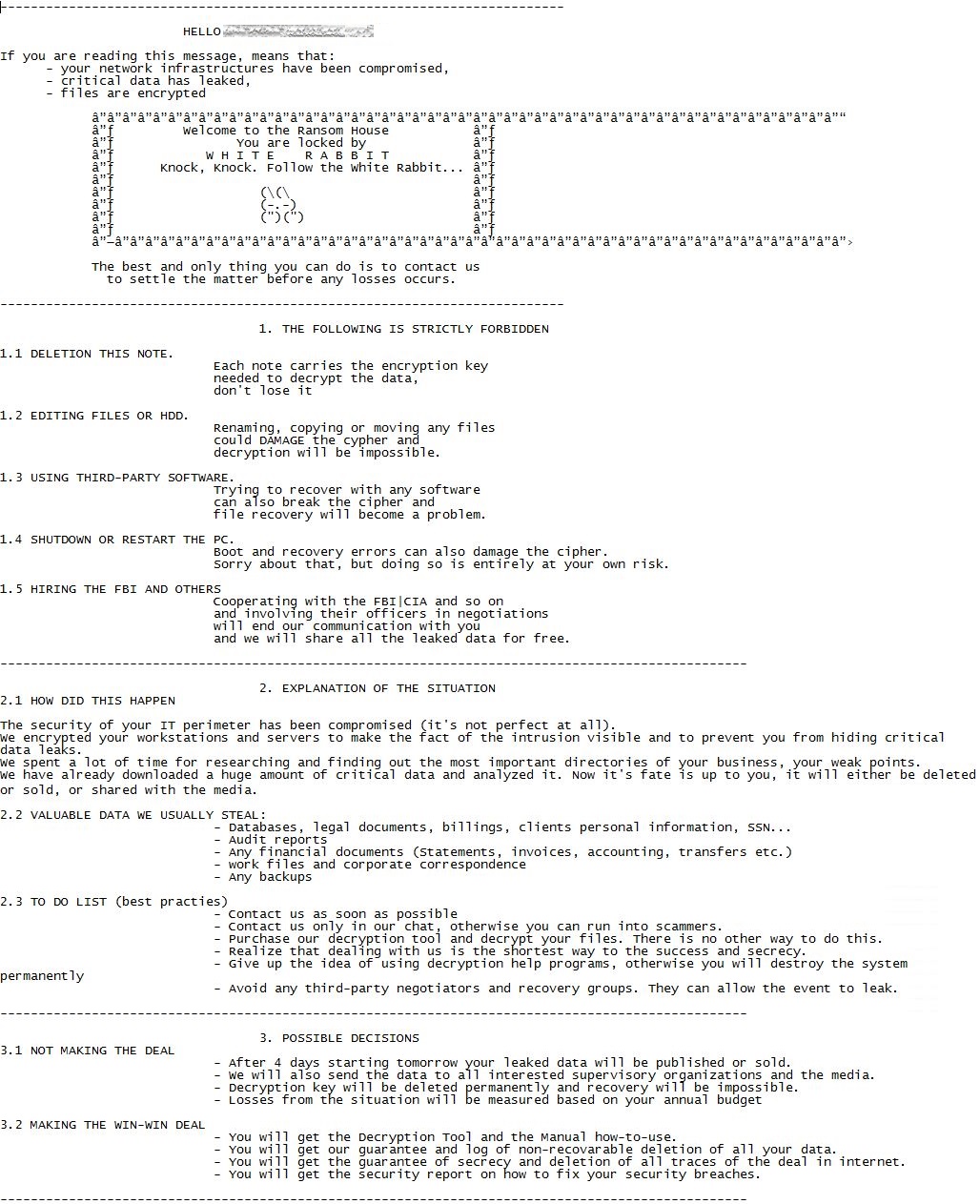
The ransom note informs the victim that their files had been exfiltrated and threatens to publish and/or sell the stolen data if the demands are not met.

White Rabbit ransom note

The deadline for the victim to pay a ransom is set to four days, after which the actors threaten to send the stolen data to data protection authorities, leading to data breach GDPR penalties.

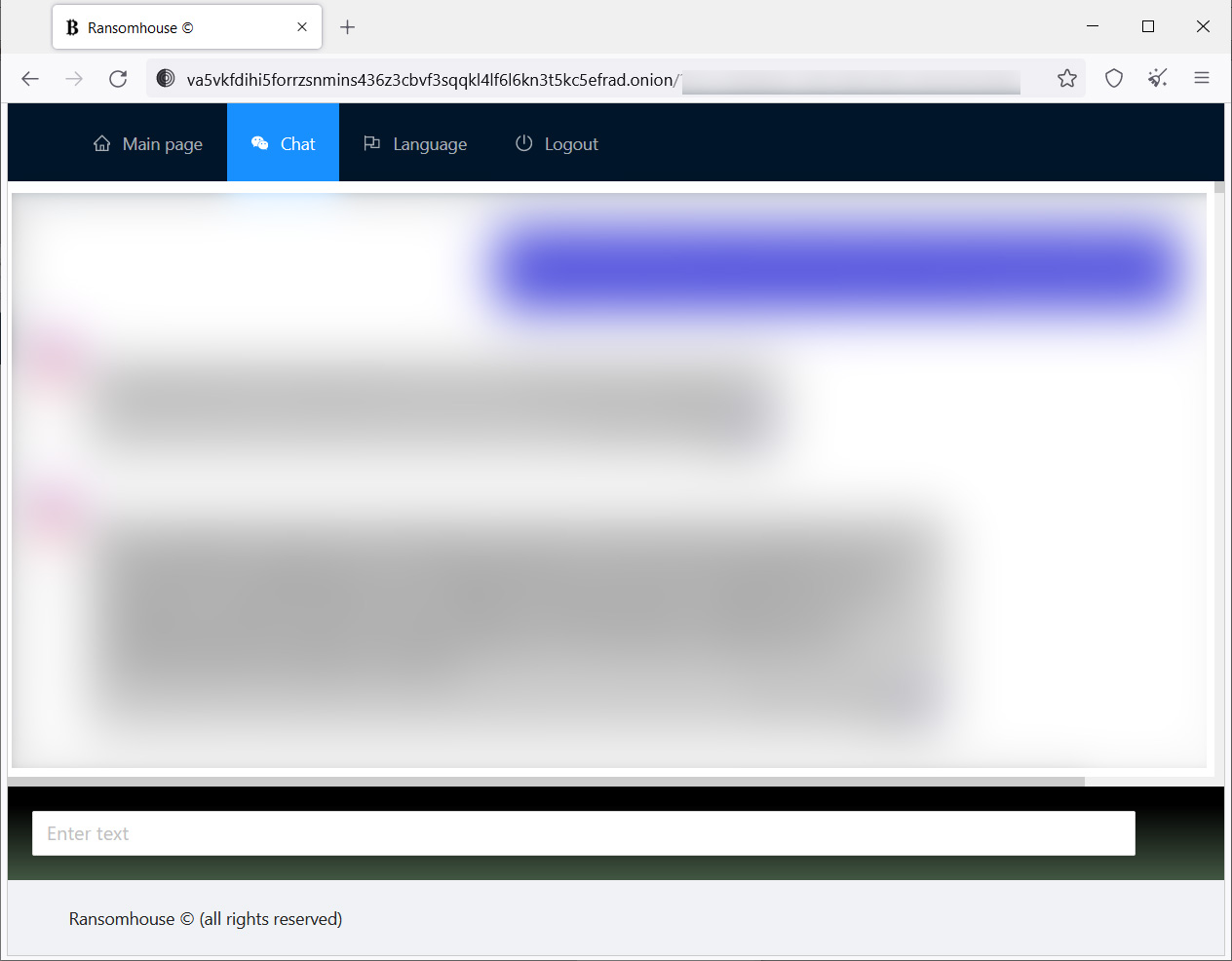
The evidence of the stolen files is uploaded to services such as 'paste[.]com' and 'file[.]io,' while the victim is offered a live chat communication channel with the actors on a Tor negotiation site.

The Tor site includes a 'Main page,' used to display proof of stolen data, and a Chat section where the victim can communicate with the threat actors and negotiate a ransom demand, as shown below.

Links to FIN8

As noted in the Trend Micro report, evidence that connects FIN8 and 'White Rabbit' is found in the ransomware's deployment stage.

More specifically, the novel ransomware uses a never-before-seen version of Badhatch (aka "Sardonic"), a backdoor associated with FIN8.

Typically, these actors keep their custom backdoors to themselves and continue to develop them privately.

This finding is also confirmed by a different report on the same ransomware family undertaken by Lodestone researchers.

They too found Badhatch in 'White Rabbit' attacks, while they also noticed PowerShell artifacts similar to FIN8-associated activity from last summer.

As the Lodestone report concludes: "Lodestone identified a number of TTPs suggesting that White Rabbit, if operating independently of FIN8, has a close relationship with the more established threat group or is mimicking them."

For now, White Rabbit has limited itself to only targeting a few entities but is considered an emerging threat that could turn into a severe menace to companies in the future.

At this point, it can be contained by taking standard anti-ransomware measures like the following:

  • Deploy cross-layered detection and response solutions.
  • Create an incident response playbook for attack prevention and recovery.
  • Conduct ransomware attack simulations to identify gaps and evaluate performance.
  • Perform backups, test backups, verify backups, and keep offline backups.

Chinese Developer Bond Rout Deepens on Hidden Debt Concerns

Here in Mesa, AZ It's "Don't ask and Don't Tell" . . .Things about OZones Nobody wants to talk about

Senate Finance Chair to Billionaire Developers: Explain How Opportunity Zone Tax Break is Helping The Poor

BLOGGER INSERT: First let's go back in time here in Mesa to March 2018

AZ State Senator Bob Worsley's Windfall Profits as DTMesa Real Estate Speculator in 'Innovation Districts' + 'Opportunity Zones'

Readers of this blog may have little noticed or don't remember that remark about "15-year moments"  made in a rare appearance by Mesa Mega-Millionaire Bob Worsley at a recent meeting of the Mesa City Council  . .  or a remark made by Mesa Mayor John Giles that the city will need to figure out how to finance recent MOUs and IGAs - Looks like Jivin'  John Giles will have to be looking for "more than an aircraft carrier" from the Federal Government to make reality out of all those half-baked Pie-In-The-Sky schemes financed by public taxpayer dollar$ for personal gain$ by his friends-and-family and their private $pecial intere$t$ - robbing from the poor and giving to the rich.
Here we go again! ...and here's a good question asked by https://news.impactalpha.com:
How do you ensure that wealth creation extends to the communities themselves, and not just the investors?
________________________________________________________________________________

The 90-day determination period for designating Opportunity Zones began in late December 2017 when the Opportunity Zones Program was created in the Tax Cuts and Jobs Act.
Invested capital will flow through “Opportunity Funds,” new funds and vehicles required to invest 90% of their assets in economically distressed communities. Governors must nominate areas for inclusion by March 21.
According to the Economic Innovation Group, which helped craft the law, there is probably close to $6 trillion sitting around in capital gains. . .

What will entice people to invest in Opportunity Zones?
Much of that is wrapped up around unrealized capital gains -- and avoiding taxes.
According to the Economic Innovation Group, which helped craft the law, there is probably close to $6 trillion sitting around in capital gains -- money made on existing investments -- with the run-up of the stock market.
The new law envisions the creation of Opportunity Funds whose managers would look for eligible projects in the Opportunity Zones, things like new businesses, investing in existing ones, real estate projects or even infrastructure.
An investor who puts his or her existing capital gains into one of those funds gets to defer paying taxes on that gain. . .

_____________________________________________________________________________

ProPublica is a nonprofit newsroom that investigates abuses of power. Sign up to receive our biggest stories as soon as they’re published.

"The chair of the Senate Finance Committee is demanding information from several billionaire developers to determine whether they are abusing a Trump tax break that was supposed to benefit poor communities.

Citing ProPublica’s reporting on the program, Sen. Ron Wyden, D-Ore., sent letters today to Jorge Perez of Related Group, Kushner Companies and several other developers asking for details on how they are taking advantage of what’s known as the opportunity zone program.

The program, created in President Donald Trump’s 2017 tax overhaul, provides a series of tax breaks for making investments in swaths of specially designated land around the country. The program’s bipartisan advocates contended the program would funnel money into disadvantaged neighborhoods that were otherwise starved for investment.

Under the program, investors receive tax advantages. Chief among them is that any gains on projects in the zones are tax-free after a number of years.

But ProPublica and other news outlets found that investments often went to develop projects that benefit the affluent. In a series of stories in 2019, ProPublica reported that developers around the country had successfully lobbied to get favored tracts included in the opportunity zone program, at the expense of poorer areas. Several of those tracts were in well-off areas or were sites of long-planned projects that predated the tax break, suggesting that public subsidies could flow to projects that were going to happen regardless.

Now Wyden is scrutinizing the tax benefit. “I have long been concerned that the Opportunity Zone program may permit wealthy investors another opportunity to avoid billions of dollars in taxes without meaningfully benefitting the distressed communities the program was intended to help,” Wyden wrote in the letter.

Wyden’s letter zeroed in on one of the projects highlighted by ProPublica: an opportunity zone in West Palm Beach, Florida, that contains a superyacht marina owned by a major Republican political donor.

“It appears that the Opportunity Zone program is already helping subsidize luxury real estate development by wealthy developers, and in many cases will allow these investors to realize the gains on their investments completely tax-free,” Wyden wrote. “Among the investments that have reportedly qualified for these generous tax breaks, are projects that include luxury apartment buildings and hotels, high-end office towers, self-storage facilities and a ‘superyacht marina.’”

In his letter to Perez, head of a company developing the luxury condo project in the West Palm Beach zone, Wyden requested information on when the project was conceived; details of any lobbying of public officials on the opportunity zone issue; and numbers on job creation and tax benefits associated with the project.

Asked for a response back in 2019, the West Palm Beach developers said they were not motivated to seek the tax break for their own benefit and hoped to spur additional economic development for the surrounding area.

Wyden’s letters are designed to fill in details about how the program is unfolding. While some have called for its outright abolition, even supporters of the opportunity zone program have decried the lack of any reporting requirements that might allow experts to measure whether the tax breaks are achieving their stated goals.

In 2019, Wyden introduced legislation that would increase reporting requirements for opportunity zone investors and curtail the kinds of projects that would qualify for tax breaks under the program. The legislation would also remove areas that were originally designated as opportunity zones that weren’t actually poor, including well-off areas of Detroit and Baltimore that ProPublica reported on that year"

RELATED CONTENT ON THIS BLOG

The hot topic of OZones has been featured multiple times of this blog for months, as faithful readers this site know well.
However, there's always more information to put in front of your eyes all the time.
Highlighted today are two reports from 03 January 2019, backed up with inserts of streaming vids [Trump signing the Opportunities & Jobs Act on December 12, 2017] + an audio to save you time on what is a lengthy and detailed post today that also features links to what the City of Mesa has published online with an excellent aerial Map.

Tomorrow's Mesa City Council Study Session at 5:15 pm starts off with a look at the City's Annual Financial Review for the fiscal years ending June 30, 2018.
The regular meeting will be presenting and discussing various ordinances and resolutions about more proposed real estate developments downtown that are within the OZone. 

Where Opportunity Zones stand, heading into 2019
The stage is set for Sean Parker’s pet project—now it’s time for the money to start rolling in
"When Trump’s tax overhaul became law a year ago, the real estate industry’s attention was focused on caps to the mortgage-interest deduction, plus state and local tax deductions—which the industry predicted would put the housing market in peril. (It didn’t.)
After the dust settled in the spring, the industry realized a hidden gem had been tucked away in the law: Opportunity Zones.

The brainchild of Silicon Valley financier Sean Parker,
Opportunity Zones allow investors to obtain massive tax advantages if they invest capital gains—money made on the sale of assets like a home, a business, or a piece of art—into “distressed” areas of the country where the post-financial crisis recovery passed by.

While the provision theoretically allows investors to put money into any type of project so long as it’s in a designated zone—a business, infrastructure, whatever—most observers believe it is especially attractive to real estate developers, partly because the largest tax benefits go to those who stay invested in the zone for at least 10 years.

Advocates for the program believe this could be a game-changing community development tool.

Given the horizon for these investments is quite far off, where do things currently stand?
While the Treasury guidance was mostly inside baseball for financial professionals, it seemed to open the flood gates for activity around Opportunity Zones, as firms announced their intention to jump into the space en masse. The firms interested tend to be private equity firms, which have experience in raising money for long-term financial projects—many of which already specialize in real estate development.
If the pitches arriving in the reporter's inbox are any indication, firms have been awfully busy making slide decks to pitch their Opportunity Zone projects to investors. Some ahead-of-the-curve outfits have already raised money, for example, private equity firm Virtua Partners, which is close to breaking ground on three Opportunity Zone projects in Arizona. . .
 
Opportunity Zones                     
OppZonePPTphotoForWeb
The Opportunity Zones program is a federal program designed to spur community investment by providing tax benefits to investors. The City of Mesa has 11 census tracts that have been designated Opportunity Zones by the U.S. Department of the Treasury.
The map below highlights these tracts within the city boundaries.
Image result for opportunity zones
Mesa’s designated Opportunity Zones are anchored by four [six] central business districts:
  • Downtown Mesa
  • the Fiesta District
  • the Falcon District
  • the Gateway Area [Gateway Area North and Gateway Area South]
  • the Riverview District [added below]
The Aerial Mesa tool showcases what makes each district an ideal place to locate and grow a business, including the location of Opportunity Zones, Major Employers and Assets, New Development and Investments, and Development Opportunities.
To visit the Aerial Mesa tool and explore Mesa’s Opportunity Zones visit the links below.
__________________________________________________________________________________

DOWNTOWN MESA Link > https://aerialsphere.com/city-of-mesa/downtown-mesa/

Source:
https://www.selectmesa.com/business-environment/incentives-programs/opportunity-zones

OPPORTUNITY ZONES:
A NEW INCENTIVE FOR INVESTING IN LOW-INCOME COMMUNITIES
________________________________________________________________________________