Tuesday, March 01, 2022
Monday, February 28, 2022
KNOCKED OUT! MISSION ACCOMPLISHED: Attacks in The Cyber Domain | Forbes Breaking News
WHOA! Hacktivists join fighting on the ground...More cyber attacks over the weekend
Moscow Exchange, Sberbank Websites Knocked Offline—Was Ukraine’s Cyber Army Responsible?

"While its claims couldn’t be verified, the Ukraine IT Army, a crowdsourced community of hackers endorsed by Kyiv officials, called on members to launch attacks on the website, Moex[.]com, early on Monday. On Telegram, the IT Army claimed it took only five minutes to knock the site down. Mykhailo Fedorov, Ukraine’s deputy prime minister who announced the formation of the Army, celebrated on Facebook: “The mission has been accomplished! Thank you!”
The central bank of Russia initially delayed and then confirmed the Moscow Exchange would remain closed today as the impact of global sanctions led to the ruble dropping to a record low against the dollar. The London-listed shares of Sberbank plunged 70% amid a major sell of Russian stocks like Lukoil that trade on the London Stock Exchange.
“We can confirm the Moscow Exchange website is down, but we don't have visibility into the incident’s root cause or the extent of the disruption,” a spokesperson for NetBlocks, which tracks internet connectivity across the world, told Forbes. Moex hadn’t responded to a request for comment at the time of publication.
This morning, the IT Army, announced by deputy prime minister Fedorov this weekend, also attempted to organize an attack on the website of Russia’s largest lender, Sberbank. Fedorov also claimed on Facebook that “Sberbank fell!” In the middle of the afternoon Moscow time, the site was inaccessible, as confirmed by NetBlocks.
The website outages land amid a range of attacks being launched alongside the fighting on the ground, where hacktivists have joined the fray in support of both Ukraine and Russia.
Many are distributed denial of service (DDoS) attacks, where website servers are flooded with traffic to the point they’re unusable. Various Ukrainian bank and government websites were knocked offline earlier this month, following attacks that were later attributed by Ukrainian, U.S. and U.K. officials to Russia. Computer wiping malware was also seen to spread across Ukrainian financial, defense, aviation and IT services organizations.
The wave of cyberattacks appears to be going in the opposite direction than it was earlier this month, with most attack traffic targeting Moscow. Cloudflare, a company that protects and tracks internet traffic, said it had seen a “marked increase” in DDoS attacks originating in Ukraine. “There was a large increase in bot traffic in Ukraine also. These two things may be related,” a spokesperson said, noting that “cyberattacks remain relatively quiet on .ua [Ukraine] domains.”
There were other reports of cyberattacks over the weekend. The official Kremlin website went down, and Belarus was drawn into the conflict on the ground and in the cyber domain.
> On Sunday, a group called the Belarusian Cyber-Partisans announced it had targeted the Belarusian railway in support of Ukraine and in protest at the involvement of Belarus in Russia’s invasion. The group claimed railroads in Minsk and Orsha had been paralyzed. Forbes could not verify their claims, though Bloomberg reported an ex-Belarusian railway employee claiming that there were some outages of certain systems."
DATA-GRABBING: What Amazon knows about YOU
The data game: what Amazon knows about you and how to stop it
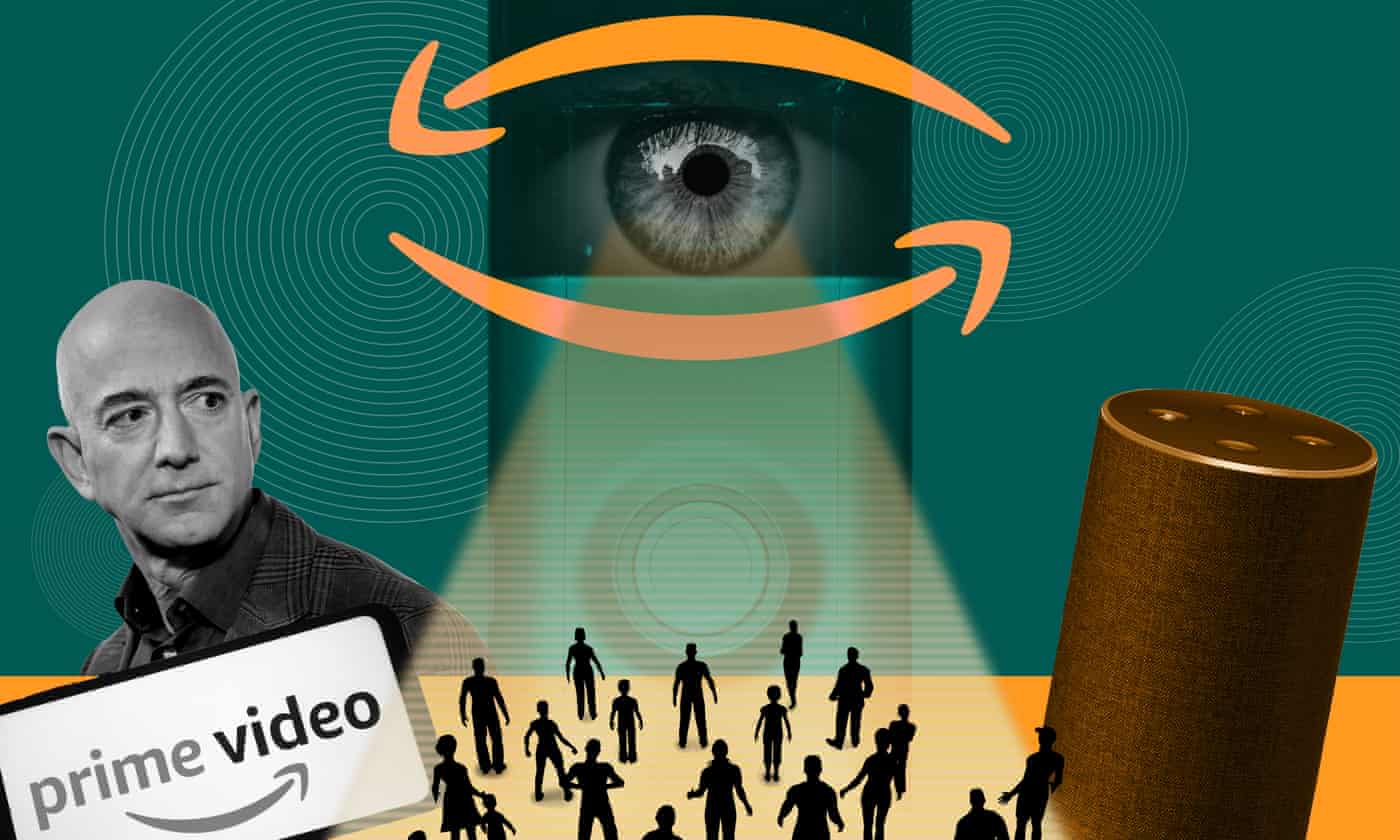
"The tech giant has many ways of gathering information about its users’ activity – from Prime to Alexa. But how much can it collect and what can you do to keep your life private?
From selling books out of Jeff Bezos’s garage to a global conglomerate with a yearly revenue topping $400bn (£290bn), much of the monstrous growth of Amazon has been fuelled by its customers’ data. Continuous analysis of customer data determines, among other things, prices, suggested purchases and what profitable own-label products Amazon chooses to produce.
The 200 million users who are Amazon Prime members are not only the corporation’s most valuable customers but also their richest source of user data. The more Amazon and services you use – whether it’s the shopping app, the Kindle e-reader, the Ring doorbell, Echo smart speaker or the Prime streaming service – the more their algorithms can infer what kind of person you are and what you are most likely to buy next. The firm’s software is so accomplished at prediction that third parties can hire its algorithms as a service called Amazon Forecast.
Not everyone is happy about this level of surveillance. Those who have requested their data from Amazon are astonished by the vast amounts of information they are sent, including audio files from each time they speak to the company’s voice assistant, Alexa.
Like its data-grabbing counterparts Google and Facebook, Amazon’s practices have come under the scrutiny of regulators. Last year, Amazon was hit with a $886.6m (£636m) fine for processing personal data in violation of EU data protection rules, which it is appealing against. And a recent investigation showed concerning privacy and security failings at the tech giant.
So, what data does Amazon collect and share and what can you do to stop it?
The data Amazon collects, according to its privacy policy
Strict EU regulation in the General Data Protection Regulation (GDPR) and UK equivalent the Data Protection Act limit the ways personal data can be used in Europe compared with the US. But, according to Amazon’s privacy policy, the tech giant still collects a large amount of information. This covers three areas: information you give Amazon, data it collects automatically and information from other sources such as delivery data from carriers.
Amazon can collect your name, address, searches and recordings when you speak to the Alexa voice assistant. It knows your orders, content you watch on Prime, your contacts if you upload them and communications with it via email. Meanwhile, when you use its website, cookie trackers are used to “enhance your shopping experience” and improve its services, Amazon says.
How often you look up words on the Kindle e-reader might indicate how literate you are in a certain language
Some of the data is used for “personalisation” – big tech speak for using your data to improve your online experience – but it can reveal a lot about you. For example, if you just use its online retail site via the app or website, Amazon will collect data such as purchase dates and payment and delivery information.
“From this information, Amazon can work out where you work, where you live, how you spend your leisure time and who your family and friends are,” says Rowenna Fielding, director of data protection consultancy Miss IG Geek.
At the same time, Prime Video and Fire TV information about what you watch and listen to can reveal your politics, religion, culture and economic status, says Fielding. If you use Amazon to store your photos, a facial recognition feature is enabled by default, she says. “Amazon promises not to share facial recognition data with third parties. But it makes no such commitment about othertypes of photo data, such as geolocation tags, device information or attributes of people and objects featured in images.”
. . .Meanwhile, Amazon’s Kindle e-reader will collect data such as what you read, when, how fast you read, what you’ve highlighted and book genres. “This could reveal a lot about your thoughts, feelings, preferences and beliefs,” says Fielding, pointing out that how often you look up words might indicate how literate you are in a certain language.
[ ] How Amazon shares data across its own services
[ ] How Amazon shares your data with third parties
[ ]
What you can do to stop Amazon collecting data
Amazon’s data collection is so vast that the only way to stop it completely is not to use the service at all. That requires a lot of dedication but there are some ways to reduce the amount of data collected and shared.
If you are concerned about what Amazon knows about you, you can ask the company for a copy of your data by applying under a “data subject access request”. The Alexa assistant and Ring doorbell have their own privacy hubs that allow you to delete recordings and adjust privacy settings. Ring’s Control Centre allows you to tweak settings including who’s able to see and access your videos and personal information from a central dashboard. Speaking to Alexa, you can say: “Alexa, delete what I just said” or: “Alexa, delete everything I said today.”
Amazon says it allows customers to view their browsing and purchase history from “Your Account” and manage which items can be used for product recommendations. More broadly, you can also use privacy-focused browsers such as DuckDuckGo or Brave to stop Amazon from tracking you.
But it’s not always easy to change the settings on Amazon itself, says Chris Boyd, lead analyst at security company Malwarebytes. He recommends turning off browsing history on Amazon and opting out of interest-based ads to reduce the level of tracking by the company. Yet he warns: “You’ll likely still see ads from Amazon or encounter third-party advertisers in one form or another – they just won’t be as targeted.”
Go here for more details >> https://www.theguardian.com/technology/2022/feb/27/the-data-game-what-amazon-knows-about-you-and-how-to-stop-it
INSTALLING SMALL CELLS ON CITY STREET LAMP POSTS: Testing and Deployment of 5G
AT&T begins testing and deployment of discreet 5G radios on city street lamp posts
/cdn.vox-cdn.com/uploads/chorus_image/image/70552296/Ericsson_Ubicquia_Street_Radio_Aerial_Install.0.jpg)
AT&T today announced it’s field testing new 5G small cell radios that can hide on top of street lamp posts. The new radios were born out of a partnership between AT&T, mobile technology manufacturer Ericsson, and urban solutions provider Ubicquia.
“It is virtually unseen from street level,” wrote Gordon Mansfield, AT&T’s VP of mobility access & architecture, in a company blog post. Mansfield touted that these new low- / mid-band 5G radios can be deployed within 15 minutes on street lamps. “No long wires and big, bulky boxes – a true aesthetic improvement,” Mansfield wrote.
Anything that helps 5G blend in is a good thing since there’s also “ground furniture” and being a target of vandalism to worry about. These new small cell radios are not a replacement for the much faster but more visible mmWave antennas that can cover only a couple of city blocks. But since the new radios are powered by street lamps and connected to nearby fiber, it could reduce the need to erect more standalone small cell towers in cities.
Street lights have become a pylon for many modern technologies in cities. By piggybacking off of existing infrastructure, technology like public Wi-Fi access points, security cameras, and gunshot-detecting sensors can be holstered on the poles. There are even companies like Ubitricity that add electric vehicle charging to street lights.
It would be welcome to get more reliable 5G data connections in cities without the ugly boxes scattering city blocks — especially if it means deploying to more underserved communities that don’t have proper connectivity. But AT&T is only “poised” to begin using the small cells, which were being trialed by the company last year. “We are now in the process of field testing and deploying commercially available units in multiple cities,” Mansfield wrote."
Reference:
AXIOS :: Recent Reuters-Ipsos Poll
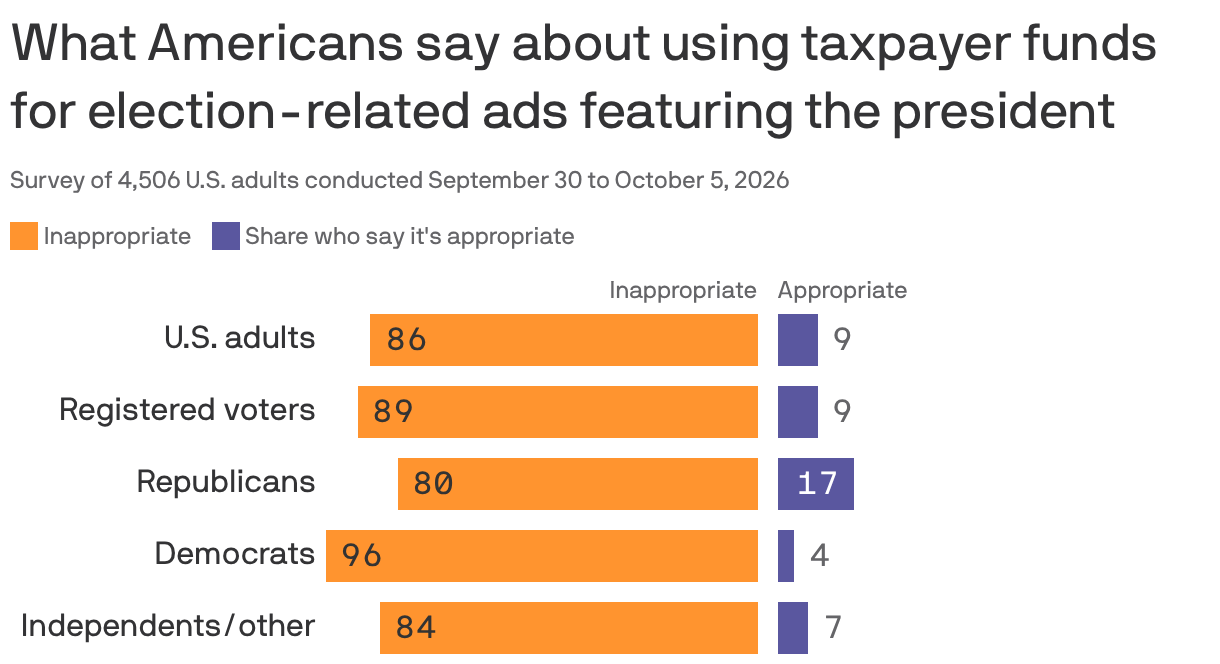
Data: Reuters/Ipsos ; Chart: Avery Lotz/Axios Nearly nine in 10 voters say using taxpayer money to pay for election-related ads featuring t...
-
 Flash News: Ukraine Intercepts Russian Kh-59 Cruise Missile Using US VAMPIRE Air Defense System Mounted on Boat. Ukrainian forces have made ...
 -
A nor’easter is about to hit the Northeast in May. That’s very unusual.

