 |
Groundwater Well Operations |

 | QUESTIONS? Contact Us |
|
Groundwater Well Operations |
| | QUESTIONS? Contact Us |

"A Ukraine government official on Monday asked the nonprofit group that oversees the Internet's Domain Name System (DNS) to shut down DNS root servers in Russia and revoke Russian domains such as .ru, .рф, and .su. The letter to ICANN (Internet Corporation for Assigned Names and Numbers) was posted here, and ICANN has confirmed that it received the letter.
. . .Sent days after Russia's invasion of Ukraine began, the letter said that Russia's "atrocious crimes have been made possible mainly due to the Russian propaganda machinery using websites continuously spreading disinformation, hate speech, promoting violence and hiding the truth regarding the war in Ukraine. Ukrainian IT infrastructure has undergone numerous attacks from the Russian side impeding citizens' and government's ability to communicate."
. . .The letter was sent by Mykhailo Fedorov, Ukraine's vice prime minister and minister of digital transformation, to ICANN CEO Göran Marby. "Apart from these measures, I will be sending a separate request to RIPE NCC asking to withdraw the right to use all IPv4 and IPv6 addresses by all Russian members of RIPE NCC (LIRs-Local Internet Registries), and to block the DNS root servers that it is operating," Fedorov wrote. RIPE NCC (Réseaux IP Européens Network Coordination Centre) is the regional Internet registry.
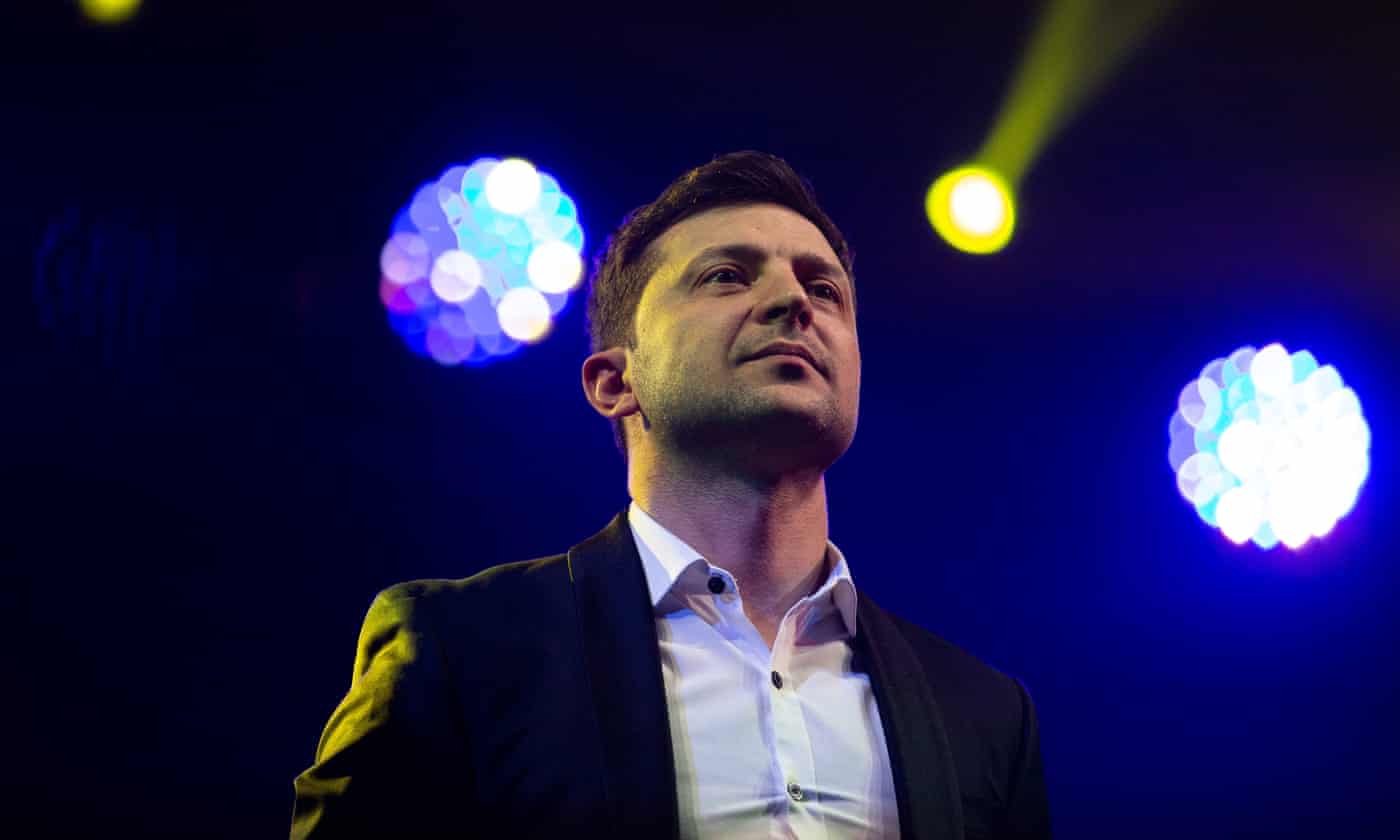
Volodymyr Zelenskiy in March 2019, weeks before becoming Ukraine’s president. Photograph: Bloomberg/Getty
Last modified on Wed 2 Mar 2022 04.10 EST
As the president of Ukraine, his defiance has made him a hero across the world. Could his success as a politician lie in his years as an entertainer?
"Hugh Bonneville was as surprised as anyone this week to learn of the extent of the talents of the Ukrainian president, Volodymyr Zelenskiy. “Until today,” he tweeted, “I had no idea who provided the voice of Paddington Bear in Ukraine.”
 But there is plenty about Zelenskiy’s showbiz career that has been underestimated. When Zelenskiy was elected in April 2019, at the age of 41, the Russian commentator Sergey Parkhomenko said: “He is weak, he does not have a religion, he does not have a nationality.” It was meant as a criticism, even though all these reasons were precisely why people had voted for Zelenskiy. He is not intimidating. He does not come from a political background. He is a Russian speaker from the centre of the country. But, most of all, to Ukrainians, he was recognisable and he was funny. That nice guy off that TV show Servant of the People. You know, the one where the geeky history teacher becomes the president overnight. The Paddington voice guy.
Outside the Russian-speaking world, you wouldn’t have known any of this. You probably wouldn’t even have heard of the TV show, even though it was eventually snapped up by Netflix. (It is now available on YouTube with English subtitles.) Beyond Ukraine, until last week, he was simply referred to as “a comedian who became president”. Initial coverage of his landslide victory – in which he won 73.2% of the vote – was derisory. What were the Ukrainians thinking? Who is this guy anyway? He is hardly Ronald Reagan. What a joke.

But the word “comedian” is misleading. It suggests someone who is a) not serious and b) a solo performer. Zelenskiy is neither of these things. He has never been a standup. The tradition of “monologue comedy” is fairly new in post-Soviet countries. (Perhaps the only post-Soviet standup known outside Russia or Ukraine is St Petersburg-based Igor Meerson, who performs in Russian and English and has supported Eddie Izzard on tour.) Also, as is now obvious from the viral videos of Zelenskiy’s pre-presidential life, his career may have been in entertainment, but he took it extremely seriously. He is a workaholic, he has always meant business and he is a team player. These are the qualities – forged in the sequined furnace of post-Soviet showbiz life – that give him the edge.
It is the “team player” aspect that is really interesting – and perhaps difficult to grasp immediately from a western perspective. If you think about the US or European model of showbiz success – and especially in comedy – performers often start in collectives (Saturday Night Live, Armando Iannucci’s The Day Today lineup), but they rarely stay together. Instead, they usually use the collective as a springboard for a career as a solo performer. Zelenskiy, however, has always been part of something bigger than himself.
He started out in 1995, as a teenager, as an improviser in KVN competitions in his area. KVN (Klub Vesyolykh i Nakhodchivykh, or Club of the Funny and Inventive) is a beloved institution known throughout the former Soviet Union, which went on to become one of the longest-running shows on Russian television. (Its social media feeds have been inactive since 27 February.) It grew out of the 60s TV show Vecher Vesleykh Voprosov (An Evening of Funny Questions), in which performers would compete to come up with the funniest answers, in the style of Whose Line Is It Anyway?. Taken off air in the early 70s after it fell foul of the censors, it was revived in 1986 during the era of glasnost and perestroika.
Zelenskiy was a keen competitive improviser and became part of Ukraine’s Kvartal 95 team of about 10 players, touring the then recently dissolved USSR, winning KVN competitions and honing their Russian-language sketches. It was only much later that they started to do more sketches in Ukrainian: Zelenskiy’s story represents the fluidity and divides between Russian and Ukrainian cultural audiences. He is and isn’t “one of ours”.

In 2003, Kvartal 95 was established as an independent production company, making TV shows and films for Ukrainian and Russian-speaking audiences. The project got a boost when Zelenskiy won Ukraine’s Dancing With the Stars in 2006, performing with his professional partner, Alena Shoptenko. She is still one of the 196 people he follows on Instagram. (He has 13.4 million followers.) Highlights included a jive to Blue Suede Shoes, with Zelenskiy giving it the full pink-satin-jumpsuited Elvis, a pencil moustache for a tango to Big Spender, a blindfolded rumba to Sting’s The Shape of My Heart and a quirky American smooth dressed as Charlie Chaplin. His performances were energetic and all-in – and he was super-fit. This was – and is – clearly important to him: until he became president, he would regularly post videos on social media from the gym, or swimming, or jogging in New York.
His screen work grew. In 2008, he played Igor, a Russian dentist living in New York, in Love in the Big City. Igor is one of three friends suddenly struck impotent, who must then find the path to true love in order to regain their virility. (It is easy to react disparagingly to this, but the film made $9m at the box office and it is fair to say that Steve Carell’s The 40-Year-Old Virgin is not too dissimilar in tone.)
Two sequels followed. In Office Romance: Our Time (2011), he played Anatoly, a financial analyst with a difficult boss. In trying to get promoted, he ends up falling in love with her, after many shenanigans involving a cable car, a motorbike and other, er, vehicles for physical comedy . . .
MORE >>

The trump card evident now, though, is Zelenskiy’s status as a team player. In his speech to the Russian people last week, he asked them to question official propaganda. Why would he support a war that targets cities he knows and loves? “To shoot who? To bomb what? … Lugansk? The home of my best friend’s mother? The place where his father is buried?”

The best friend he is talking about is Yevgeni Koshevoy, known as “Lysy” (Baldy – you can see him dancing in the Beyoncé video), whose family are indeed from Lugansk. The pair have worked together for 18 years and shared the stage in the spring of 2014 when the Kvartal 95 troupe performed to soldiers on the frontline when the war began in Donbas. Koshevoy once said of this time: “People told us they were smiling at our jokes – smiling for the first time in weeks – that night.”
Intro:

"In the wake of her speech to a white nationalist conference and a string of offensive and inflammatory social media posts, the Arizona Senate voted to censure Republican Sen. Wendy Rogers.
The Senate voted 24-3 in a rare censure of one of its own, with 11 of the chamber’s 16 Republicans siding with the chamber’s 13 Democratic members who were in attendance. Rogers voted no, as did GOP Sens. Nancy Barto and Warren Petersen.
The censure, which has no practical effect, was for comments calling for people she perceived as enemies to be hanged from gallows, and for social media postings Rogers made threatening to “personally destroy” fellow Republicans who sought to punish her. The censure resolution was silent on her embrace of white nationalists and a string of antisemitic and racist things she had posted online in recent days.
Rogers, a Flagstaff Republican, didn’t defend or even address her comments on the Senate floor. Instead, she called the censure an attempt to limit her freedom of speech.
======================================================================
INSERT: Listen to what Rogers had to say following the censure - including an allegation for defamation of character

======================================================================
“I represent hundreds of thousands of people and the majority of them are with me. And they want me to be their voice. You are really censuring them. I do not apologize. I will not back down. And I am sorely disappointed in the leadership of this body for colluding with the Democrats to attempt to destroy my reputation,” Rogers said. “In the end, I rejoice in knowing I do and say what is right. And I speak as a free American, regardless of the actions of this corrupted process today.”
However, Senate President Karen Fann said the censure wasn’t about freedom of speech.
“We do support First Amendment freedom of speech. We absolutely support it. We fight battles over it. But what we do not condone is members threatening each other, to ruin each other, to incite violence, to call us communists. We don’t do that to each other,” said Fann, a Prescott Republican. “We, as elected officials, are held to a higher standard.”
[. ] Republicans have only a 16-14 majority in the Senate, meaning Rogers could block any GOP bill that doesn’t have Democratic support from passing.
Rogers spoke to the white nationalist America First Political Action Conference on Feb. 25. She called for gallows to be built so “high-level criminals” and “traitors who have betrayed our country” can be publicly hanged. . .Rogers threatened retaliation against any GOP colleagues who joined the effort, writing on social media, “I will personally destroy the career of any Republican who partakes in the gaslighting of me simply because of the color of my skin or opinion about a war I don’t want to send our kids to die in.”
. . .Rogers reposted messages from supporters on Telegram referring to the senators who censured her “godless commies” and calling the vote “Karen Fann’s last betrayal before she slithers away into retirement.” Fann is not running for re-election, though she’s eligible to seek another term in the Senate.
Rogers posted a draft version of the censure on social media, which showed that it was originally written to reprimand her for “inciting general racial and religious discrimination.” But that language was removed, as was a reference to her support of Putin.

Fann told the Arizona Mirror that she removed the language on racial and religious discrimination because some senators wanted to make clear that they support freedom of speech, but that Rogers’ threatening comments are not protected under the First Amendment.
[. ] Rogers spent a decade seeking office, first from Tempe and then from Flagstaff, before finally winning a state Senate race in 2020, ousting incumbent Sylvia Allen in the Republican primary. She ran for the Senate in 2010, then for Congress in each of the four subsequent elections, twice seeking the seat for the 9th Congressional District in the Phoenix area and twice running for the northern Arizona-based 1st Congressional district.
...Rogers has become one of the legislature’s most vocal proponents of the false and debunked allegations that the 2020 presidential election was rigged against former President Donald Trump. She has made herself into a celebrity among Trump supporters across the country, raising $2.5 million for her re-election, a record for a legislative candidate in Arizona. . .
[. ] Please Note:
Rogers was nearly drawn out of her legislative district but was saved by a last-minute change by the Arizona Independent Redistricting Commission. Rogers’ Flagstaff home was initially going to be in the new District 6, which is majority Native American and overwhelmingly Democratic. The commission made a series of changes to move parts of Flagstaff out of the district at the behest of the tribes, which were concerned about being outvoted in Democratic primaries by white voters.
After what appeared to be the final changes, Republican Commissioner David Mehl proposed one more change that moved another portion of southern Flagstaff, including Rogers’ home, into heavily Republican District 7. Democratic Commissioner Shereen Lerner claimed Mehl said he was making the change at the request of a friend. Mehl would not say who asked him to make the change or whether he knew an incumbent lawmaker lived there."
RELATED


PHOENIX (AP) — The Arizona Republican Party is asking the state Supreme Court to strike down the vote-by-mail system used by 90% of voters in a battleground state that will be crucial to determining which party controls the U.S. Senate after the 2022 election.
The lawsuit filed Friday argues absentee voting is unconstitutional and asks the justices to get rid of it or at least eliminate the no-excuse absentee balloting system Arizona adopted in 1991 and has steadily expanded ever since.
“In-person voting at the polls on a fixed date (election day) is the only constitutional manner of voting in Arizona,” lawyers for the GOP wrote in their petition to the Arizona Supreme Court.
The lawsuit comes amid GOP efforts on many fronts to remake the system for casting and counting votes as former President Donald Trump repeats the lie that he lost the 2020 election because of fraud in Arizona and other battleground states.
It is modeled on a similar lawsuit in Pennsylvania, where a court in January struck down the state’s two-year-old mail voting law. Democratic Gov. Tom Wolf’s administration has appealed to the state Supreme Court
The Arizona Republican Party and its combative chairwoman, Kelli Ward, have been at the forefront of Trump’s efforts to cast doubt on the 2020 election results and block the certification of Democratic President Joe Biden’s victory.
> The latest suit was filed by the state GOP and Yvonne Cahill, the party’s secretary. Ward is not named as a plaintiff.
Several bills introduced in the Legislature aim to eliminate or severely restrict mail balloting, though some look unlikely to succeed due to opposition from one or more Republicans. Lawmakers voted Monday to put a question on the 2022 ballot that, if approved, would require voters to write their birthday and either a driver’s license number or partial Social Security number on mail ballots starting in 2024.
The suit drew swift condemnation from Democrats who said the GOP is attacking a secure and popular voting method.
“I look forward to once again defending the voters of Arizona and defeating this ridiculous attempt to undermine our elections,” said Democratic Secretary of State Katie Hobbs, a Democrat and a defendant in the case.
The lawsuit is based on lies and conspiracy theories about the 2020 election, said Raquel Terán, a state senator and chairwoman of the Arizona Democratic Party.
“So this is yet another attempt by the Arizona Republicans to make it harder for people to vote,” Terán said.
The lawsuit cites a provision of the state constitution outlining the procedures for citizens to propose their own laws. The constitution says initiatives are decided in “such manner that the electors may express at the polls their approval or disapproval of (a) measure.”
The inclusion of the phrase “at the polls” means the constitution requires ballots to be cast only at in-person polling places, attorneys from the firm Davillier Law Group argued.
They ask the justices to throw out all early voting procedures.
If the justices are unwilling to go that far, the GOP asks the court to roll back the expansion of no-excuse absentee voting since 1991, eliminate ballot drop boxes, prohibit ballot counting before election day, or prohibit voting absentee on initiatives and referenda.
The GOP did not challenge absentee voting for members of the military, which the state is required to allow by federal law.
In 2020, 90% of Arizona voters used a ballot that arrived in the mail, which can be returned through the U.S. Postal Service, an official drop box run by county election officials or to a polling place. The ballots are collected at a central warehouse, where workers confirm the signature on the outside of the ballot envelope matches signatures on file to verify the vote is legitimate.
There has been no widespread fraud."
About BleepingComputer.com. . . In addition to news, we provide a wide array of free technical support services, downloads, and self-educati...


