Monday, March 07, 2022

SAY WHAT: Americans want to be carbon neutral, don’t want to take needed steps

Intro: Sort yourselves out -- Obviously, if you refuse to admit that there's a problem, you're not likely to support a policy meant to address it.
There are some obvious problems here with people not having a firm grip on reality. People still don't think humans are causing climate change, or they somehow refuse to recognize that reducing fossil fuel use will lead to cleaner air. But those have been issues for a while, and the people who believe those things are unlikely to support a pathway to carbon neutrality anyway.
The larger problem is that even the people who claim to support putting the US on a path that leads to carbon neutrality don't seem to realize the sorts of changes it requires. Given that, many of them are unlikely to support the policy changes that are needed to get there.
 

Americans want to be carbon neutral, don’t want to take needed steps

The country hasn't come to grips with what carbon neutrality actually means.
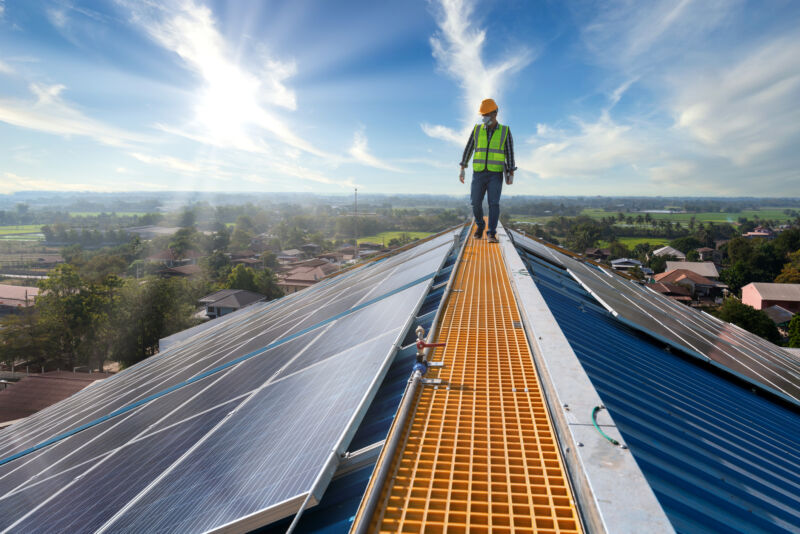
<div class=__reading__mode__extracted__imagecaption>EnlargePramote Polyamate

"Earlier this week, the Pew Research Center announced the results of polling that asked the US public its thoughts on how to address climate change. While the usual partisan split was apparent, the survey highlights an even larger challenge that policymakers will face: the US public supports contradictory things when it comes to climate policy.

> Nearly 70 percent of the public favored taking steps toward the goal of being carbon neutral by 2050. Yet less than a third support transitioning off fossil fuels.

What we want vs. how we get there

The survey was very large, having reached over 10,000 US adults at the end of January. That's enough to ensure that different groups within the population are well represented. For most questions, Pew divides up the US populace into conservative Republicans, moderate Republicans, moderate Democrats, and liberal Democrats.

As is usually the case, there's a big divide on climate issues. Overall, 70 percent of the US public supports taking a pathway to carbon neutrality. Support is much higher among the moderate and liberal Democrats, where roughly 90 percent favor going carbon neutral, as do two-thirds of moderate Republicans. But among the conservatives, only a third support this policy.

This gap is because a large portion of conservative Republicans refuse to accept reality, with just over half saying that human activity doesn't contribute to climate change, and only 11 percent acknowledging that we make a large contribution. Obviously, if you refuse to admit that there's a problem, you're not likely to support a policy meant to address it. The numbers that acknowledge our large contribution rise to 29 percent of moderate Republicans, 60 percent of moderate Democrats, and 81 percent of liberals.

Reaching carbon neutrality would involve a number of dramatic steps, including the elimination of most fossil fuels for generating electricity and transportation and the development of carbon capture to offset emissions that can't be avoided.

The most obvious routes to those goals would include the electrification of vehicles and the rapid expansion of renewable power sources like wind and solar.
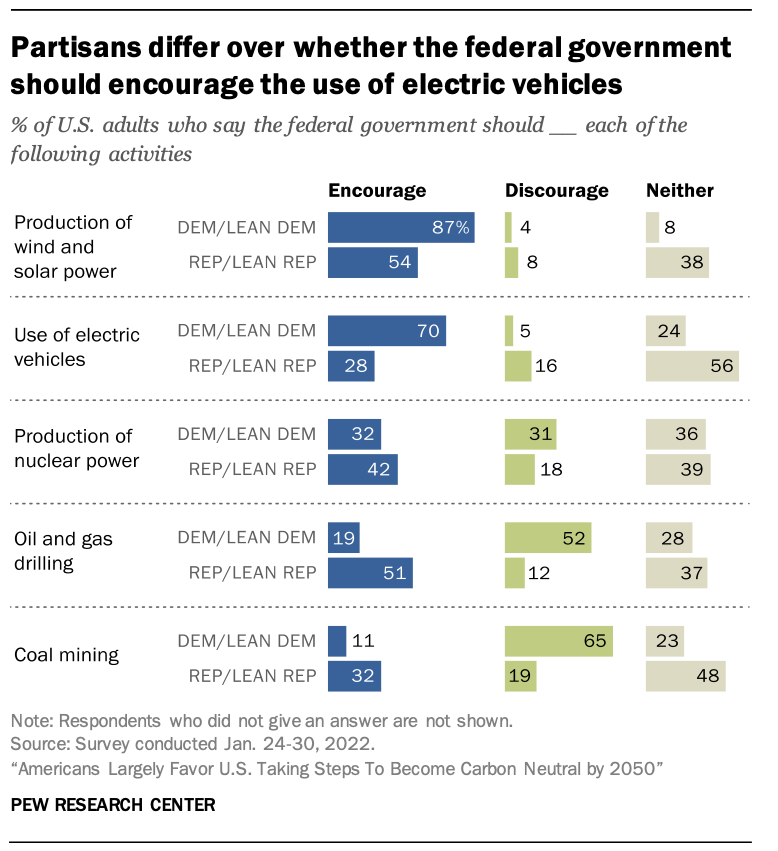
There are large partisan divides over many of the things that will be needed to get us to carbon neutrality.

Given those results, you might suspect that the support for these sorts of efforts would be roughly parallel with the support for going carbon neutral in general. But that's nowhere close to being true. Two-thirds of all respondents indicated that they wanted to see the US use a mix of fossil fuels and renewables, and a third said that the government should encourage oil and gas drilling. Twenty percent even felt the government should encourage coal mining, the most emissions-intensive form of fossil fuel (fortunately, over twice as many felt this should be discouraged).

. . .While wind and solar production was widely supported—72 percent felt it should be encouraged—only half thought the government should promote the use of electric vehicles.

Added benefits

Regardless of whether the US formally commits to a path to carbon neutrality, the low cost of renewable generation ensures that we'll be seeing a lot more of it in the near future. So Pew also asked people how they viewed this transition. A large majority of Democrats expected to see improvements to air and water quality and an increase in job opportunities in the energy sector. Republicans were evenly split between expecting the same thing or not foreseeing any significant changes. . .

The public is also wary of the risk of unforeseen consequences. Over half of Democrats and 81 percent of Republicans thought it was somewhat or very likely that the transition away from fossil fuels would create "unexpected problems."

Finally, Pew found that there was a general pessimism about whether the world will manage to avoid the worst impacts of climate change. In every group but moderate Democrats, a majority felt that we won't get our act together in time. Even among moderate Democrats, 44 percent were pessimistic.

PAIN AT THE PUMP LIKE IT'S 2008 ALL OVER AGAIN?

Intro: Markets worldwide have swung wildly recently on worries about how high prices for oil, wheat and other commodities produced in the region will go because of Russia’s invasion, inflaming the world’s already high inflation.
Companies have been exiting Russia, including Mastercard and Visa, as well as Netflix. The conflict in Ukraine also threatens the food supply in some regions, including Europe, Africa and Asia, which rely on the vast, fertile farmlands of the Black Sea region, known as the “breadbasket of the world”.

Economy|Russia-Ukraine war

Oil prices soar, stocks tank as Russia-Ukraine war rages

Brent leaps to almost $140 a barrel, the highest level since 2008

aljazeera.com

"The price of crude oil has jumped more than $10 a barrel and shares were sharply lower as the conflict in Ukraine deepened amid mounting calls for harsher sanctions against Russia.

Brent crude oil surged more than $10 early on Monday. Benchmark US crude was up nearly $9, at more than $124 a barrel.

The surge followed a warning from Russian President Vladimir Putin that Ukrainian statehood was imperilled as Russian forces battered strategic locations. A temporary ceasefire in two Ukrainian cities failed over the weekend, with both sides blaming each other.

Oil prices came under additional pressure after Libya’s national oil company said an armed group had shut down two crucial oilfields. The move caused the country’s daily oil output to drop by 330,000 barrels.

By late morning in Tokyo, US crude had jumped $9.08 to $124.74 a barrel in electronic trading on the New York Mercantile Exchange. The all-time high was marked in July 2008, when the price per barrel of US crude climbed to $145.29. . .Higher fuel costs are devastating for Japan, which imports almost all its energy.

Japan’s benchmark Nikkei 225 dipped 3.5 percent in morning trading to 25,091.93.

The all-time high for average petrol prices was set on July 17, 2008, at $4.10 per gallon. Brent crude, the international pricing standard, hit $139.13 per barrel before falling back on Monday. It was trading up $10.56 at $128.67 a barrel.

On Wall Street, US futures fell, with the contract for the benchmark S&P 500 down 1.6 percent and that for the Dow industrials falling 1.3 percent. Stock futures in Europe also declined.

Hong Kong’s Hang Seng dropped 4 percent to 21,021.38, while South Korea’s Kospi dived 2.5 percent to 2,648.48. Australia’s S&P/ASX 200 shed 1.2 percent to 7,023.10. while the Shanghai Composite lost nearly 0.8 percent to 3,421.81.

. . .“It should be clear by now that economic sanctions will not deter any aggression from the Russians, but will serve more as a punitive measure at the expense of implication on global economic growth. Elevated oil prices may pose a threat to firms’ margins and consumer spending outlook.”


Sunday, March 06, 2022

PROVIDING TARGETS IN INTERNATIONAL CONFLICTS: Satellite Image Companies...Threat Actors vs Threat Actors

Intro: This is not the first 'satellite war' by any means - that title was given to the Gulf War three decades ago - but reliance on commercial satellites in Ukraine is raising concerns about the power they give to the companies that control them, and also the risk of satellite companies being dragged into the conflict.
In the sky above Ukraine right now are around 50 working satellites, estimates Todd Humphreys, a professor at the University of Texas. Those satellites have become a key part of Ukraine’s efforts to fend off a Russian invasion. The government there has been pleading for satellite images for clues of where Russian troops might move next.

High Above Ukraine, Satellites Get Embroiled in the War

While the Russian invasion rages on the ground, companies that operate data-collecting satellites find themselves in an awkward position.

<div class=__reading__mode__extracted__imagecaption>Courtesy of Capella Space

"The traffic jam stretched from the Russian city of Belgorod to the Ukrainian border. Google Maps marked the congestion with red and orange, just as it does in all countries where the app is used to track traffic. But the GPS satellites sending these vehicles’ positions to Google were not picking up an ordinary traffic jam. This was 40 kilometers of traffic caused by Russian troops.

That convoy turned out to be an early warning that the Russian troops amassed on Ukraine’s borders were on the move. It was first noticed at 3:15 am on Thursday of last week by Jeffrey Lewis, a professor at the Middlebury Institute of International Studies (MIIS), a graduate school in California—hours before reports of Ukraine’s first explosions filtered into the news. But he did not stumble on it by accident. Lewis had a tip-off from a radar image taken by a commercial satellite company called Capella Space, which showed Russian troops lined up along the road in columns near Belgorod. “When the Russians are camping for a long time they park their tanks in a square and they put up tents,” says Lewis. 

But this satellite image showed troops in a very different formation. There were no tents; they were ready to move. When one of Lewis’ colleagues started searching for the routes this column might take to move toward Ukraine, he found the traffic jam. “It's really a story about fusing different kinds of data,” says Lewis.

Then, on February 28, Google said it would temporarily turn off live traffic updates in Ukraine “after consulting with multiple sources on the ground, including local authorities.” Google did not elaborate on why it was worried about the feature. But researchers speculate the company is concerned that traffic data revealing the location of troops or refugees could be used to inform military strikes. “You can understand why Google would not want to be a party to providing targeting data in an international conflict,” says Lewis.

In the sky above Ukraine right now are around 50 working satellites, estimates Todd Humphreys, a professor at the University of Texas. Those satellites have become a key part of Ukraine’s efforts to fend off a Russian invasion. The government there has been pleading for satellite images for clues of where Russian troops might move next. . .

[. ]

At this time of year, Ukraine’s skies are carpeted with clouds. Companies are now in high demand if they can produce a type of data called radar, which works at night and can see through clouds. Radar images are generated by Synthetic Aperture Radar (SAR) satellites, which map the world in a way that’s similar to how bats navigate in the dark—by sending out radio waves and measuring how their signals are reflected back. To carry out their work, open source researchers like Lewis buy radar data from companies like Capella and Planet, both based in San Francisco. They also have to pay for a software, such as ENVI, to interpret that radar data and turn it into images. His team’s ability to use this software is a result of years of training, he adds. “Three years ago we would not have been able to do this.”

Open source researchers are not the only ones demanding this data. Militaries want it too. "We badly need the opportunity to watch the movement of Russian troops, especially at night when our technologies are blind,” Ukraine’s vice prime minister Mykhailo Fedorov said on March 1. In a letter posted on Twitter, Fedorov called on eight commercial satellite companies to send SAR satellite data to help Ukraine’s Armed Forces see Russian troop movements through clouds. One of the companies to respond was Capella. Its founder and CEO, Payam Banazadeh, says the company is providing satellite imagery of Ukraine to both the Ukrainian and US governments.

“We have capabilities that governments don't have,” says Banazadeh. He shrugs off questions about staying neutral in a conflict. “We're a private commercial company and anyone can—as long as we have imagery available—purchase imagery from us,” he says. “But beyond that, we're an American company and we’re not playing politics or policy. We've built a commercial capability that really anyone in the world can have access to.”

But some researchers are worried that the reliance on satellite imagery has given too much power to the companies that control this technology. . .The role of private companies in conflicts such as Ukraine means commercial satellites could become targets. In the days before Russia invaded, US space officials warned satellite companies that the conflict could extend into space. “Ensure that your systems are secure and that you’re watching them very closely because we know that the Russians are effective cyber actors,” said National Reconnaissance Office director Chris Scolese at a National Security Space Association conference on February 23. “It’s hard to say how far their reach is going to go in order to achieve their objectives, but it’s better to be prepared than surprised.”

...Those attacks could take the form of cyber attacks or spoofing, when a radio transmitter is used to fake a GPS signal. Russia has been one of the few countries to demonstrate its spoofing capabilities in the open. . .

> But Russia has not only been tricking satellites to bolster its defenses, it has also practiced blowing them up. In November, the country carried out a missile test on one of its own satellites, raising the possibility that satellites could eventually become physical targets. Capella’s Banazadeh does not believe his company is facing an imminent threat as a result of its involvement in Ukraine. “Is it something that is keeping us up at night? No,” he says. “Is it something that we're aware of and we've made sure that the company and the satellites are protected? Yes.”

> Another company that could become a target for attacks is Elon Musk’s Starlink, which delivered terminals to Ukraine with the idea that they can provide a backup internet connection if the country’s network infrastructure is damaged by fighting. However, businesses are unlikely to announce publicly if their satellites have been spoofed or jammed, says Rainer Horn, managing partner of German consultancy SpaceTec Partners, adding that he has not heard about any recent attacks. . ."

Read more >> https://www.wired.com/story/ukraine-russia-satellites/

More Great WIRED Stories


Crypto regulation: SEC Chair Gary Gensler discusses the future of crypto...

Problem With Big Tech's Wartime Push Against Putin | Wired

Stephen Levy wrote this story on March 4, 2022 in Wired Business. He has been writing about technology for more than 30 years

Vladimir Putin wearing a suit against a red curtain background
Photograph: Mikhail Svetlov/Getty Images

Steven Levy covers the gamut of tech subjects for WIRED, in print and online, and has been contributing to the magazine since its inception. His newest column, Plaintext, will soon only be available to subscribers; sign up here. He has been writing about technology for more than 30 years, writing... Read more

Shocking Discovery, Pole Shift Hitting Ionosphere | S0 News Mar.6.2022

Jerome Powell Previews Upcoming Fed Meeting, Says Inflation Will Peak An...