Wednesday, March 09, 2022

What is The Letter 'Z': Government Supporters are using the letter as a Pro-War Symbol to Show Solidarity

Intro: A clear explanation from the Aljazeera Media Network

Why has ‘Z’ been embraced by supporters of Russia’s Ukraine war?

Government supporters are using the letter as a pro-war symbol to show solidarity with Russia’s armed forces.

First spotted on the side of Russian tanks and military vehicles amassing on the border with Ukraine, the letter “Z” has since become the main symbol of public support for Russia’s war in Ukraine.

Following the February 24 invasion, government supporters have used the letter, which does not exist in the Cyrillic alphabet used in Russia, to show solidarity with the armed forces fighting in the neighbouring country.

In one video shared on social media, former spy Maria Butina, convicted of espionage in the United States, can be seen carving the symbol onto her jacket.

Russian gymnast Ivan Kuliak had the letter prominently taped on the front of his outfit as he stood on the podium next to Ukraine’s Illia Kovtun during an event in Qatar’s capital, Doha. He now faces disciplinary proceedings by the International Gymnastics Federation, which blasted his “shocking behaviour”.

Russian gymnast Ivan Kuliak displayed the symbol at an event in Doha [Screen grab/YouTube]

And at a cancer hospice in the city of Kazan, staff and patients, including children, lined up to form the letter Z in the snow, according to an image circulating online.

Film critic Anton Dolin, who has criticised the “criminal war” in a Facebook post and is now in Latvia, noticed before leaving that the door to his apartment had been spray-painted with the letter Z.

“The purpose of this is clear,” he wrote. “We know where your family live, beware.”

There have been a number of theories suggested over what the letter means [File: Alexander Ermochenko/Reuters]

Meanwhile, Russia’s internet censor board, Roskomnadzor, changed its Telegram channel handle to emphasise the letter Z.

A large sign showing Z alongside a hashtag reading “We don’t leave ours” can also be seen over a street in Saint Petersburg, Russia’s second-largest city.

The symbol has also been embraced by pro-war supporters outside Russia – on Friday, Serbs demonstrating in support of Moscow’s actions carried banners with the Z letter and painted it on the streets of Belgrade as they marched through Serbia’s capital.

A protester paints the ‘Z’ sign on a street in reference to Russian tanks marked with the letter, during a rally organised by Serbian right-wing organisations in support of the Russian invasion in Ukraine, in Belgrade, March 4, 2022 [File: Andrej Isakovic/AFP]

What does it mean?

There have been various theories put forward since Z was first seen emblazoned on military hardware, alongside other letters, including V and O.

They have ranged from suggestions that they stood for the first letters of the full name of Ukraine’s president, Volodymyr Oleksandrovych Zelenskyy, to suspicions that they represent the areas where the soldiers operating them were usually based.

An Instagram post by the Ministry of Defence has meanwhile suggested that the Z symbol stands for “za pobedu”, or “for victory”.

Russia’s war has drawn widespread international condemnation, resulting in Western countries imposing crippling sanctions against Russia and prompting an exodus of a number of multinational companies from the country.

Last week, the Russian Ministry of Defence acknowledged that 498 Russian soldiers have died since what it calls a “special military operation began”.

Russian media are supposed to report on the war using only official, government-approved sources. News outlets and schools have also been banned from referring to the ongoing hostilities as an “invasion”, “attack”, or “declaration of war”."

THE SANCTIONS STRATEGY IS WRONG. . The West misunderstands the Russian concept of Oligarchy

Time to Re-Think: "The central flaw in the design of western sanctions is the premise that putting economic pressure on the inner circle of Russia’s president will cause them to demand change. . . .What the sanctions do achieve is the weakening of Russia’s economy, and with that, its military capacity. It is only a matter of time before the state can no longer pay its entitlements and employees – doctors, teachers, administrators, but also the police and the military-industrial complex. No new tanks, destroyers or howitzers, and no soldiers to shoot them either.
Whether it is going to be weeks or months depends on how Russia plays its remaining cards, such as cooperation with China, and how effectively it exploits its existing resource monopolies. In the meantime, Putin’s war will continue unchecked."
Note on the author: Olga Chyzh researches political violence and repressive regimes, she is an assistant professor in the Department of Political Science at the University of Toronto.
 

The sanctions strategy is flawed. To defeat Putin, you have to know how the Kremlin works

Boris Berezovsky, left, and Roman Abramovich in the state duma in 2000. Berezovsky was forced into exile after he turned on Putin.

O
The west misunderstands the Russian concept of oligarchy, which leaves these powerful actors more beholden to the state
[Image caption:
Boris Berezovsky, left, and Roman Abramovich in the state duma in 2000. Berezovsky was forced into exile after he turned on Putin. Photograph: SVF2/Universal Images Group]
 
Tue 8 Mar 2022 13.00 ESTLast modified on Wed 9 Mar 2022 03.53 EST
 
"Western states hit Russia with a package of sanctions so unprecedented that they were described as a “declaration of war” by Russia’s president, Vladimir Putin. The hope was that beyond the measures targeting the Russian central bank and financial institutions, asset freezes and travel bans would “entice” powerful oligarchs and members of Putin’s inner circle to influence the Russian leader to call off the invasion. Some even suggested that sanctions might topple the regime.

But while the world rejoiced at the spectacle of seized lavish superyachts and secluded chalets, Russian troops continued making inroads and attacking Ukrainian cities. Only two of the sanctioned individuals expressed their rather reserved disapproval of the war – hardly the “mounting pressure” that the west might have envisioned.

Russian oligarchs will not put pressure on Putin, not now and not anytime soon. They stay silent, even as they watch their assets and fortunes dwindle. We should have expected this. The west misunderstands the concept of oligarchy in modern Russia, which leaves these powerful actors more beholden to the state – or president – than any outside influence, and prevents the jet-set tycoons we see in the western media from wielding real political power.

What the west calls “Russian oligarchs” are not a homogenous group in terms of their interests, functions within the state, or political influence. Those who have direct access to the president fall into two broad categories: the economic oligarchs and the strongmen

> The first group – the economic oligarchs – are essentially trustees who manage day-to-day operations of various industries within the Russian economy, such as banking or oil extraction . Beyond the gaudy decor, private jets and extravagant parties, there are two important factors that characterise this group: their dependence on the status quo, and a total mismatch between their wealth and political influence. . .

> The second group, the strongmen, consists of Putin’s St Petersburg political connections . Originally middle managers, low-level administrators, special ops, scientists, athletes and criminal thugs, these individuals are now holding key government and other power positions. These are Putin’s most loyal supporters, who also hold the most political influence.

This group, on balance, are ideologically conservative and hostile towards the West. They view economics as a tool of the state and are unconcerned with western sanctions. If anything, they view Russia’s looming isolation and the forced return of the economic oligarchs to Russia as a benefit. Autarky and isolation facilitate repression, and further strengthen their status. Strongmen have no reason to remove Putin now – he is fulfilling their dream of a ruthless police state.

The above description is simplified, a rough sketch of the power dynamics in today’s Russia, but it offers important insights. These latest sanctions are unlikely to topple the regime because they do not prevent Putin from distributing rents to his core supporters. They decrease the size of the pie but the pie is still very large, and as long as he can do this, his inner circle will stand by him.

TAKE THE TIME TO READ BETWEEN-THE-LINES >> https://www.theguardian.com/commentisfree/2022/mar/08/sanctions-vladimir-putin-kremlin-russian-oligarchy


We'll Need a Lot of Dry Powder Ready, Says Rock Creek's Doriwala

S & P INDEX: Crossing The Point Where A Short-Term Correction Morphs Into A Longer-Term Down-Trend

  1. Home

Market Extra  

A death cross for the S&P 500 is nearing as inflation fears, Russia’s Ukraine offensive rattles stock-market investors

The Dow and Nasdaq Composite have already produced death cross patterns

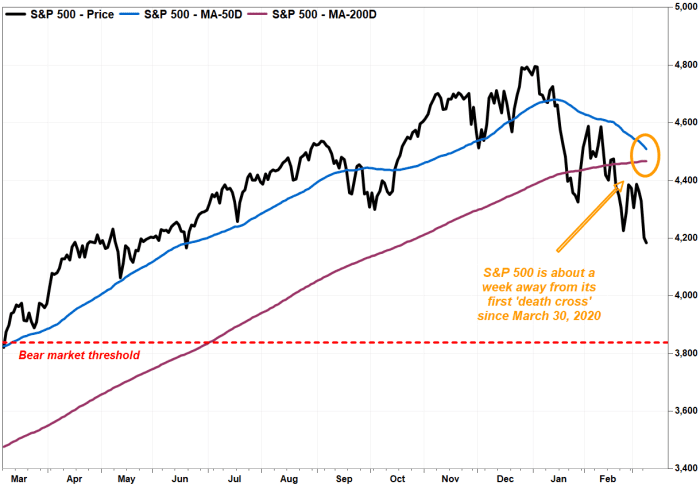
The S&P 500 index is closing in on a death cross, an ominous chart pattern that underscores the downtrend suffered in an asset.

A death cross appears when the 50-day moving average crosses below the 200-day moving average, an event that many chart watchers view as marking the spot a shorter-term correction morphs into a longer-term downtrend.

At last check, the S&P 500 index SPX, +2.40% was trading down 0.6%, with its 50-day moving average at 4,508.56 and its 200-day at 4,466.34, a differential of 42.22 points, which it could possibly breach by next week at the current pace of decline.

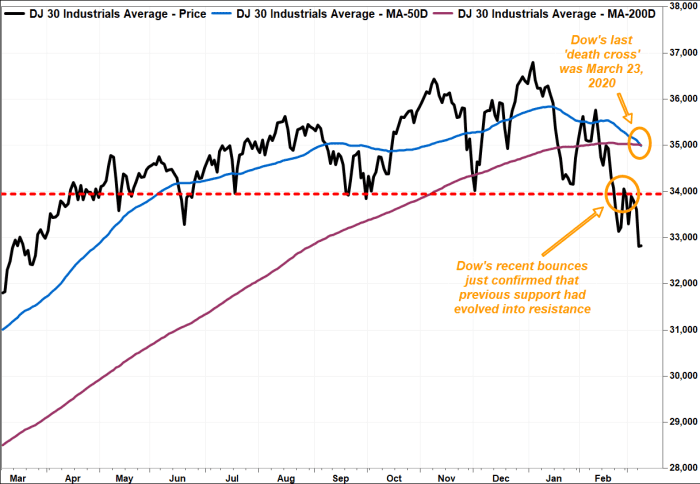
The approach of a death cross for the broad-market benchmark comes as the Dow Jones Industrial Average DJIA, +1.93% saw a death cross materialize (the 50-day at 34,990.79 fell below the 200-day MA at 35,008.55) in Tuesday trade, with Monday’s nearly 800-point tumble likely hastening that bearish cross.

FactSet, MarketWatch

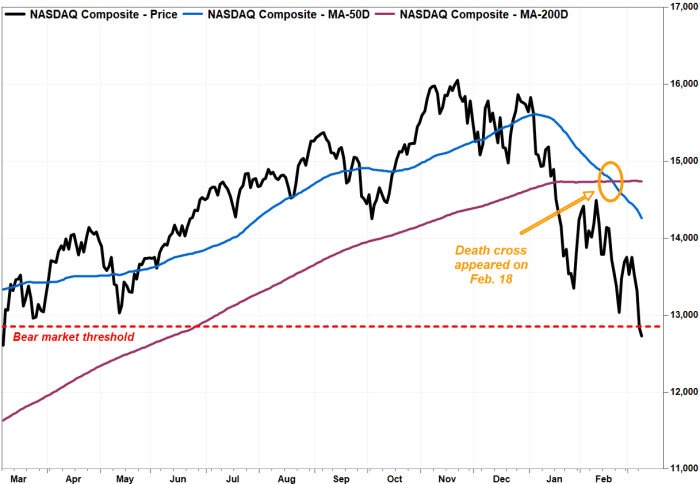
A number of other assets have seen death crosses materialize, including the technology-laden Nasdaq Composite Index COMP, +3.14% in mid February.

FactSet, MarketWatch

The last time the S&P 500 registered a death cross was nearly two years ago on March 30, 2020, at the height of the pandemic-induced selling. The DJIA saw its death cross materialize at what is widely viewed as stock’s bear-market bottom on March 23, 2020.

It is worth noting that such crosses aren’t necessarily good market-timing indicators, however, as they are well telegraphed, but they can help put a selloff in historical perspective, technicians say.

The decline in the broader market was taking hold, with safe-haven assets, including gold GC00, -2.74% and benchmark 10-year Treasury notes TMUBMUSD10Y, 1.940%, generally drawing bidding, as a intensifying clash in Eastern Europe, raises the prospects of a slowdown in the global economy and a jump in values of commodities.

See: More than a quarter of Nasdaq-100 stocks are in bear markets—Wall Street sees a buying opportunity

Crude-oil futures CL.1, -11.49%, for example, were adding to their climb to the highest prices since 2008, as the U.S. and the U.K. set out to ban purchases of energy from Russia in response to its unprovoked invasion in Ukraine. The European Union, which has grown dependent on Russia crude and natural gas, has said it hopes to wean itself off energy assets out of Moscow by the coming winter.

The geopolitical tensions combined with fears that the U.S. central bank, and other global monetary policy makers, may need to lift interest rates to combat swelling inflationary pressures, was contributing to the market’s bearish overall tone.

On Monday, the Nasdaq Composite finished in a bear market, falling by 20% from its Nov. 19 peak and the Dow industrials notched its first correction, a decline of at least 10% (but no greater than 20%) in over two years."

— Tomi Kilgore contributed to this article          

MUSTANG PANDA: Gone Phishing with Refreshed Lures Targeting European Diplomats

Chinese phishing actors consistently targeting EU diplomats

briefcase

  • March 9, 2022
  • 02:02 AM

"The China-aligned group tracked as TA416 (aka Mustang Panda) has been consistently targeting European diplomats since August 2020, with the most recent activity involving refreshed lures to coincide with the Russian invasion of Ukraine.

According to a new report by Proofpoint, TA416 spearheads cyber-espionage operations against the EU, consistently focusing on this long-term role without reaping opportunistic gains.

By keeping their tools and tactics essentially unchanged since 2020 and only refreshing their phishing themes and peripheral components, TA416 has made attribution simple for the analysts.

Timeline of activity

Starting in August 2020, the phishing actors impersonated EU-based organizations to target governments in the continent.

Email impersonating a UN agent
Email impersonating a UN agent (Proofpoint)

The malicious emails used a DropBox URL to deliver a variant of the PlugX malware, which was previously deployed in attacks against Australian organizations.

In November 2021, TA416 added hidden image trackers on emails to validate message openings and follow a more targeted approach in their campaign.

On January 17, 2022, Proofpoint noticed new delivery attempts involving ZIP files that were custom-named to match the target’s interests.

January 2022 phishing email
January 2022 phishing email (Proofpoint)

A change in tactic also occurred at this point, as the ZIP files weren’t fetched from a cloud hosting service but instead leveraged a dropper malware executable.

The four components downloaded this way were the PlugX malware, its loader, the DLL search order hijacker (process loader), and a PDF decoy file.

Finally, on February 28, 2022, the Chinese threat actors were spotted using a compromised diplomat’s address to target other top-ranking officials of NATO countries with lures involving the Russian invasion of Ukraine.

The most recent phishing lure linked to TA416
The most recent phishing lure linked to TA416 (Proofpoint)

The compromised person worked in refugee and migrant services, an area that was recently targeted by Belarusian hackers as well.

Superficial changes

While the tactics, malware drop, installation, and loading methods remain constant across campaigns, Mustang Panda puts some effort into regularly changing the components used.

“The group uses different legitimate PE files to initiate side-loading, as well as a variety of PlugX DLL loaders including the PotPlayer and DocCon versions,” elaborates the Proofpoint report.

“TA416 also uses different variants of the final PlugX payload in which the communication routines are observed to be different when closely analyzed.”

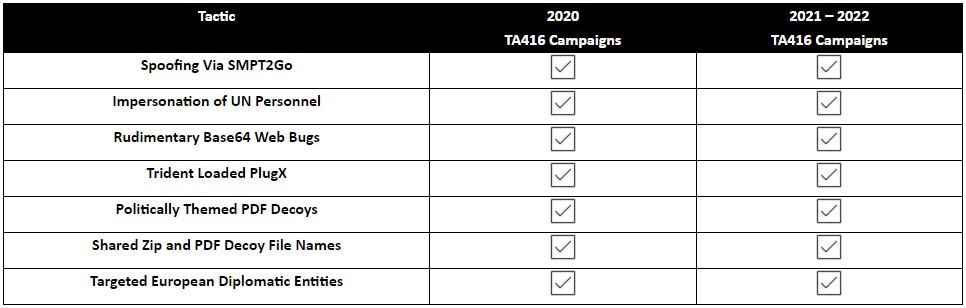
However, too many elements form a common ground between 2020, 2021, and 2022 campaigns, as reflected in the following table.

Common TA416 tactics throughout the years
Common TA416 tactics throughout the years (Proofpoint)

As Proofpoint’s report underlines in conclusion, these superficial variations will continue unabated, especially now that a fresh set of indicators of compromise has been published, so vigilance and good email security practices are advised to all potential targets.

Related Articles:

Google: Russia, China, Belarus state hackers target Ukraine, Europe

Emotet growing slowly but steadily since November resurgence

Google: Chinese hackers target Gmail users affiliated with US govt

Adafruit discloses data leak from ex-employee's GitHub repo

Russia-Ukraine war exploited as lure for malware distribution

US intelligence leaders testify before House Intelligence Committee

ARIZONA DEMO-CRAZY: Gerrymandering Sets Up A 2-Way Far-Right Fringe-Femme Fatale Smackdown

Who's running now against each other in the August Primary Election - Rogers and Townsend have been close political allies who late last year found themselves drawn into the same legislative district, despite living hundreds of miles apart.
Rather than face off in 2022, Townsend opted to declare her candidacy for a southern Arizona congressional district — that she doesn’t live in — and Rogers swiftly endorsed her

Wendy Rogers refuses to condemn white nationalist leader after GOP senator challenges her

"A day after the Arizona Senate voted to censure Flagstaff Republican Wendy Rogers for comments she made at a white nationalist conference and a string of inflammatory social media posts, another one of her colleagues challenged her to condemn those she had praised in a fiery speech on the Senate floor. 

“I contend that this is unbecoming rhetoric, it is inappropriate rhetoric,” Sen. Kelly Townsend, R-Mesa, said on the Senate floor Wednesday. . .

“I received ugly blowback from people on my side,” Townsend said. “Like being in a piranha tank — but I’m not afraid of the piranha tank anymore.”

Townsend herself is no stranger to controversy. In 2019, Townsend toured the border with the extremist group AZ Patriots whose leader walked around the Arizona State Capitol with a “kekistan” flag, a white nationalist symbol used to troll liberal events. 

And last year, Townsend compared vaccine supporters to Nazis and sharing an image of needles in the shape of a swastika on social media. When the Anti-Defamation League sharply criticized her rhetoric, Townsend rebuked the 108-year-old Jewish organization. “Learn your history,” she retorted."