Saturday, March 12, 2022

JONATHAN PIE OPINION VIDEO SERVE IT FORTH: Welcome to Londongrad, Where Kleptocrats Wash Their Money Clean

First of all please note: Jonathan Pie videos were previously licensed to RT — formerly known as Russia Today — in the U.K.
Jonathan Pie is a fictional newscaster created by the British comedian Tom Walker. Mr. Westbrook is a producer and editor with Opinion Video.
Mr. Walker has never worked for the network and has had no relationship with it since 2016.

Welcome to Londongrad, Where Kleptocrats Wash Their Money Clean

"These are, to say the least, uncomfortable times to be a Russian oligarch.

In response to Russia’s invasion of Ukraine, governments are taking aim at the superwealthy with close ties to Vladimir Putin, hitting them with sanctions, cutting off their access to offshore wealth, seizing their luxury yachts and villas and generally making it difficult to be a filthy rich person.

But in the Opinion Video above, Jonathan Pie, the fictional broadcast journalist played by the comedian Tom Walker, argues that even while the United States and the European Union have come down hard on Russian oligarchs, Britain has taken a gentler approach. This response, he argues, is the result of a dark symbiotic relationship that the country has developed with ill-gotten Russian money.

For years, Russian wealth has poured into Britain with few questions asked, helping to finance political campaigns and buoying the luxury property market. Russian oligarchs have been so happy to avail themselves of Britain’s laissez-faire regulatory climate to park their wealth and launder dirty money that the nation’s capital has earned the moniker Londongrad.

And that, Pie argues, is why the British government has been reluctant to step up the pressure on the Russian elite. Stronger sanctions, he argues, would risk hurting Britain even more than they would Putin and his cronies.

“And this was Putin’s plan all along,” Pie asserts. “For 20 years, he’s been slowly neutralizing us as a threat — by using our own greed against us.”

Reference: https://www.nytimes.com/2022/03/11/opinion/london-oligarchs-sanctions-putin.html

Jonathan Pie videos were previously licensed to RT — formerly known as Russia Today — in the U.K. Mr. Walker has never worked for the network and has had no relationship with it since 2016."

Greenwald: The White House's game-playing denials of bio labs in Ukraine

AMERICA'S PAVLOVIAN TRIGGER POLITICS: "Freedom Dumplings" for Your Food Delights

Some people might remember the controversial campaign against France when we got trained to say "Freedom Fries" - almost overnight everything wildly considered 'French' was either avoided or boycotted or renamed to reclaim the notion of Freedom.
NOW ALMOST OVERNIGHT EVERYTHING BAD IS RUSSIAN...the fast un-leashed fury is un-informed lashing out even to one brand of Russian vodka (Stolichnaya Vodka that's actually distilled in Latvia!)
That's a conditional reflex creating by training our brains and easily triggered in our Orwellian world of social media everywhere and every minute of the day-and-night.
Ivan Petrovich Pavlov was a Russian physiologist known primarily for his work in classical conditioning.
Known for: Founder of modern Behavior Therapy; Classical conditioning
Awards: Nobel Prize in Physiology or Medicine (1904)
Pavlov's Theory of Classical Conditioning
Based on his observations, Pavlov suggested that the salivation was a learned response. Pavlov's dog subjects were responding to the sight of the research assistants' white lab coats, which the animals had come to associate with the presentation of food.
Classical conditioning is learning through association and was first demonstrated by Ivan Pavlov. Pavlov showed that dogs could be conditioned to salivate at the sound of a bell if that sound was repeatedly presented at the same time that they were given food

‘Freedom dumplings’: the chefs cooking in solidarity with Ukraine

Bakers, bartenders and cooks are using food and drink to show support and to fundraise for relief efforts

A plate of blue and yellow dumplings.
Ms Chi Cafe, a Chinese restaurant in Los Angeles, is selling ‘freedom dumplings’ to support Ukrainian relief efforts. Photograph: Courtesy of Shirley Chung/Ms Chi Café
 
These are excerpts from a report by

Thu 10 Mar 2022 18.01 EST Last modified on Thu 10 Mar 2022 18.07 EST

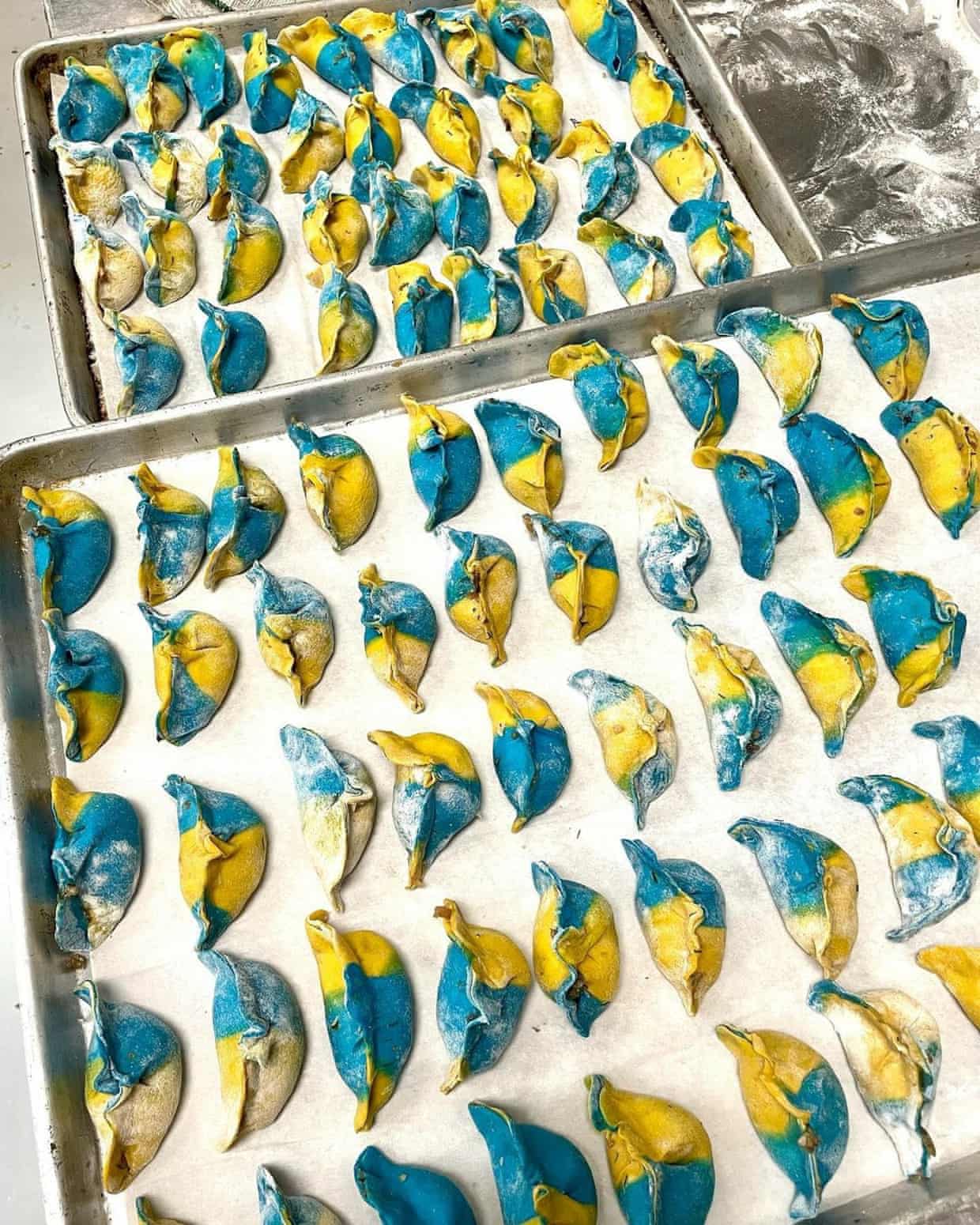
"In Culver City, a Chinese restaurant is selling bright blue and yellow “freedom dumplings”, the colors of the Ukrainian flag. In West Hollywood, a popular cocktail bar is offering a special “Pruzhnyy”, or resilience, cocktail, made with Ukrainian Khor vodka. Bakeries across California are making special batches of hamentaschen, a Jewish cookie associated with resistance to tyrannical government officials, and pampushka, a Ukrainian garlic bread.

It’s all part of a wave of solidarity among California chefs, who are using food to show support for Ukrainians after Russia’s invasion and to fundraise for humanitarian relief efforts.

All the proceeds from the special menu items are going to organizations such as World Central Kitchen, the non-profit offering hot meals to Ukrainian refugees at border crossings; Polish Humanitarian Action; Libereco PHR, a Swiss-German relief group; and Unicef. Although the individual dollar amounts raised are often modest, the chefs, bakers and bartenders involved said they want to send a message. . .

“I understand the price of freedom. I didn’t grow up in a democracy,” said Shirley Chung, the Los Angeles chef who created the blue and yellow dumplings. Watching Ukrainians fighting for their democracy, she said, “I feel like they’re fighting for the world.”

Two pans hold several dozen blue and yellow dumplings
Chef Shirley Chung was inspired to make her dumplings by the global campaign Cook for Ukraine. Photograph: Courtesy of Shirley Chung/Ms Chi Cafe

The California food industry relief efforts are part of a broader international movement. Chung said she was inspired by Cook for Ukraine, a global campaign started by London-based chefs Alissa Timoshkina, who is Russian, and Olia Hercules, who is Ukrainian, which raised more than £75,000 ($98,000) in donations in its first week. Those two friends were inspired by a previous culinary campaign, Cook for Syria, which encourages people to cook traditional meals and talk about the crisis, while also donating money for relief efforts. . .

Reference >> https://www.theguardian.com/food/2022/mar/10/chefs-bakers-bartenders-solidarity-ukraine-los-angeles

WEAPONIZING SOCIAL MEDIA

How Ukraine has been so successful at turning the tables on the supposed Russian masters of information war is crucial to understanding the situation so far in Ukraine and what happens next.
It is also a lesson for any other nation, politician, corporation or activist at how to win what I and others call #LikeWar, the hacking of social networks not through malware but through the effective weaponization of social media for clicks, likes and shares.

Opinion | How Ukraine Won The #LikeWar

Magazine

"By effectively employing 10 essential messaging themes, Ukraine beat Russia in shaping the early narrative of the conflict, helping to keep themselves in the real-world fight.

In modern war and politics, the information space is one of the most crucial parts of the battlefield. This is not about mere propaganda. If your ideas get out and win out, that determines everything from whether soldiers, civilians and onlookers around the world will join your cause to what people believe about the very truth of what’s occurring on the ground. And, if your ideas don’t win out, you can lose the war before it even begins.

In the arena of information warfare, there was arguably no one more feared over the last decade than Vladimir Putin. Russia’s information warriors ran wild for years, hacking democracies by intervening in more than 30 national elections from Hungary and Poland to Brexit and the 2016 U.S. presidential race. They elevated conspiracy theories that ranged from Q-Anon to coronavirus vaccine lies and provided justification for Russian military action everywhere from Georgia to Syria.

Yet, when it came time for one of Putin’s most ambitious and important operations of all, the invasion of Ukraine, Russia failed at the information side of the fight as much as it failed at its plan for a quick seizure of Kyiv. And the stakes could not have been higher. While Putin’s forces may be able to turn around their military prospects by sending more missiles, tanks and troops to overwhelm Ukraine’s cities, they have no such opportunity on the information war side. Contrary to claims that it is somehow too early to call, Ukraine isn’t just winning the battle for hearts and minds online, it has already won. And now it’s too late for Russia to change the narrative.

[. ]

At this task, Ukraine — both through official government channels and through a global coalition of supporters participating with them in the online front — has been masterful at driving forward 10 essential persuasion messaging themes. Each of these themes had scores of underlying narratives and examples, pushed out by wider networks that scaled from the hundreds to the millions.

1) Not waiting to debunk: Pre-bunking

2) Highlighting heroism

3) Stacking the cards in just the right way

4) Mythologizing martyrs

5) Showing a Man of the People

6) Amplifying civilian harm

7) Magnifying civilian resistance

8) Encouraging others to jump on your bandwagon

9) Humanizing your side (and let slip the cats of war)

10) Making use of mockery

{.  }

But Is It Working?

By all measures, the combination of these efforts have been a stunning success inside Ukraine. This is proven most by the very fact that the Ukrainian state and society didn’t collapse the way Russia hoped would happen in the first few days of fighting. Indeed, besides the rapid swing in Zelenskyy’s polling, surveys also show that now 70 percent of Ukrainians believe that their military is the side that will win the war, despite the real combat power disadvantage and territory losses.

This disparity makes the fronts of the information war essential for Ukraine. No matter the attitudes and bravery of its people, Ukraine only has a chance if it enlists the outside world in its fight. And here, the Ukrainian efforts are winning. Nations as far away as Australia and as surprising as Germany have promised military aid to Ukraine, and once unthinkable levels of financial sanctions have been put into place to squeeze the Russian economy. Indeed, when even Switzerland agrees to join sanctions against you (something it wouldn’t even do to Hitler), you have lost the narrative fight.

In the U.S., one could almost get whiplash by how rapidly things have changed from when former President Donald Trump complimented Putin as a “genius” and former Secretary of State Mike Pompeo reportedly screamed at a journalist “Do you think Americans care about Ukraine?” Trump has started complimenting Zelenskyy as “brave,” and Pompeo took to tweeting about how supporting Ukraine was the key to stopping Putin. Even Fox News, whose most popular host Tucker Carlson was a prominent early backer of Putin’s side, has recently published stories like “Russian President Vladimir Putin has features of a psychopath” and aired segments such as “Ukrainian civilians volunteer to fight for democracy.” This shift is reflected among the public more broadly, too: Between the beginning and end of February, polling shows that the percentage of Americans who said the U.S. should take Ukraine’s side went from less than the percentage who said the U.S. should remain neutral to more than double it, driven in large part by a 42-point swing in Republican opinion.

Yet, the audience that might matter the most to whether the war ends is inside Russia. Here, the information situation is different than the battles we have seen Ukraine win so vividly. The Putin regime has spent years building up both direct and indirect control of the media, and it uses everything from arrests to “accidental” deaths of activists to reinforce censorship. Indeed, at the start of the war, Putin’s information-shaping was so effective that many Russians did not even know they were at war. The relative popularity of social media platforms also matters. For as much as #SupportUkraine has trended on Twitter and Instagram, the most popular social network for Russians is VK.

But the longer the war goes on, the harder this becomes to sustain. Casualties are difficult to keep quiet and undercut a message of an easy win. Indeed, the fact that Russia’s government has just implemented new laws that threaten 15 years in prison for spreading “fake information” about the military or the war in Ukraine is a sign that the Putin regime fears it is losing this fight.

An essential mission of Ukraine’s information war is to try to further pierce this information bubble, an effort that is already underway. Reportedly, Ukraine’s interior ministry has been reaching out on VK to parents of Russian prisoners of war to let them know that their son is alive but that they should Go out and protest, overthrow your government before we bury all in Ukrainian soil.” Similarly, in the absence of any Russian government death notices, a “Look For Your Own” website was also created to allow parents of Russian soldiers to submit their DNA information to find out whether their son had been killed in combat in Ukraine. Even that site’s address, 200rf.com, is loaded with meaning. It is a reference to “Cargo 200,” the Russian military term for flying home the bodies of dead soldiers. It is a brutal but potent example of what Ukraine warns is to come on the battlefield and, more importantly, of how Ukraine wants Russia to know it."

MORE DETAILS >> https://www.politico.com/news/magazine/2022/03/12/ukraine-russia-information-warfare-likewar-00016562

Friday, March 11, 2022

Crypto Investors Take On Wyoming Real Estate | WSJ

SWING STATE ARIZONA: Attorney General Mark "Numchuck" Brnovich Bid for Senate Seat is A Toss-Up

From Politico: Brnovich holds a steady, but not rock-solid, polling lead over his lesser-known primary opponents.
 "Right now, Brnovich, a lifelong Republican and diehard conservative, is the frontrunner for the Republican nomination for the U.S. Senate — with a reasonable chance to flip the seat back from incumbent Mark Kelly, the Democrat who won only narrowly in 2020.
In any normal year, his current job would be a big asset: He’s one of Arizona’s highest profile elected officials, with unmatched name ID and what seems to be a standing invitation to Fox News. . ."
It’s a tricky balancing act for an officeholder, and it’s unclear if Brnovich, whose office and campaign didn’t respond to requests for comment, is adept enough to manage it. His fate will say much about the state of the Republican Party in 2022.

The Arizona Republican Caught in a Vise by Trump’s Big Lie

Pimco Heavily Exposed to Russian Debt