Tuesday, March 15, 2022

ASIAN GIANT KILLER HORNETS:The murder hornet drones go wild for this sex pheromone chemical cocktail

Researchers Could Lure Murder Hornets to Their Deaths With Sex

The smell of hornet sex may be entomologists' best bet for culling these giant invaders.

"Birds do it, bees do it—even the wasps that kill bees do it. A clever team of scientists now has an idea to use the Asian giant hornets’ horniness against them, in hopes of stopping the invasive species from decimating U.S. bee populations. They’ve identified the sex pheromones of the queen and propose trapping the hornet drones that are lured in by the pheromones.

The (Vespa mandarinia) preys on bees, and its stings are pretty painful to humans (they can people who are allergic to their venom). The hornets are native to Asia but have recently spread into the U.S.; they were in Washington State in August 2020, and they’ve spread across the American northwest. This invasion is worrying, since the hornets can slaughter a honeybee hive in a matter of hours.

Recently, a team of entomologists caught a bunch of virgin giant hornet queens and their drones from colonies in Yunnan, China. They swabbed the queens’ sex glands and used gas chromatography-mass spectrometry to identify pheromone compounds from six of the queens. The team’s findings were in Current Biology.

“We were able to isolate the major components of the female sex pheromone, a odor blend that is highly attractive to males who compete to mate with virgin queens,” said James Nieh, an entomologist at the University of California at San Diego and co-author of the recent paper, in an email to Gizmodo. “When these components or their blend was tested in sticky traps, they captured thousands of males.”

. . .

Introducing SPAM: How the American Dream Got Canned

Bleeping Computer Updates Today + Latest Articles

BSI warns against using Kaspersky

<div class=__reading__mode__extracted__imagecaption>Kaspersky Lab (Wikipedia,&#160;By Alexxsun - Own work, CC BY-SA 4.0)

Today, the BSI is warning German companies to replace Kaspersky AV and any other products from the firm with alternative software from non-Russian vendors.

As the BSI statement explains, antivirus software typically has higher-level privileges on Windows systems, maintaining a permanent, encrypted, and non-verifiable connection to the vendor’s servers for constant virus definition updates.

Furthermore, as real-time protection from almost all antivirus vendors can upload suspicious files to remote servers for further analysis, there is concern that antivirus developers could use their software to exfiltrate sensitive files.

While Kaspersky is likely trustworthy and ethical, it still has to abide by Russian laws and regulations, including allowing state agents to access private firm databases.

BSI is taking this further by suggesting that Kaspersky could be forced into aiding the Russian intelligence forces in carrying out cyberattacks or conducting espionage.

"The actions of military and/or intelligence forces in Russia and the threats made by Russia against the EU , NATO and the Federal Republic of Germany in the course of the current military conflict are associated with a considerable risk of a successful IT attack. A Russian IT manufacturer can carry out offensive operations itself, be forced to attack target systems against its will, or be spied on without its knowledge as a victim of a cyber operation, or be misused as a tool for attacks against its own customers."

BSI

To avoid panic moves like switching off protection without activating a replacement security product, BSI advises all organizations to prepare accordingly by first performing a complete assessment.

Also, whenever a switch to alternative security products takes place, loss of comfort, functionality, and even safety is expected, so a remediation plan to address all that must be developed.

This warning has already led to German organizations, such as Germany's Eintracht sports club, to no longer use Kaspersky's services. 

However, Kaspersky believes that BSI's warning to remove Kaspersky products is a political decision rather than a technical assessment of their products.

A Kaspersky spokesperson shared the following statement with BleepingComputer regarding BSI's warnings, which we have shared in full below:

We believe this decision is not based on a technical assessment of Kaspersky products – that we continuously advocated for with the BSI and across Europe – but instead is being made on political grounds. We will continue to assure our partners and customers in the quality and integrity of our products, and we will be working with the BSI for clarification on its decision and for the means to address its and other regulators’ concerns.

At Kaspersky, we believe that transparency and the continued implementation of concrete measures to demonstrate our enduring commitment to integrity and trustworthiness to our customers is paramount. Kaspersky is a private global cybersecurity company and, as a private company, does not have any ties to the Russian or any other government.

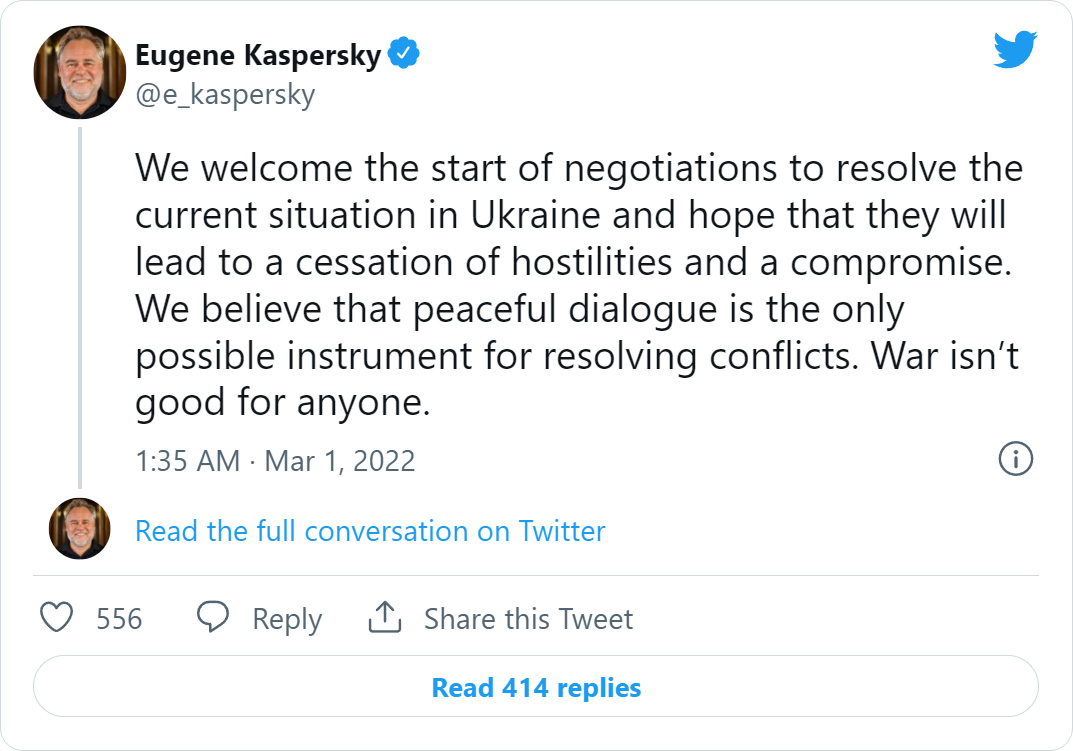
We believe that peaceful dialogue is the only possible instrument for resolving conflicts. War isn’t good for anyone.

Our data processing infrastructure was relocated to Switzerland in 2018: since then, malicious and suspicious files voluntarily shared by users of Kaspersky products in Germany are processed in two data centers in Zurich that provide world-class facilities, in compliance with industry standards, to ensure the highest levels of security. Beyond our cyberthreat-related data processing facilities in Switzerland, statistics provided by users to Kaspersky can be processed on the Kaspersky Security Network’s services located in various countries around the world, including Canada and Germany. The security and integrity of our data services and engineering practices have been confirmed by independent third-party assessments: through the SOC 2 Audit conducted by a ‘Big Four’ auditor, and through the ISO 27001 certification and recent re-certification by TÜV Austria.

Kaspersky has set the industry benchmark for digital trust and transparency. Our customers can run a free technical and comprehensive review of our solutions, allowing them to:

  • Review our secure software development documentation including threat analysis, secure review, and application security testing processes
  • Review the source code of our leading solutions including Kaspersky Internet Security (KIS), our flagship consumer product; Kaspersky Endpoint Security (KES), our flagship enterprise product; and Kaspersky Security Center (KSC), a control console for our enterprise products
  • Review all versions of our builds and AV-database updates, as well as the types of information which Kaspersky products send to our cloud-based Kaspersky Security Network (KSN)
  • Rebuild the source code to make sure it corresponds to publicly available modules
  • Review the results of an external audit of the company’s engineering practices conducted by one of the ‘Big Four’ accounting firms;
  • Review the Software Bill of Materials (SBOM) for Kaspersky Internet Security (KIS), Kaspersky Endpoint Security (KES), and Kaspersky Security Center (KSC)
 
Latest Articles

S&P 500 Falls Into 'Death Cross'

Raspberry Pi Plant Watering (& Time Lapse)

GOVERNMENT SACHS: The Wisdom of Solomon - "Well I don’t know that it’s the job of large financial institutions to ostracize Russia"

"...the U.S. is engaged in an economic war against Russia, and Goldman — as a private sector agent of that economy — is caught in the middle.
Even just saying we’re just going to follow the law amounts to a kind of policy prescription, at least for how other companies should act.
It’s also a bit of a rebuke to companies like Facebook parent Meta, which went out of its way to play footsie with nation building by briefly allowing for users to call for the death of Vladimir Putin.

Goldman Sachs CEO Says Ostracizing Russia Isn’t the Finance Industry’s Job

"Over the weekend, TIME published an interview with Goldman Sachs CEO David Solomon that started off with a question about what the Wall Street investment bank should be doing about Russia following its invasion of Ukraine. Solomon, who recently pulled his bank out of the country and is winding down their contracts there, took an interesting stance in his response:

Well, I don’t know that it’s the job of large financial institutions to ostracize Russia. We operate in a financial system that has a regulatory and government overlay. The [U.S.] government, I think in this case appropriately, has decided to place sanctions on Russia. And it’s our job to make sure that we are executing against the legal letter of the law of those sanctions, but also the spirit of those sanctions, which basically require us to wind our business down in Russia. …

I don’t think businesses are supposed to decide how global trade works in the world. Government sets policy and then businesses follow that policy. I happen to agree very strongly with the policy. What’s going on in Ukraine is absolutely horrible. I think the actions taken are reasonable and powerful actions. But you ask, “are we doing a good job, ostracizing Russia?” That’s not our job. And by us, I mean the financial industry broadly. . .I know on social media at the moment, there’s a call for companies to ostracize Russia. I don’t understand how we ostracize Russia. We follow the laws — both in the letter and the spirit.

. . . Goldman, as Solomon mentions in the interview, has already pulled out of the country and is winding down contracts, even though they are still reportedly pitching Russian bonds to hedge funds, and advising them to sock it away in personal accounts to avoid scrutiny. (This is allowed by U.S. sanctions, and the bank told CNBC, which broke the story: “Winding down our operations in Russia and supporting our clients around the globe in managing and closing out their market obligations are not mutually exclusive.”)

. . .Goldman has not taken a passive role on Russia’s economic policy during the last 30 years. In 1992, the bank rushed in to advise former President Boris Yeltsin on the “shock treatment” transition to capitalism after the fall of the Soviet Union. It has collected more than $114 million in fees there over the years.

> During the Clinton administration, former Goldman co-chairman Robert Rubin — who was then Treasury Secretary — was one of the architects of a failed loan from the International Monetary Fund to prop up the country, before Russia devalued its currency. It’s not like the term “Government Sachs” came out of nowhere.

Wall Street’s overall record on activism has also been mixed at best. Back in 2018, Citigroup, Bank of America, and other major banks stopped doing business with companies that sell firearms. That led more conservative and gun-friendly states to say they’d stop doing business with them.

> Texas passed a law that would bar the state from doing some of its underwriting business with companies that “discriminate” against gun companies, and legislatures in Arizona, Kentucky, Missouri, Ohio, South Dakota, and West Virginia have proposed similar bills.

> And if that had any effect on the firearms industry, it doesn’t appear to have shown up in recent sales — as 2020 and 2021 were the two biggest years for gun sales on record.

In reality, Goldman has a history of ignoring the social costs of doing business with unsavory governments.

> As Bloomberg reporter Sridhar Natarjan points out, Solomon didn’t wait too long to show his face in Saudi Arabia after Mohammed bin Salman’s elite security detail lured the Washington Post journalist to his death.

> Solomon has also aggressively moved into China after the country cracked down on Hong Kong’s independence.

Still, the U.S. is engaged in an economic war against Russia, and Goldman — as a private sector agent of that economy — is caught in the middle. Even just saying we’re just going to follow the law amounts to a kind of policy prescription, at least for how other companies should act. It’s also a bit of a rebuke to companies like Facebook parent Meta, which went out of its way to play footsie with nation building by briefly allowing for users to call for the death of Vladimir Putin.

Goldman has a history of entering and leaving Russia as its economy has gone up and down. Solomon, as the head of an investment bank that does business with oil producers and miners and governments, wouldn’t want to stop doing business with one of the world’s largest and most natural resource-rich countries in the world if and when the war is over."

China Seeks to Avoid Hit From U.S.-Led Russia Sanctions