Sunday, March 27, 2022
Saturday, March 26, 2022
MAN TAZERED IN THE GENITALS: Excess Use-of-Force by Glendale AZ Police
Intro: Multiple independent law enforcement experts, who agreed to review the incident, said the officers’ conduct was unlawful, potentially criminal, and one of the most cruel and troubling cases of police misconduct they’ve ever seen.
Qualified Immunity Denied To Officer Who Tased Man In The Genitals

from the let-the-jury-do-its-job dept
"A Glendale (AZ) police officer (now former police officer… more on that in a bit) isn’t going to be able to walk away from a civil rights lawsuit stemming from excessive force he deployed during a routine traffic stop.
An Arizona federal court says there’s enough in dispute that Officer Matt Schneider will have to continue to face the lawsuit filed against him by Johnny Wheatcroft, the vehicle passenger he tased eleven times, including one shot to the groin after Wheatcroft was handcuffed and restrained face down on 108-degree parking lot pavement by two other officers.
Here’s Courthouse New Service’s recounting of the incident.
Body camera video shows officers approach Wheatcroft’s vehicle in a Motel 6 parking lot just after dusk on July 26, 2017. Schneider asks Wheatcroft and his wife, who was driving, to hand over ID. The officer said the car failed to use a turn signal when entering the parking lot.
Wheatcroft, a passenger, told the officer he did nothing wrong and refused to provide ID. Schneider then said he would take Wheatcroft to the police station. Schneider accused Wheatcroft of stuffing something between the car seats or in a bag by his feet, which Wheatcroft denied. Schneider then opened the passenger door, placed his Taser on Wheatcroft’s shoulder and told Schneider to relax his arm and stop tensing up.
According to Wheatcroft’s lawsuit, Schneider used his Taser on Wheatcroft 11 times. Body camera video shows Wheatcroft lying face down on the pavement with his shorts pulled down while Schneider deploys his Taser in an area that appears to be close to Wheatcroft’s genitals. The man’s children can be seen and heard crying and screaming, “No, daddy.”
The video is disturbing to watch.
It even disturbed law enforcement professionals interviewed by ABC15, which first obtained the body cam footage.
Multiple independent law enforcement experts, who agreed to review the incident, said the officers’ conduct was unlawful, potentially criminal, and one of the most cruel and troubling cases of police misconduct they’ve ever seen.
Justice, however is not blind 
“I have never seen anything like this before,” said Jeff Noble, an attorney and former deputy chief of police in Irvine, Calif., who’s testified in hundreds of cases including Tamir Rice and Philando Castile. “ It reminds me of a case in New York where an individual was sadistically taking a broom handle and shoving it up (the suspect’s) anus. This is just beyond the pale. It’s outrageous conduct.”
 This was a classic pretextual stop. The stated reason was a failure to signal before pulling into the motel parking lot. That claim is also disputable, even though it’s not part of the claims being made by Wheatcroft in his lawsuit. Lowering the Bar’s coverage of this ruling notes that security cam footage from the motel indicates the officers could not have seen the alleged no-signal turn from where they were originally parked.
The incident happened in 2017, after officers made a traffic stop of a vehicle in a motel parking lot. Although by “traffic stop,” I mean they lied about seeing the car turn into the lot without signaling. That kind of technical violation might justify a stop, but here security-cam footage made it clear the officers could not have seen the car turn because they were a block away in a back alley at the time.
A defensive statement was issued by the Glendale PD shortly after body cam footage was released to the public. The statement, as ABC15 notes, is clearly contradicted by both camera footage and the department’s own internal investigation of Officer Schneider. . .
 Even this reaction from the Glendale PD was delayed. The internal investigation wasn’t immediate. Nothing happened to the officer until ABC15 started asking questions. Here’s Lowering the Bar again:
According to ABC15, initially no one was disciplined for this, and the department and city blew off its requests for comment. After the reports started to air, the department conducted an internal investigation, after which it suspended Schneider. For three days. (It was his fourth suspension.) But that was it, and prosecutors also declined to charge him. Only after the reports continued and the body-cam footage was released in 2019 did they reopen the case. Schneider is now, finally, a former police officer being charged with aggravated assault, and he’s also one of the defendants in the civil case.
(He was allowed to retire on “accidental disability” so he gets to keep his pension.)
Officer Schneider is now no longer technically an officer. That means he may not get indemnified if he loses the lawsuit filed against him by the man he subjected to multiple Taser deployments.
(On the other hand, the public will still be paying his pension for years to come.)
There’s no qualified immunity to be had, says the federal court [PDF].
> This is going to go in front of a jury.
Here, a genuine dispute exists as to whether Wheatcroft presented an immediate threat to the safety of the Officers. Officer Lindsey testified during his deposition that Wheatcroft was “reaching toward the middle console” and “continuing to reach” into the console after Officer Schneider gave him a command to stop. Officer Lindsey testified that he believed “[t]here could be a weapon in there. There could be
something that could harm the people in the vehicle, harm me, harm themselves.” Officer Schneider testified he went “hands on” with Wheatcroft “[b]ecause he started reaching down into the center console.” But Wheatcroft testified that during his conversation with the Officer, he was “trying to unbuckle his seat belt” and while the Officer had him in an arm bar, he was not pulling his arm away, the Officer was “twisting” his arm, which was “making [him] go down.”The Officer Defendants assert that their methods of force were necessary given the “high crime area” around the Motel 6, Wheatcroft’s refusal to obey the Officers’ commands, Wheatcroft’s agitated demeanor, his use of obscenities, and his acts of tensing his arm and “shifting his hands in between his backpack and the center console.” But almost all of Defendants’ justification for their use of force against Wheatcroft is disputed: the parties dispute whether the Motel 6 had an active trespass agreement with the City of Glendale Police Department; whether Wheatcroft was moving his hands around the car and accessing his backpack; where the Taser struck on Wheatcroft’s body; and even whether Wheatcroft had to identify himself to the Officers in the first place.
First, Wheatcroft was under no obligation to provide ID to Officer Schneider. The law used to charge Wheatcroft says a person is only obligated to do this if they are “lawfully detained based on reasonable suspicion” of committing a crime. The stated reason for the interaction was a failure to signal, which was a criminal infraction that could only be committed by the driver, not any of the passengers, including Wheatcroft.
Second, it’s pretty rich for an overly aggressive officer to claim a citizen’s “agitated manner” and “use of obscenities” justifies force deployment. Officer Schneider did both and yet no one would claim that his “agitated manner” and “use of obscenities” would justify resisting arrest or use of physical force against him. Heal thyself, you irony-proof ingrate.
The officer’s arguments aren’t really arguments, the court says. A jury will sort out the differences and decide whether tasering a handcuffed vehicle passenger was justified under the circumstances — a failure to signal traffic stop. (It also should be noted no illegal substances or weapons were discovered on Wheatcroft or in the vehicle.)
...Ignorance of clearly settled law is no excuse.
Blankenhorn and Graham would adequately put a reasonable officer on notice that Tasing Wheatcroft six times to effectuate an arrest when he offered no resistance to the Officers, and even told them he was not resisting, was a Fourth Amendment violation. The law here was clearly established at the time of Wheatcroft’s arrest and gave the Officers sufficient notice.
 If the Glendale PD is smart, it will settle. If it isn’t, it will try to appeal this decision, increasing the cost to Glendale residents currently being underserved by their police department. They’re already paying for one officer’s retirement. There’s no reason they should be expected to fund further arguments against their own best interests."
Friday, March 25, 2022
RE-COLONIZING ARIZONA: "Pioneer Crossing" - Marking The Mormon Trail with Streets of Luxury Housing
top story spotlight
Ranching family’s project aims to preserve Mesa history
"Streets of luxury housing are planned to replace century-old orange groves and pastures at the end of Val Vista Drive on the south banks of the Salt River in northeast Mesa over the next two to three years.
 While most of the orange groves will be lost, the four families that own the parcels hope years of planning and vetting potential developers will lead to a project that does justice to a historic slice of Mesa and opens it up to residents with public trails and trailheads.
JUSTICE??? 300 Latter-Day Saints arrived in indigenous lands and territories inhabited by more than 5,000 "Indians", staked out homesteads, claiming water-rights along The Salt River.
=======================================================================
The landowners in this part of Lehi have partnered with Blandford Homes to create an 85-acre planned area development called Pioneer Crossing, a reference to a historic crossing point on the Salt River close by.
SEE THIS RELATED CONTENT
Here in Mesa - and in Tempe and Phoenix and Scottsdale - there's documentation as well for what Frank Midvale called "The Pre-Historic Irrigation of the Salt River Valley" of earlier indigenous cultures that were established for centuries before anyone recorded their versions of that history when evidence of those who were here before was "discovered" and their settlements patterns were mapped.

< Here's a closer look from a Digital Geo Map 2003 uploaded by Richard A. Neely.
Major Hohokam Irrigation Systems in the Lower Salt River Valley
The link is below if you're interested in more details.
But let's note at this point, that it was the usual practice to bury the dead on higher ground above the irrigation canals close to settlements and housing patterns.
Finding artifacts or human remains is often the result of chance - or new construction.
Research Gate
INSERT: Post of this blog from July 2019
Digging-Deeper: Know Your Water + Water-Rights

Here in Arizona in what we now call The Salt River Valley, ancient indigenous cultures created a vast system of canal networks over the centuries before the arrival of new 'Pioneers'. They expanded the open canals to supply natural water resources, converted to private-ownership or municipal control to build vast fortunes for agricultural lands and ranches. After World War II those same lands were needed to create large tracts of housing for Suburban Sprawl and shopping centers and for new industries. Irrigation districts had to be created. Water usage increased. Groundwater had to be tapped into. Water and Wastewater Treatment Plants had to get built. Planning for the future, the city of Mesa once owned 11,400 acres in Pinal County called the Mesa Water Farm. That acreage - and the water-rights - were sold off to Saints Holding Company. . ."
========================================================================
Mesa City Council last week approved an assortment of zoning changes and plan amendments that have cleared the way for the development to proceed.
Councilmember Mark Freeman, who represents the district and worked with stakeholders and the landowners as they contemplated the development, said after the council meeting that the families involved had turned away a lot of offers from developers over the years before arriving at this plan.
He praised the project for blending in with the surrounding area, providing the public with trail access and preserving a piece of the area’s agricultural heritage.
In a January Planning & Zoning Board hearing, neighbors were generally supportive of the development as long as the city put in a new fire station to serve the additional houses. Freeman agreed that a station is needed and said he is working to put a fire station at 32nd and McDowell on the ballot for the next bond election.
One of the properties involved in the development is Tyler Farms, a 40-acre horse boarding ranch. Attorney Brian Campbell, a member of the Tyler family and their representative, said the land surrounding Pioneer Crossing is loaded with history. The plans for the PAD, he said, were built around a vision to protect and highlight its history.
The day after the Council vote March 8, Campbell showed the Mesa Tribune some of that history.
Standing on a hill overlooking the Salt River near Tyler Farms, Campbell pointed down the dry river toward a small white obelisk marking the Lehi Crossing. This spot was an important crossing on the Salt River used by traffic from Fort McDowell and pioneer families in the earliest days of Mesa. . .
Using historical documentation, the family believes the ranch is the site of the 1878 Mesa Company’s “river camp,” where the company camped while laying out the townsite of Mesa.
 > Between the 7th and 14th centuries they built and maintained these extensive irrigation networks along the lower Salt and middle Gila rivers that rivaled the complexity of those used in the ancient Near East, Egypt, and China. These were constructed using relatively simple excavation tools, without the benefit of advanced engineering technologies.
CYBERCRIME MARKETPLACE HERE IN AMERICA
Intro:
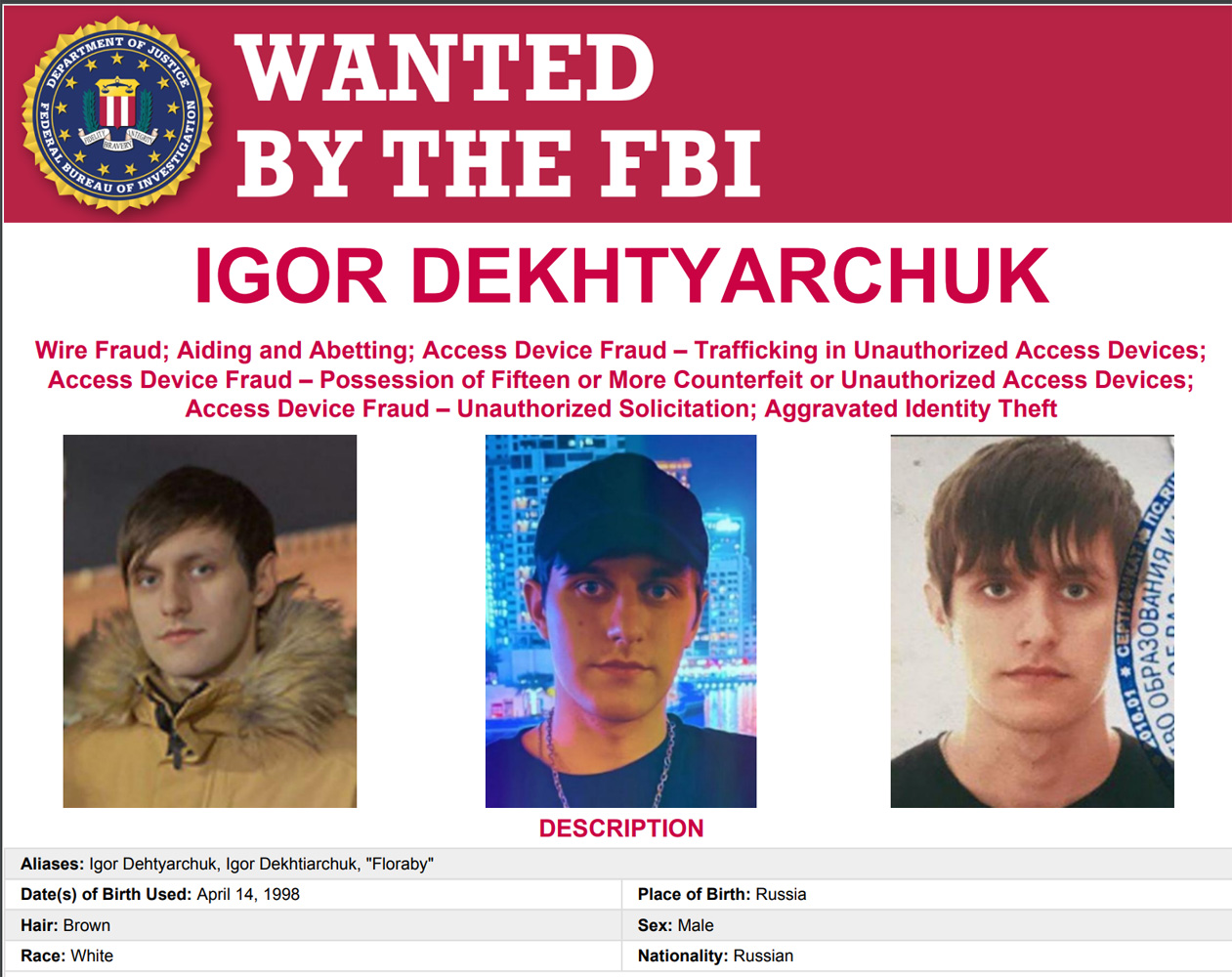
While the indictment did not reveal what cybercrime marketplace was created by Dekhtyarchuk, it did mention that he operated under the alias 'Floraby.'
Using KELA's cybersecurity intelligence service DARKBEAST, BleepingComputer was able to find a person named 'Floraby' promoting the BAYACC marketplace, which sold compromised credentials.
While the site appears to be down, you can see from archived snapshots that BAYACC sold accounts for various companies, including eBay, Amazon, SamsClub, and PayPal, with the prices advertised in Russian Rubles
A Russian national has been indicted by the US DOJ and added to the FBI's Cyber Most Wanted list for allegedly creating and managing a cybercrime marketplace.
Igor Dekhtyarchuk, a resident of Russia, was indicted in the Eastern District of Texas for running the cybercrime marketplace that sold credit cards, access to compromised devices or accounts, and personal information.
The indictment claims that Dekhtyarchuk launched the marketplace in May 2017 and began promoting it on Russian hacking forums starting with April 2018.
"Dekhtyarchuk began advertising the sale of compromised account data in Russianlanguage hacker forums in April 2018 and opened Marketplace A in May 2018. Dekhtyarchuk immediately began advertising Marketplace A and the products it sold in May 2018," reads the DOJ indictment.
"As of May 2021, Dekhtyarchuk, through Marketplace A, publicly advertised that he has sold over 48,000 compromised email accounts, 25,000 compromised Company B accounts, and 19,000 compromised Company A accounts."
When buyers purchased device access from the marketplace, they were allegedly contacted on Telegram by Dekhtyarchuk or one of his associates and sent either login credentials or a login cookie that allows access to the purchased device or account.
Dekhtyarchuk has since been added to the FBI's Cyber Most Wanted List on charges of Wire Fraud, Access Device Fraud, and Aggravated Identity Theft.
=========================================================================
LATEST ARTICLES
Russia bans Google News for "unreliable" info on war in Ukraine
Roskomnadzor, Russia's telecommunications regulator, has banned Alphabet's news aggregator service Google News and blocked access to the news.google.com domain for providing access to "unreliable information" on the ongoing war in Ukraine.
- March 23, 2022
- 04:55 PM
 13
13

New Mustang Panda hacking campaign targets diplomats, ISPs
An ongoing Mustang Panda campaign that has started at least eight months ago has been uncovered by threat analysts who also managed to sample and analyze custom malware loaders and a new Korplug variant.
- March 23, 2022
- 03:13 PM
- 0

FBI: Ransomware hit 649 critical infrastructure orgs in 2021
The Federal Bureau of Investigation (FBI) says ransomware gangs have breached the networks of at least 649 organizations from multiple US critical infrastructure sectors last year, according to the Internet Crime Complaint Center (IC3) 2021 Internet Crime Report.
- March 23, 2022
- 03:00 PM
- 0
TONIGHT 8-11PM: Live Music Angel Robles
ANGEL ROBLES is k nown for an eclectic set list that spans multiple genres, . . He utilizes loop pedals, acoustic guitars, and backing...

-
 Flash News: Ukraine Intercepts Russian Kh-59 Cruise Missile Using US VAMPIRE Air Defense System Mounted on Boat. Ukrainian forces have made ...
 -
A nor’easter is about to hit the Northeast in May. That’s very unusual.

