Thursday, April 07, 2022

FBI TAKEDOWN: "Cyclops Blink"

Further reading provided once again by Dan Goodin

Companies were slow to remove Russian spies’ malware, so FBI did it for them

How the FBI took down "Cyclops Blink," a Russia state botnet infecting network firewalls.

<div class=__reading__mode__extracted__imagecaption>EnlargeGetty Images

"The FBI remotely accessed and disinfected US-located devices running a powerful new strain of Russian state botnet malware, federal authorities said Wednesday. Those authorities added that the Kremlin was using the malware to wage stealthy hacks of its adversaries.

The infected devices were primarily made up of firewall appliances from WatchGuard and, to a lesser extent, network devices from Asus. Both manufacturers recently issued advisories providing recommendations for hardening or disinfecting devices infected by the botnet, known as Cyclops Blink. It is the latest botnet malware from Russia’s Sandworm, which is among the world’s most elite and destructive state-sponsored hacking outfits.

Regaining control

Cyclops Blink came to light in February in an advisory jointly issued by the UK’s National Cyber Security Centre (NCSC), the Cybersecurity and Infrastructure Security Agency (CISA), the National Security Agency (NSA), and the Federal Bureau of Investigation (FBI). WatchGuard said at the time that the malware had infected about 1 percent of network devices it made.

Cyclops Blink was a replacement for another piece of Sandworm-designed malware known as VPNFilter, which researchers discovered in 2018 infecting 500,000 US-based routers made by Linksys, MikroTik, Netgear, QNAP, and TP-Link.

The FBI quickly seized a server Sandworm was using to infect devices with VPNFilter. Once that was completed, the bureau instructed the public to reboot their devices. With that, the botnet was dismantled.

Cyclops Blink was Sandworm’s attempt to regain persistent control of networking devices, and the malware almost worked . . .

Slippery slopes and the law of unintended consequences

Following the February advisory, however, the number of devices in the Cyclops Blink botnet fell by just 39 percent. In response, the FBI went one step further than it did with VPNFilter in 2018. In a clandestine takedown operation cloaked by a federal warrant, agents remotely accessed infected WatchGuard devices connected to 13 US-based IP addresses. . .

It’s not the first time the FBI has remotely accessed an infected device to remove a threat, but it is an early example. Many security professionals have raised concerns that such moves have the potential to cause harm if such actions accidentally disrupt a mission-critical process. Privacy advocates have also decried the exposure such actions may have on private individuals’ information.

Jake Williams, a former hacker for the NSA and now Executive Director of Cyber Threat Intelligence at security firm SCYTHE, voiced the same concerns surround this case. He said the specific steps the FBI took, however, left him feeling more comfortable. In a message, he wrote:

I think it’s always dicey for LE [law enforcement] to modify anything on a server that they don’t control. However, in this case, I don’t think there was significant risk, so the benefits clearly outweighed the risks. Many will cite slippery slope arguments as reasons this particular action was improper, but I think that’s wrong. The fact that the FBI coordinated with private enterprise (WatchGuard) in this action is particularly significant.

The FBI affidavit said, last September, agents interviewed representatives of a company operating an infected device on its network. The company allowed the agents to take a forensic image of the machine and to “prospectively observe the network traffic associated with the firewall appliance.”


READ MORE >> https://arstechnica.com/information-technology/2022/04/fbi-accesses-us-servers-to-dismantle-botnet-malware-installed-by-russian-spies/

A QUIET FIX NOT EXPLICITLY DISCLOSED:

Intro:

WatchGuard failed to explicitly disclose critical flaw exploited by Russian hackers

Silently fixed authentication bypass remained a secret even after it was under attack.

<div class=__reading__mode__extracted__imagecaption>EnlargeGetty Images

"Security vendor WatchGuard quietly fixed a critical vulnerability in a line of its firewall devices and didn’t explicitly disclose the flaw until Wednesday, following revelations hackers from Russia’s military apparatus exploited it en masse to assemble a massive botnet.

Law enforcement agencies in the US and UK on February 23 warned that members of Sandworm—among the Russian government’s most aggressive and elite hacker groups—were infecting WatchGuard firewalls with malware that made the firewalls part of a vast botnet. On the same day, WatchGuard released a software tool and instructions for identifying and locking down infected devices. Among the instructions was ensuring appliances were running the latest version of the company’s Fireware OS.

Putting customers at unnecessary risk

In court documents unsealed on Wednesday, an FBI agent wrote that the WatchGuard firewalls hacked by Sandworm were “vulnerable to an exploit that allows unauthorized remote access to the management panels of those devices.” It wasn't until after the court document was public that WatchGuard published this FAQ, which for the first time made reference to CVE-2022-23176, a vulnerability with a severity rating of 8.8 out of a possible 10.

“WatchGuard Firebox and XTM appliances allow a remote attacker with unprivileged credentials to access the system with a privileged management session via exposed management access,” the description read. “This vulnerability impacts Fireware OS before 12.7.2_U1, 12.x before 12.1.3_U3, and 12.2.x through 12.5.x before 12.5.7_U3.”

The WatchGuard FAQ said that CVE-2022-23176 had been “fully addressed by security fixes that started rolling out in software updates in May 2021.” The FAQ went on to say that investigations by WatchGuard and outside security firm Mandiant “did not find evidence the threat actor exploited a different vulnerability.”

When WatchGuard released the May 2021 software updates, the company made only the most oblique of references to the vulnerability.

. . .Even after all of these steps, including obtaining the CVE, however, the company still didn't explicitly disclose the critical vulnerability that had been fixed in the May 2021 software updates. Security professionals, many of whom have spent weeks working to rid the Internet of vulnerable devices, blasted WatchGuard for the failure to explicitly disclose.

Wednesday, April 06, 2022

Starlink interference: Astronomers complain of satellite light pollution

ZERO-DAY VULNERABILITIES: 37,000 Spring4Shell attacks were detected over the past weekend alone.

Ah-ha --- so were detected + here we go again!

SpringShell attacks target about one in six vulnerable orgs

Roughly one out of six organizations worldwide that are impacted by the Spring4Shell zero-day vulnerability have already been targeted by threat actors, according to statistics from one cybersecurity company.

The exploitation attempts took place in the first four days since the disclosure of the severe remote code execution (RCE) flaw, tracked as CVE-2022-22965, and the associated exploit code.

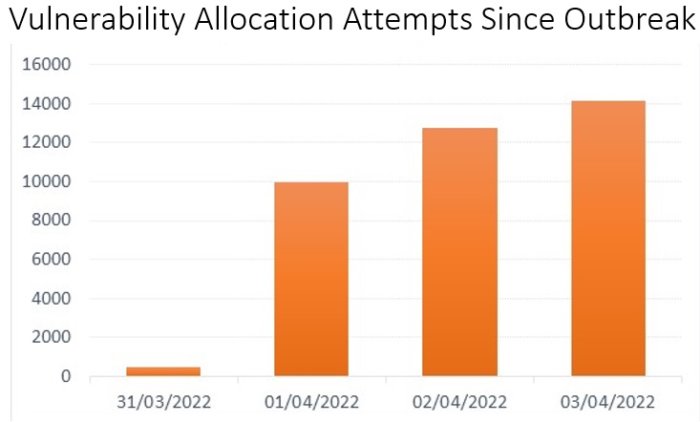
According to Check Point, who compiled the report based on their telemetry data, 37,000 Spring4Shell attacks were detected over the past weekend alone.

Number of Spring4Shell exploitation attempts(Check Point)

The most impacted industry appears to be software vendors, accounting for 28% of the total, potentially due to being excellent candidates for supply chain attacks.

As for the most targeted region, Check Point ranks Europe first with 20%, based on their visibility.

This indicates that the malicious effort to take advantage of existing RCE opportunities against vulnerable systems is well underway, and threat actors appear to be shifting to Spring4Shell while they can still take advantage of unpatched systems.

Exploit signs in the U.S.

North America accounts for 11% of Check Point’s detected Spring4Shell attacks, and confirmations of active exploitation in the U.S. come from other entities too.

Yesterday, the U.S. Cybersecurity & Infrastructure Security Agency (CISA) added four vulnerabilities to its catalog of flaws known to be leveraged in actual attacks, one of them being Spring4Shell.

More specifically, the agency has seen evidence of attacks targeting VMware products, for which the software vendor released security updates and advisories yesterday.

Microsoft also published guidance for detecting and protecting against Spring4Shell attacks and noted that they are already tracking exploitation attempts.

"Since the Spring Core vulnerability was announced, we have been tracking a low volume of exploit attempts across our cloud services for Spring Cloud and Spring Core vulnerabilities," Microsoft said.

Protect against Spring4Shell attacks

CVE-2022-22965 impacts Spring MVC and Spring WebFlux apps running on JDK 9+, so all Java Spring deployments should be considered as potential attack vectors.

The vendor has released Spring Framework versions 5.3.18 and 5.2.2, as well as Spring Boot 2.5.12, which successfully address the RCE problem. Therefore, there is a strong recommendation to upgrade to these versions or later.

Moreover, system admins should also consider the CVE-2022-22963 and CVE-2022-22947 remote code execution flaws in the Spring Cloud Function and Spring Cloud Gateway. Proof of concept exploits for these flaws already exist and are publicly available."

Lighthouses Live 2022 #GLN22

She's OK "IN THE MAINSTREAM": Surprising Change-of-Mind for Utah Republican Senator Mitt Romney

He was one of three Republican Senators who switched sides in what is still a divided Congress, just before they go on a two-week break and other news takes over all the headlines as we go onto another news cycle.

Mitt Romney Explains His Surprising Reversal On Ketanji Brown Jackson

The Utah senator is supporting President Joe Biden's Supreme Court nominee after voting against her for a lower court position last year
Sen. Mitt Romney (R-Utah) is supporting Judge Ketanji Brown Jackson for a seat on the Supreme Court after opposing her nomination to a lower court last year.

On Monday, the Utah Republican voted to advance Jackson’s nomination to the Supreme Court, a rare reversal in the deeply divided Senate, where ugly confirmation fights over the highest court in the land are quickly becoming the norm.

“In her previous confirmation vote, I had concerns about whether or not she was in the mainstream,” Romney told reporters on Tuesday. “And having spent time with her personally and reviewing her testimony before Congress [I] became convinced that she is in the mainstream.”

In announcing his support for Jackson, which came as a bit of a surprise, Romney called the judge a “well-qualified jurist” and a “person of honor” even though he said they may differ on ideological grounds. . .

Republicans launched ugly and misleading accusations against Jackson over her quite mainstream record of sentencing sex offenders, cherry-picking cases and ignoring similar sentences handed down by Republican-appointed judges. The GOP senators who are backing Jackson are even being smeared as “pro-pedophile” by some on the right.

. . .Sen. Lindsey Graham (R-S.C.), meanwhile, was far more explicit on that point, suggesting Monday that Republicans would not have held hearings on Jackson’s nomination if they were in control of the Senate.

. . .Graham voted to confirm Jackson to her current seat on the U.S. Court of Appeals for the District of Columbia Circuit last year. But in a reverse-Romney move, Graham is opposing Jackson’s nomination to the Supreme Court ― the first time he’ll oppose a Supreme Court pick since joining the Senate in 2003."

Council Study Session - 4/4/2022

Zelensky Calls for a European Army as He Slams EU Leaders’ Response

      Jan 23, 2026 During the EU Summit yesterday, the EU leaders ...