Tuesday, April 19, 2022
DOWNTOWN MESA'S "POLTERGEIST" MOMENT: Pre-History Buried Underground Comes Back To Bite City Planners


 ^ Now please take a look at the concentration and high density of dots in the upper-right corner of the enlarged cropping from the map shown to the left - the word MORONI (the name of an angel from The Book of Mormon) is appended to the Spanish word Pueblo in a section of concentrations of centuries-old settlements with "many small reservoirs and temples". Places of worship. sacred ground - clearly marked on this historic map.
_________________________________________________________________________
What is your MesaZona blogger getting at focusing on just that one word temples?
Simply because it's not unusual for one civilization or culture to attempt to bury or cover over signs of earlier cultures, physically removing from sight or building structures on top of the sites of earlier cultures.
featured top story
A canal runs through it: city site’s new challenge
"All the buildings on a city-owned vacant lot near downtown Mesa have been cleared in preparation for long-sought development, but an archaeological consultant thinks the site could still hold Mesa history and prehistory underground.
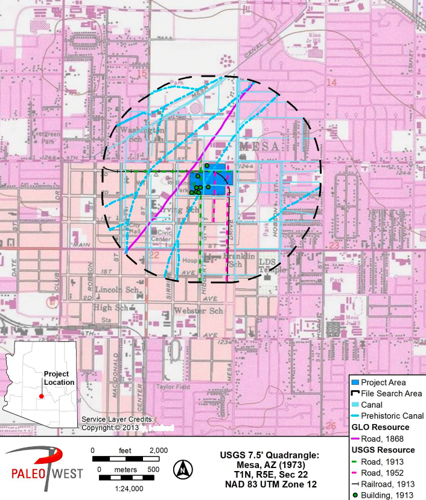
As part of city development partner Miravista Holdings’ master planning process for the development of the so-called Transform 17 site, Phoenix-based archaeology firm PaleoWest reviewed historic documentation of the area and issued a report on the site’s historical features.
PaleoWest tried to assess what cultural resources might still exist beneath the lot before construction crews potentially disturb it if the city and Miravista sign off on a final development agreement in August for the 27-acre site just north of Main Street near Phoenix Marriott Mesa.
It studied historic maps and scoured databases of previous archaeological and historic research within the site and a half-mile radius around it.
PaleoWest believes its study is the first cultural resource survey of the Transform 17 site, which is within the original Mesa townsite and less than a mile from the Mesa Grande pueblo... PaleoWest found reasons to believe “significant information on the prehistoric occupation in the Phoenix Basin or on the early residents and development of the Town of Mesa“ may still be preserved beneath the former home sites...the historic development could have had the effect of preserving subsurface prehistoric resources that may have been present in the Project area. [that may have] survived the demolition of the residential structures.”
. . .Sampling can give archaeologists an idea of what’s beneath a site without excavating the whole area.
One important factor for Miller’s recommendation is the presence of a prehistoric canal running through the site diagonally from northeast to southwest. This would have brought Salt River water to agricultural fields during the Hohokam period, from 500 A.D. to 1400 A.D., when ancestral desert farmers made the Salt River valley bloom.
The canal is no longer evident on the parcel’s surface, but Miller wrote that evidence of it could still exist below the surface. He recommended that archaeologists focus test digs along “the mapped alignment of the prehistoric canal” to see what clues remain.
. . .Old maps reveal other interesting things about Transform 17’s past.
> On an 1870 federal General Land Office map, PaleoWest identified a road running southwest-northeast just outside Transform 17. On the map, the road is labeled “Maricopa Wells to Fort McDowell.” Fort McDowell was an important hub for American settlement in the mid 1800s, and Maricopa Wells was a stop along the Southern Emigrant Trail.
> A railroad circa 1913 passed through the site, though no clues of it remain on the surface.
Neil Calfee a representative with Miravista Holdings, said the company has “not yet undertaken any testing or mitigation measures related to site archeology. Our current efforts are focused on completing our entitlement process and finalizing our development agreement with the city. . ."
> Vic Linoff, a local historian and president of the nonprofit Mesa Preservation Foundation, said he hopes the city and Miravista are diligent about following PaleoWest’s recommendations...it was especially important to record the past at Transform 17 given “the very sad chapter, I think, in the city’s history” related to the acquisition of the property. . .
> To sell its recommendation to conduct an archaeological study before starting construction of the new development, PaleoWest’s report emphasizes the potential prehistoric and Territorial period history of the site, but Linoff thinks Transform 17’s later history as a place where marginalized Mesans could make a home is also important. . ."
Tags
Read more >>
Monday, April 18, 2022
THE PSYCHEDELIC RENAI$$ANCE: Now on-the-road to Creating Billion$$$$$$$$$ to Treat Trauma and Depression
GoDaddy Billionaire Bob Parsons Believes Psychedelics Can Heal Trauma—And He’s Putting His Money (And Brain) On The Line
The Marine infantryman still suffers from PTSD from his tour in Vietnam but credits LSD and MDMA with helping him “come home.” Now he’s on a mission to help other veterans

Let's flash forward (after the long and detailed opening paragraphs): "...By the 1980s, he was a brash, motorcycling-riding businessman with a pierced ear and the founder of Parsons Technology, an accounting software company he sold in the 1990s for $64 million to Intuit.
In 1997, Parsons started a web design company that would eventually become his most famous venture—domain name reseller GoDaddy, which would become notorious for its raunchy Super Bowl commercials.
He became a billionaire in 2011 when he sold the majority of GoDaddy to private equity investors, earning $900 million in cash and shares in the publicly traded company.
He is now worth some $3.4 billion.
[. ]
But like many Vietnam veterans, Parsons was still haunted by the war. He didn’t know what to call it, but he realized his personality was completely different from the young kid from Baltimore who grew up poor. Thanks to post-traumatic stress disorder, Parsons had a hair-trigger temper and didn’t want to be around people. “It most certainly cost me two marriages,” he says.
He tried therapy to ease the PTSD, but it wasn’t until 2018, when he read Michael Pollan’s book about psychedelic-assisted therapy, How to Change Your Mind, that he thought about using mind-altering drugs. Parsons mentioned to his third wife, Renee, that he wanted to try therapy with psychedelics and within two months she had set up a trip down in Hawaii, where they own a home. Under the supervision of a trained therapist with vast experience helping people through a psychedelic journey, Parsons underwent multi-day therapy sessions.
The treatment involved a series of Schedule I drugs—including psilocybin (the hallucinogen in “magic mushrooms”), DMT (the active ingredient in ayahuasca) and LSD—meaning they are banned by the federal government and believed to have a high potential for abuse and no medical value. "For four days I was at it: the first day it was ayahuasca, the second day mushrooms,” Parsons says.
"The third day, I just played golf. I'd never putted so good in my whole life, before or since."
I mean it was like the green was saying ‘Hit it is here, Bobby’ and it would go right in.”
. . .On the fourth day, Parsons took “good, old-fashioned LSD.”
========================================================================
Prescription sales for depression medication is estimated to be $50 billion a year globally, while the total mental health market is worth about $100 billion in annual sales.
Pharmaceutical analysts say that FDA-approved psychedelic-assisted therapy could seize $10 billion in annual sales by targeting the treatment-resistant depression subcategory alone.
There is still a lot of work to be done to prove the efficacy of these drugs, but Parsons needs no convincing. Nor do medical researchers in the space who see dramatic results with patients, although nothing has been proven, says Rachel Yehuda, director of Mount Sinai’s Center for Psychedelic Psychotherapy and Trauma Research. . .
Parsons is among those leading the charge, but he is not interested in starting a business in the field. Even though he sees tremendous economic potential, he has embraced the role of the billionaire donor. . .
And Parsons is not the only billionaire putting his money into psychedelics. Paypal founder Peter Thiel (net worth: $5.2 billion) invested in Nasdaq-traded German biotech Atai Life Sciences, which owns a suite of companies conducting clinical trials on various psychedelic molecules, including Compass Pathways, which is developing a patented form of psilocybin to be used in conjunction with therapy to treat depression. Atai has produced its own billionaire, Christian Angermayer ($1.3 billion). Hedge fund billionaire Steven Cohen ($17.4 billion), author of the Four-Hour Workweek Tim Ferriss, co-founder of WordPress Matt Mullenweg, and Toms Shoes founder Blake Mycoskie donated $17 million to build the Johns Hopkins Center on Psychedelic and Consciousness Research. . .
Despite having positive results with psychedelics, Parsons—who also founded PXG, a successful golf equipment company, owns several motorcycle dealerships, the Scottsdale National Golf Club, and manages his own hedge fund and real estate portfolio—admits he is not completely cured. . ."
You are invited to read more go here >> https://www.forbes.com/sites/willyakowicz/2022/04/17/godaddy-billionaire-bob-parsons-believes-psychedelics-can-heal-trauma-and-hes-putting-his-money-and-brain-on-the-line/
Patriarch Kirill l A Former KGB Spy & Spiritual Guru Is The Driving Forc...
A DECADE-QUEST TO FIND A DUMB TV. . .It's not impossible

from the more-isn't-automatically-better dept
Yet when if you go shopping for “dumb” televisions — as in just a high quality display with a bunch of HDMI ports and not much else, you’re usually going to be out of luck. There are options, but guides on this front will usually shovel you toward computer monitors (too pricey at large sizes), or business-class displays (ditto). This Lifehacker article ironically forgot to even list the few models that do exist:
The big caveat when it comes to dumb TVs is that they are absolutely not the priority in the market, and so it can be difficult to find a dumb TV that has the screen size, resolution, and other features of a smart TV. Still, it’s not impossible. Samsung makes a 65-inch 4K dumb TV, for example, as does Sceptre, but identifying and finding dumb TVs can be challenging. . .
That gap has likely closed in the year since, if it hasn’t slammed shut. Worse, TV makers seem insistent on pushing their luck and ruining the quality of their own products as they pursue new online revenues. You’ll routinely see smart TV GUIs slathered with obtrusive ads. And in some cases, greedy TV makers, like Vizio (previously busted tracking users without permission), are now pushing ads over live content.
“Smart” TV makers can’t just take the ad and consumer tracking money and be satisfied, they’re constantly pushing “innovations” seemingly invented to annoy you in a bid to obtain improved quarterly returns.
- Techdirt Podcast Episode 317: Algorithmic Destruction
- John Oliver Tries To Scare DC Into Doing Something About The Privacy Dumpster Fire That Is Adtech
- Clearview AI Walks Back Earlier Claims, Is Now Willing To Sell Its Sketchy Product To Anyone With Money And A Pulse
- FCC Inaction On Media Consolidation Continues On Anniversary Of Prometheus Ruling
- EU/US Say They've Agreed To A New Privacy Shield... That Doesn't Seem To Deal With Any Of The Problems Of The Old One
Sunday, April 17, 2022

-
 Flash News: Ukraine Intercepts Russian Kh-59 Cruise Missile Using US VAMPIRE Air Defense System Mounted on Boat. Ukrainian forces have made ...

