Saturday, April 23, 2022
*** Mesa City Council Study Session Thu 04.21.2022 at 07:30 a..m. ***
 Link >>
  Item 1-a
Conference: Tuesday, April 18, 2017 from 8:30 to 5pm at the Mesa Convention Center, 263 N Center Street, Mesa, AZ 85201
Welcome Reception: Monday, April 17, 2017 from 5:30 to 7pm at the Mesa Arts Center, 1 E Main St, Mesa, AZ 85201
Keynote Speakers:

Broadband is a critical driver for American prosperity and economic growth.
As a result, state and local governments are seeking ways to expand broadband access and digital inclusion to improve economic growth, workforce development, education outcomes and healthcare in their communities.
• Does your community need broadband?
• Do you want to learn more about how to plan and fund broadband infrastructure access in your community?

The official description from the city's webpage:
"Each year, the city's budget is developed in conjunction with residents, the Mayor and City Council, City Manager and City Employees.
| Meeting Name: | City Council Study Session | Agenda status: | Final |
| Meeting date/time: | 4/21/2022 7:30 AM | Minutes status: | Draft |
| Meeting location: | Lower Council Chambers | ||
| Published agenda: |  Agenda Agenda | Published minutes: | Not available | |
| Meeting video: |

| Attachments: |
|
|
YUK! RARE HYPER-INFECTION PARASITIC PROWLERS: An Unusual Army of Roundworm Larvae Writhes and Slithers
Intro: It's your fault for clicking — 144 Comments
Army of worm larvae hatch from man’s bum, visibly slither under his skin
Doctors watched the shifting rash blanket his body in rare hyperinfection.

Beth Mole Beth is Ars Technica’s health reporter. She’s interested in biomedical research, infectious disease, health policy and law, and has a Ph.D. in microbiology.
"Doctors in Spain diagnosed a man with an unusual roundworm infection after watching an army of larvae writhe and slither under his skin, blanketing his whole body in an ever-shifting rash.
Doctors reported the man's rare hyperinfection this week in the New England Journal of Medicine, highlighting the unusual sight of a wriggling, sliding skin rash that tracked the movements of individual parasitic prowlers. The official diagnosis was larva currens from Strongyloides.
The unfortunate patient appeared to have a perfect storm of risk factors to develop the uncommon and unpleasant infection. The 64-year-old worked in sewage management and had previously been diagnosed with metastatic lung cancer. For three years prior, doctors had noted bouts where he had eosinophilia—unusually high levels of disease-fighting white blood cells—which can be an indicator of a parasitic infection. . .
Vermin invasion
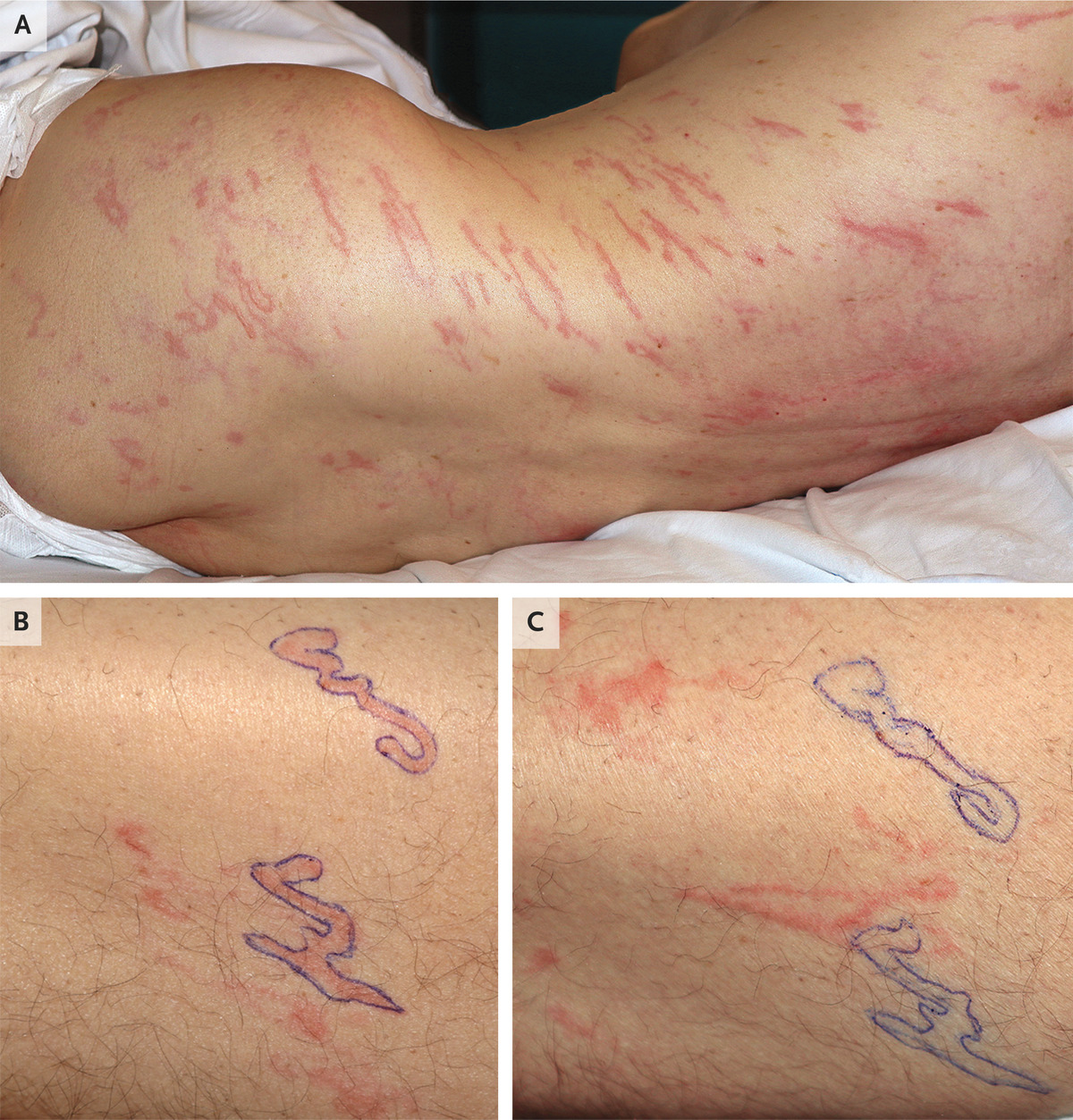
The worm in this case is Strongyloides stercoralis, a nematode or roundworm known to infect people. Infections begin when a person is exposed to contaminated soil or sewage. The worms can mature and breed there, and legions of little larvae—about 600 micrometers in length—can emerge, burrow directly into a person's skin unnoticed, and make their way into the intestines by various routes. In some instances, the larvae make their way to the lungs, get coughed up, and then swallowed to reach their final destination. Once in the intestines, the worms embed themselves in the mucosa of the small intestines and reproduce. Larvae that hatch there are then shed in feces to start the process again—or penetrate the skin in the perianal area, resulting in an "auto-infection."
This latter, most disturbing cycle is what appears to have occurred in the cancer patient. Doctors noted that the problems began with a raised, itchy rash and mild diarrhea. The red, wavy skin lesions originated in his perianal region, then began to migrate under his skin, reaching all over his trunk and limbs. Doctors outlined individual red squiggles on his skin with pen and noted that 24 hours later, the squiggles had moved. . ."
TIME-LAPSE SATELLITE IMAGES: Climate Crisis 2022
Google doodle marks Earth Day 2022 with stark images of climate crisis
Time-lapse satellite images show glacial retreat at Mount Kilimanjaro, Great Barrier Reef coral bleaching, deforestation in Germany and Greenland glacial melt

Thu 21 Apr 2022 23.29 EDT
Last modified on Thu 21 Apr 2022 23.52 EDT"Google is marking Earth Day with time-lapse satellite images showing melting glaciers, retreating snow cover, deforestation and coral bleaching to remind its users about humanity’s impact on the climate and environment.
The 2022 Earth Day Google doodle includes four Gifs created from satellite imagery and photographs from The Ocean Agency that will rotate throughout the day.
Other images show the result of a coral bleaching event on the Great Barrier Reef near Lizard Island in Australia between March 2016 and October 2017 and deforestation of the Harz forests in Elend, Germany, between December 1995 and 2020.
Climate counsellor Lesley Hughes, a professor of biology at Macquarie University in Sydney, said the images of coral bleaching on the Great Barrier Reef are “a very high-impact visual image” that would resonate.
“Our major natural icon, that we are stewards of, is a symbol of the impact of climate change on an extraordinarily diverse ecosystem,” Hughes said.
“Our physical and biological world is transforming before our eyes and that’s what these images are emphasising and so there’s absolutely no time to waste.”
The Great Barrier Reef went through its sixth mass bleaching event in March with aerial surveys showing almost no reefs across a 1,200km stretch escaping the heat – the first known to have occurred during a La Niña year.
Hughes said for those elsewhere, the images of glacial ice retreating would be similarly meaningful.
In New Zealand, the vast and ancient glaciers are thinning at an alarming rate.
The National Institute of Water and Atmospheric Research (Niwa) found that between 1977 to 2014, a third of the permanent snow and ice was lost from the Southern Alps – a dramatic decline that began accelerating rapidly in the last 15 years.
More recently the summer of 2017-2018 brought temperatures 3C warmer than average across New Zealand, shrinking some glaciers so much they all but disappeared.
Elsewhere artefacts long-entombed in the Italian Alps are being revealed as the ice melts, leading to the discovery of equipment left behind by soldiers camped out on the peaks during the first world war and a 5,300-year-old crime scene when the mummified body of Ötzi was found by hikers.
What has been a boon for archaeologists is also a symptom of the catastrophic threat caused by climate change. Forni, one of Italy’s largest valley glaciers, has retreated 800 metres within the past 30 years and 1.2 miles (2km) over the past century.
The images contrast with the positive note struck with the animation published for Earth Day 2021, which the company said was designed to “encourage everyone to find one small act they can do to restore our Earth”.
Hughes said the confronting images published in 2022 may be a response to the IPCC26 report and were important for raising awareness.
“I think when you’re sitting in a middle-class environment and it’s a nice day and the sun’s come up or has gone down, it’s easy to become complacent about the larger forces at work in our climate system and the impacts those forces have,” Hughes said.
“So reminding people that just because it’s a nice day, climate change hasn’t gone away is really important. . ."
Reference >>
U.S.-SUPPLIED PHOENIX GHOST DRONE: Kamikaze One-Way Defense Attack Drone For Striking Targets
Phoenix Ghost: What we know about the US’s new drones for Ukraine
The Pentagon says the Phoenix Ghost tactical unmanned aerial system was designed mainly for striking targets
Source: Al Jazeera and news agencies
"The United States has disclosed details of its latest military aid package to be used by Ukraine’s forces in the country’s east after Russian forces this week launched a full-scale offensive in the region.
The new $800m assistance package includes a new unmanned aerial weapons system, or drone, dubbed the Phoenix Ghost.
Pentagon spokesman John Kirby said the drones, which are produced by a US company, Aevex Aerospace, are particularly well suited for the fight in Ukraine’s east, in the flat and open terrain of the region known as Donbas.
“Without getting into the specifications, but the kinds of things this drone can do lend itself well to this particular kind of terrain,” Kirby told reporters on Thursday.
“I think I’m just going leave it at that. But its purpose is akin to that of the Switchblade … which is basically a one-way drone, an attack drone. And that’s essentially what this is designed to do”.
=========================================================================
The transfer of the Phoenix Ghost drones to Ukraine is part of a $800 million package announced on April 21.Other assets that will be transferred to Ukraine include 72 155mm howitzers and 144,000 artillery rounds, 72 tactical vehicles to tow the howitzers, and
field equipment and spare parts.
This commitment, together with the 18 155mm howitzers announced on April 13, provides enough artillery systems to equip five battalions. The United States has now committed more than $4 billion in security assistance to Ukraine since the beginning of the Biden administration, including approximately $3.4 billion since the beginning of Russia’s unprovoked invasion on February 24.
This authorization is the eighth drawdown of equipment from DoD inventories for Ukraine since August 2021.
Source: https://defbrief.com/2022/04/21/us-sending-secretive-new-phoenix-ghost-tactical-drones-to-ukraine/
=========================================================================
Drones such as the Turkish Bayraktar TB2 and the US-made Switchblade have so far played a key role in the Ukrainian forces’ defence against the Russian invasion.
Not much else is known about the Phoenix Ghost drones, including their range and precise capabilities. Kirby, however, did say that the drones, which have not yet been delivered to Ukraine, are equipped with onboard cameras

“It can also be used to give you a sight picture of what it’s seeing, of course. But its principal focus is attack,” he said.
He added that the systems had been in development since before Russia’s invasion of neighbouring Ukraine on February 24.
“But we will continue to move that development in ways that are attuned to Ukrainian requirements for unmanned aerial systems of a tactical nature in eastern Ukraine,” he added.
The Pentagon said training for the Ghost drones would be similar to the training on the Switchblade, but did not reveal any details about training plans or say how many Ukrainians would be trained on the new system."
Link reference >> https://www.aljazeera.com/news/2022/4/22/phoenix-ghost-what-we-know-about-us-new-drones-for-Ukraine
RELATED CONTENT

Duration: 2:07
Posted: 2 days ago

Duration: 1:19
Posted: 1 day ago
FEEL THE BERN:
Jeff Bezos is worth $160bn – yet Congress might bail out his space company

If we are going to send more humans to the Moon and eventually to Mars, will the goal be to benefit the people of the US and the world, or to make billionaires even richer?
On 20 July 1969, 650 million people throughout the world watched with bated breath as Neil Armstrong successfully fulfilled President Kennedy’s vision. The United States achieved what had seemed impossible just a few decades before. We had sent a man to the moon.
On that historic day, the entire world came together to celebrate the enormous accomplishment as Armstrong’s voice boomed from our television sets: “That’s one small step for man, one giant leap for mankind.”
In just eight short years the US, led by our extraordinary scientists, engineers and astronauts at Nasa, had opened up a new world for humanity. And while the entire world rejoiced, there was a special joy and pride in our country because this was an American project. It was our financing, our political will, our scientific ingenuity, our courage that had accomplished this milestone in human history. We had not only “won” the international space race, but more importantly, we had created unthinkable opportunities for all of humankind.
Fifty-three years later, as a result of a huge effort to privatize space exploration, I am concerned that Nasa has become little more than an ATM machine to fuel a space race not between the US and other countries, but between the two wealthiest men in America – Elon Musk and Jeff Bezos, who are worth more than $450bn combined.
After many billions of dollars of taxpayer funding the American people are going to have to make a very fundamental decision. If we are going to send more human beings to the moon and eventually to Mars, who will control the enterprise and what will be the purpose of that exploration? Will the goal be to benefit the people of the United States and the entire world, or will it be a vast boondoggle to make billionaires even richer and open up outer space to corporate greed and exploitation?
At this moment, if you can believe it, Congress is considering legislation to provide a $10bn bailout to Jeff Bezos’s Blue Origin space company for a contract to build a lunar lander. This legislation is taking place after Blue Origin lost a competitive bid to SpaceX, Musk’s company.
[ ]
The time is now to have a serious debate in Congress and throughout our country as to how to develop a rational space policy that does not simply socialize all of the risks and privatize all of the profits. Whether it is expanding affordable high-speed internet and cellphone service in remote areas, tracking natural disasters and climate change, establishing colonies on the moon and Mars or mining asteroids, the scientific achievements we make should be shared by all of us, not just the wealthy few.
Space exploration is very exciting. Its potential to improve life here on planet Earth is limitless. But it also has the potential to make the richest people in the world incredibly richer and unimaginably more powerful. When we take that next giant leap into space let us do it to benefit all of humanity, not to turn a handful of billionaires into trillionaires."

-
 Flash News: Ukraine Intercepts Russian Kh-59 Cruise Missile Using US VAMPIRE Air Defense System Mounted on Boat. Ukrainian forces have made ...

