The Supreme Court, which is expected to rule in June, may refrain from overturning Roe, or may craft a compromise in which abortions early in pregnancy remain protected. But many legal experts who watched the oral arguments say it is likely that Roe will be substantially weakened.
What an America Without Roe Would Look Like
Legal abortions would fall, particularly among poor women in the South and Midwest, and out-of-state travel and abortion pills would play a bigger role
"Last week’s Supreme Court arguments on a Mississippi abortion law raised the prospect of a return to a time half a century ago — when the procedure was illegal across most of the United States and women, perilously, tried to end pregnancies on their own or sought back-alley abortions.
If the court decides to reverse or weaken the landmark Roe v. Wade ruling, it will usher in a somewhat different era. Abortion would remain legal in more than half of states, but not in a wide swath of the Midwest and the South.
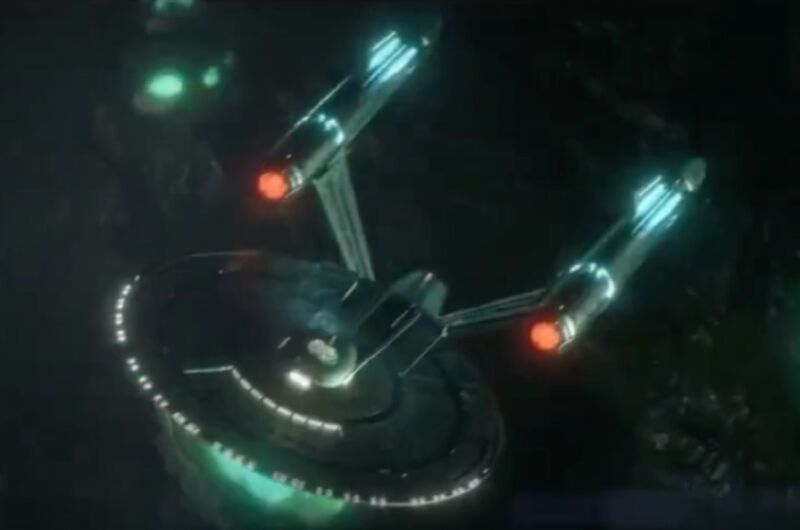
"Paramount+ debuted the official opening credits for Star Trek: Strange New Worlds on Twitter this morning, and the sequence leans heavily into fan nostalgia. The credits are a visually stunning tribute to the iconic opening credits sequence for Star Trek: The Original Series, showing the USS Enterprise soaring through space, past asteroid belts and clouds of interstellar dust as it searches for the titular new worlds. Even the voiceover dialogue remains the same (except "no man" is now "no one").
As we've previously reported, showrunner Akiva Goldsman has confirmed that Strange New Worlds will return to the episodic structure of classic Star Trek—making it a rare beast in this era of serialized storytelling and streaming platforms—and will respect existing canon. It will feature Capt. Christopher Pike (Anson Mount), Number One (Rebecca Romijn), and Ethan Peck's Spock, who first appeared in Star Trek: Discovery's second season. . .
Paramount+ released a brief teaser in March and a full-length trailer just a few weeks ago. The latter opened with Pike beaming into the middle of what appears to be a bitter dispute between two alien factions. There were crew members beaming down to the surface of a comet and encountering a large, glowing, golden egg-shaped structure. Pike and the Enterprise found themselves under fire by aliens who considered their presence to be "blasphemy." And romance bloomed for both Pike and Spock (separately, not with each other—sorry, slashfic shippers).
Star Trek: Strange New Worlds debuts on Paramount+ on May 5, 2022, so we'll soon learn much more about the crew's adventures in this first season.
Intro: NASA has already made a bet on Starship. With its selection as the Human Landing System for Artemis, the large, cutting-edge vehicle is now on the critical path to landing humans on the Moon, NASA's most ambitious human spaceflight program in half a century.
And if NASA's astronauts are betting that Starship will succeed, then the rest of the space agency probably should be, too.
SpaceX engineer says NASA should plan for Starship’s “significant” capability
"We all need to be thinking bigger and better and really inspirationally about what we can do."
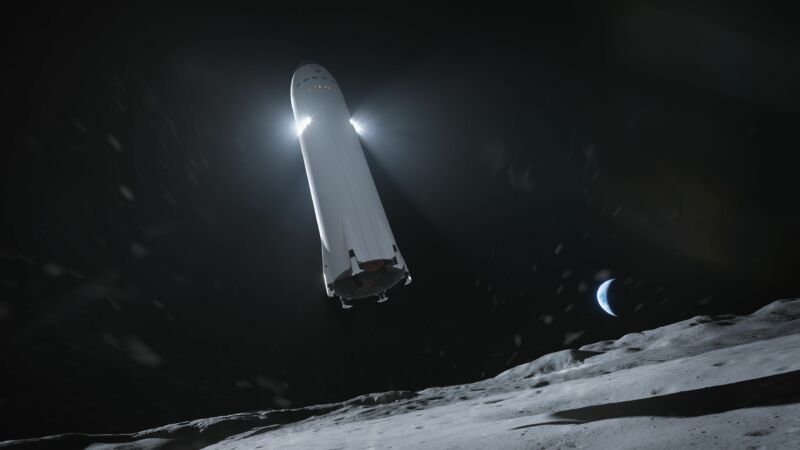
(In this illustration, SpaceX's Starship vehicle is seen landing on the Moon)
"As part of its Artemis program to return humans to the Moon this decade, NASA has a minimum requirement that its "human landing system" must be able to deliver 865 kg to the lunar surface. This is based on the mass of two crew members and their equipment needed for a short stay.
However, in selecting SpaceX's Starship vehicle to serve as its human lander, NASA has chosen a system with a lot more capability. Starship will, in fact, be able to deliver 100 metric tons to the surface of the Moon—more than 100 times NASA's baseline goal.
"Starship can land 100 tons on the lunar surface," said Aarti Matthews, Starship Human Landing System program manager for SpaceX. "And it’s really hard to think about what that means in a tangible way. One hundred tons is four fire trucks. It’s 100 Moon rovers. My favorite way to explain this to my kids is that it's the weight of more than 11 elephants."
No mass constraints
Matthews made her comments last week at the ASCENDxTexas space conference in Houston. She was responding to a question from an audience member, Jeff Michel, an engineer at Johnson Space Center. He works in the area of in-situ resource utilization, the processing and use of local materials known more colloquially as "living off the land." What role, he asked, should NASA’s technical workforce play in developing these technologies?
In answering the question, Matthews urged Michel and his colleagues and NASA to think bigger about what they could do on the surface of the Moon with a vehicle as capable as Starship. This would be wholly different from any capability NASA has ever had before. By way of comparison, in a "truck" configuration for cargo only, it was estimated that this Apollo Lunar module vehicle could bring about five tons down to the lunar surface.
"NASA specified a high-level need, but we, industry, are taking away one of your biggest constraints that you have in designing your payloads and your systems," she said. "It’s significantly higher mass. It’s essentially infinite volume for the purposes of this conversation. And the cost is an order of magnitude lower. I think that our NASA community, our payload community, should really think about this new capability that’s coming online."
Think bigger
Matthews noted that all space projects face extremely challenging mass and size limitations. This, in turn, constrains the performance of the payload, be it a scientific experiment or some kind of demonstration.
"We all need to be thinking bigger and better and really inspirationally about what we can do," Matthews said. "Anyone who has worked on hardware design for space application knows you’re fighting for kilograms, and sometimes you’re fighting for grams, and that takes up so much time and energy. It really limits ultimately what your system can do. That’s gone away entirely."
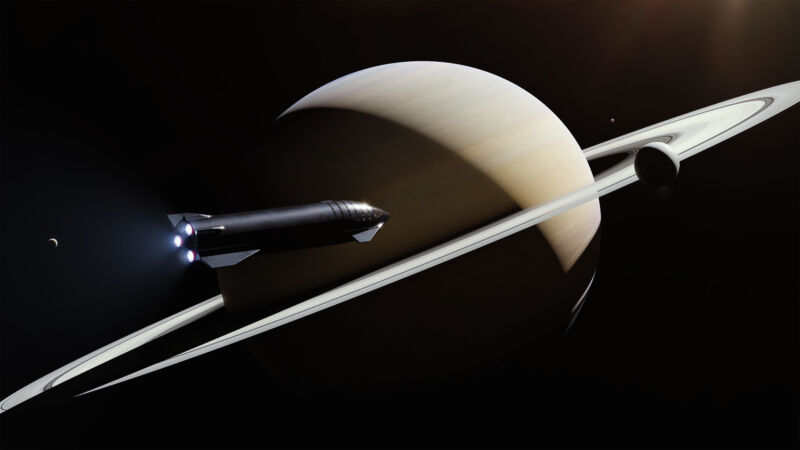
[ ] A group of planetary scientists, for example, have started warming to the idea that Starship could open up the Solar System to a new era of exploration. When SpaceX sends its first test missions to Mars, these scientists say, NASA should have experimental payloads ready to take advantage of the mass and volume capabilities of the new vehicle.
With her comments last week Matthews extended that challenge to Michel and other engineers and scientists at the space agency.
"If you, as an engineer, are developing an in-situ resource utilization system, what does your system look like when you have no mass constraint?" she asked. "What about when you have no volume constraint? That would be the exciting thing that I would like to hear from NASA engineers, what they can do with this capability."