Thursday, May 05, 2022

HIKES, RALLIES & PLUNGES: Hold on for a Slippery Rough Ride. No Pain. No Gain

Intro: The central bank also plans to shrink its nearly $9 trillion bond holdings, a move that could directly affect financial markets.
So far this year, the S&P 500 has gained or lost more than 2.5 percent on seven separate days, all of them in March, April and May. In 2021, there was only one day in which stocks rose or fell by that much, in late January of that year.

Stocks slide, erasing gains that followed Fed meeting, as volatility continues to reign.

Rage Red Stocks GIF - Rage Red Stocks Crash GIFs

"Stocks dove on Thursday, erasing gains from their best day since 2020 in a swing that highlights Wall Street’s heightened anxiety over what the Federal Reserve’s campaign to slow inflation means for the economy.

The S&P 500 fell 3.6 percent, after surging 3 percent on Wednesday.

The Nasdaq composite slid 5 percent, its biggest drop since June 2020.

The volatility was on display in other financial markets, too. Yields on government bonds spiked, with the rate on 10-year U.S. Treasury notes, a benchmark for borrowing costs across the economy, climbing above 3 percent and touching its highest level since 2018, reversing a drop on Wednesday.

The stomach-churning swings in the stock market have become bigger than usual in recent weeks, as investors panic that a combination of inflation and fast-rising interest rates could hit consumer spending, corporate profits and — ultimately — economic growth. In between those bouts of panic, glimmers of good news have triggered big rallies. . ."

Source: https://www.nytimes.com/live/2022/05/05/business/economy-news-inflation-russia#stock-market-fed-rate-hike 

Stock indexes slump as worries grow over higher interest rates

A video display on the floor of the New York Stock Exchange

DAMIAN J. TROISE and ALEX VEIGA

"Stocks closed sharply lower on Wall Street on Thursday, erasing a rally from a day earlier, as markets assess the looming fallout from the Federal Reserve’s stepped-up fight against inflation.

The Standard & Poor’s 500 pulled back 3.6%, marking its biggest loss in almost two years.

The Dow Jones industrial average fell 1,063 points, or 3.1%.

Tech stocks fell the most, pulling the Nasdaq down 5%. . .

> The Fed is between a rock and a hard place, and because of instant information investors are experiencing both fear and greed at the exact same moment,” said Sam Stovall, chief investment strategist at CFRA. . .

> The Bank of England on Thursday raised its benchmark interest rate to the highest level in 13 years, its fourth rate hike since December as U.K. inflation runs at 30-year highs.

Energy markets remain volatile as the conflict in Ukraine continues and demand remains high amid tight supplies of oil. European governments are trying to replace energy supplies from Russia and are considering an embargo. OPEC and allied oil-producing countries decided Thursday to gradually increase the flows of crude they send to the world.

Higher oil and gas prices have been contributing to the uncertainties weighing on investors as they try to assess how inflation will ultimately affect businesses, consumer activity and overall economic growth.

The latest corporate earnings reports are also being closely watched by investors trying to get a better picture of inflation’s impact on the economy. Cereal maker Kellogg rose 3.5% after reporting encouraging financial results. Etsy stumbled 17.7% after giving a weak forecast.

Twitter rose 2% after Elon Musk said he had secured more backing for his bid to take over the company.

> Technology companies had some of the biggest losses and weighed down the broader market, in a reversal from the solid gains they made a day earlier. Internet retail giant Amazon slumped 8.1% and Google’s parent company fell 5.4%.

> Home builders fell broadly as average long-term home loan rates climbed. D.R. Horton slid 7.1%.

The average rate on a 30-year fixed-rate mortgage rose to 5.27% this week, its highest level since 2009, according to mortgage buyer Freddie Mac.
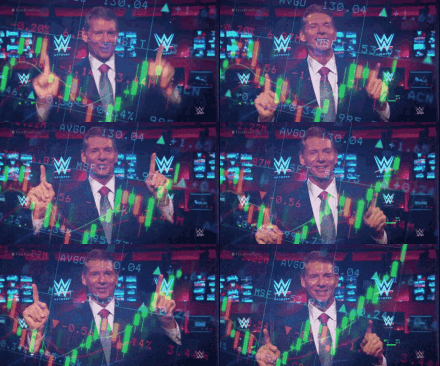
Stonks Wsb GIF - Stonks Wsb Stocks GIFs


RELATED CONTENT

Bank stocks, a key indicator of economic expectations, dropped 2.7%, according to the KBW Nasdaq index of large commercial lenders. The Russell...
43 mins ago
All three major U.S. stock indexes gyrated between positive and ... "We've hit 3% on the 10-year (Treasury yield), interest rates are going...
3 days ago
The S&P 500 fell 3.5%, and the Nasdaq Composite tumbled 5%, while Dow Jones Industrial Average slid over 1,059 points or 3%. DJIA. Timeframe. 1D...
27 mins ago
Among media stocks, Warner Bros. Discovery fell 4%, Disney and Comcast (which owns NBCUniversal) both skittered down 3%, Fox Corp. was off 1.9%...
1 hour ago
U.S. stocks climbed Monday after the S&P 500 touched a new intraday low for the year and the yield on the U.S. 10-year Treasury note hit 3%...
3 days ago
Wayfair, Sally Beauty, Etsy, Crocs Earnings: Consumer Premarket; Bank Stocks Fall After Three Days of Gains: Financials Premarket...
5 hours ago
They also can hurt demand for riskier stocks by reducing the value that ... to a rate increase of three-quarters of a percentage point,...
1 hour ago


VW sells out of electric cars in US and Europe

VW warned that there was “a continued risk” that the war and lockdowns in China would “have a negative impact on . . . business activities in the current year.”
> The auto industry’s overall sales forecasts for the year have been reduced in recent weeks, as the global economy continues to suffer from rising raw material prices and the war in Ukraine.
> Market leader Tesla delivered more than three times that number in the same quarter

links in the chain are broken —

VW sells out of electric cars in US and Europe

World’s second-largest EV manufacturer hit by supply chain bottlenecks.

A blue VW ID.4 in a studio

""Volkswagen, the world’s second-largest electric vehicle manufacturer by volume, has “sold out” of battery-powered models in the US and Europe for this year as persistent supply chain bottlenecks hit global production.

The Wolfsburg-based group, which includes brands such as Porsche, Audi, and Škoda, sold more than 99,000 electric models worldwide in the first three months of 2022 as it was hit by a shortage of semiconductors and wiring harnesses made in Ukraine.

Market leader Tesla delivered more than three times that number in the same quarter.

However, VW boss Herbert Diess said that, since demand had remained robust, the company had an order backlog in Western Europe of 300,000 electric cars. He added that customers now placing orders in Europe and the US would not get their electric models delivered before 2023...

 However, VW boss Herbert Diess said that, since demand had remained robust, the company had an order backlog in Western Europe of 300,000 electric cars. He added that customers now placing orders in Europe and the US would not get their electric models delivered before 2023..."

COMMENTS: 140

READ More >> https://arstechnica.com/cars/2022/05/vw-sells-out-of-electric-cars-in-us-and-europe/

FEDERAL RESERVE BANK NEW YORK: Domestic Market Operations

Intro:The New York Fed conducts various operations in U.S. fixed income and money markets to support the Federal Reserve's monetary policy and financial stability objectives, which include maximum employment, stable prices, and moderate long-term interest rates.


> Real-time results from domestic market operations can be found in the Markets Data Dashboard.

> Additional information on past operations can be found in the domestic market operations archive.

Monetary Policy Implementation

The Federal Reserve sets U.S. monetary policy in accordance with its mandate from Congress: to promote maximum employment, stable prices, and moderate long-term interest rates in the U.S. economy.

The Federal Reserve achieves these goals by managing the level of short-term interest rates—specifically, by setting a target (or target range) for the federal funds rate, which is an overnight, unsecured, interbank borrowing rate. The level of short-term interest rates then influences the availability and cost of credit in the economy, and, ultimately, the economic decisions made by businesses and households.

The Federal Reserve has a variety of tools for implementing monetary policy. The Board of Governors of the Federal Reserve System (Board of Governors) is responsible for tools such as the discount rate, reserve requirements, and interest on reserves; and the Federal Open Market Committee (FOMC) is responsible for open market operations.

Since 1936, the FOMC has annually selected the New York Fed to execute transactions for the System Open Market Account (SOMA)—the largest asset on the Federal Reserve's balance sheet—and issued a directive to the New York Fed's Open Market Trading Desk (the Desk) to undertake open market operations. The Desk executes operations as authorized and directed by the FOMC to achieve specific objectives, such as the target federal funds rate or a size or composition for SOMA securities holdings. The FOMC selects a manager of the SOMA to report to the Committee on SOMA transactions and financial market conditions.

The FOMC's approach to implementing monetary policy has evolved over time.

Pre-Crisis Policy Implementation

Before the financial crisis, the FOMC achieved its federal funds rate target by directing the New York Fed to actively manage the supply of reserves in the banking system. The Desk purchased and sold Treasury securities outright or through repurchase and reverse repurchase agreements to bring the supply of reserves in the banking system in line with the estimated quantity of reserve balances demanded at the FOMC's target rate.

Read more
Policy Implementation During and After the Financial Crisis

The financial crisis prompted several important changes in monetary policy implementation. As part of its effort to counteract the economic effects of the crisis, the FOMC reduced its target for the federal funds rate in a number of steps from 5¼ percent in mid-2007 to a range of zero to ¼ percent in December 2008. With short-term interest rates effectively constrained at the zero lower bound, the FOMC shifted the focus of its monetary policy implementation directives to the SOMA portfolio. Changes in the size and composition of the portfolio allowed for further easing of monetary conditions.

Read more
Policy Normalization

In 2014, the FOMC indicated that there would be two main components to monetary policy normalization: gradually raising the target range for the federal funds rate to more normal levels and gradually reducing the SOMA's securities holdings. The FOMC outlined its intended approach to these objectives in a statement of Policy Normalization Principles and Plans, initially published in September 2014 and periodically updated with additional details.

In December 2015, the FOMC raised its target range for the federal funds rate for the first time since the financial crisis and indicated that adjustments to short-term interest rates once again would be the primary tool for adjusting the stance of monetary policy. Yet with an abundant supply of reserve balances, implementation of monetary policy required a new operational approach, because small variations in the supply of reserves would no longer cause meaningful changes in the federal funds rate.

In September 2017, the FOMC announced its intention to begin normalizing the SOMA portfolio in October 2017, by gradually and predictably reducing its reinvestment of principal payments received from SOMA securities.

Read more
Additional Operations

To support the effective conduct of open market operations, the Desk lends eligible Treasury and agency debt securities held in the SOMA on an overnight basis. Also, in order to maintain its readiness to operate in any of the ways that the FOMC might direct in the future, the Desk conducts small value exercises from time to time across a range of operation types as a matter of prudent advance planning. These operations do not represent a change in the stance of monetary policy.

ANNOUNCEMENTS

RESOURCES
Data Visualization of the SOMA Portfolio
FAQs: Treasury Rollovers
FAQs: Agency MBS Reinvestments
FAQs: Reverse Repurchase Agreement Operations
FAQs: Standing Repo Facility

Elon Musk JUST REVEALED SpaceX's INSANE NEW Starship 2.0!

YESTERDAY'S DAILYFX

Intro: May Federal Reserve Meeting, Rate Decision
Christopher Vecchio, CFA, Senior Strategist


Fed Rate Hike Cycle Set to Accelerate

There was been a discernible shift in tone among Fed policymakers since the start of April. Whereas most officials believed that a 25-bps rate hike would be appropriate in May, recent inflation data spurred a more hawkish shift in rhetoric, with several FOMC members openly advocating for a 50-bps rate hike – and one has even talked up the possibility of a 75-bps rate hike.

After the Fed raises rates by 50-bps in May, there are still 200-bps rate hikes discounted into early-2023. The 2s5s10s butterfly has traded sideways in recent weeks, suggesting that the market has retained its overall hawkish interpretation of the near-term path of Fed rate hikes. Focus remains more on the Fed and less on Russia’s invasion of Ukraine

Rate Hike Timeline

Fed fund futures have remained very aggressive in recent weeks, with a rapid pace of tightening expected over the next three meetings.


Traders see a 100% chance of a 50-bps rate hike in each of May, June and July, with the main Fed rate expected to rise to 2.75% (currently 0.50%) by the end of 2022.

  • May 2022 = balance sheet winddown announced; 50-bps rate hike (107% chance)
  • June 2022 = 50-bps rate hike (142% chance)
  • July 2022 = 50-bps rate hike (133% chance)
  • September 2022 = 50-bps rate hike (90% chance)

We’ll discuss how markets may react to the May Federal Reserve rate decision starting at 13:45 EDT/17:45 GMT. You can join live by watching the stream at the top of this note

FOMC: Decisions Regarding Monetary Policy Implementation

 
Here is the official statement: Press Release                                                                      
May 04, 2022

Implementation Note issued May 4, 2022

Decisions Regarding Monetary Policy Implementation

The Federal Reserve has made the following decisions to implement the monetary policy stance announced by the Federal Open Market Committee in its statement on May 4, 2022:

  • The Board of Governors of the Federal Reserve System voted unanimously to raise the interest rate paid on reserve balances to 0.9 percent, effective May 5, 2022.

  • As part of its policy decision, the Federal Open Market Committee voted to authorize and direct the Open Market Desk at the Federal Reserve Bank of New York, until instructed otherwise, to execute transactions in the System Open Market Account in accordance with the following domestic policy directive:

    "Effective May 5, 2022, the Federal Open Market Committee directs the Desk to:

    • Undertake open market operations as necessary to maintain the federal funds rate in a target range of 3/4 to 1 percent.
    • Conduct overnight repurchase agreement operations with a minimum bid rate of 1.0 percent and with an aggregate operation limit of $500 billion; the aggregate operation limit can be temporarily increased at the discretion of the Chair.
    • Conduct overnight reverse repurchase agreement operations at an offering rate of 0.8 percent and with a per-counterparty limit of $160 billion per day; the per-counterparty limit can be temporarily increased at the discretion of the Chair.
    • Roll over at auction the amount of principal payments from the Federal Reserve's holdings of Treasury securities maturing in the calendar month of June that exceeds a monthly cap of $30 billion. Redeem Treasury coupon securities up to this monthly cap and Treasury bills to the extent that coupon principal payments are less than the monthly cap.
    • Reinvest into agency mortgage-backed securities (MBS) the amount of principal payments from the Federal Reserve's holdings of agency debt and agency MBS received in the calendar month of June that exceeds a monthly cap of $17.5 billion.
    • Allow modest deviations from stated amounts for reinvestments, if needed for operational reasons.
    • Engage in dollar roll and coupon swap transactions as necessary to facilitate settlement of the Federal Reserve's agency MBS transactions."
  • In a related action, the Board of Governors of the Federal Reserve System voted unanimously to approve a 1/2 percentage point increase in the primary credit rate to 1 percent, effective May 5, 2022. In taking this action, the Board approved requests to establish that rate submitted by the Boards of Directors of the Federal Reserve Banks of Boston, New York, Philadelphia, Cleveland, Richmond, Atlanta, Chicago, St. Louis, Minneapolis, Kansas City, Dallas, and San Francisco.

This information will be updated as appropriate to reflect decisions of the Federal Open Market Committee or the Board of Governors regarding details of the Federal Reserve's operational tools and approach used to implement monetary policy.

More information regarding open market operations and reinvestments may be found on the Federal Reserve Bank of New York's website.

RELATED INFORMATION                  

Top stories

Recent Developments

Federal Reserve Hikes Interest Rates by Half Point