Thursday, May 12, 2022
Wednesday, May 11, 2022
How will 1 million people get water in Arizona’s newest city?
 |

by Jon Talton
 “In honor of our 50th anniversary, we are recognizing individuals and organizations that prioritize sustainability for Arizona,”
 said Lori Singleton, president and CEO at Arizona Forward.

In addition to the celebration of all projects submitted this year, awards will be given to projects that are outstanding demonstrations of environmental excellence.”
Let's turn to some extracts taken from an earlier post on this blog, featuring a different reporter, Gary Nelson. The next piece of the jig-saw puzzle was written about earlier in the summer.
Superstition Vistas: An EV vision on hold looks for new life


Another controversial Land-Deal - it's a 270-square mile parcel bigger than the four towns of Mesa, Gilbert, Tempe and most of Chandler combined, just east of the Maricopa County line. . .
Here's the incredulous narrative-spin concocted by Jordan Rose who wants readers of the The Law Group Reporter to believe-in.
BLOGGER NOTE: Hang on to four towns ( it comes up in a story farther down)
She appends it to an seemingly innocuous account of a recent Arizona State Land Auction
"This is a tremendous accomplishment for the State Land Department and a great victory of education in Arizona. To have such a robust auction with multiple legitimate potential developers means this State Land Department made a great decision to go to auction”
Jordan Rose, Rose Law Group Founder and President
____________________________________________________________________________________
WHAT? Exactly what is legitimate in how she frames that narrative?
It's an ENTIRE CLOUD to hide what the real story on-the-ground here in Arizona is - a smokescreen
Let's take a time-out on that and look at the real nitty-gritty and the use of that frequently-used word "Vistas".
In Arizona that word and "Superstition Vistas" was the vision of Roc Arnett.In Vermont - the birthplace of Mormon Prophet Joseph Smith - it was a non-profit named The New Vistas Foundation that first made waves in 2016 when Utah millionaire bought up 900 acres. Those 900 acres were part of a larger plan to collect 5,000 acres across the four towns of Royalton, Sharon, Strafford, and Tunbridge, and carve out a walkable, mixed-use urban development for 15,000 to 20,000 people.
Hall claimed that the project isn’t religious...and that the LDS isn’t involved in any way...Hall had already dropped $100 million on kickstarting a chain of global NewVistas, and a prototype community in Provo, Utah, close to Brigham Young University, was still on track.
PARADISE LOST
Vermont’s Mormon megacity called off after preservationists sound the alarm
By Robert Anglen | Arizona Republic
AUTOCRATIC DEMOCRACY: A Reversal of 1986 "People's Power Revolt"
Intro:
Late Dictator's Son Wins Philippine Presidency, Unofficial Count Shows
The namesake son of late dictator Ferdinand Marcos appears to have won the presidency in a reversal of the 1986 “People Power” revolt that ousted his father.
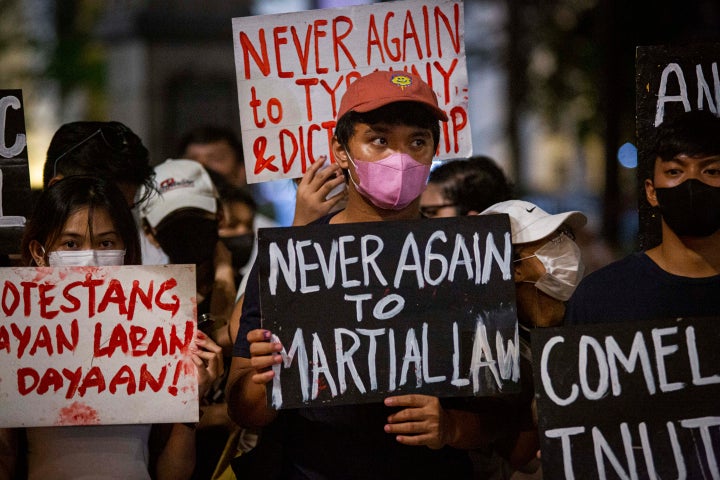
MANILA, Philippines (AP) — The namesake son of late Philippine dictator Ferdinand Marcos appeared to have been elected Philippine president by a landslide in an astonishing reversal of the 1986 “People Power” pro-democracy revolt that ousted his father.
Marcos Jr. had more than 30.8 million votes in the unofficial results with more than 97% of the votes tabulated as of Tuesday afternoon. His nearest challenger, Vice President Leni Robredo, a champion of human rights, had 14.7 million votes in Monday’s election, and boxing great Manny Pacquiao appeared to have the third highest total with 3.5 million.
His running mate, Sara Duterte, the daughter of the outgoing president and mayor of southern Davao city, had a formidable lead in the separate vice presidential race.
The alliance of the scions of two authoritarian leaders combined the voting power of their families’ political strongholds in the north and south but compounded worries of human rights activists.
Dozens of anti-Marcos protesters rallied at the Commission on Elections, blaming the agency for the breakdown of vote-counting machines and other issues that prevented people from casting their votes. Election officials said the impact of the malfunctioning machines was minimal.
A group of activists who suffered under the dictatorship said they were enraged by Marcos’s apparent victory and would oppose it.
“A possible win based on a campaign built on blatant lies, historical distortions and mass deception is tantamount to cheating your way to victory,” said the group Campaign Against the Return of the Marcoses and Martial Law. “This is not acceptable.”
[. ] Marcos Jr., a 64-year-old former provincial governor, congressman and senator, has defended the legacy of his father and steadfastly refused to acknowledge and apologize for the massive human rights violations and plunder under his father’s strongman rule.
Presidential candidate Ferdinand Marcos Jr., son of the late dictator Ferdinand Marcos Sr., speaks to the members of the media, at his party heaquarters in Manila
After his ouster by the largely peaceful 1986 uprising, the elder Marcos died in 1989 while in exile in Hawaii without admitting any wrongdoing, including accusations that he, his family and cronies amassed an estimated $5 billion to $10 billion while he was in power. A Hawaii court later found him liable for human rights violations and awarded $2 billion from his estate to compensate more than 9,000 Filipinos who filed a lawsuit against him for torture, incarceration, extrajudicial killings and disappearances.
His widow, Imelda Marcos, and their children were allowed to return to the Philippines in 1991 and worked on a stunning political comeback, helped by a well-funded social media campaign to refurbish the family name."
Reference: https://www.huffpost.com/entry/philippines-elections-dictator_n_627ac824e4b046ad0d82c0a5
100 YEARS OF INDEPENDENT JOURNALISM: The New Statesman
The New Statesman Podcast named Best Political Podcast for second year running
The New Statesman has come first in two categories at the Publisher Podcast Awards.

ARIZONA #2 for Worst COVID-19 Death Rates in America | Robert Hart, writing today in Forbes
These ten states have the worst Covid-19 death rates
- Mississippi
- Arizona
- Oklahoma
- Alabama
- Tennessee
- West Virginia
- Arkansas
- New Jersey
- Louisiana
- Michigan
Here Is What One Million Covid Deaths In The U.S. Looks Like
"According to official estimates from the CDC, Johns Hopkins University and other organizations that collect public health data, the United States is nearing the grim milestone of one million deaths from Covid-19.
Since February 2020, Covid-19 has been listed as the underlying cause of death on at least 90% of these death certificates, according to the Centers for Disease Control and Prevention. This means the disease “initiated the train of events leading directly to death.” For the remainder, Covid-19 contributed to death but was not the underlying cause.
Covid-19 is now the third-leading cause of death in the U.S.
For two years running, Covid-19 has killed more Americans than almost anything else. Around 462,000 Americans died from the disease in 2021 and 386,000 did in 2020, according to the CDC, accounting for 13.3% and 10.4% of all deaths, respectively. Only heart disease and cancer—sweeping terms that cover many distinct diseases—killed more. More than 150,000 people have already died from Covid-19 in 2022, a figure that would easily rank it among the top 10 leading causes of death in recent years. . .
More than 150,000 people have already died from Covid-19 in 2022
Covid-19 has proven far more deadly than the flu, or HIV, or two world wars
Despite frequent comparisons to the flu in order to downplay the threat of the pandemic—including many by former President Donald Trump—Covid-19 has already killed nearly three times more people in a little over two years than flu does in a decade. According to the CDC, seasonal influenza killed roughly 360,000 people in the U.S. between 2010 and 2020. Covid-19 has killed more Americans than HIV has in the last four decades and nearly twice the number killed in both world wars. Covid-19 is not far from having killed as many Americans as every U.S. war between 1775 and 1991—nearly 1.2 million people—according to data from the Department of Veterans Affairs. . .
> One million is likely an underestimate of Covid’s true death toll
> Covid-19 has been deadlier in Republican states
> The U.S. has 4% of the world’s population but recorded 16% of Covid-19 deaths
> The U.S. has a far higher Covid-19 death rate than other wealthy countries
Covid-19 came in waves
The U.S. has endured several waves of Covid-19, though different regions experienced very different pandemics. Broadly, the number of deaths peaked in mid-2020 during the initial outbreak, in the winter of 2020-21, during a delta-driven wave during the fall of 2021 and the winter of 2021-22 as the omicron variant spread. . .
We are in one of the least deadly stages of the pandemic so far
Besides the very beginning of the pandemic in 2020, fewer people died in June and July 2021 than did in any other month. Roughly 8,000 people died in June 2021 and 11,000 in July 2021, though deaths later surged throughout August and September, which were the fifth- and seventh-deadliest months of the pandemic. The number of deaths plummeted to around 13,000 in March 2022, down from nearly 48,000 in February, one of the deadliest months. Data for April 2022 is not complete and subject to change, though records indicate slightly fewer people may have died than during the previous month. . .
Death rates plummeted in highly vaccinated states
Before vaccines were widely available—a date Forbes crudely marked as June 1, 2021—New Jersey, New York and Rhode Island respectively had the three worst per capita death rates of any state. The trio embraced vaccination and now report some of the highest percentages of their population as fully vaccinated, respectively ranking first, seventh and ninth, according to data collated by the New York Times. In the time since the vaccine rollout, New Jersey, New York and Rhode Island have reported some of the lowest death rates in the country, according to data provided by Johns Hopkins University and analyzed by Forbes. For that period, they respectively had the ninth, sixth and seventh lowest death rate per capita. Connecticut, the fourth most vaccinated state, experienced a similar transformation, reporting the sixth worst per capita death rate before the rollout and the fourth best afterwards.
Before the vaccine rollout, these ten states had the worst Covid-19 death rates
- New Jersey
- New York
- Rhode Island
- Mississippi
- Arizona
- Connecticut
- Louisiana
- Alabama
- South Dakota
- Pennsylvania
After the rollout, these ten states reported the lowest Covid-19 death rates
- Vermont
- Hawaii
- California
- Connecticut
- Utah
- New York
- Rhode Island
- Maryland
- New Jersey
- New Hampshire
READ MORE >> https://www.forbes.com/sites/roberthart/2022/05/10/here-is-what-one-million-covid-deaths-in-the-us-looks-like/
MORE FROM FORBES

-
 Flash News: Ukraine Intercepts Russian Kh-59 Cruise Missile Using US VAMPIRE Air Defense System Mounted on Boat. Ukrainian forces have made ...

