Thursday, May 19, 2022

LOOK WHO'S PUBLISHED A CHILDREN'S BOOK NOW...a dude named Kash

Intro: A pre-publication of the book titled 'The Plot Against The King" was obtained by The Guardian before it is set to be published by Brave Books

Former Trump official Kash Patel writes children’s book repeating false claim over Steele dossier
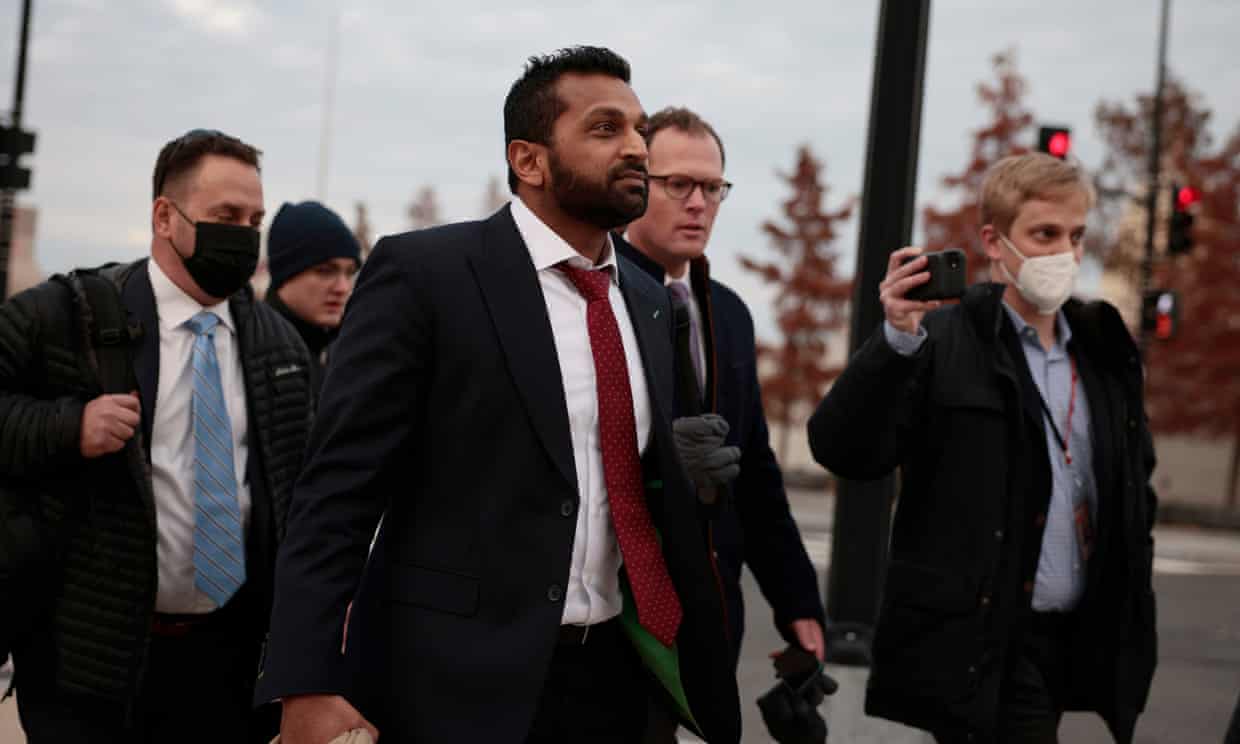
<div class=__reading__mode__extracted__imagecaption>Kash Patel, a former US defense department chief of staff, third from left, has written a children’s book repeating Donald Trump’s false claim around an FBI investigation into Russian collusion with the ex-president Photograph: Anna Moneymaker/Getty Images<br>Kash Patel, a former US defense department chief of staff, third from left, has written a children’s book repeating Donald Trump’s false claim around an FBI investigation into Russian collusion with the ex-president Photograph: Anna Moneymaker/Getty Images</div>

"Story with characters such as King Donald and his enemy Hillary Queenton gives revisionist account of FBI inquiry that dogged Trump presidency

Kash Patel, a former Republican aide on the House intelligence committee who Donald Trump weighed installing as deputy CIA director, is publishing a children’s book on Monday that perpetuates the false claim the Steele dossier sparked investigations into Russian collusion.

The book features characters such as “King Donald” and his enemy “Hillary Queenton”.

In the book, titled “The Plot Against the King” and set to be published by Brave Books, Patel repeats Trump’s false claim that the FBI began investigating links between his campaign and Russia based on a dossier compiled by Christopher Steele, a former British spy.

The 35-page tome, complete with an epilogue that details Donald Trump’s false claims about the FBI inquiry, bizarrely uses the tool of children’s fictional characters to provide a revisionist account of the probe that dogged the first two years of the Trump presidency and eventually led to a special counsel investigation.

Over the course of the book, the narrative lionises Patel and depicts him as a wizard who supposedly shows how “the King” Trump was wrongly accused of “cheating” to take the throne.

The book claims the king was accused of cheating by a “shifty knight” – a reference to the Democratic chair of the intelligence committee, Adam Schiff, who claims to have a “paper” from a “steel” box attesting to wrongdoing.

But Patel writes that he then found evidence that the slug “Keeper Komey” – a reference to former FBI director James Comey – put slugs in the “steel” box at the behest of “Hillary Queenton”, who was also vying for the throne – a reference to Clinton.

The wizard Patel then proclaims to the kingdom, the book says, that “the king, King Donald, is innocent” and “did not work with the Russonians” – a reference to Russia – and “Hillary wrote that paper and had her sneaky slugs slide into the steel box”. . .

Read more anyone? https://www.theguardian.com/us-news/2022/may/16/former-trump-official-kash-patel-writes-childrens-book-repeating-false-claim-over-steele-dossier

Where Did Cheese Really Come From?

Elon Musk puts Twitter deal on hold: Business savvy or cold feet? | DW News

That's the headline ending with a binary question, but there's probably much more that goes into contexualing what the media produces - and then again social media gets into the mix, for example in this reporting on Forbes from last Friday

Elon Musk’s Early Morning Tweet Sends Twitter Shares Crashing, But He Ends The Day Billions Of Dollars Richer


"With a single tweet at 5:44 AM Friday, Tesla and SpaceX chief Elon Musk simultaneously placed his $44 billion Twitter takeover on hold and demonstrated the platform’s power to move markets. Twitter shares, which plunged in pre-market trading early Friday, ended the day down 9.7%, while shares of Musk’s electric vehicle maker rallied 5.7% Friday to close an otherwise challenging week down 11.1%. The fortune of the world’s richest person–worth an estimated $232.5 billion–rose by $9.5 billion Friday. His losses for the week were cut to $23.4 billion.

The divergent fortunes of Twitter and Tesla shareholders are no surprise to Columbia University law professor John C. Coffee, an expert on corporate governance. “The two stocks are logically inversely related, since what is good for Twitter is bad for Tesla,” he says. “If it looks like Musk may call the [Twitter] deal off, Twitter stock could fall like a stone, as the deal price is all that is supporting it today.”
On the other hand, Tesla shareholders’ concerns about the distraction that the Twitter acquisition poses for their CEO had largely driven the 28.8% drop in Tesla’s stock price from April 13, the day before Musk announced his takeover plans, through Thursday. Covid-related production issues in China have also weighed on the stock, as have government probes into Musk’s late disclosure of his Twitter stake and a judge’s pre-trial ruling in an investor lawsuit that Musk acted recklessly when he tweeted plans to take Tesla private in 2018. According to Wedbush analyst Dan Ives, who covers Tesla, the partial rebound of the electric vehicle maker’s shares Friday reflects investor sentiment that the deal is now less likely to happen, despite a follow-up tweet by Musk two hours later Friday morning that he is “still committed to acquisition.”

“The street is viewing this like a boy that cries wolf with Musk,” says Ives. “It’s now likely that the deal happens lower or he walks and pays $1 billion. . .

Musk’s $44 billion takeover is based on a price of $54.20 per share, though Twitter short-seller Hindenburg Research said in a note released Monday that it sees “a significant risk that the deal gets repriced lower” due to the declining values of tech companies since Musk made his initial offer (the tech heavy Nasdaq is down 13.5% since April 13, even after rallying 3.8% Friday). If Musk were to walk away from the deal, he would have to pay a $1 billion breakup fee.

While Musk cited concerns in his tweet early Friday that Twitter may have understated the 5% of its users that are spam or fake accounts, some have speculated that this may just be a convenient way out of the deal for him.

Columbia University law professor Eric Talley tweeted that Musk’s announcement “has all the trappings of looking for a rip cord to pull.”

Talley’s colleague John Coffee says Musk “could decide that he is paying much too much for Twitter (possibly $10 billion too much) and decide to cut his losses at $1 billion.”

While some have argued that Musk can’t simply pay $1 billion to walk away without certain conditions being met, one of those conditions is likely “third-party financing concerns.” [ ] According to Columbia’s John Coffee, “some of his equity investors could get cold feet, particularly if they have lost a lot on their crypto investments.”

. . As Columbia’s John Coffee puts it, “you may have already noticed that he can change his mind quickly and rarely flies in a straight line for very long.”

========================================================================

Thu 19 May 2022 Top stories

========================================================================

Plus, the way in which Musk handled his announcement may not have been all that comforting to Tesla shareholders.

According to Wedbush’s Dan Ives, “The nature of Musk creating so much uncertainty in a tweet (and not a filing) is very troubling to us and the Street and now sends this whole deal into a circus show with many questions and no concrete answers as to the path of this deal going forward.”.

BE PREPARED: U.S. at 'Very, Very High Risk' of Recession | Goldman's Blankfein via Bloomberg

Wealth
Economics

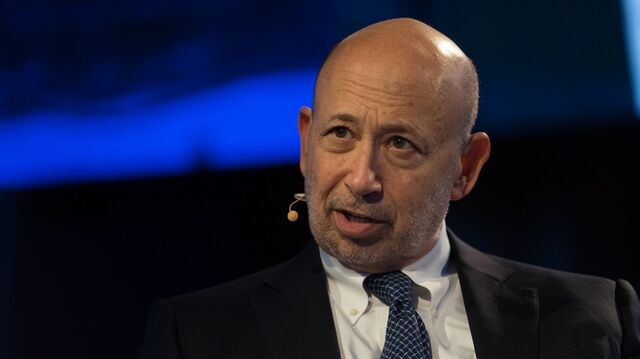
Goldman’s Blankfein Says US at 'Very, Very High Risk' of Recession

  • It’s not ‘baked in’ and policy makers have a narrow path
  • Says Fed has been responding well to historic price increases
Video player cover image
Goldman’s Blankfein Says US Should Prepare for Recession
on May

Listen to this article

2:05
 

Wednesday, May 18, 2022

CHALLENGE CONVENTIONAL NARRATIVES

Intro: The media and social media encourage despairing voices. However, blanket statements obscure nuances and don’t allow for productive inquiry. . .

A Guide For Tech Journalists: How To Be Bullshit Detectors And Hype Slayers (And Not The Opposite)

"Tech journalism is evolving, including how it reports on and critiques tech companies. At the same time, tech journalists should still serve as bullshit detectors and hype slayers

>> The following tips are intended to help navigate the terrain.

As a general rule, beware of overconfident techies bragging about their innovation capabilities AND overconfident critics accusing that innovation of atrocities. If featured in your article, provide evidence and diverse perspectives to balance their quotes.     

Minimize The Overly Positive Hype

“Silicon Valley entrepreneurs completely believe their own hype all the time,” said Kara Swisher in 2016. “Just because they say something’s going to grow #ToTheMoon, it’s not the case.” It’s the journalists’ job to say, “Well, that’s great, but here are some of the problems we need to look at.” When marketing buzz arises, contextualize the innovation and “explore why the claims might not be true or why the innovation might not live up to the claims.”

Despite years of Techlash, tech companies still release products/services without considering the unintended consequences. A “Poparazzi” app that only lets you take pictures of your friends? Great. It’s a “brilliant new social app” because it lets you “hype up your squad” instead of self-glorification. It’s also not so great, and you should ask: “Be your friends’ poparazzi” – what could possibly go wrong?

The same applies to regulators who release bills without considering the unintended consequences — in a quest to rein in Big Tech. To paraphrase Kara Swisher, “Just because they say something’s going to solve all of our problems, it’s not the case” (thus, bullshit). It’s the journalists’ job to avoid declaring the regulatory reckoning will End Big Tech Dominance when it most likely will not, and to examine new proposals based on past legislation’s ramifications. See, for example, Mike Masnick’s “what could possibly go wrong” piece on the EARN IT Act.

Minimize The Overly Negative Hype When critics relentlessly focus on the tech industry’s faults, you should contextualize them within the broader context (and shouldn’t wait until paragraph 55).

Take, for example, this article about the future of Twitter under Elon Musk, which claimed: “Zuckerberg sits at his celestial keyboard, and he can decide day by day, hour by hour, whether people are going to be more angry or less angry, whether publications are going to live or die. With anti-vax, we saw the same power of Mr. Zuckerberg can be applied to life and death.”

No factual explanation was provided for this premium bullshit. Even though this is not how any of this works. In a similar vein, we can ask Prof. Shoshana Zuboff if she “sits at her celestial keyboard, and decide day by day, hour by hour, whether people are going to be more angry at Zuckerberg or the new villain Musk.” I mean, she used her keyboard to write that it’s in their power to trade “in human futures.” 

>> If the loudest shouters are given the stage, you end up with tech companies that simply ignore all public criticism as uninformed cynicism. So, challenge conventional narratives: Are they oversimplified or overstated? Be deliberate about which issues need attention and highlight the experts who can offer compelling arguments for specific changes (Bridging-based ranking, for example --

Look For The Underlying Forces 

Reject binary thinking. “Both the optimist and pessimist views of tech miss the point,” suggested WIRED’s Gideon Lichfield. This “0-or-1” logic turns every issue into divisive and tribal: “It’s generally framed as a judgment on the tech itself – ‘this tech is bad’ vs. ‘this tech is good.’” Explore the spaces in between, and the “underlying economic, social, and personal forces that actually determine what that tech will do.” 

First, there are the fundamental structures underneath the surface. Discuss “The Machine” more than its output. Second, many “tech problems” are often “people problems,” rooted in social, political, economic, and cultural factors. 

The pressure to produce fast “hot takes” prioritizes what’s new. Take some time to prioritize what’s important. . ."

PLEASE TAKE THE TIME TO READ MORE Go Here >> https://www.techdirt.com/2022/05/17/a-guide-for-tech-journalists-how-to-be-bullshit-detectors-and-hype-slayers-and-not-the-opposite/


Why the rise of a new cloud-based ruling class is crushing democracy | Y...

Israeli forces attack funeral of veteran journalist Shireen Abu Aqla - B...