Sunday, June 05, 2022

EVASIVE PHISHING

Another non-stop for malicious activities reported in Bleeping Computer today

Evasive phishing mixes reverse tunnels and URL shortening services
"Security researchers are seeing an uptick in the use of reverse tunnel services along with URL shorteners for large-scale phishing campaigns, making the malicious activity more difficult to stop.

This practice deviates from the more common method of registering domains with hosting providers, who are likely to respond to complaints and take down the phishing sites.

With reverse tunnels, threat actors can host the phishing pages locally on their own computers and route connections through the external service. Using a URL shortening service, they can generate new links as often as they want to bypass detection.

Many of the phishing links are refreshed in less than 24 hours, making tracking and taking down the domains a more challenging task.

Service abuse

Digital risk protection company CloudSEK observed an increase in the number of phishing campaigns that combine services for reverse tunneling and URL shortening.

In a report the company shared with BleepingComputer, researchers say they found more than 500 sites hosted and distributed this way.

The most widely abused reverse tunnel services that CloudSEK found in their research are Ngrok, LocalhostRun, and Cloudflare's Argo. They also saw Bit.ly, is.gd, and cutt.ly URL shortening services being more prevalent.

Reverse tunnel services shield the phishing site by handling all connections to the local server it is hosted on. This way, any incoming connection is resolved by the tunnel service and forwarded to the local machine.
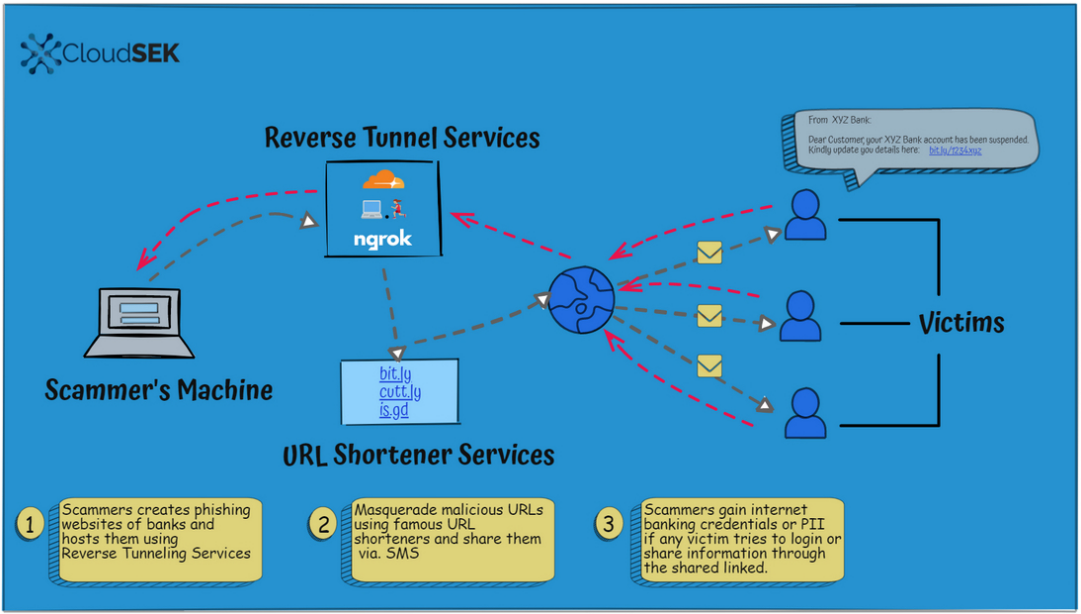
The modus operandi of the phishing actors
The modus operandi of the phishing actors (CloudSEK)

Victims interacting with these phishing sites end up with their sensitive data being stored directly on the attacker's computer.

By using URL shortners, the threat actor masks the name of the URL, which is typically a string of random characters, CloudSEK says. Thus, a domain name that would raise suspicions is hidden in a short URL.

According to CloudSEK, adversaries are distributing these links through popular communication channels like WhatsApp, Telegram, emails, text, or fake social media pages. 

It is worth noting that misuse of these services isn’t new. For example, Cyble presented evidence of Ngrok abuse in February 2021. However, as per CloudSEK’s findings, the problem is getting worse. . ."

Related Articles:

Bored Ape Yacht Club, Otherside NFTs stolen in Discord server hack

Microsoft disrupts Bohrium hackers’ spear-phishing operation

RuneScape phishing steals accounts and in-game item bank PINs

Telegram’s blogging platform abused in phishing attacks

Intuit warns of QuickBooks phishing threatening to suspend accounts


ATTEMPTS-IN-THE-WORKS FOR SELF-IMMUNIZING WAR CRIMES

No reasonable person can ignore two recent reports:

1

Gina Haspel Observed Waterboarding at C.I.A. Black Site, Psychologist Testifies

The testimony emerged in pretrial hearings in the Cole bombing case at Guantánamo Bay, where the war court is wrestling with the legacy of torture after 9/11.

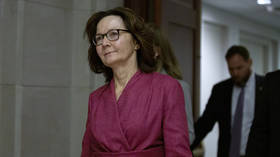
<div class=__reading__mode__extracted__imagecaption>Gina Haspel oversaw a C.I.A. black site in Thailand before becoming the agency’s director in 2018.Credit...Erin Schaff/The New York Times

WASHINGTON — During Gina Haspel’s confirmation hearing to become director of the C.I.A. in 2018, Senator Dianne Feinstein asked her if she had overseen the interrogations of a Saudi prisoner, Abd al-Rahim al-Nashiri, which included the use of a waterboard.

Ms. Haspel declined to answer, saying it was part of her classified career.

Ex-CIA director watched torture of prisoner – NYT

(FILE PHOTO: Ex-CIA director Gina Haspel walks to attend a closed door briefing in the Senate © Global Look Press / Stefani Reynolds)

While there has been reporting about her oversight of a C.I.A. black site in Thailand where Mr. Nashiri was waterboarded, and where Ms. Haspel wrote or authorized memos about his torture, the precise details of her work as the chief of base, the C.I.A. officer who oversaw the prison, have been shrouded in official secrecy.

But testimony at a hearing last month in Guantánamo Bay, Cuba, included a revelation about the former C.I.A. director’s long and secretive career. James E. Mitchell, a psychologist who helped develop the agency’s interrogation program, testified that the chief of base at the time, whom he referred to as Z9A in accordance with court rules, watched while he and a teammate subjected Mr. Nashiri to “enhanced interrogation” that included waterboarding at the black site.

Z9A is the code name used in court for Ms. Haspel.

The C.I.A. has never acknowledged Ms. Haspel’s work at the black site, and the use of the code name represented the court’s acceptance of an agency policy of not acknowledging state secrets — even those that have already been spilled. Former officials long ago revealed that she ran the black site in Thailand from October 2002 until December 2002, during the time Mr. Nashiri was being tortured, which Dr. Mitchell described in his testimony.

Guantánamo Bay is one of the few places where America is still wrestling with the legacy of torture in the aftermath of the Sept. 11, 2001, attacks. Torture has loomed over the pretrial phase of the death penalty cases for years and is likely to continue to do so as hearings resume over the summer.

Defense teams have been asking military judges to exclude certain evidence from the war crimes trials of accused Qaeda operatives as tainted by not just torture but also cruel, inhuman and degrading treatment. In May, that meant revisiting what happened nearly 20 years ago at the secret prison in Thailand. . .

The law firm that employs Ms. Haspel, King & Spalding L.L.P., declined to comment and referred questions to the C.I.A., which also declined to comment.

Dr. Mitchell never mentioned the person by name. Instead, because she was serving in a clandestine role at the time, he was required to refer to the chief of base as Z9A, or, as one lawyer sounded it out, “Zulu Nine Alpha.”

The codes are part of the choreography of the hearings at Guantánamo Bay, where the court has a mute button to protect against inadvertent disclosures of classified information and prosecutors work with the C.I.A. to keep official secrets out of the public record.

Prosecutors in the death-penalty cases, working with members of the intelligence community, assigned alphanumeric codes to most C.I.A. staff members who worked at the black sites. Nations where the C.I.A. had prisons are referred to by numbers. For Dr. Mitchell’s hearing, prosecutors provided him with a secret list of names and alphanumerics — a key of sorts that lawyers in court called “a crosswalk.”

For example, Dr. Mitchell referred to the agency’s chief interrogator in 2002, who died not long after he oversaw some of Mr. Nashiri’s harshest interrogations, as NX2.

And although Ms. Haspel’s role as chief of base at the black site in Thailand is widely known, it is still considered a state secret.

The judge, Col. Lanny J. Acosta Jr., agreed to allow Dr. Mitchell to testify because the C.I.A. had destroyed videotapes that defense lawyers argue showed the psychologists torturing and interrogating Mr. Nashiri and another prisoner at the black site in Thailand. Defense lawyers said that deprived them of potential evidence, including something they might have wanted to show a military jury deciding whether to impose a death penalty.

The disclosure that the C.I.A. had destroyed the tapes — most of them showing Abu Zubaydah, the first detainee taken into custody and known to be tortured by the C.I.A. after the Sept. 11 attacks — prompted the Senate Intelligence Committee to investigate the black site program.

Ms. Haspel has acknowledged her role in the destruction of those tapes as a chief of staff to the operations chief, Jose A. Rodriguez Jr. At her confirmation hearing, she said, “I would also make clear that I did not appear on the tapes.” . .

The Senate Intelligence Committee study of the C.I.A. program, only a part of which is public, said that interrogators wanted to stop using “enhanced interrogation techniques” on Mr. Nashiri because he was answering direct questions, but they were overruled by headquarters.

Mr. Nashiri would also be tortured later, after Dr. Mitchell had taken him to a different C.I.A. black site. Another interrogator revved a drill next to the naked detainee’s hooded head, apparently to try to get him to divulge Qaeda plots. At another black site in 2004, the C.I.A. infused a dietary supplement into his rectum for refusing to eat. His Navy lawyer has called the procedure rape."

ADDITIONAL REPORTING:The CIA black sites were set up as part of America’s War on Terror, essentially as secret prisons to detain ‘enemy combatants’. 

The European Court of Human Rights (ECHR) ruled in 2014 that Poland violated the European Convention on Human Rights, as the CIA had tortured Zubaydah and al-Nashiri in a secret facility in the country. 

In 2018, the ECHR found that by allowing torture in their countries, Romania and Lithuania also violated the rights of Zubaydah and al-Nashiri.

2

UK officials in line for immunity in assisting crimes overseas, say critics

Exclusive: Draft security bill would let spies and ministers enable killings and torture, warn charity and ex-minister

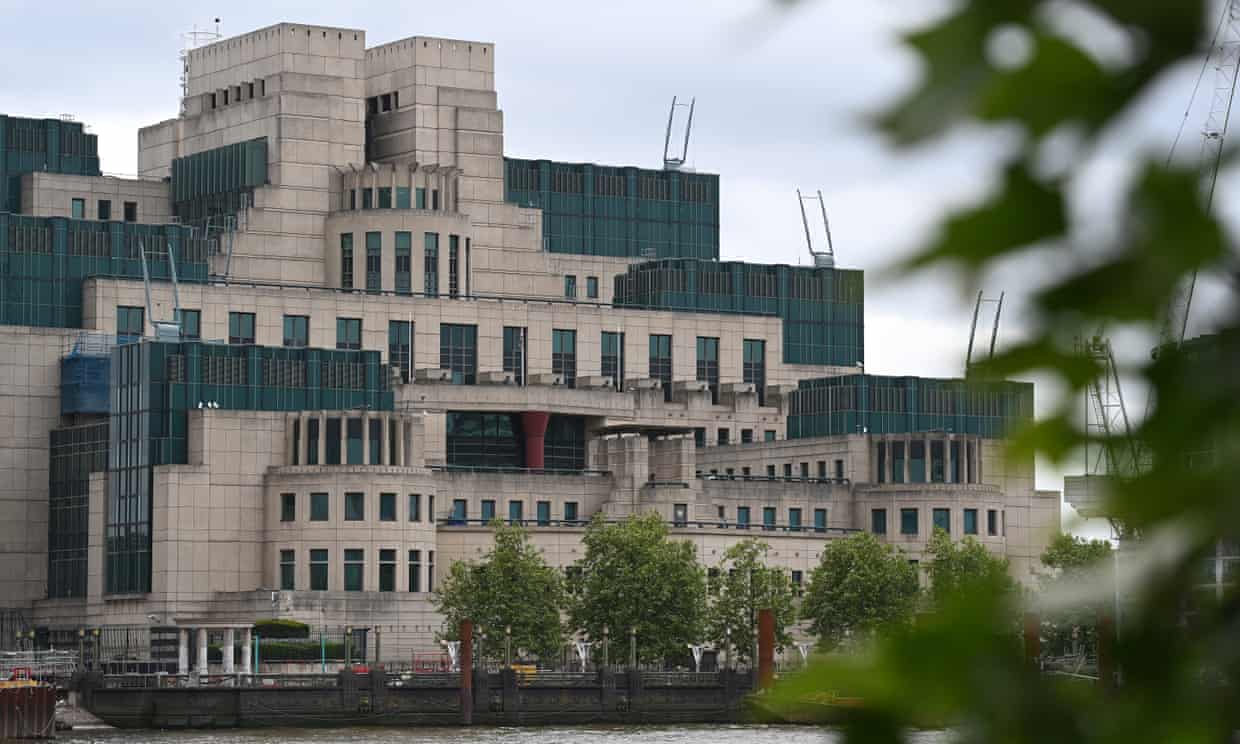
<div class=__reading__mode__extracted__imagecaption>The rules would no longer apply to those making decisions ‘necessary for the proper exercise of any function’ of services such as MI6. Photograph: Andy Rain/EPA<br>The rules would no longer apply to those making decisions ‘necessary for the proper exercise of any function’ of services such as MI6. Photograph: Andy Rain/EPA</div>

"Ministers and spies would be given immunity from accusations of assisting crimes overseas under a new national security law to be debated by MPs next week, a human rights charity and former Tory cabinet minister have warned.

The Home Office was told that the powers being proposed were “far too slack” and would diminish the UK’s moral authority to condemn atrocities such as the killing of the Saudi journalist Jamal Khashoggi.

The concerns centre on a change to the Serious Crime Act, which was passed in 2007 and made it an offence to do anything in the UK to encourage or assist a crime overseas – such as aiding an unlawful assassination or sending information to be used in a torture interrogation.

Under a clause in the national security bill, which is having its second reading in the House of Commons on Monday, this would be disapplied where “necessary for the proper exercise of any function” of MI5, MI6, GCHQ or the armed forces.

Reprieve, an international human rights charity, said it would effectively grant immunity to ministers or officials who provide information to foreign partners that leads to someone being tortured or unlawfully killed in a drone strike.

Concerns were also raised that the move would restrict victims’ ability to seek civil damages in the courts.

Maya Foa, joint executive director of Reprieve, said it was an unthinkable power to grant ministers and officials that would “risk putting them above the ordinary criminal law” and could even embolden leaders to “commit serious crimes thinking they can do so with effective impunity”.

Foa said that enacting clause 23 of the national security bill would “destroy the UK’s moral legitimacy to condemn similar atrocities by autocratic states” after the murder of Khashoggi, a journalist who US intelligence agencies believe was killed on the orders of the Saudi ruler, Mohammed bin Salman. . .

[    ] The national security bill was announced in last month’s Queen’s speech, with the intention to support Britain’s spy agencies and “help them protect the United Kingdom”. It will be debated when MPs return from recess next Monday.

A Home Office spokesperson said: “The amendment to the Serious Crime Act will only remove the risk of individuals facing criminal liability where they are carrying out authorized lawful activities deemed necessary, in good faith and following proper procedure."

“Put simply, the government believes it is not fair to expect the liability for this action to sit with an individual UK intelligence officer or member of the armed forces who is acting with wholly legitimate intentions.”

ANNOTATED WITH IMAGES: Animated Sideline Inserts are Editorial Reactions

Your MesaZona blogger just couldn't resist juxtaposing some selected images as counter-points to assertions and statements published by Simon Tisdall earlier this morning

Timid Biden condemns Ukrainians to an agonizing war without end

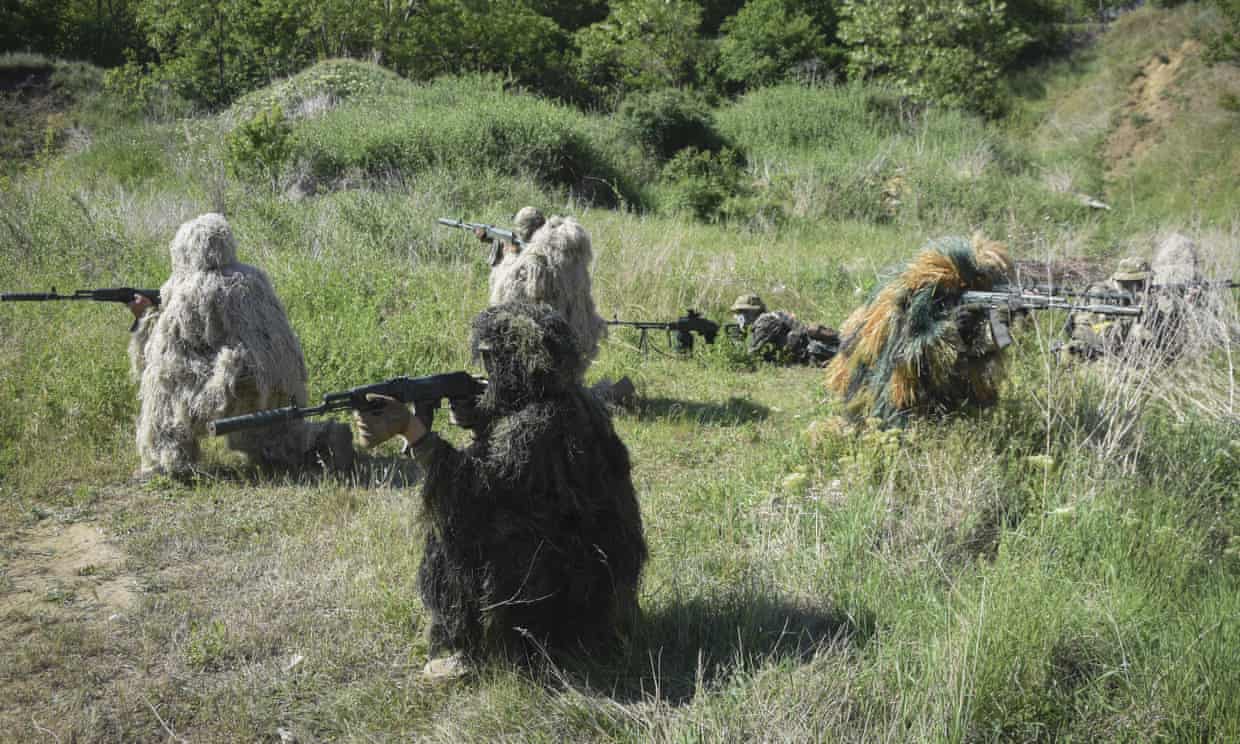
<div class=__reading__mode__extracted__imagecaption>Ukrainian soldiers train on the outskirts of Odesa last week. Photograph: Max Pshybyshevsky/AP<br>Ukrainian soldiers train on the outskirts of Odesa last week. Photograph: Max Pshybyshevsky/AP</div>

By failing to act boldly and face down the Russians, NATO ensures this conflict will run and run

It seems odd, to put it mildly, that Joe Biden is happy to supply Ukraine with advanced rockets as long as it does not fire them at Russia. Vladimir Putin can aim missiles at Ukrainians from across the border whenever he wants – but Volodymyr Zelenskiy’s troops can’t shoot back at their tormentors.


Strange, too, that the UN is seeking Russia’s agreement for convoys to escort grain from Odesa and other Ukrainian ports. It’s Putin who is preventing 22 million tons of grain reaching the Middle East and Africa, where millions face famine. Don’t ask permission. Send a multinational force to smash his illegal blockade.

The US and UK have made a big fuss in the past about preserving freedom of navigation in international waters, including the Black Sea. Puzzlingly, they in effect ceded these waters on 24 February to Russia, whose navy bombards and besieges Ukraine’s cities and ports at will.

Wise heads point to Turkey’s guardianship of an obscure 1936 convention restricting wartime passage through the Bosphorus. A fig for that! Recep Tayyip Erdoğan should help his western partners. It’s high time Turkey’s ageing bully minded his responsibilities, which include welcoming NATO applicants Finland and Sweden.

NATO's reluctance to seize the initiative, rather than passively reacting to Russian actions, is unfathomable, too. Proposals for a no-fly zone and safe havens in western Ukraine are repeatedly rejected as too risky. So dare to try something else! NATO has the muscle and means. It could do much more to stop the systematic killing of civilians and push Russia back, as previously argued here.

Left to fight alone, Zelenskiy pleads for heavy weapons but his pleas still often go unmet or responses are delayed. “We need to get serious about supplying [Ukraine’s] army so that it can do what the world is asking it to do: fight a world superpower alone on the battlefield,” says US Gen Philip Breedlove, formerly NATO commander in Europe. He’s right.

It’s no good relying on sanctions, as the EU proved again last week. Its decision to let Hungary’s mini-Putin, Viktor Orbán, water down an oil embargo was weird. Yet Germany’s Olaf Scholz and fellow euro-wobblers are content. Duty done on oil, they will now more stubbornly resist what their bankers and businessmen most fear: sanctions on gas.

Hardest of all to understand, perhaps, is why some western governments persist in attempting business as usual with Putin, who they know, for certain, is overseeing atrocities and war crimes. Scholz and France’s Emmanuel Macron hold regular phone chats with him. It’s said they are realists seeking peace. No. They are dupes, normalizing mass murder.

Sophisticated diplomats explain that it’s necessary to maintain channels of communication. Fearful of a destabilizing Russian meltdown, they want to give Putin a “way out”. But they don’t get it. “Messianic” Putin’s just not listening. . .

[    ] Contradicting recent Pentagon statements, Biden insisted: “We do not want to prolong the war just to inflict pain on Russia.” He ignored hawkish UK foreign secretary Liz Truss’s maximalist demand for a full Russian retreat from Crimea and all of Donbas.

Biden’s too-modest war aims are a manifesto for the muddled middle. Where does this leave Ukraine? Still solitary, still lacking essential modern weapons, and still fighting for its life with one hand tied behind its back – by its closest friends. . .

[    ] This weak-kneed approach guarantees only one thing: the war will run and run. Diplomacy is stalled. Sanctions are having limited effect and, in terms of energy prices, are harming Europe more than Russia. Only increased direct and indirect NATO military pressure can shift this dynamic.

Campaigning in 2020, Biden pledged an end to what he called America’s “forever wars”. Now, tremulously pulling their punches, he and other western leaders condemn Ukrainians to exactly that."

A BUNDLE OF ALUMINUM CHAFF: Cost-Effective China Sea Defense to An Air Intrusion from Oz

Challenges and provocations continue in one of the world's hotly-contested places - this time with a low-tech solution to release a bundle of chaff, which contains small pieces of aluminium, some of which were ingested into the engine of the P-8 aircraft, deployed to exercise "the right to freedom-of-navigation and overflight in international waters and airspace”.

Chinese fighter jet’s actions near Australian aircraft ‘very dangerous’, deputy PM says

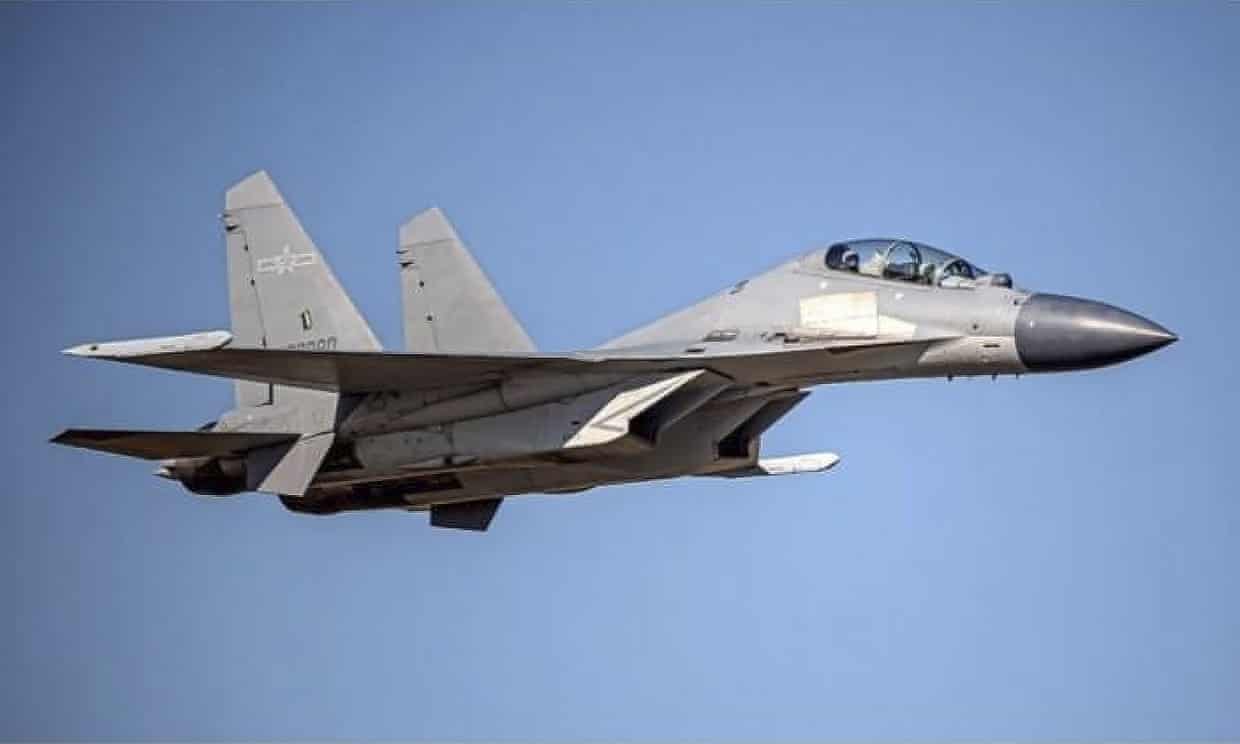
<div class=__reading__mode__extracted__imagecaption>A Chinese PLA J-16 fighter jet performed a ‘dangerous manoeuvre’ that risked the safety of an Australian aircraft and its crew, Defence has advised. Photograph: AP<br>A Chinese PLA J-16 fighter jet performed a ‘dangerous manoeuvre’ that risked the safety of an Australian aircraft and its crew, Defence has advised. Photograph: AP</div>

Defence reports J-16 jet released ‘chaff’ including aluminium shards in front of Australian flight in South China Sea region

"Australia has complained to China over its interception of a maritime surveillance flight in international airspace in the South China Sea region, which the deputy prime minister labelled “very dangerous”.

The defence department has revealed the interception of a “routine maritime surveillance activity” in a statement on Sunday, claiming it resulted in a “dangerous manoeuvre” that risked the safety of the Australian aircraft and its crew.

The incident on 26 May, just five days after the federal election, comes at a crucial juncture in Australia’s relationship with China, as Labor’s election provides a circuit-breaker to escalating rhetoric, although no substantial reset in policy has occurred. . .

The defence minister, Richard Marles, told reporters in Geelong the Chinese aircraft “flew very close to the side of the [Australia] P-8 maritime surveillance aircraft” then “released flares”.

“The J-16 then accelerated and cut across the nose of the P-8, settling in front of the P-8 at very close distance.”

“At that moment, it then released a bundle of chaff, which contains small pieces of aluminium, some of which were ingested into the engine of the P-8 aircraft. Quite obviously, this is very dangerous.”

[.     ] In 2016 a UN tribunal overwhelmingly rejected China’s claims to ownership of the South China Sea. Australia has pledged to increase defence cooperation with the US in the South China Sea, while America has called on it to expand its commitment to freedom of navigation operations.

In February the defence department complained the lives of Australian Defence Force personnel could have been endangered after an aircraft detected a laser emanating from a Chinese ship.

The P-8A Poseidon detected a laser illuminating the aircraft while in flight over Australia’s northern approaches in the Arafura Sea, a move interpreted as linked to China’s displeasure about patrols of the South China Sea.

One week out from the election, the former defence minister Peter Dutton labelled the presence of a Chinese spy ship off the coast of Western Australia “an aggressive act” – despite the fact it was in Australia’s exclusive economic zone, not its territorial sea.

In response to a similar incident in November, Scott Morrison said China had “every right to be there under international maritime law, just like we have every right to be in the South China Sea”.

PASS THE BLAME IN TEXAS TO 'TOXIC MASCULINITY'

In the last paragraph, author Elizabeth Bruenig posits this remarkable closing:
". . .In its own imagination, Texas is the land of men who would never admit defeat at all, much less surrender instantly with decent odds and innocent lives at stake:
Surely its police ought to feel the highest and noblest sort of calling to valor, the type of vocation that surpasses profession and speaks to a person’s mission in life.
Or perhaps those things, too, all the militarism and bravado, the heady authority and free respect, the unearned certainty in one’s own capacities provoked by so many Punisher bumper stickers and decals, had the same corrupting effect as the guns and body armor. Eventually, one either develops their own virtues or finds they’ve developed vices instead.

The Uvalde Police Chose Dishonor

Where was their courage? Why were there no heroes?

Illustration of a police officer with a crowd in the background.

"Society cannot demand courageous self-sacrifice; we can only ask for it. Most of us know we ourselves would be too frightened to face an armed gunman in a direct confrontation, and we accordingly choose to seek work that doesn’t put us in such positions—or shouldn’t. But perhaps even some of those who do volunteer for danger now lack the fortitude, the relevant virtues of courage, honor, and selflessness, to take up the task.

On Tuesday, the Texas Department of PublicSafety announced that Pete Arredondo, the chief of the Uvalde school district’s police, had ceased cooperating with the agency’s investigation into Arredondo and his officers’ response to last week’s mass murder at Robb Elementary School. Though DPS officials didn’t venture a guess as to why Arredondo had withdrawn his cooperation, the performance of the Uvalde police at the shooting—a portrait of which has emerged in grim detail after grim detail over the past several days—certainly supplies enough suggestion of lethal negligence and catastrophic failure to encourage the employ of a good lawyer.

Another man might own up to what he had done directly, but that same man likely wouldn’t have done what Arredondo evidently did in the first place—namely, barely anything at all. Unlike other school shootings, the urgent mystery at the heart of the Robb Elementary School slaughter is as much about the behavior of law enforcement as the behavior of the killer. Per the latest reports, though two senior police officers entered the school only two minutes after the killer and exchanged fire with him through a locked classroom door, Arredondo ordered his men to stand back for more than an hour, while children were dead and dying.

Though DPS and the Department of Justice have yet to release any findings from their investigations into the police response at Uvalde, we can rule out one explanation for so much incomprehensible delay: It wasn’t that they couldn’t breach the door. Police beat down locked doors regularly. It rather seems that Arredondo believed that all the children within the shooter’s reach were already dead—they weren’t; Arredondo had no reason to presume such, and possibly reasons to believe otherwise—and therefore that the most important thing was to wait for a Border Patrol team with better protective equipment to breach the door.

Yesterday, The New York Times reported that after a 10-year-old student called 911 and told the operator one of her teachers lay dying in the classroom, a group of law-enforcement officers in the corridor finally decided to act, ignoring an explicit order not to breach. Once they had chosen, after precious time had passed, to act, they simply entered the classroom and killed the shooter. No law-enforcement officers were killed, although one was grazed by a bullet fragment.

If the police had just broken down the door early on, they may have found the odds of a veritable throng of adult men against a teenage boy fairly favorable. .  .

[.     ] On occasion, and typically in contexts having more to do with what is done but ought not to be than what isn’t done but should be, we consider the malignant variant of male character called toxic masculinity.More familiar instances of toxic masculinity concern the wanton infliction of violence, especially the sexual kind, especially upon women and girls. In his threats of rape and domestic battery, the Uvalde killer himself exhibited this strain: emasculated, resentful, explosively violent but mainly toward women and children, for he was afraid of adult men.

Yet on the other side of the wall was, it seems, another sort of toxic masculinity—a platoon of armed and trained men who had evidently come to rely so heavily on guns and armor in lieu of courage and strength that they found themselves bereft of the latter when outdone in the former. Instead they were beset by cowardice, evidently as convinced as the shooter was that the gun really does make the man, and that outgunned is thus as good as outmanned.

TRAGEDIES CONVERGE: Eventually everything, and everyone, cracks

Intro: Our bold, flawed project of citizenry, of permitting Americans of every hue, status, orientation, and religious belief a voice in the building of our republic has failed. Our elected leaders have failed us. And we, in part, have failed ourselves by not doing more sooner. The collective feel—the Final Vibe, as it were—is total disrepair, and an ushering into the dark ages.

The Breaking Point Is Here—Again

Tragedies converge, apocalypse colors the air, and digital realities no longer suffice. Eventually everything, and everyone, cracks.

<div class=__reading__mode__extracted__imagecaption>Illustration: Elena Lacey; Getty Images

"What I want to pinpoint is a sensation—physical, cognitive, temporal—that is occurring at this fixed point in time, especially this past week, in the days following the twin tragedies in Buffalo, where 10 Black people were fatally gunned down in a supermarket, and Uvalde, where 19 children and two teachers were massacred at a rural Texas elementary school, in what is now the second-largest school shooting in US history.

First, let us finally do away with the big, stinking lie of immoderation, of how terrorism casts its depravity in our jagged land. The language of radicals and extremists is not born in the margins, as the folklore has gone about replacement theory, the foul dogma the gunman used to justify his slaughter in Buffalo. There is nothing peripheral about how hate draws breath. To be among the marginalized, outside the arena of power in the America of yesterday and tomorrow, is to live in the stifling yoke of wholesale animosity. It is to know the face of such cruelties as a constant, as an always. . .

The tragedies in Buffalo and Uvalde join a doom-laden surreality of unraveling horrors, each one ricocheting off the other. According to an economist at BMO Capital Markets, in an interview with Bloomberg News, the rising price of “food, rent, and a few other items look to remain troublesome” in curbing US inflation in the year ahead. This, in a year that could very well be plagued by the Supreme Court reversing a person’s right to an abortion, worsening climate conditions, the calculated narrowing of queer rights, a housing crisis, the threat of monkey pox, and what feels like never-ending pandemic fatigue. All of this, and with no time to process because the hamster-wheel of capitalism demands that we work, that we continue to satisfy its greed. . .

If you, like me, are wedged somewhere between Gen Z and age 45, you live with the internet as a daily fact of life. It’s like water, a natural resource impossible to live without. The internet has made it such that we consume at a certain uninterrupted, and likely unhealthy, velocity: harshly and oppressively around the clock.

The Buffalo gunman’s relationship to the internet became a necessary obsession; he was, he said, “awakened” on 4chan. For months, he researched and meticulously planned his attack online. Perhaps more sinister are the lengths he took to catalog and broadcast his beliefs across a string of social media networks including Discord and Twitch, where he streamed the shooting for two minutes before it was cut. He understood carnage as more than spectacle or mass entertainment—but as inheritance in the grand tradition of other mass shooters.

In this way, the fortune of social media is also its curse. It has given us access to people, cultures, experiences, and opportunities we never imagined. It’s opened the world to us. It’s given us the tools to make and remake ourselves. But it hasn’t changed the nature or intent of hate. It has only made it more immediate, more intimate, more paralyzing.

By now the carnage—in Uvalde this past Tuesday, in Buffalo 14 days ago, in El Paso in 2019, at Marjory Stoneman Douglas High School in 2018, on the Las Vegas Strip in 2017, at Pulse nightclub in 2016, at Sandy Hook Elementary in 2012—is so beyond the point of doubt that it’s entered the realm of the hyper-real, the unremarkable, the thoroughly, tragically mundane. In America, horror is a cloverleaf: at once a bound reality and a recurring spectacle, shared and remixed online, appropriated and made a fool of by soulless pundits on Fox News. There is nothing one can do against the tsunami of affliction, set asunder in its unforeseen tempest. . .

All of these pinballing realities—of what it means to live in a Black body, of what it means for Roe v. Wade to be struck down, of what climate catastrophe will unleash on the even more marginalized among us, of how the electorate will continue to betray basic fundamental rights—have all seemed to echo a little louder lately. For me, the magnification of all of this and more has become even more dangerously resonant online.

[    ] The dread seems to never quiet. It only compounds. And eventually everything—and every one of us—breaks.

At least, that’s what it feels like. Much has been written about “the Great Resignation,” the way the pandemic eroded our trance-like commitment to capitalism, cultivating healthier paths to fulfillment. But everything feels more tenuous than usual these days, rendered in all sorts of dystopian hues. What I fear is on the horizon, as our many selves and experiences have smushed irrevocably, is a collective breaking point—call it the Great Snapping. Or maybe it will feel more like a crush, as we are all flattened into feelingless blobs, helpless to the anarchy that grows around us."

Source: https://www.wired.com/story/buffalo-uvalde-shootings-breaking-point/ 

STAGED VIDEOS:

Intro: ". . .According to the Russian Defense Ministry, the videos are meant to inspire confidence in Kiev’s fighting abilities both in Ukraine and Western nations, and to showcase the “supposed effectiveness” of Western weapons supplied to the country.

The shootout scene, according to the statement, is meant to be a recreation of a heroic Ukrainian stand against overwhelming Russian forces that never actually happened.

The first video, the Russian military claimed, is supposed to show advancing Russian troops, who were played by a group of Ukrainian militias. The statement claimed the film crew couldn’t get any actual Russian armored vehicles for the scene and used Ukrainian ones instead.

“The next filming session is scheduled for June 5 and 6,” Defense Ministry spokesman Major General Igor Konashenkov claimed. “The footage will be of staged testimony by ‘ordinary Ukrainians’ accusing Russia of supposedly firing at peaceful communities on purpose.”

The ministry claimed that the UK not only funded the filming, but also offered its creative input. The project was launched “amid Kiev’s political disaster in Mariupol and military defeats in the Donbass,” the statement said.

3 Jun, 2022 10:57

Ukraine staging battle scenes for propaganda – Russia

The propaganda footage was allegedly sponsored by the British government
Share Video
Share Video
00:04
00:07
 

The Russian Defense Ministry released on Friday what it claimed to be staged combat scenes filmed on behalf of the Ukrainian government and paid for by the British government. The two short clips appear to be raw footage of what looks like a war movie.

The filming of the videos took place on May 28 in the town of Meshkovka in Ukraine’s Nikolaev Region, the ministry said. A train station of the same name is located on the outskirts of the provincial capital in the south of the country.

One of the videos shows two armored vehicles facing the camera. At the command of a woman, who appears to be the film director, the backdoor of the closest vehicle opens, and a group of armed men in uniform wearing red armbands starts pouring out. Several others rise from the grass around the second vehicle in the distance and start moving forward, their weapons raised.

Share Video
Download
Share Video
00:00
00:21
 

The second clip is a shootout scene, with a group of armed uniformed men retreating through rubble while firing back at an unseen enemy. Pyrotechnics appear to simulate enemy fire. At one point, a professional-looking film crew comes into view.

Share Video
Download
Share Video
00:00
00:47
 

Zelensky Calls for a European Army as He Slams EU Leaders’ Response

      Jan 23, 2026 During the EU Summit yesterday, the EU leaders ...