Monday, June 20, 2022

VISUAL AFTER-EFFECTS OF SPACEX LAUNCH EXPLAINED...Somewhat, but mysteries remain

Hey Guys! Prof Richard Easther, a physicist at Auckland University, who called the phenomenon “weird but easily explained”. Clouds of that nature sometimes occurred when a rocket carried a satellite into orbit, he said.

Spirals of blue light in New Zealand night sky leave stargazers ‘kind of freaking out’

Social media abuzz with pictures and theories about formations thought to be from
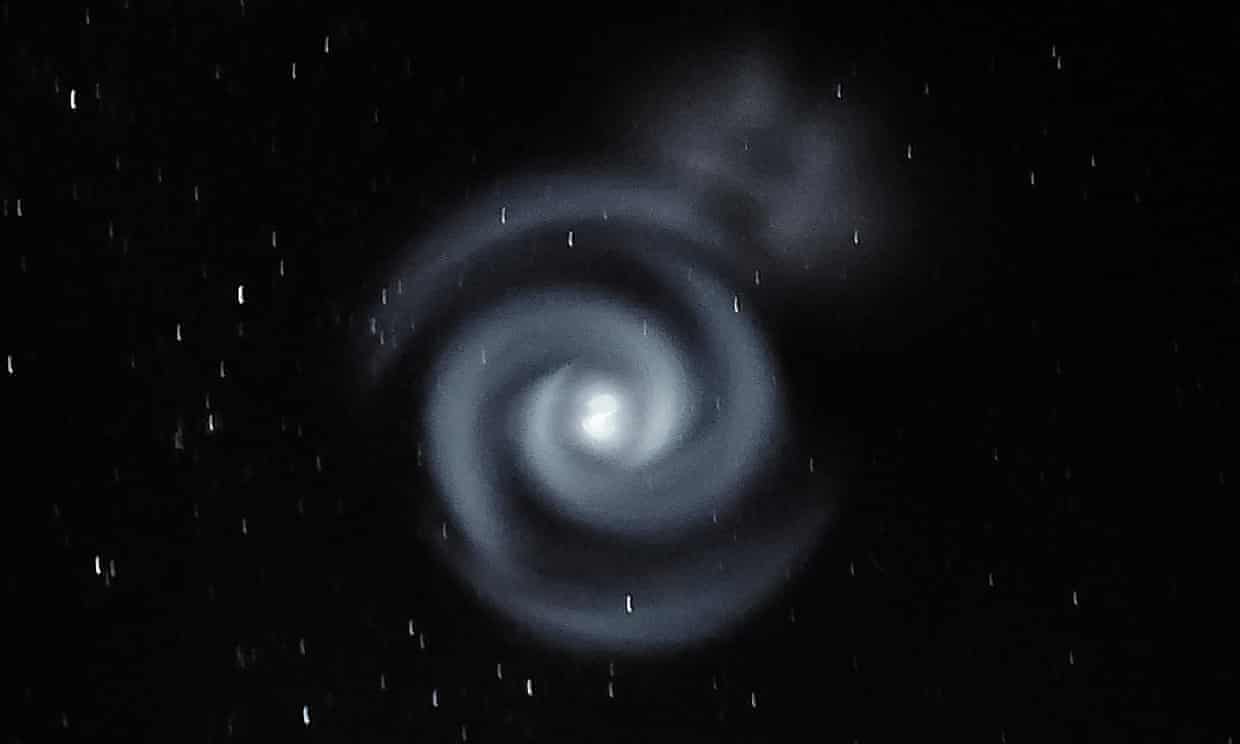
<div class=__reading__mode__extracted__imagecaption>A spiral of blue lights as seen from Stewart Island/Rakiura, New Zealand, on Sunday. Theories on social media about its origins ranged from aliens to foreign rockets to commercial displays. Photograph: Alasdair Burns/Twinkle Dark Sky Tours<br>A spiral of blue lights as seen from Stewart Island/Rakiura, New Zealand, on Sunday. Theories on social media about its origins ranged from aliens to foreign rockets to commercial displays. Photograph: Alasdair Burns/Twinkle Dark Sky Tours</div>

Tess McClure

the Guardian

Sun 19 Jun 2022 21.38 EDT Last modified on Sun 19 Jun 2022 21.49 EDT

"Last night around 7.25pm Alasdair Burns, a stargazing guide on Stewart Island/Rakiura, saw a huge, blue spiral of light amid the darkness. “It looked like an enormous spiral galaxy, just hanging there in the sky, and slowly just drifting across,” Burns said. “Quite an eerie feeling.”

Burns snapped a few images of the lights on long exposure, capturing the spiral from his phone. “We quickly banged on the doors of all our neighbours to get them out as well. And so there were about five of us, all out on our shared veranda looking up and just kind of, well, freaking out just a little bit.”

The country’s stargazing and amateur astronomy social media groups lit up with people posting photographs and questions about the phenomenon, which was visible from most of the South Island. Theories abounded – from UFOs to foreign rockets to commercial light displays.

“Premonition from our orbital black hole,” said one stargazer. “Aliens at it again,” commented another. . .

========================================================================

but . . . . 

. . . it seems like this quite a fe
The Twilight Zone 1959 Original Opening Title  ~ UPA Animation

========================================================================

THE REPORT CONTINUES: ". . .

The reality was likely a little more prosaic, said Prof Richard Easther, a physicist at Auckland University, who called the phenomenon “weird but easily explained”.

Clouds of that nature sometimes occurred when a rocket carried a satellite into orbit, he said.

“When the propellant is ejected out the back, you have what’s essentially water and carbon dioxide – that briefly forms a cloud in space that’s illuminated by the sun,” Easther said. “The geometry of the satellite’s orbit and also the way that we’re sitting relative to the sun – that combination of things was just right to produce these completely wacky looking clouds that were visible from the South Island.”

Easther said the rocket in question was likely the Globalstar launch from SpaceX, which the company sent into low-earth orbit off Cape Canaveral in Florida on Sunday.

Burns had guessed the spiral was likely a rocket, having read about a similar phenomenon in 2009, when a Russian missile launch caused huge blue spirals over Norway. Even knowing the likely source, he said, it was a confronting sight. “None of us had ever seen anything like that before. It was spectacular.”

========================================================================

Some aspects of Sunday’s launch caused observers to raise questions about other spacecraft that may have been deployed alongside the Globalstar satellite. . .In an another unusual move, Globalstar did not acknowledge any details about the launch of its spare satellite in advance of Sunday’s mission. Globalstar released a statement in a quarterly financial report last month that said it planned to launch the backup spacecraft in the “near future.” At the time, the company did not identify the launcher for the spare satellite.

SpaceX did not mention any other payloads in its live launch webcast or on the Globalstar mission page on its website.

But the relatively light weight of the Globalstar satellite would typically leave enough propellant reserve on the Falcon 9’s booster to return to landing. Instead, Sunday’s mission featured a landing on SpaceX’s offshore recovery platform.

The live webcast of Sunday’s launch provided by SpaceX did not show any on-board camera views of the Globalstar satellite until an hour into the mission, an unusual practice for SpaceX’s commercial launches. When the live on-board camera views began airing live, the Globalstar satellite was visible mounted to a structure on the upper stage appeared to be designed to accommodate other payloads.

If there were additional satellites on Sunday’s launch, they were already deployed from the Falcon 9 rocket when the live camera views began showing on SpaceX’s webcast.

. . .The $327 million contract for the 17 new satellites is being primarily funded by an unnamed “potential customer” for Globalstar’s services.

Globalstar has not disclosed the organization funding the new satellites, but the operator said last month it has signed a term sheet with a “large, global customer” to begin deploying S-band services in the so-called “Band 53” range of frequencies in the United States and in other countries.

The unnamed customer also paid for the majority of the costs associated with launching the Globalstar FM15 satellite, Globalstar said in its financial filings with the Securities and Exchange Commission.

SpaceX launches third Falcon 9 rocket in less than two days

<div class=__reading__mode__extracted__imagecaption>A Falcon 9 rocket lifts off from pad 40 at Cape Canaveral Space Force Station with the Globalstar FM15 satellite. Credit: SpaceX

". . .The live webcast of Sunday’s launch provided by SpaceX did not show any on-board camera views of the Globalstar satellite until an hour into the mission, an unusual practice for SpaceX’s commercial launches. When the live on-board camera views began airing live, the Globalstar satellite was visible mounted to a structure on the upper stage appeared to be designed to accommodate other payloads. 

Top stories

"SpaceX hauled a Globalstar communications satellite into orbit early Sunday from Cape Canaveral, pulling off the third Falcon 9 rocket flight in 36 hours, the fastest sequence of three missions by any commercial launch company in history.

A spare spacecraft built more than a decade ago for Globalstar’s satellite phone and messaging network was tucked inside the Falcon 9 rocket’s payload shroud for liftoff from Cape Canaveral Space Force Station at 12:27:36 a.m. EDT (0427:36 GMT).

The Falcon 9 shot off the launch pad at Cape Canaveral with 1.7 million pounds of thrust from nine Merlin main engines. The engines vectored their nozzles to guide the 229-foot-tall (70-meter) rocket northeast from Florida’s Space Coast, lining up with an orbital plane in Globalstar’s satellite fleet.

The rocket surpassed the speed of sound in about one minute, and shut down its booster stage about two-and-a-half minutes into the flight. A few seconds later, the booster dropped away to head toward a SpaceX recovery platform, or drone ship, parked in the Atlantic Ocean east of Charleston, South Carolina.

The Falcon 9’s first stage — itself 15 stories tall — landed on the drone ship about 10 minutes after liftoff, adding a ninth trip to space to the booster’s logbook.

The upper stage of the Falcon 9 rocket fired its single Merlin engine three times, stepping through different orbits before finally reaching an altitude of about 700 miles (1,126 kilometers) to deploy the Globalstar FM15 communications satellite nearly two hours into the mission.

SpaceX said the upper stage reached the mission’s target orbit, and officials celebrated the company’s third successful launch in less than two days.

SpaceX’s Falcon 9 rocket streaks through the night sky after liftoff from Cape Canaveral at 12:27 a.m. EDT (0427 GM) Sunday. Credit: Michael Cain / Spaceflight Now / Coldlife Photography

The trifecta of Falcon 9 missions began at 12:09 p.m. EDT (1609 GMT) Friday with the launch of 53 Starlink internet satellites from the Kennedy Space Center. That mission set a record with the 13th flight of a reusable Falcon booster, which returned to a landing on one of SpaceX’s drone ships in the Atlantic.

SpaceX teams at Vandenberg Space Force Base in California launched another Falcon 9 rocket at 10:19 a.m. EDT (7:19 a.m. PDT; 1419 GMT) Saturday with the German military’s SARah 1 radar reconnaissance satellite. The Falcon booster used on the SARah 1 descended back Vandenberg for an onshore landing.

With Sunday’s mission for Globalstar, SpaceX notched three Falcon 9 flights in 36 hours, 18 minutes, the shortest span between three missions that any commercial rocket company has achieved.

The launches marked the 158th, 159th, and 160th flights of a Falcon 9 rocket overall, and the 24th, 25th, and 26th Falcon 9 missions this year, trying the 26-launch tally SpaceX achieved in the entire year of 2020. SpaceX is on pace to surpass the 31-launch mark — its total from last year — by the end of July.

Company officials are aiming for more than 50 Falcon 9 and Falcon Heavy launches in 2022.

 

MALSPAM CAMPAIGN: Cobalt Penetration Suite Opens The Way to Wider Exploitation Potential

On May 23, 2022 Cobalt Strike as a second-stage payload in Metanbuchus malspam campaign was first reported by DCSO, a German security company.
They also noticed that Qakbot was also delivered in some cases.
Interestingly, in that campaign, the digital signature used for the MSI file was again a valid one from DigiCert, issued to "Advanced Access Services LTD."
 

New phishing attack infects devices with Cobalt Strike

 
"Security researchers have noticed a new malicious spam campaign that delivers the 'Matanbuchus' malware to drop Cobalt Strike beacons on compromised machines.
Cobalt Strike is a penetration testing suite that is frequently used by threat actors for lateral movement and to drop additional payloads.

Matanbuchus is a malware-as-a-service (MaaS) project first spotted in February 2021 in advertisements on the dark web promoting it as a $2,500 loader that launches executables directly into system memory.

Palo Alto Networks' Unit 42 analyzed it in June 2021 and mapped extensive parts of its operational infrastructure. The malware's features include launching custom PowerShell commands, leveraging standalone executables to load DLL payloads, and establishing persistence via the addition of task schedules.

Ongoing campaign

Threat analyst Brad Duncan captured a sample of the malware and examined how it works in a lab environment.

The malspam campaign currently underway uses lures that pretend to be replies to previous email conversations, so they feature a 'Re:' in the subject line.

> The emails carry a ZIP attachment that contains an HTML file that generates a new ZIP archive. This ultimately extracts an MSI package digitally signed with a valid certificate issued by DigiCert for "Westeast Tech Consulting, Corp."

Valid digital certificate used on the MSI file
Valid digital certificate used on the MSI file (isc.sans.edu)

> Running the MSI installer supposedly initiates an Adobe Acrobat font catalog update that ends with an error message, to distract the victim from what happened behind the scenes.

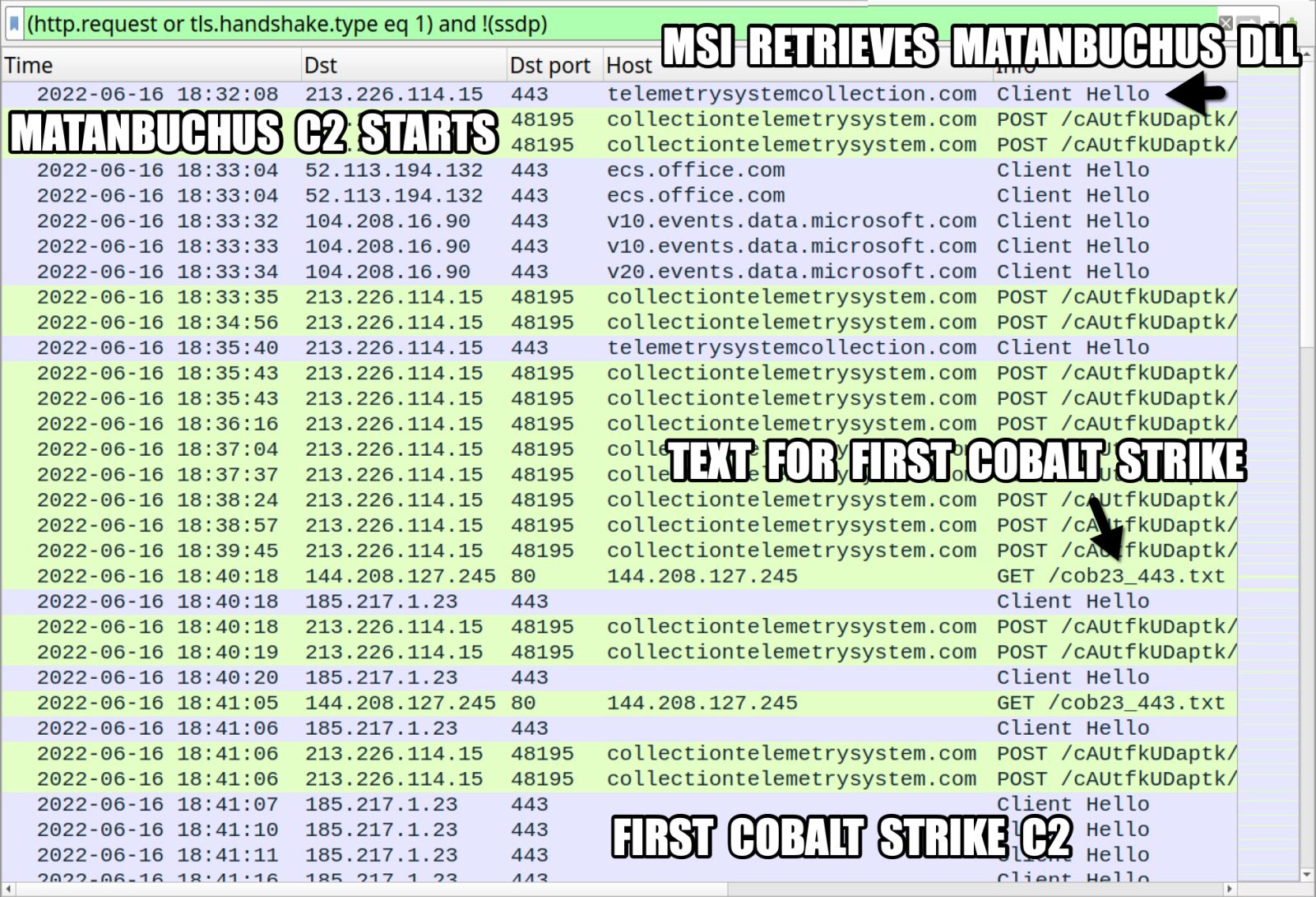
> In the background, two Matanbuchus DLL payloads ("main.dll") are dropped in two different locations, a scheduled task is created to maintain persistence across system reboots, and communication with the command and control (C2) server is established.

Snapshot of malicious network traffic
Snapshot of malicious network traffic (isc.sans.edu)

Finally, Matanbuchus loads the Cobalt Strike payload from the C2 server, opening the way to wider exploitation potential.

Matanbuchus current infection chain
Matanbuchus current infection chain (isc.sans.edu)

Related Articles:

Fake antivirus updates used to deploy Cobalt Strike in Ukraine

Android-wiping BRATA malware is evolving into a persistent threat

Hackers exploit three-year-old Telerik flaws to deploy Cobalt Strike

New MaliBot Android banking malware spreads as a crypto miner

Android malware on the Google Play Store gets 2 million downloads

Sunday, June 19, 2022

RE-THINKING INFLATION: Let's LooseThe Blunders This Time Around

Intro: Niall Ferguson, MA, D.Phil., is the Milbank Family Senior Fellow at the Hoover Institution, Stanford University, and a senior faculty fellow of the Belfer Center for Science and International Affairs at Harvard.

Niall Ferguson Preferred.jpg

He is the author of sixteen books, including Doom: The Politics of Catastrophe and Kissinger, 1923-1968: The Idealist, which won the Council on Foreign Relations Arthur Ross Prize. In addition to writing a syndicated weekly column, he is the founder and managing director of Greenmantle LLC, an advisory firm.

CONNECT

Opinion
Niall Ferguson

The Fed Hasn’t Fixed Its Worst Blunder Since the 1970s

Jay Powell wants us to believe he has what it takes to bring inflation under control. History warns us to be skeptical.

Paul Volcker knew a few things about inflation.

Paul Volcker knew a few things about inflation.

Photographer: Pierre Manevy/Hulton Archive via Getty Images

 
niall ferguson from www.youtube.com
 
Mar 10, 2022 · John is rejoined by pre-eminent historian Niall Ferguson to analyse the latest in the war between ...
Duration: 27:55
Posted: Mar 10, 2022
 
niall ferguson,inflation from www.youtube.com
Mar 12, 2021 · Hoover Institution Senior Fellow Niall Ferguson looks at historical causes of inflation in the ...
Duration: 11:43
Posted: Mar 12, 2021
niall ferguson from www.hks.harvard.edu
 
Jul 16, 2021 · Ferguson has studied booms, busts, the rise and fall of empires, the power of social networks ...
Duration: 25:57
Posted: Jul 16, 2021
 
niall ferguson,inflation from www.youtube.com
 
Mar 5, 2022 · Historian Niall Ferguson joins 'Jesse Watters Primetime' #jessewattersprimetime ...
Duration: 2:42
Posted: Mar 5, 2022
niall ferguson,inflation from www.youtube.com
 
Mar 20, 2022 · John is joined by historian Niall Ferguson, who considers the consequences of the West ...
Duration: 7:04
Posted: Mar 20, 2022
niall ferguson,inflation from www.youtube.com
 
Sep 3, 2021 · Top economic historian Niall Ferguson, Milbank Family Senior Fellow at the Hoover Institution ...
Duration: 3:14
Posted: Sep 3, 2021

The Zen Playboy: "Whole Earth: The Many Lives of Stewart Brand"

/ If, in the historical light of 2022, it were possible to make Stewart Brand look good, I’m sure Markoff would have managed it, which makes it all the more remarkable that he does not. . .What else do you need to know about a man who habitually induced his Whole Earth Catalog coworkers to play a game with padded swords just so he, with his experience and size, could beat the crap out of them? Arrogant, lazy, pretentious, and mean: Between the lines, it sure sounds like this guy sucks. . .
HOLD ON! As for politics, Markoff notes that leftists who met Brand assumed he was working with the CIA, an accusation that could be rated as indirectly to literally true, depending on the circumstances (later in life Brand would work alongside the CIA doing scenario planning). When he did take an unusual shine to someone political, as he did later in life with the environmentalist Wendell Berry and the cartoonist R. Crumb, Brand quickly turned them off.
>> At a time when revolution gripped the country, the Whole Earth Catalog reflected his right-wing thought by omission.
After one young staffer suggested ways to make the catalog more political, Stewart vetoed the notion with a surprising set of rules: “No politics, no religion, and no art.” What was left? Computers and shopping. As a futurist, he had that much right.
 

Stewart Brand’s Dubious Futurism

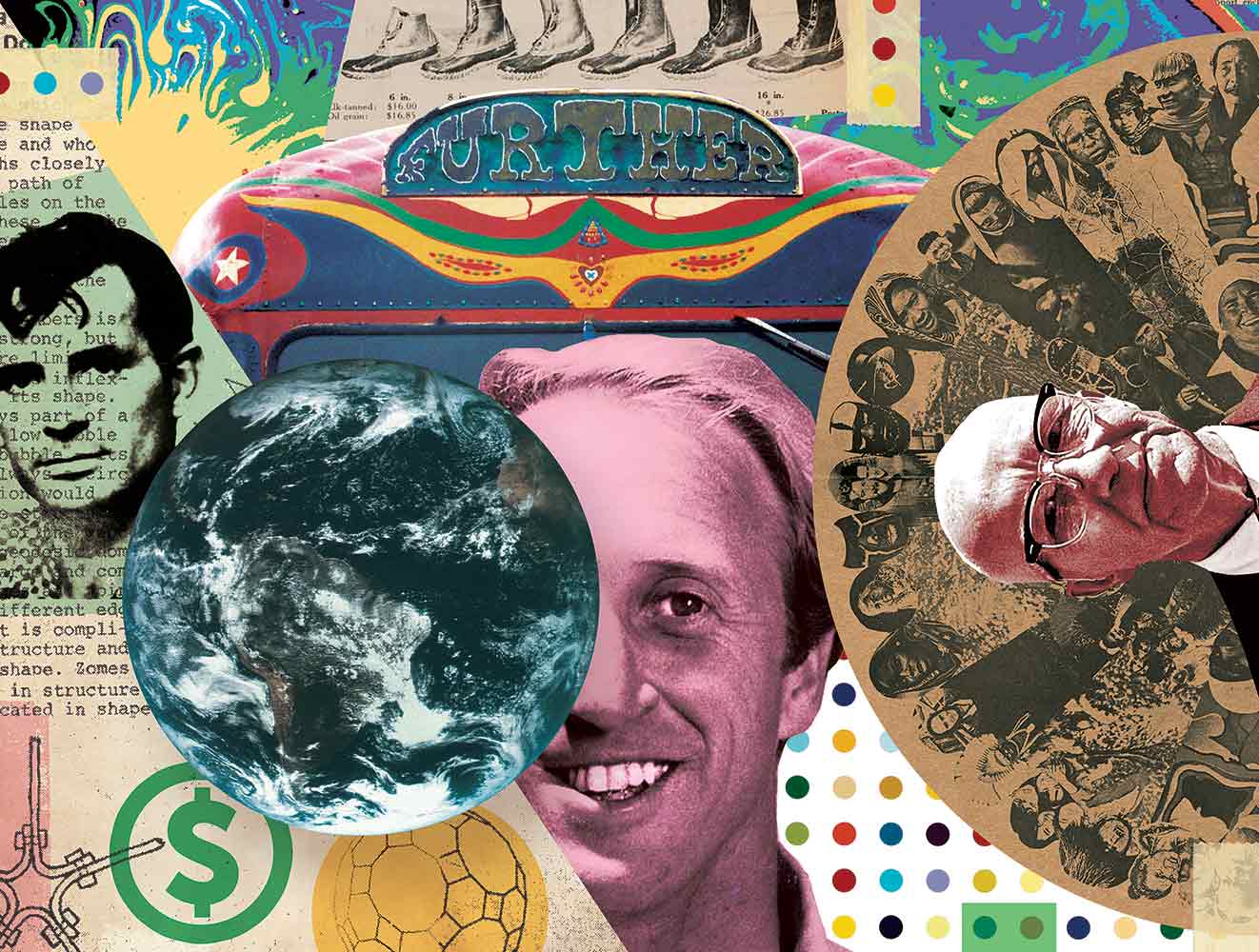
<div class=__reading__mode__extracted__imagecaption>Illustration by Tim Robinson.

"Stewart Brand is not a scientist. He’s not an artist, an engineer, or a programmer. Nor is he much of a writer or editor, though as the creator of the Whole Earth Catalog, that’s what he’s best known for. Brand, 83, is a huckster—one of the great hucksters in a time and place full of them. Over the course of his long life, Brand’s salesmanship has been so outstanding that scholars of the American 20th century have secured his place as a historical figure, picking out the blond son of Stanford from among his peers and seating him with inventors, activists, and politicians at the table of men to be remembered. But remembered for what, exactly?

Whole Earth: The Many Lives of Stewart Brand is the first full biographical consideration of a man who has already provided useful fodder for writers seeking to characterize the various social and intellectual movements that came out of California in the final third of the 20th century. The author, the longtime tech journalist John Markoff, has covered Brand at length before, in What the Dormouse Said: How the Sixties Counterculture Shaped the Personal Computer Industry. But his new book puts Brand, the man—rather than his role as an exemplary connector of others—at the center of its story. An authorized project, Markoff’s biography draws primarily from Brand’s own words in contemporary interviews and in his detailed journals, to which the author had access. If, in the historical light of 2022, it were possible to make Stewart Brand look good, I’m sure Markoff would have managed it, which makes it all the more remarkable that he does not.

In works ranging from Tom Wolfe’s The Electric Kool-Aid Acid Test—the book opens with Brand driving the famous Merry Prankster bus—to Fred Turner’s 2004 study From Counterculture to Cyberculture, Brand found a way to put himself behind the wheel, most often by buying the car. He pops up repeatedly in what has become the standard prehistory of Silicon Valley: organizing the San Francisco Trips Festivals, which kick-started the hippie movement, helping show off the first personal computer prototype, supplying those newly minted hippies with “back to the land” fantasies, advising the Zen governor of California Jerry Brown, telling America about early computer games, cofounding one of the first successful experiments in Internet community, and coining the phrase “Information wants to be free.” As an overlapping member of so many relevant milieus, Brand is like a transitional fossil, revealing changes and continuities. In him, academics and reporters have found a useful tool for narrating the period, helping readers ride smoothly from the 1960s to the 1980s and linking together the ostensibly disparate cultures in Turner’s title. . .

Unlike Forrest Gump, who jogged through the same period blissfully ignorant and unseduced by any particular line, Brand fervently believed in almost everything—at least for a little while. . .

[    ] If becoming a flea-bitten trust-funder tooling around the Bay on his new sailboat, driving to the woods in his new red VW bus (imported from Germany), and trailing Jack Kerouac sounds like the worst road Brand could have taken, it’s worth keeping the alternative in mind. Had he possessed the endurance or patience to join an elite military unit, he likely would have been among the first boots on the ground in Vietnam, where the US Special Forces began the war with a murderous counterinsurgency campaign. Say what you will about rich-kid beatniks, but at least they were not war criminals. . .

[.    ] Brand did have the luck, however, to be fishing in a well-stocked pond with the luxuries of time and good equipment. The Trips Festival wasn’t Brand’s idea—he got it from the Merry Pranksters, who wanted to do a concert-size Acid Test—but he had $300 for a venue deposit as well as connections to concert professionals in San Francisco, including the young promoter Bill Graham. As a vehicle for Brand’s experimental art, the festival was a total bust, but as a Grateful Dead concert it was a success, and Brand reassured his father not only that he had no interest in becoming a socialist but that there was good money to be made as a beatnik.

Brand’s next big idea combined his receding interest in photography with his increasing interest in “systems thinking,” a shift from his Randianism to the faddish work of architectural theorist Buckminster Fuller. On one 1966 acid trip, Brand was struck by an idea: Why hadn’t NASA released a satellite picture of the entire planet yet? It was a puzzling question, and with its conspiratorial overtones and hippie implications, Brand recognized what we might call a “good meme.” . .Like the acid advocate Timothy Leary, Brand had a top-down approach to social enlightenment, an elitism that, more than any ideology, position, or interest, has guided his whole life.

NASA did release such a photo the next year, and Brand recycled it for another notion, as the name of his catalog. Why a catalog? One strand that runs through Markoff’s book unremarked is the fact that Brand loved shopping. He was the prototypical early adopter, prepared to pay sticker price for the latest gadgets, a habit linked to his father’s love for mail-order catalogs and even further back to a family hardware supply business. He took the same shopping approach to ideas and identities, always on the lookout for something new. Many of his peers were the same way, and for them he dreamed up the Whole Earth Catalog, a thick brochure for the reverse-engineered store of Stewart.

The form was brilliant, in its way: With no critical or creative agenda to speak of, the Whole Earth Catalog could play fast and loose with copyright, raiding the latest books for their coolest pictures and diagrams. In it, the reader found all sorts of stuff, from walkie-talkies to tepees, calculators to kerosene lamps, as well as a whole lot of what we might now call ’60s books. Brand took the large format from Steve Baer’s newsprint instructional zine Dome Cookbook, the typeface from L.L. Bean, and his famous intro (“We are as gods and might as well get good at it”) from a British anthropologist. Reviewers got $10 apiece, and Brand paid for the latest in bespoke publishing technology. His $25,000 investment ($200,000 or so today) did not break his bank. The 64-page Catalog had a cover price of $5, roughly 10 times the price of a paperback.

. . .the Whole Earth Catalog made his reputation. It allowed him to put more than $1 million in profits into a short-lived foundation that awarded small, arbitrary grants to the kinds of projects he liked—Brand, still getting family checks, didn’t need the money. When Stewart and Lois divorced, she got only $10,000 and the TV. He kept the catalog’s National Book Award and the credit, . .

Though, unlike nearly everyone else in his milieu, Brand never programmed a computer, he did find a niche near California’s tech ecosystem. As a transitional figure between the ’70s and the ’80s, he is unparalleled; for Brand, the leap from hippie to yuppie was no more than a step. After the catalog’s success, he committed himself to realizing a new ideal: the “Zen playboy.”

[.    ] At one point in time, it was possible to see Brand as the goofy grandfather of a gentler, more thoughtful capitalism headquartered in the San Francisco Bay Area: decentralized but still ambitious; environmentally conscious and techno-optimist; philosophical and even spiritual rather than materialistic and stultified. If Brand had died before the 2008 crash, before Edward Snowden and Uber and Facebook as a tool of genocide and Jeffrey Epstein and coal-fired Bitcoin-mining plants, he might have secured an uncomplicated legacy. Now we all know better, and Brand’s biographer can’t get around that.

'Artsy Outing' Here in Downtown Mesa @ MCAM: BienVenido a "LolaLand", Magic Chicano-Mex Pop Surrealismo

Say What??... does only one current exhibition in four galleries at the below-ground-level Mesa Museum of Contemporary Arts really deserve to be termed an "Artsy Outing"??
Extracts from a Retrospective Review written by Amy Young, an arts-and-culture writer who also spends time curating arts-related exhibits and events, and playing drums in local bands French Girls and Sturdy Ladies.
Contact: Amy Young
"MCAM’s chief curator, Tiffany Fairall, was excited to present this retrospective because of the multiple ways Cota’s work resonates with her. “What makes Lalo Cota’s work stand out for me are its playfulness and accessibility,” she tells Phoenix New Times.
“Through bold colors and elements that celebrate our state’s rich Mexican heritage, Lalo truly captures the Arizona flavor of Chicano identity while subtly commenting on our complicated relationship with new immigrants.
A popular muralist, Lalo’s work is probably very familiar to many living in the Phoenix metro area, and the iconography he uses is very recognizable and relatable to those that are part of a Mexican-American community,” Fairall adds.

Art

Why a Visit to Laloland in Mesa Is the Artsy Outing You Need

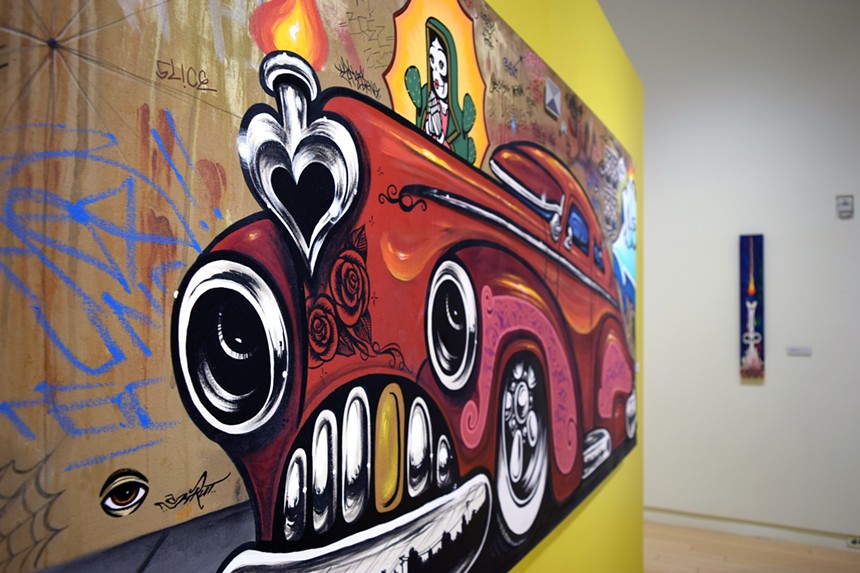
Laloland, installation view.

Contact: Amy Young

Currently, Mesa Contemporary Arts Museum (MCAM) is honoring Cota’s work with Laloland, a retrospective of his work from the last 20 years. You can see it now through August 7.

[    ] ". . .You know an exhibition is inviting when the first thing you see is the show’s title across a bright yellow backdrop, and in front of that signage, a large-scale painted panel in the shape of a classic low-rider. Not just any sign, this one allows you to put yourself behind the wheel. It’s the perfect show selfie — you get to be a part of Cota’s art. . .

As you stroll through the show, it’s exciting to see the color and inspiration threads that flow through Cota’s work, yet each piece tells a clear-cut tale. La Carrera, which translates to The Race, could be a nod to La Carrera Panamericana. Also known as The Mexican Road Race, this historic auto event traces back to the 1950s. Though it only lasted a few years, it was revived in the late ‘80s and still occurs today.

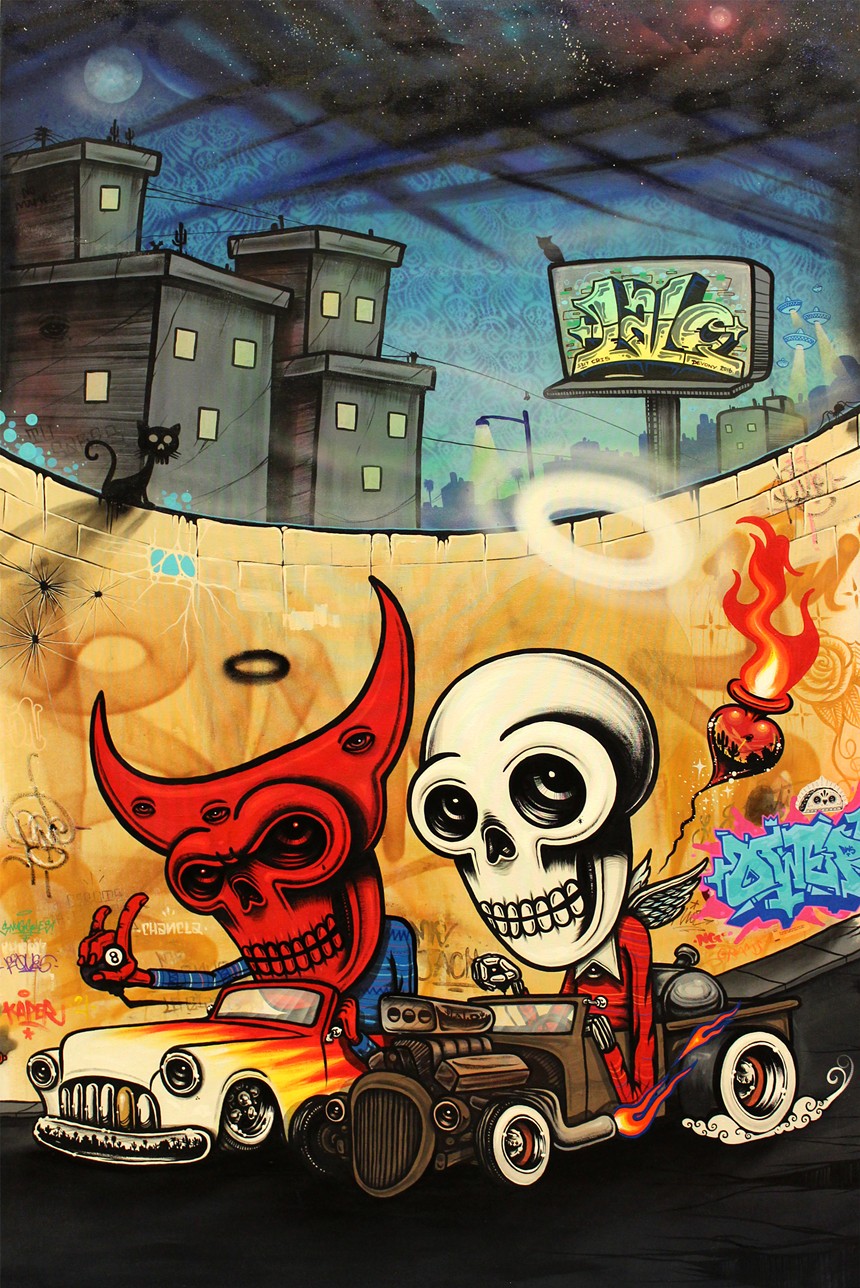
La Carrera, mixed media, by Lalo Cota. - MESA CONTEMPORARY ARTS MUSEUM

In Cota’s piece, the devilish driver and his skeletal racing associate have their hands on the gear shifts of their respective vehicles as they cruise past graffiti-tagged walls that include Lalo’s signature on a billboard that’s part of the city skyline. In the distance, his unique sombrero-shaped saucers beam light down from above. The flame rising behind them and the smoke emitting from their hot wheels conjures up the smells and sounds of the race’s action and intrigue.

Subtly, but without losing one iota of importance in his approach, the two paintings above (and, of course, many of his other creations) remind us of Mexican culture’s pervasive impact and influence in the automotive arena — past, present, and future.

Lalo Cota creates unique work that offers his takes on Mexican cultural and societal aspects by merging his style with an affinity for Mexican folk art. Laloland is a well-deserved retrospective for one of the Valley’s most prolific artists and an excellent opportunity to soak up the art made at different points on his timeline in one space. . .

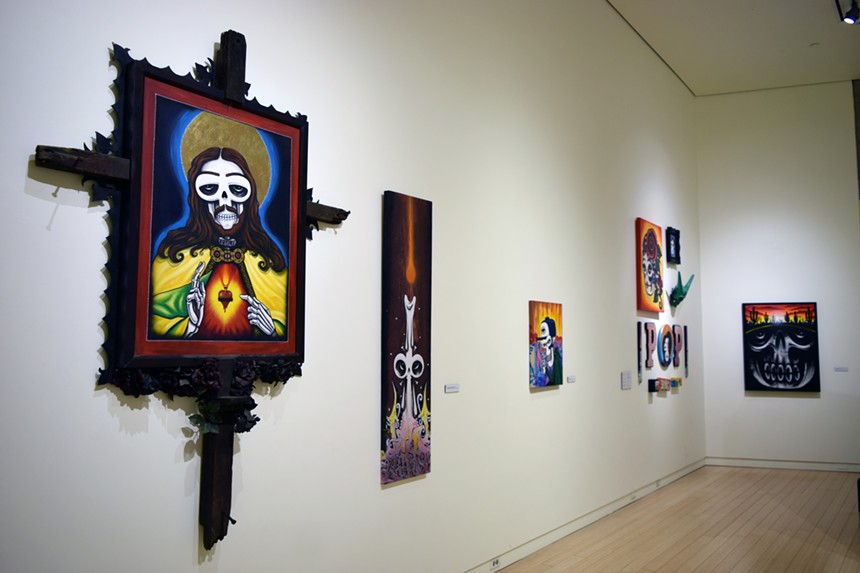
Jesus may have never looked as laid back — and that’s saying a lot — as he does in Cota’s Personal Jesus triptych. A larger piece featuring the historical and biblical figure is flanked by two smaller pieces, each with a slinky, white ghostly character. Jesus sits between them in an ornate wood frame with a cross as its backbone. His heart-shaped pendant is luminous, and his right hand has its first two fingers up. He’s either making a point or offering a mellow version of the universal peace sign.
Laloland, installation view. - MESA CONTEMPORARY ARTS MUSEUM
Though the grainy wood cross with its exposed nails is a little gothic and slightly haunting, there’s an overall benevolence to Cota’s Jesus and a tinge of gentle humor. Like many Cota subjects, Jesus possesses lustrous eyes — vast, deep, and captivating. It’s one example of the motion his work exudes. His style is energetic, and his subjects are inviting. They become more intriguing as you study their saucer-y eyes and vivid expressions. His cars bounce and pop from the surfaces on which they are painted.

The desert landscape is often present in Cota’s work. There are cactuses, sometimes intensely green, other times soft and shadowy. Then there’s the sky. You’ll find that varying from heady blues to outrageous gold tones, outlining the magic of its different moods.

Laloland, installation view. - MESA CONTEMPORARY ARTS MUSEUM

Laloland runs through August 7 at Mesa Contemporary Arts Museum, 1 East Main Street in Mesa. Admission is free. Visit the website for hours.


NO CAPTAIN ONBOARD