Thursday, June 30, 2022

EXTERNAL LOCUS OF CONTROL: Consumer Confidence

No doubt that many factors that influence consumer confidence are outside of our control.

Jul 28, 2021 · Trade wars are once again emerging as a major risk to the global economy and business operations. Existing tactics include tariffs, ...

Falling consumer confidence is a symptom rather than the cause of the recession. Consumer confidence is only a survey and people may become pessimistic for reasons not related to a change in economic fundamentals. Consumer confidence is based on qualitative surveys, where people carrying out research ask a sample of the population questions, . . .

Early read on impact of war in Ukraine: Consumer Confidence in Europe plummets, but not uniformly

April 01, 2022 | Charts
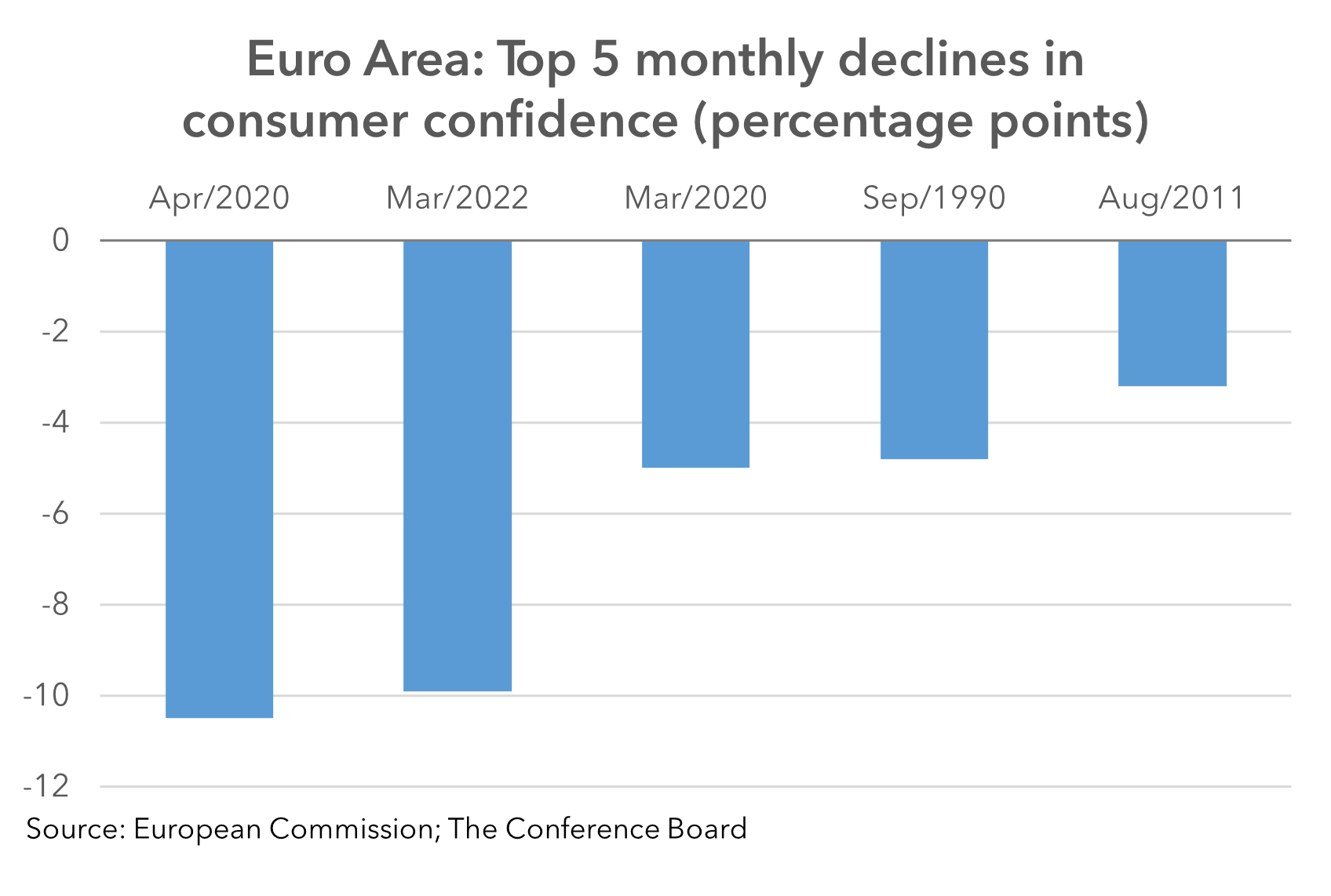
percentage points

Aug 7, 2020 · The trade war caused economic pain on both sides and led to diversion of trade flows away from both China and the United States. As described by ...

Consumer confidence can influence the effectiveness of economic policy.

In theory, it is possible for consumers to ‘talk themselves into a recession‘. If people expect a recession, confidence drops, spending drops, creating a negative multiplier effect of lower growth and higher unemployment. This, in turn, causes more falls in consumer spending. Though in reality, consumers don’t expect a recession without some good reason. Recessions have more causes than an unexplained fall in confidence. However, the drop in confidence strengthens the underlying negative factors

The Political (And Economic) Origins of Consumer Confidence        

American Journal of Political Science

Suzanna De Boef and Paul M. Kellstedt
"Economic conditions, the story usually goes, influence consumer confidence, which in turn influences both political evaluations and votes. But we have little sense of the origins of consumer confidence itself. It is generally assumed that monthly reports of the nation's level of consumer confidence respond to objective economic conditions. We argue that politics is important for understanding consumer sentiment beyond what we know from economic conditions. Specifically, we demonstrate a direct effect of political evaluations of the president's management of the economy, the party of the president, extraordinary political events, and monetary policy, as well as an indirect effect of media coverage of the economy, on consumer sentiment, after controlling for economic conditions. When news coverage is positive, citizens give favorable evaluations, leading to more positive sentiment. Our findings suggest that understanding the political economy requires an emphasis on the causal effect of politics as well as economics."


Markets
Economics

US Consumer Confidence Hits 16-Month Low on Drag From Inflation

  • Conference Board index sags to 98.7, lowest since February ‘21
  • Expectations index plummets to worst in nearly a decade
Video player cover image
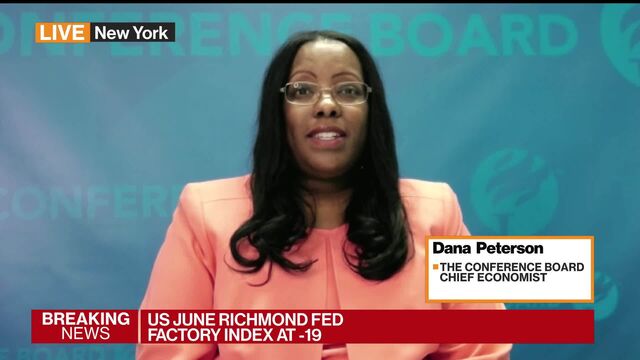
WATCH: Conference Board’s Dana Peterson discusses the takeaways from the June US consumer confidence data. Source: Bloomberg
on June

> US consumer confidence dropped in June to the lowest in more than a year as inflation continues to dampen Americans’ economic views.

The Conference Board’s index decreased to 98.7 from a downwardly revised 103.2 reading in May, data Tuesday showed. The median forecast in a Bloomberg survey of economists called for a decline to 100.

=======================================================================

The monthly Consumer Confidence Survey®, based on an online sample, is conducted for The Conference Board by Toluna, a technology company that delivers real-time consumer insights and market research through its innovative technology, expertise, and panel of over 36 million consumers. The cutoff date for the preliminary results was June 22.

The Conference Board publishes the Consumer Confidence Index® at 10 a.m. ET on the last Tuesday of every month. Subscription information and the technical notes to this series are available on The Conference Board website: https://www.conference-board.org/data/consumerdata.cfm.

Latest Press Release

Updated: Tuesday, June 28, 2022

Consumer Confidence Falls Again in June

Index Drops to Lowest Level Since February 2021 as Expectations Continue to Decline

The Conference Board Consumer Confidence Index® decreased in June, following a decline in May. The Index fell to 98.7 (1985=100)—down 4.5 points from 103.2 in May—and now stands at its lowest level since February 2021 (Index, 95.2).

The Present Situation Index—based on consumers’ assessment of current business and labor market conditions—declined marginally to 147.1 from 147.4 last month.

The Expectations Index—based on consumers’ short-term outlook for income, business, and labor market conditions—decreased sharply to 66.4 from 73.7 and is at its lowest level since March 2013 (Index, 63.7). . .

Present Situation

Consumers’ appraisal of current business conditions was less favorable in June.

  • 19.6% of consumers said business conditions were “good,” down slightly from 19.8%.
  • 23.0% of consumers said business conditions were “bad,” up from 21.7%.

Consumers’ assessment of the labor market was mixed.

  • 51.3% of consumers said jobs were “plentiful,” down from 51.9%.
  • Conversely, 11.6% of consumers said jobs were “hard to get,” down from 12.4%.

Expectations Six Months Hence

Consumers grew more pessimistic about the short-term business conditions outlook in June.

  • 14.7% of consumers expect business conditions will improve, down from 16.4%.
  • 29.5% expect business conditions to worsen, up from 26.4%.

Consumers were more pessimistic about the short-term labor market outlook.

  • 16.3% of consumers expect more jobs to be available, down from 17.5%.
  • 22.0% anticipate fewer jobs, up from 19.5%.

Consumers were also more pessimistic about their short-term financial prospects.

  • 15.9% of consumers expect their incomes to increase, down from 17.9%.
  • 15.2% expect their incomes will decrease, up from 14.5%.

Wednesday, June 29, 2022

Can everybody take a step back and acknowledge that the biggest breakthrough innovation we have had since inception is TSA PreCheck?”

Nilay Patel speaks with the TSA’s chief innovation officer, Dan McCoy, about airport surveillance, security lines, and what we surrender when we sign up for PreCheck. . .We do not have to surveil you, we just have to know that you in this moment do not pose a threat.”

. . .FinTech is a really data-secure ecosystem where you give up a lot of data. If there is a change there, maybe it can apply to what we are doing. Our hope from the innovation team is that those people exist, are educated on what we want them to do, and are empowered to do it. We hope that those new approaches that are beneficial to the whole agency and traveling public will take place where they should, in that business unit.

I know Clear has a database of faces; I don’t love it, but again, I am impatient. At least they are a private company. If they do something wrong, people can sue them. It feels like there is that check where if Clear blows it, they can lose their contract and that is existential for them. TSA doesn’t get to lose its contract. If you give the government the database of faces and they screw up, it feels like the remedies are less existential.

Intro to the interview:  A lot of government innovation groups have been really focused right now on emerging venture capital and emerging technology, and how to integrate them. I would best describe my role as chief facilitation officer for innovation. 

How the TSA created two classes of travelers

How the TSA created two classes of travelers

By: Nilay Patel
Illustration: Kristen Radtke
Animation: Grayson Blackmon

I’m old enough to remember what it was like to fly before 9/11 — there were no TSA lines, there was no PreCheck, and there certainly wasn’t any requirement to take off your shoes. In fact, there wasn’t any TSA at all.

But 9/11 radically changed the way we move through an airport. The formation of the new Department of Homeland Security and the new Transportation Security Administration led to  much more rigorous and invasive security measures for travelers trying to catch their flight.

This year is the 20th anniversary of the Department of Homeland Security and the TSA, and I think it’s safe to say that nobody enjoys waiting in the airport security line. And in the post-9/11 world, things like PreCheck are the great innovation of the department.

At least according to Dan McCoy, who is the TSA’s chief innovation officer, who told me that PreCheck is “a hallmark government innovation program.”

But what do programs like PreCheck and the larger surveillance apparatus that theoretically keep us safe mean for the choices we make? What do we give up to get into the shorter security line, and how comfortable should we be about that?

This week, The Verge launches “Homeland,” our special series about the enormous influence of the Department of Homeland Security and how it has dramatically changed our country’s relationship with technology, surveillance, and immigration. So we have a special episode of Decoder with Dan McCoy to see where the TSA fits into that picture. . .

"The Princess" is released on 30 June in cinemas.

Excerpt from the following review: ". . .Perhaps the whole movie is justified by the amazing human-sacrifice sequence of the wedding day: heartbreakingly young and virginal Diana, being led into St Paul’s Cathedral – an event weirdly similar in its reverent unreality to her funeral at Westminster Abbey, just 16 years later."

The Princess review – Diana’s story remains captivating – and agonising

We know what happens but, even so, Ed Perkins’s skilfully edited documentary on the dazzling outsider royal is utterly and unerringly compelling

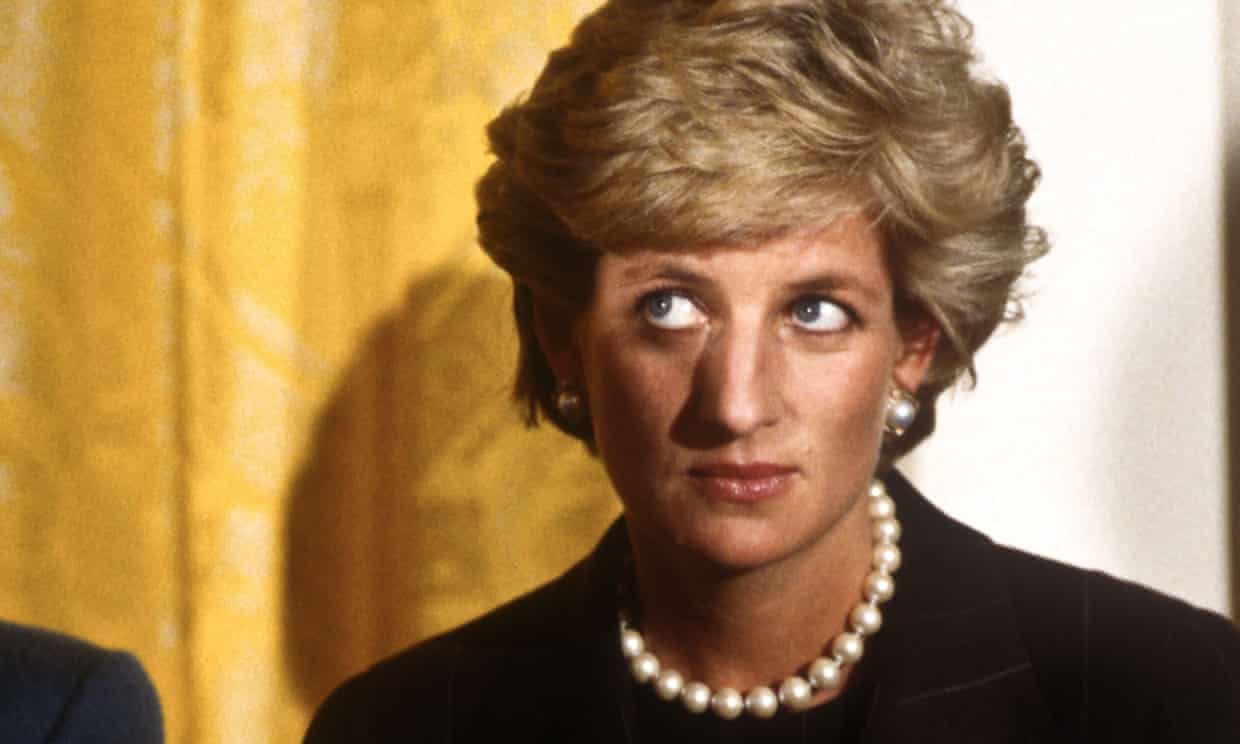
<div class=__reading__mode__extracted__imagecaption>Simple and spontaneous … Diana, Princess of Wales in 1996.  Photograph: Richard Ellis/Alamy<br>Simple and spontaneous … Diana, Princess of Wales in 1996.  Photograph: Richard Ellis/Alamy</div>

Wed 29 Jun 2022 08.00 EDTLast modified on Wed 29 Jun 2022 17.27 EDT

She has grown not old as those who are left grew old: the “royal watchers”, the journalists, the charity workers, the prime ministers, the paparazzi, the ex-husband and the two sons, both now older than she was when she died. Maybe Ed Perkins’s documentary about Diana, Princess of Wales’s operatically exciting public life shouldn’t really be as fascinating as it is, but I spent much of it on the edge of my seat. It tells the story using only existing archive footage and some video material, perhaps inspired by film-maker Asif Kapadia who has often taken this approach, notably with racing driver Ayrton Senna, who was killed in an F1 crash in 1994.

The sting of this technique is that we now know everything, or almost everything, about the wrenching misery that went on behind the scenes; we know for example how she was tricked into the Panorama interview with Martin Bashir in which she revealed that there were “three people” in her marriage and that she wanted to be “Queen in people’s hearts”. So now there is a new frisson and a new context for this public record. The editing contrives to give us new glimpses behind the curtain, including the breezy mentions, in the royal wedding commentary, of the impeccably loyal and supportive Mr and Mrs Parker-Bowles.

The problem with this approach is that it can’t show us anything of Diana that has not been committed to the visual record: most importantly, it can’t show us her unpleasant but revealing feud with her sons’ nanny “Tiggy” Legge-Bourke, whom she suspected of having an affair with Charles. (It is always amazing to me how even some of the most saucer-eyed Diana fans have no idea about this.)

This documentary is more satisfying than Pablo Larraín’s overheated and essentially credulous fiction-fantasy Spencer, amusingly acted by Kristen Stewart (who was not, however, as good as Emma Corrin in the same role for Netflix’s The Crown). It is captivating and agonising all over again to see how dazzling Diana was, how simple and spontaneous she was compared with both the stuffy royals but also the secular celebrity class – how she instinctively knew to work with the press when it was still essentially sympathetic, but how panicky and dysfunctional she became when this same press became boorish and predatory. In the later stages of the film, when there is video footage taken by the photographers, we can hear them charmlessly swearing and jeering among themselves.

As for Diana herself, post-divorce, she often miserably retreated behind a baseball cap brim or a tennis racket, or pictured radiantly arriving at endless, New York-style gala charity events, often kissing on both cheeks some smooth tuxedo-ed man who is there to welcome her. On one occasion, gruesomely, this was Henry Kissinger.

Then there was the terrible crash itself; that extraordinary event in those pre-social-media days when it was still possible to tell people the news. . ."