.jpg)
The Fossil--Fuel Industry
.jpg)


.jpg)
The United Nations chief sharply criticized the “grotesque greed” of oil and gas companies on Wednesday for making record profits from the energy crisis on the back of the world’s poorest people, “while destroying our only home.”
Secretary-General Antonio Guterres said it was “immoral” that the largest energy companies in the first quarter of the year made combined profits of close to $100 billion.
He urged all governments to tax these excessive profits “and use the funds to support the most vulnerable people through these difficult times.”
Guterres urged people everywhere to send a message to the fossil fuel industry and their financiers that “this grotesque greed is punishing the poorest and most vulnerable people, while destroying our only common home, the planet.”
The secretary-general spoke at the news conference launching a report by the Global Crisis Response Group he set up to tackle the triple interconnected crises of food, energy and finance which have especially hit countries trying to recover from the COVID-19 pandemic and deal with the devastating impact of the war in Ukraine.
Guterres told reporters that “we are seeing excessive, scandalous profits of the oil and gas industry in a moment in which all of us are losing money” because of inflation around 7-8%. And “nothing will be more popular than to tax the excessive profits … and to distribute that money to the most vulnerable families,” he said.
The crisis group has already presented recommendations on food and finance and Guterres said he believes “we are making some progress” in those areas, especially on food.
The report released Wednesday focuses on the energy crisis, and the secretary-general said it aims to achieve the equivalent of the grain deal he first proposed to the Russian and Ukrainian presidents to enable Ukrainian grain to be shipped from Russian-blockaded ports on the Black Sea to world markets in desperate need of food supplies. The first ship to leave Ukraine was headed to Lebanon Wednesday after a three-hour inspection in Turkish waters.
Guterres said speculators and obstacles to getting grain and fertilizers to global markets during the Ukraine war sent food prices soaring. But since negotiations on the grain deal “gained traction,” he said, there has been “a significant fall” and today prices of most foodstuffs and fertilizers are more or less at their pre-war prices.
“But that doesn’t mean that bread in the bakery is at the same price before the war, because these are quotations in wholesale markets, some of them related to futures,” he said, and there are a lot of other factors contributing to rising prices including transportation and insurance costs and supply chain disruptions.
U.N. trade chief Rebeca Grynspan, who coordinated the crisis group, said wheat prices are down almost 50% from their peak, corn and fertilizer prices have dropped almost 25% in the past month and crude oil is now around $93 a barrel compared to $120 dollars a barrel in June. “Only natural gas has bucked the trend and is still higher than a month ago,” she told reporters by video from Geneva.
Falling prices are “good news,” Grynspan said, but they have been high for too long and since June forecasts for extreme poverty have risen by 71 million people and forecasts for food insecurity by 47 million.
In another key recommendation, the crisis group urges richer developed countries, especially, to conserve energy including by reducing air conditioning and heating use and by promoting public transport “and nature-based solutions.”
Guterres said new technologies including storage for batteries “should become public goods,” and governments must scale up and diversify supply chains for raw materials and renewable energy technologies.
The group also recommends scaling up private and multilateral finance for “the green energy transition.” And it backed the International Energy Agency’s goal of increasing investments in renewable energy by a factor of seven to meet the goal of cutting greenhouse gas emissions to “net zero” by 2050 to help curb man-made climate change.
“Today, developing countries are spending around $150 billion on clean energy,” said Grynspan, the secretary-general of the United Nations Conference on Trade and Development. “They need to spend $1 trillion in investments.”
Sign up for the Fortune Features email list so you don’t miss our biggest features, exclusive interviews, and investigations.
The United Nations chief sharply criticized the “grotesque greed” of oil and gas companies on Wednesday for making record profits from the energy crisis on the back of the world’s poorest people, “while destroying our only home.”
Secretary-General Antonio Guterres said it was “immoral” that the largest energy companies in the first quarter of the year made combined profits of close to $100 billion.
He urged all governments to tax these excessive profits “and use the funds to support the most vulnerable people through these difficult times.”
Guterres urged people everywhere to send a message to the fossil fuel industry and their financiers that “this grotesque greed is punishing the poorest and most vulnerable people, while destroying our only common home, the planet.”
The secretary-general spoke at the news conference launching a report by the Global Crisis Response Group he set up to tackle the triple interconnected crises of food, energy and finance which have especially hit countries trying to recover from the COVID-19 pandemic and deal with the devastating impact of the war in Ukraine.
Guterres told reporters that “we are seeing excessive, scandalous profits of the oil and gas industry in a moment in which all of us are losing money” because of inflation around 7-8%. And “nothing will be more popular than to tax the excessive profits … and to distribute that money to the most vulnerable families,” he said.
The crisis group has already presented recommendations on food and finance and Guterres said he believes “we are making some progress” in those areas, especially on food.
The report released Wednesday focuses on the energy crisis, and the secretary-general said it aims to achieve the equivalent of the grain deal he first proposed to the Russian and Ukrainian presidents to enable Ukrainian grain to be shipped from Russian-blockaded ports on the Black Sea to world markets in desperate need of food supplies. The first ship to leave Ukraine was headed to Lebanon Wednesday after a three-hour inspection in Turkish waters.
Guterres said speculators and obstacles to getting grain and fertilizers to global markets during the Ukraine war sent food prices soaring. But since negotiations on the grain deal “gained traction,” he said, there has been “a significant fall” and today prices of most foodstuffs and fertilizers are more or less at their pre-war prices.
“But that doesn’t mean that bread in the bakery is at the same price before the war, because these are quotations in wholesale markets, some of them related to futures,” he said, and there are a lot of other factors contributing to rising prices including transportation and insurance costs and supply chain disruptions.
U.N. trade chief Rebeca Grynspan, who coordinated the crisis group, said wheat prices are down almost 50% from their peak, corn and fertilizer prices have dropped almost 25% in the past month and crude oil is now around $93 a barrel compared to $120 dollars a barrel in June. “Only natural gas has bucked the trend and is still higher than a month ago,” she told reporters by video from Geneva.
Falling prices are “good news,” Grynspan said, but they have been high for too long and since June forecasts for extreme poverty have risen by 71 million people and forecasts for food insecurity by 47 million.
In another key recommendation, the crisis group urges richer developed countries, especially, to conserve energy including by reducing air conditioning and heating use and by promoting public transport “and nature-based solutions.”
Guterres said new technologies including storage for batteries “should become public goods,” and governments must scale up and diversify supply chains for raw materials and renewable energy technologies.
The group also recommends scaling up private and multilateral finance for “the green energy transition.” And it backed the International Energy Agency’s goal of increasing investments in renewable energy by a factor of seven to meet the goal of cutting greenhouse gas emissions to “net zero” by 2050 to help curb man-made climate change.
“Today, developing countries are spending around $150 billion on clean energy,” said Grynspan, the secretary-general of the United Nations Conference on Trade and Development. “They need to spend $1 trillion in investments.”
Sign up for the Fortune Features email list so you don’t miss our biggest features, exclusive interviews, and investigations.
.jpg)
According to this report yesterday it was 'a surprise summer hit'. OK, but if you are curious when there was a post on this blog about that subject you're invited to use the Search Box located in the right-hand margin
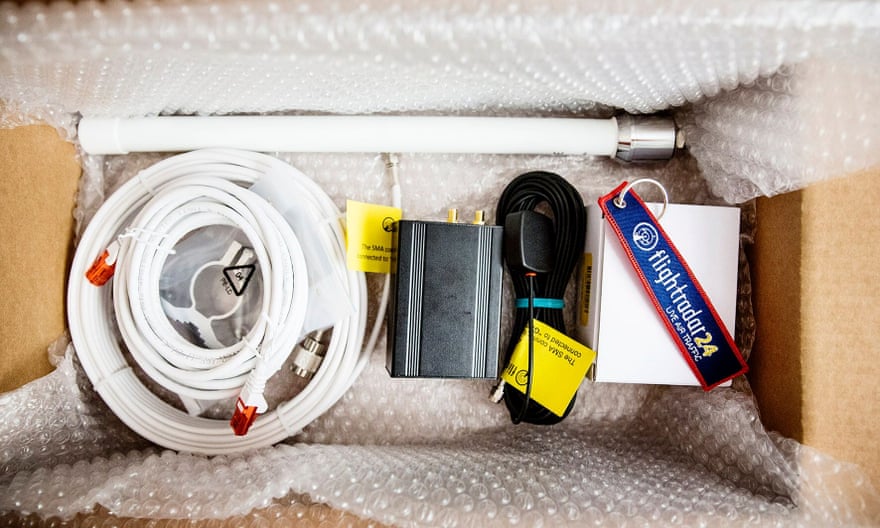
Flight trackers rely on a new open-standard surveillance technology called automatic dependent surveillance-broadcast (ADS-B), which allows planes to transmit their locations and other information to anyone with receiver.

Forget Netflix: millions are now tuning into to watch little yellow plane icons move across a map of the world
Want to watch a top-secret government flight live? Track a drug kingpin’s movements in real time? Or know how much Taylor Swift’s jets are polluting the air? They’re all streaming live on the sleeper hit of the summer: online flight trackers.
On Tuesday, viewers set new records on Flightradar24, one of the largest flight tracker websites in the world, as they watched the seven-hour flight of Nancy Pelosi from Kuala Lumpur to Taipei. The trip, shrouded in secrecy until its final moments, grabbed international attention after China made military threats in the weeks leading up to the visit, and then launched live-fire exercises once she had landed.Ian Petchenik, the head of communications for Flightradar24, said the site had seen “unprecedented sustained interest” over Pelosi’s flight, and at its peak, a record 708,000 people were simultaneously watching the little red icon representing the House speaker’s Boeing C-40C – callsign SPAR19 – as it looped around the Philippines to bypass Chinese bases in the South China Sea, then soared across the Luzon Strait, reportedly under the watchful cover of a trio of US aircraft carriers, and arced across Taiwan’s mountain ranges before touching down in Taipei.
Anyone can set up an ADS-B receiver using inexpensive kits. That’s allowed Flightradar24 to go from a couple of receivers in Sweden, when the site was founded in 2007, to a huge network with more than 30,000 receivers around the world, many of them run by volunteers. The receivers have a range of a few hundred miles, though they struggle with terrain such as mountains. To close the gaps, Flightradar24 cross-references its ground-based receivers with data from other sources, including satellites and data from the Federal Aviation Administration (FAA) in the US.
Subscribing to the government data comes with a catch: trackers must agree to abide by FAA rules that let aircraft owners request their information be removed from public websites. That means Flightradar24 displays some flights anonymously, though Petchenik can’t specify which ones.
That’s where a popular uncensored flight tracker comes in: ADS-B Exchange. The website was founded as a hobby in 2016 by Dan Streufert, an IT professional who describes the site’s policy: “We don’t block anything.” That’s possible in part because the site doesn’t subscribe to the FAA feed. Instead, it relies on data funneled from a network of about 9,000 ADS-B receivers around the world run by aviation enthusiasts and other volunteers.
Streufert’s network allows users to observe flights that powerful people want to be kept secret. Once, Streufert received a letter from a European lawyer who demanded ADS-B Exchange stop tracking his client’s flights. After looking up the flight data, Streufert realized: “The guy used to work for Gaddafi. He’s been accused of war crimes and killing people and yada yada. I guess somebody had used our data to figure out that he was moving gold from Venezuela to Libya on his private jet, and he wasn’t too happy about that being exposed.”
ADS-B Exchange’s approach to open data has also allowed citizen journalists to reveal the habits of America’s rich and famous. This year, a 19-year-old programmer named Jack Sweeney created a bot that tweeted out the flight paths of Elon Musk. Musk offered Sweeney $5,000 to take the feed down (the teen refused).

ADS-B Exchange’s data made headlines this summer when an environmental non-profit used it to estimate the carbon emissions produced by stars including Drake, Kylie Jenner, Travis Scott, and Taylor Swift – who has responded that her jet is “loaned frequently to other individuals”.
But Steufert says sometimes high-profile planes will deliberately broadcast their ADS-B data. “When the Ukraine war started, you could see the US strategically turning on their transponders of aircraft in the area to sort of send a message. In a hot zone like that, you know that they’re not accidentally leaving it on.”
Steufert says official agencies frequently use ADS-B Exchange’s data, whose grassroots network may pick up movements that official systems don’t. “We have many sort of inexpensive ground stations where government agencies probably have much fewer but far fancier ground stations. There’s pros and cons to each way to monitor traffic. But there’s also less red tape to get access to our system.”
ADS-B Exchange often shares its data with air crash investigators, and it also has contracts with the US defense department, Steufert said. “They don’t really tell us what they use it for, but it helps defray some of the costs.”
Steufert says sites like his are doing nothing wrong. “We don’t interpret the data – we leave that to journalists, media, researchers, whoever, to interpret what that might mean. But we can share as much data as we want.”
So much to read!
Just a few weeks we noted that this was inevitable, but Facebook has now made it official that it’s no longer interested in dumping money on news publishers.
“A lot has changed since we signed deals three years ago to test bringing additional news links to Facebook News in the U.S. Most people do not come to Facebook for news, and as a business it doesn’t make sense to over-invest in areas that don’t align with user preferences,”
This should not be a surprise
We’ve noted for years how U.S. consumer location data is routinely abused by a long list of bad actors, including wireless carriers, broadband providers, app makers, adtech companies, data brokers, police, people pretending to be police, governments, and more.
It’s also, not too surprisingly, a problem in Canada.
Restaurant chain Tim Hortons was recently found to have been collecting “vast amounts of sensitive location data” in violation of Canadian privacy laws. More specifically, one report found the app tracked a user’s location over 2,700 times in less than half a year any time they left home, visited a competitors, or hit a local sports venue, and the restaurant chain mislead users into thinking the tracking would only occur when the app was in use.
Worry not though, as part of a new settlement with the company, it says it will be giving impacted customers enough money for a “hot beverage and a free baked good” with a total retail value of $8.58:
Civil asset forfeiture has shown us the government has a weird way of instigating lawsuits. In rem forfeiture cases allow government agencies to file suits against objects, rather than the people they’ve been seized from. This leads to some very amusing case names (even if the underlying process verges on legalized theft), like South Dakota v. 15 Impounded Cats and, um… UNITED STATES of America v. AN ARTICLE of hazardous substance CONSISTING OF 50,000 cardboard BOXES more or less, each containing one pair OF CLACKER BALLS, labeled in part: (Box) “* * * Kbonger * * It’s Fun Test Your Skill It Bounces It Flips Count The Hits * * * Specialty Mfg. Co., Seattle, Wash. * *.
A state law in Virginia allows residents to sue things rather than people. That’s what a couple of ridiculous politicians (Delegate Timothy Anderson and congressional candidate Tommy Altman) have done.
Early last year, Indonesia implemented a new internet regulation law. Referred to as “MR5,” the law gave the government the power to engage in widespread blocking of content. Not only did the law create intermediary liability, it required any site offering services to Indonesian representatives to register with the government. On top of that, service providers were expected to give law enforcement full access to any user content, including private communications and privately stored content.
On top of the normal sort of illegal content, service providers were supposed to proactively monitor user content to remove “prohibited information,” a catch-all term that includes such uber-vague things like content that “creates community anxiety” and
Bring your smartphone functionality to your wrist with the C-MAX CALL TIME. Over fourteen available features and functions on the 1.7” full color, touchscreen display. Answer calls, get message alerts, monitor your sleep, track multiple sports, and more! Also, the soft, flexible, silicone band makes C-MAX CALL TIME comfortable to wear all day, every day. There are four colors available and they’re on sale for $50.
As you’ll recall, the defining moment that lead to Donald Trump creating his Truth Social Twitter clone was his being banned from Twitter for potentially egging on further violence on January 6th. Even before Truth Social was started, Trump’s most vocal and loyal… well, let’s just call them “fans,” kept insisting that what was needed was a social media site that didn’t do any moderation at all — or, at the very least, did no moderation based on viewpoint.
Of course, as we’ve explained for years now, such a thing is literally impossible
This week we noted how the Democratic party had introduced a new two-page bill that would simply give the FCC even clearer authority to restore net neutrality. Of course the bill won’t pass this corrupt Congress, was barely noticed in the summer heat, and couldn’t be implemented anyway because the telecom industry and GOP have successfully blocked the appointment of Gigi Sohn, gridlocking the agency.
Still, the faintest idea we might revisit net neutrality still sent a shiver up the spine of telecom companies, who got right to work pretending that base levels of competent oversight of their industry would be utterly apocalyptic for broadband investment