A friendly reminder
https://mesazona.blogspot.com/2017/07/profile-in-courage-barbara-lee-americas.html
.jpg)

https://m.youtube.com/watch?v=15YgdrhrCM8
https://m.youtube.com/watch?v=2yfXgu37iyI
A friendly reminder
https://mesazona.blogspot.com/2017/07/profile-in-courage-barbara-lee-americas.html
https://m.youtube.com/watch?v=15YgdrhrCM8
https://m.youtube.com/watch?v=2yfXgu37iyI
Returning readers of this blog may appreciate that there are extensive earlier posts that feature the subject DARPA...You are invited to use the Search Box in the right-hand margin to access information retrievable from The Archives.

Here first is some related content: from Gizmodo on 03 August + three videos
...every few decades or so, a truly groundbreaking technology oozes its way out of the DARPA caves and transforms into something deeply emblematic of the time its was created. Whether or not those creations were net positive or negatives for the world depends who you asked.
While sorting through its most societally significant breakthroughs, Gizmodo spoke to multiple DARPA officials, including its current director, reviewed dozens of DARPA documents and scoured through recent books documenting the nutty agency’s history. Here’s what we found.
Everything DARPA's Been Doing for the Last 20 Years
Digging into DARPA's history to suss out the agency's most significant, sometimes scary research from the last two decades.
ByMack DeGeurin
8/03/22 12:10PM
Comments (10)
Videos
11:39
🌐youtube.com
DARPA: A Culture of Innovation - YouTube
September 24, 2018
04:31
🌐youtube.com
DARPA 2021 Year In Review - YouTube
December 27, 2021
03:40
🌐youtube.com
Demonstrations of DARPA's Ground X-Vehicle Technologies - YouTube
June 22, 2018
IT Pro
•
12 hours ago
DARPA recruits SpaceX, Intel and Amazon for major satellite network project


HUNTSVILLE, Ala. — Five commercial satellite operators — SpaceX, Telesat, SpaceLink, Viasat and Amazon’s Kuiper — are among 11 organizations selected by the Defense Advanced Research Projects Agency to help develop laser terminals and technical standards to connect satellites in space.
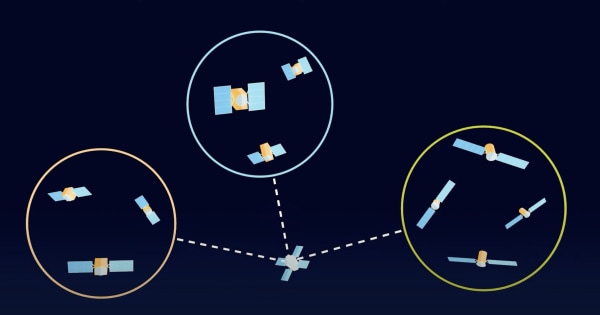
Under a project called space-based adaptive communications node, or Space-BACN, DARPA is pursuing a new laser terminal design that would be compatible with any constellation and make it easier for government and commercial satellites to talk to each other.
DARPA announced Aug. 10 it selected 11 teams for phase 1 of Space-BACN. The goal is to create an internet of low Earth orbit satellites, “enabling seamless communication between military, government and commercial and civil satellite constellations that currently are unable to talk with each other,” Greg Kuperman, program manager at DARPA’s Strategic Technology Office, said in a statement.
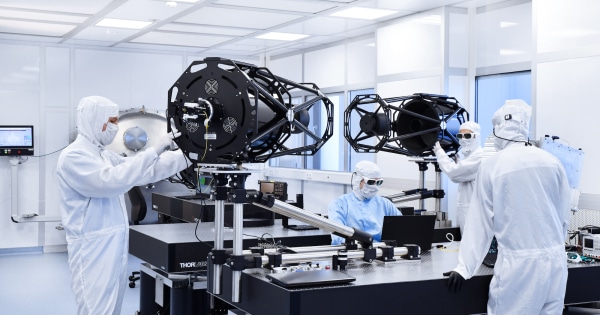
CACI, MBryonics and Mynaric were selected to develop a small optical terminal. II-VI Aerospace and Defense, Arizona State University and Intel Federal will work on a reconfigurable optical modem and will help define the interface between system components.
The five satellite operators will help define command-and-control requirements to support optical intersatellite link communications across constellations.
Phase 1 of Space- BACN will last about 14 months and will conclude with a preliminary design review and a connectivity demonstration in a simulated environment.
DARPA said at the completion of phase 1, some of the providers will be selected to participate in an 18-month phase 2 to develop engineering design units of the optical terminal components. The satellite operators during phase 2 will continue to evolve concepts for cross-constellation communications.
Wins in new contracts
SpaceX's reusable Falcon Heavy rocket can now carry US spy satellites into orbit
The Space Force has approved the heavy-duty vehicle for top secret missions.

Jon Fingas
J. Fingas|08.11.22
@jonfingas
SpaceX Falcon Heavy demo mission launch
SpaceX, Flickr
SpaceX may soon handle some of the US government's highest-priority satellite missions. Bloomberg reports the Space Force has certified SpaceX to launch top secret spy satellites using Falcon Heavy rockets equipped with reusable boosters. The move gives SpaceX more high-profile government missions, of course, but also promises to save federal money by reducing the costs of ferrying these satellites to orbit. The Space Force has already saved over $64 million for GPS missions by using reusable Falcon 9 rockets, Space Systems Command's Falcon chief Walter Lauderdale said.
The Space Force issued the certification in June, but didn't disclose the approval until now. SpaceX can carry spy satellites aboard Falcon 9 rockets, but they don't always have the power needed for heavier payloads. The first Falcon Heavy-based launch is expected sometime between October and December, when SpaceX will deliver a National Reconnaissance Office satellite.
This could represent a significant if temporary blow to rival rocket producers. The Boeing and Lockheed-Martin joint venture United Launch Alliance still hasn't received similar approval for a version of its Vulcan rocket using Blue Origin motors. Air Force officials are still reviewing the approach to 39 national security launches slated for fiscal 2025 through 2027. SpaceX isn't guaranteed to win business that would otherwise go to ULA, but its earlier certification could influence any decisions.
All products recommended by Engadget are selected by our editorial team, independent of our parent company. Some of our stories include affiliate links. If you buy something through one of these links, we may earn an affiliate commission.
View All Comments
Here are reports from two different sources:
SPACE NEWS yesterday
SpaceX loses $900 million in rural broadband subsidies
by Jason Rainbow — August 10, 2022

The FCC said Starlink and LTD Broadband failed to show they "could deliver the promised service” required for rural subsidies. Credit: FCC via Flickr
LOGAN, Utah — SpaceX has lost its bid for nearly $900 million in rural broadband subsidies for its Starlink broadband service.
The Federal Communications Commission said Aug. 10 that SpaceX had failed to show it could meet requirements for unlocking the funds, which aim to incentivize expanding broadband services to unserved areas across the United States.
“We must put scarce universal service dollars to their best possible use as we move into a digital future that demands ever more powerful and faster networks,” FCC chair Jessica Rosenworcel said in a statement.
“We cannot afford to subsidize ventures that are not delivering the promised speeds or are not likely to meet program requirements.”
SpaceX was provisionally awarded the subsidies in December 2020 after competing in an auction under phase one of the FCC’s Rural Digital Opportunity Fund (RDOF).
SpaceX’s winning share was one of the largest among the auction’s 180 successful bidders, and covered nearly 643,000 homes and businesses in 35 states.
Auction winners were required to submit paperwork to the FCC to show how they planned to deploy services that meet RDOF conditions to receive the funds over 10 years.
For Starlink, this included providing 100 megabits per second (Mbps) download speeds and 20 Mbps upload speeds.
Terrestrial telco LTD Broadband, which was provisionally awarded $1.3 billion in subsidies under the program, also failed to demonstrate it could “deliver the promised service,” Rosenworcel said.
“Starlink’s technology has real promise,” Rosenworcel added.
“But the question before us was whether to publicly subsidize its still developing technology for consumer broadband—which requires that users purchase a $600 dish—with nearly $900 million in universal service funds until 2032.”
Ookla speed tests showed median download speeds for SpaceX’s Starlink satellite broadband network improved 38% to 90.55 Mbps in the first quarter of 2022, compared with the corresponding quarter last year.
However, Ookla said upload speeds fell from 16.29 Mbps to 9.33 Mbps.
SpaceX has launched more than 2,700 Starlink satellites to low Earth orbit (LEO) to improve its service and coverage.
According to satellite broadband competitor Viasat, limitations in Starlink’s network architecture prevent it from meeting RDOF obligations even with more satellites.
“As the number of Starlink subscribers increases, the system will become even more capacity-constrained, which is likely to impair network performance and constrain speeds for end users,” Viasat told the FCC in a July 13 letter.
In a July 29 letter to the FCC, SpaceX said Viasat “is transparently attempting to have the Commission impede competition at all costs to protect its legacy technology.”
SpaceX and Viasat have a long history of battling it out over regulatory matters through FCC filings.
Viasat, which operates broadband satellites in geostationary orbit, was denied an attempt to bid for subsidies in the RDOF auction with a proposed LEO constellation.
Rosenworcel’s decision comes after she said last year that the FCC was taking steps to “clean up issues with the program’s design originating from its adoption in 2020,” following complaints about how some of the subsidies would fund broadband in parking lots and well-served urban areas.
These steps included letters to SpaceX and other winning RDOF bidders to withdraw funding requests for areas that already have service, or where “significant questions of waste have been raised.”
SpaceX has been raising billions of dollars to support plans to expand Starlink and its next-generation rocket Starship. The company raised $250 million in an equity round from undisclosed investors in July, bringing total funding raised so far this year to a reported $2 billion.
This article was edited Aug. 10 to correct a typo in Ookla’s upload speed figures for Starlink.
email-white sharing button Emailtwitter-white sharing button Tweet
COMMERCIAL SMALL SATELLITE CONFERENCE SPACEXVIASAT
More Like This
Starlink Screenshot
Viasat asks FCC to halt Starlink launches while it seeks court ruling
SpaceX Hangar Florida
SpaceX won’t seek U.S. rural broadband subsidies for Starlink constellation
Viasat wants FCC to review Starlink’s government funding
Falcon 9 Starlink 10 launch
SpaceX, Hughes and Viasat qualify to bid for $20.4 billion in FCC rural broadband subsidies
FCC rejects Starlink request for nearly $900 million in broadband subsidies
Officials aren't convinced SpaceX's outfit can fulfill its promises.

Jon Fingas
J. Fingas|08.10.22
@jonfingas
BRAZIL - 2022/05/02: In this photo illustration, the Starlink logo is seen in the background of a silhouetted woman holding a mobile phone. (Photo Illustration by Rafael Henrique/SOPA Images/LightRocket via Getty Images)
Rafael Henrique/SOPA Images/LightRocket via Getty Images
Starlink can't count on a flood of government subsidies to help expand its satellite internet service. The FCC has rejected the SpaceX unit's bid to receive $885.5 million in aid through the Rural Digital Opportunity Fund. The broadband provider "failed to demonstrate" that it could deliver the claimed service, according to a statement.
FCC chair Jessica Rosenworcel said Starlink had "real promise," but suggested her agency couldn't justify 10 years of subsidies for "developing technology" that requires a $600 satellite dish. She added that the FCC needed to make the most of "scarce" funding for broadband expansion.
SpaceX won its bid in December 2020 through an auction. At the time, it said it would use the subsidies to serve 35 locations. It also promised prices in sync with terrestrial broadband, and that it would meet "periodic" service buildout requirements.
LTD Broadband, a fixed wireless provider, netted over $1.3 billion in that auction and also lost its bid today. That company was not "reasonably capable" of deploying the required internet service after it lost qualifying statuses in seven states, the FCC said.
We've asked SpaceX for comment. The denial isn't a fatal blow to the company's plans, but it makes clear that Starlink will have to rely on its own funding if it's going to expand as outlined in 2020. The FCC's move might also serve as a warning to other would-be fund recipients. While the Commission is eager to improve rural broadband, it won't grant money to internet providers without some close scrutiny.
All products recommended by Engadget are selected by our editorial team, independent of our parent company. Some of our stories include affiliate links. If you buy something through one of these links, we may earn an affiliate commission.
View All Comments
.jpg)
Sen. Mike Lee (R-Utah) is facing his first real reelection challenge from an ex-Republican endorsed by Democrats who, if elected, would caucus with neither party.

Utah is home to the Great Salt Lake, the NBA’s Jazz and the Church of Jesus Christ of Latter-day Saints. Oh, and the strangest Senate race in America.
.jpg)
Awkwardly stuck in the middle: Sen. Mitt Romney, whose neutrality in the race McMullin “greatly appreciates.”
.jpg)
Even as a clear underdog, McMullin is making it the most competitive Utah Senate race in perhaps 30 years. It’s a remarkable test of McMullin’s unproven theory that he can topple a conservative by running a one-on-one race with no Democratic spoiler. The matchup is as much about the last six years of the Republican Party — and Lee’s place in it — as it is about McMullin’s half-court heave of a political strategy.
“I’m taking it very seriously,” Lee said in an interview. “It’s still closer than I’d like it to be.”
.jpg)
“When you advise spurious legal challenges to a free and fair election that were designed to convince tens of millions of Americans that the election was stolen … that is not what a constitutional conservative does,” McMullin said.
Lee counters that he was merely exploring the validity of the Trump team’s “unusual and surprising” legal arguments about widespread fraud: “So I made phone calls. The rumors were not true. And I voted to certify the election.”
Though he came to enjoy a close relationship with Trump, Lee is not a down-the-line Trump Republican. The Utahn recalled telling Trump at the start of his presidency that if you “fight to protect and restore federalism and separation of powers, you have no greater ally. And so far as you undermine those things, I will be a thorn in your side.”
The well-funded GOP super PAC Senate Leadership Fund “will be there if [Lee] needs us,” said a spokesperson. But in a sign of how awkward the race is for Utah Republicans, who are split between the politics of Romney and Trump, a spokesperson for Gov. Spencer Cox (R-Utah) said he was “unavailable” for an interview.
“There’s never been a race like this,” said Rep. Blake Moore (R-Utah), who supports Lee.
DESERET NEWS
KEEP UTAH… WEIRD?— Across the country in Utah, one of the strangest Senate races this cycle is playing out. Evan McMullin, a former Republican, is running as an independent backed by state Democrats. And he insists he wouldn’t caucus with either party if he gets to Washington. (Would make for a lonely lunch club.) He’s challenging incumbent Sen. Mike Lee (R-Utah) who morphed into a Trump ally during the former president’s tenure. But he didn’t vote for Trump in 2016. He cast his ballot for… McMullin. And that’s not the half of it.
.jpg)
Sen. Mitt Romney (R-Utah) is staying out of the fray, not endorsing either candidate. Burgess dips into the strange state of affairs: Welcome to the strangest Senate race in America
Relax. Take it easy. All good things in time...Please make sure to read the 50+ comments included with this report by
.jpg)
.jpg)
Google Fiber says it plans to expand its fiber-to-the-home Internet service to several new states for the first time since it announced a pause in construction in October 2016. The plans are pending local approvals. The Alphabet division said in a press release today that it is "talking to city leaders" in five states "with the objective of bringing Google Fiber's fiber-to-the-home service to their communities."
.jpg)
"These states will be the main focus for our growth for the next several years, along with continued expansion in our current metro areas," Google Fiber CEO Dinni Jain wrote. "In addition, we'd also love to talk to communities that want to build their own fiber networks. We've seen this model work effectively in Huntsville and in West Des Moines, and we'll continue to look for ways to support similar efforts."
.jpg)
Jain urged people to "stay tuned in the coming months as we fill in this picture with more details about our new cities, even faster speeds and redefined customer service." Other than his quote about "the next several years," Jain didn't offer a specific timeline for when residents can expect homes to be wired up. However, he wrote that Google Fiber has been busy in other cities lately.
"We've been steadily building out our network in all of our cities and surrounding regions, from North Carolina to Utah," Jain wrote in today's announcement. "We're connecting customers in West Des Moines—making Iowa our first new state in five years—and will soon start construction in neighboring Des Moines."
Google Fiber launched with big plans to change the US consumer broadband industry in 2012. It faced problems getting timely access to utility poles, and cities that gave quicker pole access to Google Fiber were sued by AT&T, Charter, and Comcast. AT&T and Comcast won one of those lawsuits against Nashville.
.png)
Google Fiber also had problems of its own making. Buildouts were limited, and many residents complained the network never reached their homes. In Kansas City, the site of the first Google Fiber buildout, some residents got cancellation emails several years after ordering service.
Google Fiber had some positive effects on competition as incumbent ISPs matched the upstart's gigabit speeds and prices, but the effect was limited by Google Fiber's actual network size. For example, in 2015, AT&T matched the $70 gigabit price in Google Fiber cities but charged $40 more per month in places where it faced no meaningful competition. Even that $70 price required opting into a controversial AT&T system that analyzed users' Internet habits to deliver personalized ads.
Jain, who was COO of Time Warner Cable before that company was bought by Charter in 2016, told Reuters that Google Fiber's impact on broadband competition made executives at Time Warner Cable "so paranoid."
But the momentum reversed, and in October 2016, Google Fiber cut its staff by 9 percent and announced it would "pause" or end fiber operations in 10 cities where it hadn't yet fully committed to building. In Louisville, Kentucky, Google Fiber shut off its service in 2019 and agreed to pay the local government $3.84 million to remove exposed fiber cables left behind by the ISP's failed nano-trenching experiment.
Google Fiber bought the wireless ISP Webpass in 2016 to provide broadband in some areas where it didn't install fiber. As of now, its website lists fiber service in 12 metro areas and wireless home Internet in seven. As previously noted in this story, Google Fiber's announcement said the plan for the five new metro areas is to use fiber-to-the-home, not wireless.
According to Reuters, Jain said "that his team was finally prepared to 'add a little bit more build velocity' after over four years of sharpening operations." The choices of five new metro areas "were based on the company's findings of where speeds lag," the article said.
Google Fiber's previous results suggest the buildouts are likely to cover only portions of the new metro areas, and Jain stressed that he isn't looking to rival the biggest ISPs in nationwide presence. "There was an impression 10 years ago that Google Fiber was trying to build the entire country," Jain told Reuters. "What we are gesturing here is, 'No, we are not trying to build the entire country.'"
Alphabet is slowing its hiring pace, so Google Fiber will have to be judicious in how it spends money. In addition to fiber-to-the-home buildouts, it "will continue to pursue wireless service, through its Webpass brand, for multi-unit buildings" and "lease local fiber networks from other providers" in some cases, Reuters wrote.
"The intent is to build businesses that will be successful in and of their own right, and that is what we are trying to do at Google Fiber for sure," Jain said, adding that the Alphabet subsidiary can't simply rely on "a rich parent's wallet."






reader comments
55