Friday, August 12, 2022

75 Years Ago Today: Britain Created Two New Democracies Based on Religion

The entire world is now dealing with the new extreme consequences 

✓ 

Infographic: How were India-Pakistan partition borders drawn?

This animated map shows how the borders of the Indian subcontinent have evolved since the 1947 partition

Interactive_Partition_outside image

Seventy-five years ago, Sir Cyril Radcliffe, a British lawyer, was commissioned to draw the borders that would divide British-ruled India into two new, independent nations: Hindu-majority India and mainly Muslim Pakistan.

He had just five weeks to do so despite having never travelled to India, which had been under British rule for 200 years.

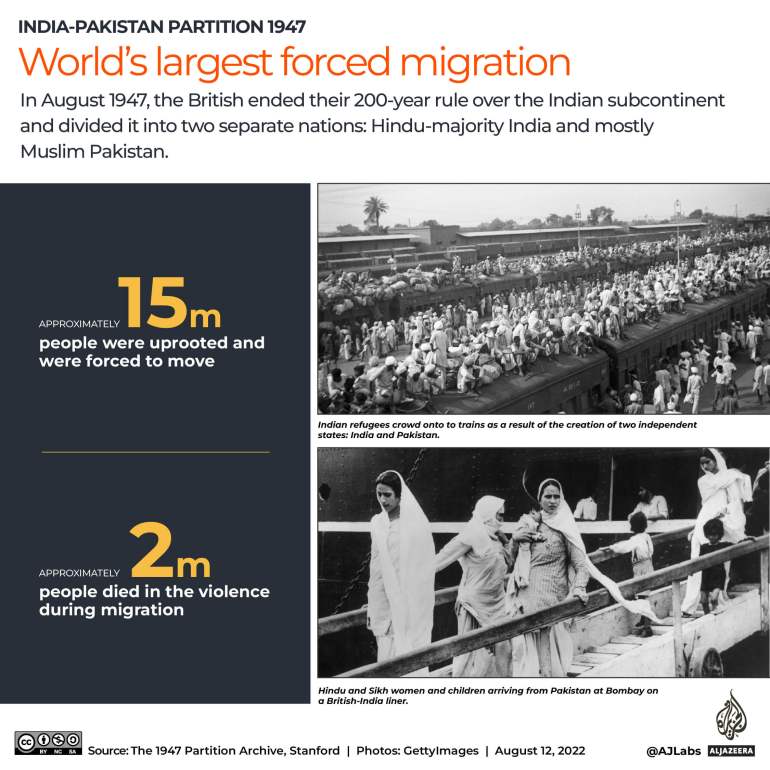
The lines he drew triggered one of the largest forced mass migrations in modern history, with roughly 15 million people displaced and more than two million people killed.

Interactive_Partition_migration3-04
(Al Jazeera)

The boundary between the two nations became known as the Radcliffe Line and was officially announced on August 17, 1947, days after the independence of India and Pakistan.

Radcliffe was asked to base his lines on the population of Muslims and Hindus, in addition to “other factors”. These additional factors were never officially defined but are believed to include economic and communication resources, such as irrigation channels and railway lines.

Toggle through the displayed options on the graphic below and draw lines on the map based on how you think Radcliffe drew the borders.

The information on population, railways and rivers is based on the archived maps from The Imperial Gazetteer of India of 1931.

How India, Pakistan and Bangladesh were formed

The process of partition was not simple. In addition to the British-controlled territories, the subcontinent also consisted of many other territories controlled by the French, Portuguese or Omani rule, as well as more than 500 sovereign princely states ruled by local monarchs.

Privacy Policy

Upon independence, the British gave the princely states the option to join India or Pakistan – by signing the Instrument of Accession – or to remain independent. Some of these territories and princely states did not become part of India or Pakistan until recently.

Today, Kashmir remains the only region of British India that has not been fully integrated into one of the two nations or gained political independence.

In the following two-minute animation, Al Jazeera looks at how the Indian subcontinent was divided by the British in 1947 and how it has changed since.

Source: Al Jazeera


How The Hyperloop One Will Revolutionize Transportation

UNTOUCHABLE TRUMP: James Risen asks if Trump could go down like Al Capone?

 Keep it simpler and easier-to-understand...from The Intercept

While it is possible that the FBI search will not lead to criminal charges against Trump, it is really hard to see how U.S. Attorney General Merrick Garland and the Justice Department would have approved the historic step of an FBI search of a former president’s home without much higher stakes than just a bureaucratic attempt to retrieve missing presidential records. It also seems difficult to believe that the Justice Department would conduct such a politically radioactive search if officials were only considering some slap on the wrist in the case, like the light punishments applied in the past to former CIA Director John Deutch and former national security adviser Sandy Berger.

Clearly, a big question at the heart of the case is what was Trump planning to do with so many highly classified documents after leaving office. When it comes to Trump, it’s hard to go wrong thinking the worst.


Could Trump Go Down Like Al Capone?

Eliot Ness got Al Capone on tax evasion. Merrick Garland may get Donald Trump in a leak investigation.


Al Capone’s murderous gangsterism in Chicago in the 1920s wasn’t stopped by investigating the killings he ordered or the river of rum he sold during Prohibition, but by a patient federal investigation into his failure to pay income taxes on all of his illicit gains.

Donald Trump has yet to face criminal charges for his efforts to incite a violent coup against the United States government. But Monday’s unprecedented FBI search of Trump’s Florida home appears to be part of a criminal investigation into his removal — a better word might be theft — of classified documents after he left the White House.

So instead of being charged as a violent insurrectionist bent on destroying American democracy, Donald Trump may go to jail for a much more mundane reason: He pissed off the nerds at the National Archives, the legal custodians of the missing documents, who then tipped off the Justice Department. . .

✓ READ MORE

The FBI search really is evidence of a leak investigation — perhaps the biggest in history. But in legal terms, the case doesn’t appear that different from the many leak investigations that Trump’s own Justice Department aggressively prosecuted throughout his time in office. In fact, Trump put enormous pressure on the Justice Department to pursue leaks of classified information while he was president, usually related to negative disclosures in the press about him. Many of the people charged in cases involving leaks of classified information during the Trump administration came in connection to disclosures in the press about Trump or Russia, or both. The Intercept reported last year that the Trump administration had referred a record of at least 334 leaks of classified information to the Justice Department for criminal investigation.

In many cases involving leaks to the press, the Justice Department has wielded a century-old draconian law — the Espionage Act — that can potentially put away the leaker for decades. The government often uses the Espionage Act as a threat to intimidate leakers into pleading to lesser charges; the leakers often end up pleading to some charges related to the mishandling of classified information. The New York Times observed Tuesday that one of the laws that would come with lesser charges than the Espionage Act and which would seem to fit Trump’s case is Section 2071 of Title 18 in the U.S. code; under that law, an official who has custodial responsibility for the documents who then “willfully and unlawfully conceals, removes, mutilates, obliterates, falsifies or destroys” the records could face up to three years in prison and could be barred from running for federal office again.

Prosecuting under that statute would not seem to require the government to prove that Trump gave documents to foreign spies, the media, or other unauthorized people.

The FBI search, authorized by a search warrant approved by a federal judge, caught Washington by surprise, but it did not come completely out of the blue. A quiet battle between the National Archives, the Justice Department, and Trump has been underway over the issue since last year

✓ Read more

Techdirt's Over-The-Hump-Day to Finish Off This Week ...Today is another day?

 Today there will be more reports to anticipate

About Techdirt.

Started in 1997 by Floor64 founder Mike Masnick and then growing into a group blogging effort, the Techdirt blog relies on a proven economic framework to analyze and offer insight into news stories about changes in government policy, technology and legal issues that affect companies’ ability to innovate and grow. As the impact of technological innovation on society, civil liberties and consumer rights has grown, Techdirt?s coverage has expanded to include these critical topics.

The dynamic and interactive community of Techdirt readers often comment on the addictive quality of the content on the site, a feeling supported by the blog’s average of ~1 million visitors per month and more than 1.7 million comments on 73,000+ posts. Both Business Week and Forbes have awarded Techdirt Best of the Web thought leader awards.

You can also find Techdirt on Twitter and Facebook.


Elon Musk’s Legal Filings Against Twitter Show How Little He Actually Cares About Free Speech

from the you-have-to-fight-for-free-speech dept

I can’t say for certain how Elon Musk’s thought process works, but his progression in how he talks about free speech over the last few months through this Twitter ordeal certainly provides some hints. When he first announced his intention to buy Twitter, he talked about how important free speech was, and how that was a key reason for why he was looking to take over the company. Here he was talking to TED’s Chris Anderson:

Well, I think it’s really important for there to be an inclusive arena for free speech. Twitter has become the de facto town square, so, it’s really important that people have both the reality and the perception that they’re able to speak freely….

Later in that same conversation, however, as Anderson pushed him a bit on the limits to free speech (including the terrible example of fire and theaters), Musk suggested that countries’ laws should define free speech — or at least the U.S.’s should:

Well, I think, obviously Twitter or any forum is bound by the laws of the country it operates in. So, obviously there are some limitations on free speech in the US. And of course, Twitter would have to abide by those rules.

Which, fair enough, that’s an accurate statement. But it raises questions about when you’re willing to push back against the government for trying to strip free speech rights. And there, Musk got pretty wishy washy, and basically said he’d follow the law anywhere

Consumer Advocates Angry That New Privacy Law Erodes Oversight Of Telecom Monopolies

from the first-do-no-harm dept

We noted the other day how our shiny newly proposed federal privacy bill (as written now) includes a massive gift to US telecom monopolies. It effectively strips away huge swaths of FCC authority over telecom giants, shoveling it over to an FTC that often lacks the resources or expertise to police telecom.

Because “big tech” is all that matters and “big telecom” policy is so very unsexy right now, the press literally couldn’t be bothered to cover this small wrinkle, at all. Well, except for Tonya Riley at Cyberscoop, who spoke to numerous consumer groups who have been raising alarm bells for weeks, noting that the privacy law could actually weaken consumer privacy protection as it pertains to telecom

WhatsApp Again Affirms It Will Not Break Encryption To Appease Government Entities

from the governments-invited-to-go-fuck-themselves dept

The debate over end-to-end encryption continues in the UK. It’s really not much of a debate, though. government officials continue to claim the only way to prevent the spread of child sexual abuse material (CSAM) is by breaking or removing encryption. Companies providing encrypted communications have repeatedly pointed out the obvious: encryption protects all users, even if it makes it more difficult to detect illicit activity by certain users. It’s impossible to break encryption to detect criminal activity without breaking it for every innocent user as well.

Study Shows Anti-Piracy Ads Often Made People Pirate More

from the the-sky-is-not-falling dept

As it turns out, people would download a car.

For decades, Techdirt has highlighted the wide array of incredibly stupid anti-piracy ads the entertainment industry has used to try and steer people away from piracy. Usually these ads were being run at the same time the industry was busy fighting against evolution (providing less expensive, more convenient alternatives piracy) or demonizing new technologies (Home Taping Is Killing Music!).

Would you be shocked to learn that these ads not only didn’t work, they, in some instances, resulted in people pirating content more? That’s the finding of a new paper (hat tip, TorrentFreak and Motherboard) that studied several decades of anti-piracy advertising by the entertainment industry.


Activision Wins Rule 11 Sanctions Over Frivolous ‘COD: Infinite Warfare’ Trial

from the clapback dept

It’s always frustrating when you come across an intellectual property lawsuit that is so laughably frivolous. On the other hand, it’s then quite fun when a court gets things so right that the frivolous filer gets a good wrist-slapping for their trouble. In late 2021, Activision Blizzard was sued by a company called Brooks Entertainment, which argued that the video game Call of Duty: Infinite Warfare contained several instances of trademark and copyright infringement.


✓ 

✓ 


Thursday, August 11, 2022

Bruce Springsteen - Dancing In the Dark (from Born In The U.S.A. Live: L...

EXTREMISM IN THE DEFENSE OF LIBERTY IS A VICE


FBI Standoff Suspect Posted ‘Call to Arms’ on Trump's Truth Social

The suspect has been identified by media as Ricky Walter Shiffer. Social media posts reviewed by VICE News appear to show a man violently angry about the FBI's search of Trump's home.

KH

By Keegan Hamilton

TO

By Tess Owen

August 11, 2022, 4:26pm


Share


Tweet


Snap

Several of the social media posts of the man believed to have attacked an FBI building. ​

SEVERAL OF THE SOCIAL MEDIA POSTS OF THE MAN BELIEVED TO HAVE ATTACKED AN FBI BUILDING.

The gunman who fired at police and engaged in an hours-long standoff in a corn field after trying to enter the FBI’s office in Cincinnati on Thursday has been identified in multiple media reports as someone who was present at the U.S. Capitol during the Jan. 6, 2021 insurrection.


The man also apparently left a trail of posts on Truth Social, the social media platform created by former president Donald Trump, announcing his plans to attack the FBI office and indicating that his actions were a direct response to the FBI’s search Monday of Trump’s Mar-a-Lago club.


The suspect is Ricky Walter Shiffer, according to NBC News and the New York Times, which reported that Shiffer was under investigation for having “ties to extremist groups,” including the Proud Boys, which he apparently mentioned on social media.


The standoff suspect was shot and killed by police on Thursday afternoon, the Ohio State Highway Patrol said, but his identity has not been confirmed.


The 42-year-old Shiffer reportedly posted on Facebook on Jan. 5, 2021, showing him attending a pro-Trump rally at Black Lives Matter Plaza in Washington the night before the Capitol was stormed, according to the Times. 


Image from iOS (23).jpg

A SCREENSHOT OF THE NOW-DELETED TRUTH SOCIAL ACCOUNT.


A Twitter user named Ricky Shiffer also posted about the Proud Boys, the Times found, quoting a message that said: “Save ammunition, get in touch with the Proud Boys and learn how they did it in the Revolutionary War, because submitting to tyranny while lawfully protesting was never the American way.” 


On Truth Social, according to posts reviewed by VICE News before they were deleted from the platform Thursday evening, Shiffer described himself in an account created Aug. 1 as a construction electrician who’d been blocked from other social media platforms.


“If you don’t hear from me, it is true I tried attacking the F.B.I. and it’ll mean either I was taken off the internet, the F.B.I. got me, or they sent the regular cops,” Shiffer wrote Thursday morning.


Two days ago, after the Mar-a-Lago search, Shiffer posted, “People this is it. I hope a call to arms comes from someone better qualified, but if not, this is your call to arms from me. Leave work tomorrow as soon as the gun shop/ Army-Navy store/ pawn shop opens, get whatever you need to be ready for combat. We must not tolerate this one. They have been conditioning us to accept tyranny and we must respond with force.”


Shiffer then added: “If you know of any protests or attacks, please post here.”


In another post on Truth Social from two days ago, Shiffer wrote about Trump, saying he expected the former president to “call for peace.” 


“Donald Trump was my hero just a year ago but we must not continue to lay down and take this,” Shiffer wrote. “If he does not call for peace, it is probably because he fears for the lives of his grandchildren and young children. It is a dark situation for that family, but millions of other kids are in danger until we show the enemy how Americans do it.”


In a conversation with another Truth Social user, Shiffer wrote, “Don’t forget how Americans handle tyrants.”


Shiffer’s presence on Truth Social was first spotted by extremism researcher Travis View.


Spokespeople for Trump and Truth Social did not immediately respond to a request for comment.


Image from iOS (10).png

SCREENSHOTS OF THE NOW-DELETED TRUTH SOCIAL ACCOUNT.


Shiffer also reportedly posted on Twitter in response to a photo of rioters at the Capitol: “I was there. We watched as your goons did that,” with the “goons” apparently referencing police.


While it does not appear that Shiffer faced any criminal charges connected to the attempted insurrection, his presence at the Capitol may help explain his confrontation with law enforcement on Thursday.


The FBI said a suspect “attempted to breach the Visitor Screening Facility” at its office in Cincinnati, reportedly firing a nail gun before fleeing the scene in a white Ford Crown Victoria. The Ohio State Highway Patrol said they tried to pull the suspect over on a nearby freeway, but he fired shots at them and then fled his vehicle to hide in a corn field. The man was reportedly wearing body armor and armed with an AR-15-style rifle.


News

Rudy Giuliani Promises Revenge Raid of Biden’s House If Trump Wins in 2024

CAMERON JOSEPH

08.11.22


The stand-off ended late in the afternoon, according to the Clinton County Emergency Management Agency, which posted a message on Facebook at 4:25 p.m. saying, “law enforcement operations and response has ended.”


A spokesperson for the Ohio State Highway Patrol said earlier Thursday no law enforcement officers were injured.


“Throughout the afternoon troopers and our law enforcement partners attempted to negotiate with the suspect to bring the standoff to a peaceful end,” the Highway Patrol said. “Once negotiations failed, officers attempted to take the suspect into custody by utilizing less lethal tactics. At approximately 3:42 p.m., the suspect raised a firearm and shots were fired by law enforcement officers. The suspect succumbed to fatal injuries on scene.”


The FBI raid at Mar-a-Lago has triggered an angry backlash from Trump’s supporters on the far right, with some threatening the judge who authorized the warrant, and conservative leaders and pundits calling for “civil war.”


Hours after the incident in Cincinnati, Attorney General Merrick Garland said the Justice Department would seek to unseal the Mar-a-Lago search warrant, a move that would shed more light on why the FBI searched Trump’s club.


(Disclosure: Gavin McInnes, who founded the Proud Boys in 2016, was a co-founder of VICE in 1994. He left the company in 2008 and has had no involvement since then.)


TAGGED:

POLITICSCRIMEFBIJANUARY 6CAPITOL RIOTTHE EXTREMISM DESK

GET THE LATEST FROM VICE NEWS IN YOUR INBOX. SIGN UP RIGHT HERE.

Your email address

Your Email:

Subscribe

By signing up, you agree to the Terms of Use and Privacy Policy & to receive electronic communications from Vice Media Group, which may include marketing promotions, advertisements and sponsored content.


MORE

FROM VICE

News

Standoff With Armed Man Who Tried to Breach FBI Building Ends

KEEGAN HAMILTON

08.11.22


News

Democrats Take Aim at Tiny ‘Switches’ That Create Illegal Machine Guns

KEEGAN HAMILTON

07.25.22


News

Cops Who Shot Hmong Man Fleeing Wildfire With Family Won’t Be Charged

KEEGAN HAMILTON

06.27.22


News

A Police Dog Attacked a Black Man After a Traffic Stop. He Lost an Eye.

TRONE DOWD

07.20.22


News

The GOP Could Stop Abortions for Child Migrants Who Are Victims of Rape

KEEGAN HAMILTON

07.06.22


News

The Uvalde Shooting Should Have Been Stopped Within Minutes, Top Boss Admits

KEEGAN HAMILTON

06.21.22


ABOUT

JOBS

PARTNER

VICE VOICES

CONTENT FUNDING ON VICE

SECURITY POLICY

PRIVACY & TERMS

ACCESSIBILITY STATEMENT

© 2022 VICE MEDIA GROUP

MEGADROUGHT

 No denials now

 https://m.youtube.com/watch?v=HfRtAxtIUsA

June 2021


Mark Squillace and Quinn Harper: Hard choices are ahead for the Colorado River

Business as usual will not solve the problem of the shrinking Colorado River.

(Zak Podmore | The Salt Lake Tribune) The sun rises above cracking mudflats deposited just above where the Colorado River meets Lake Powell on April 11, 2022.

(Zak Podmore | The Salt Lake Tribune) The sun rises above cracking mudflats deposited just above where the Colorado River meets Lake Powell on April 11, 2022.

The seven Colorado River states – Arizona, California, Colorado, New Mexico, Nevada, Utah and Wyoming – face a daunting mid-August deadline. The federal government has asked them to come up with a plan to reduce their combined water usage from the Colorado River by up to 4 million acre-feet in 2023.

That is a massive reduction for a river system that currently produces about 12.4 million acre-feet. The Bureau of Reclamation, which manages the Colorado River, warned that it will “act unilaterally to protect the system” if the states cannot come up with an adequate plan on their own.

The seven states have worked cooperatively over the past two decades to identify solutions to a shrinking river. But their response now, much like the global response to climate change, seems far from adequate to the enormous challenge.

In a recent letter to the Bureau of Reclamation, the Upper Colorado River Commission, speaking for the four Upper Basin states, proposed a plan that adopts a business-as-usual, “drought-reduction” approach. They argue that their options are limited because “previous drought response actions are depleting upstream storage by 661,000 feet.”

The commission complains that water users “already suffer chronic shortages under current conditions resulting in uncompensated priority administration, which includes cuts to numerous present perfected rights in each of our states.”

This leads the commission to conclude that any future reductions must come largely from Mexico and the Lower Basin states of Arizona, California and Nevada, because they use most of the water.

But the Lower Basin states have already taken a significant hit to their “present perfected rights,” and if bureau makes good on its promise to act unilaterally, they will face another big reduction. The cooperative relationship among the states will not endure if the Upper Basin refuses to share the burden by reducing its consumption.

A good place to start might lie with two Colorado projects to divert water from the Colorado River basin to the Front Range. Both began construction this summer. The Gross Reservoir Expansion Project will triple the size of one of Denver Water’s major storage units. Denver Water’s original justification for this project – to serve Denver’s growing urban population – seems odd given that water demand in their service area over the past two decades has shrunk, even as its population rose by nearly 300,000.

Similar questions have been raised with the Northern Colorado Water Conservancy District’s Windy Gap Firming Project, which plans to store Colorado River water to support population growth in Front Range cities.

These two projects suggest that Colorado is prepared to exacerbate the current crisis when the opposite response is so desperately needed.

Abandoning these two projects would signal that Colorado is serious about giving the Colorado River a fighting chance at survival. It might also jump-start good-faith negotiations over how Mexico, the states, and tribes might work to achieve a long-term solution to this crisis.

The homestead laws of the 19th century attracted a resilient group of farmers to the West who cleverly designed water laws to secure their water rights against all future water users. “First in time, first in right” became the governing mantra of water allocation, because, except for Tribal Nations, the farmers were first.

That system worked well for many years. As communities grew, cities and water districts built reservoirs to store the spring runoff, ensuring that water was available throughout the irrigation season.

Climate change and mega-droughts have upended that system. Nowhere have the consequences been as dire as in the Colorado River Basin. America’s two largest reservoirs, Lake Powell and Lake Mead – key components of the Colorado River’s water storage system – have not filled for more than two decades. They now sit well below 30% of their capacity.

Hotter temperatures, less mountain snowpack and dry soils that soak up runoff like a sponge have brought us to this seven-state crisis. All seven states must now share the pain of addressing this crisis.

The Upper Basin Commission’s anemic response to the Bureau of Reclamation’s plea is not a serious plan. We can do better and we must.

Mark Squillace |Writers on the Range

Mark Squillace is the Raphael J. Moses professor of natural resources law at the University of Colorado Law School.

Quinn Harper | Writers on the Range

Quinn Harper is a graduate student pursuing a master’s degree in natural resource policy at the University of Colorado, Boulder.

Both are contributors to Writers on the Range, writersontherange.org, an independent nonprofit dedicated to spurring lively conversation about the West.

https://www.circleofblue.org/2022/world/speaking-of-water-curtis-riganti/