Wednesday, September 07, 2022

All-In-One Hump Day: Bleeping Computer Wednesday 09.07.2022

 Intro: Take the time read...you might be glad you did.


www.bleepingcomputer.com

Second largest U.S. school district LAUSD hit by ransomware

Sergiu Gatlan
7 - 9 minutes

Los Angeles Unified

"Los Angeles Unified (LAUSD), the second largest school district in the U.S., disclosed that a ransomware attack hit its Information Technology (IT) systems over the weekend.

LAUSD enrolls more than 640,000 students, spanning from kindergarten through 12th grade. It includes Los Angeles and 31 smaller municipalities, as well as several Los Angeles County unincorporated sections.

The school district first revealed districtwide technical issues after discovering that the attackers disrupted access to LAUSD systems, including email servers.

Roughly seven hours later, it confirmed that this was a ransomware attack, tagging the incident as "criminal in nature."

LAUSD has reported the incident and is working with law enforcement and federal agencies (the FBI and CISA) as part of an ongoing investigation and incident response. 

"After the District contacted officials over the holiday weekend, the White House brought together the Department of Education, the Federal Bureau of Investigation (FBI) and the Department of Homeland Security's Cybersecurity and Infrastructure Security Agency (CISA) to provide rapid, incident response support to Los Angeles Unified, building on the immediate support by local law enforcement agencies," the district said.

"At the District's request, agencies marshaled significant resources to assess, protect and advise Los Angeles Unified's response, as well as future planned mitigation protocols." 

— Los Angeles Unified (@LASchools) September 6, 2022

Even though the attack disrupted LAUSD infrastructure, the district says schools will still open today while it works to restore impacted servers, with some expected delays affecting some services.

"While we do not expect major technical issues that will prevent Los Angeles Unified from providing instruction and transportation, food or Beyond the Bell services, business operations may be delayed or modified," LAUSD added.

"Based on a preliminary analysis of critical business systems, employee healthcare and payroll are not impacted, nor has the cyber incident impacted safety and emergency mechanisms in place at schools."

The district added that instruction and staffing, as well as payroll processing, were undisrupted by this incident. 

In November, the U.S. Department of Education and the Department of Homeland Security (DHS) were urged to strengthen cybersecurity protections at K-12 schools nationwide to keep up with a massive and ongoing wave of attacks.

The call for action came from U.S. Senators Maggie Hassan, Kyrsten Sinema, Jacky Rosen, and Chris Van Hollen after a Government Accountability Office (GAO) report assessing the Education Dept's current plan for addressing K-12 school threats (issued in 2010) to be significantly outdated and focusing on mitigating physical threats.

According to Emsisoft threat analyst Brett Callow, ransomware attacks have disrupted education at approximately 1,000 universities, colleges, and schools during 2021.

This number was lower than in 2020 (when 1,681 education institutions were affected), mainly because last year's ransomware attacks have hit smaller school districts." 

Related Articles:

FBI warns of Vice Society ransomware attacks on school districts

Ransomware gang's Cobalt Strike servers DDoSed with anti-Russia messages

Albania blames Iran for July cyberattack, severs diplomatic ties

Quantum ransomware attack disrupts govt agency in Dominican Republic

QNAP patches zero-day used in new Deadbolt ransomware attacks

THE EARLIEST FIRST UP 

  • Google says former Conti ransomware members now attack Ukraine

    Google says some former Conti cybercrime gang members, now part of a threat group tracked as UAC-0098, are targeting Ukrainian organizations and European non-governmental organizations (NGOs).

  •  

  • Albania blames Iran for July cyberattack, severs diplomatic ties

    Albanian Prime Minister Edi Rama announced on Wednesday that the entire staff of the Embassy of the Islamic Republic of Iran was asked to leave within 24 hours.

  •  

  • Ransomware gang's Cobalt Strike servers DDoSed with anti-Russia messages

    Someone is flooding Cobalt Strike servers operated by former members of the Conti ransomware gang with anti-Russian messages to disrupt their activity.

  •  

  • New Iranian hacking group APT42 deploys custom Android spyware

    A new Iranian state-sponsored hacking group known as APT42 has been discovered using a custom Android malware to spy on targets of interest.

  •  

  • 200,000 North Face accounts hacked in credential stuffing attack

    Outdoor apparel brand 'The North Face' was targeted in a large-scale credential stuffing attack that has resulted in the hacking of 194,905 accounts on the thenorthface.com website.

  •  

  • Ukraine dismantles more bot farms spreading Russian disinformation

    The Cyber Department of the Ukrainian Security Service (SSU) dismantled two more bot farms that spread Russian disinformation on social networks and messaging platforms via thousands of fake accounts.

  •  

  • Cisco won’t fix authentication bypass zero-day in EoL routers

    Cisco says that a new authentication bypass flaw affecting multiple small business VPN routers will not be patched because the devices have reached end-of-life (EoL).

  •  

  • HP fixes severe bug in pre-installed Support Assistant tool

    HP issued a security advisory alerting users about a newly discovered vulnerability in HP Support Assistant, a software tool that comes pre-installed on all HP laptops and desktop computers, including the Omen sub-brand.

  •  

  • Prepare for your IT certifications with this $20 practice bundle deal

    The IT field is expanding, and getting certified can be your next step toward a lucrative career. You can prepare for certification with the 2022 CompTIA & AWS Practice Exam E-Book Bundle, on sale today for $19.99.

    • BleepingComputer Deals
    • September 07, 2022
    • 02:07 PM
    • Comment 0

  • ICYMI: Who's feeling food insecure & Rising Costs of Living??


    des.az.gov

    Arizona Commodity Senior Food Program (CSFP)

    4 - 5 minutes

    older woman eating salad; older couple smiling at each other; a tray holding a bowl of oatmeal, a cup of coffee, an apple and a pastry

    The Commodity Senior Food Program (CSFP) works to improve the health of low-income persons who are at least 60 years of age by supplementing their diets with a monthly package of nutritious food at no cost. CSFP foods are purchased by the state from United States Department of Agriculture (USDA) Food and Nutrition Service (FNS) division.


    The Commodity Senior Food Program is also known as the “Commodity Supplemental Food Program” and “Food Plus”.

    Food Packages

    CSFP food packages do not provide a complete diet but are good sources of the nutrients typically lacking in the diets of participants. Packages include a variety of foods, such as nonfat dry and ultra high-temperature fluid milk, juice, farina, oats, ready-to-eat cereal, rice, pasta, peanut butter, dry beans, canned meat, poultry or fish, canned fruits and vegetables.


    Participation

    Participation in this program is limited, therefore new applicants may be put on a wait list.

    Active participants are eligible to receive a CSFP package once a month during their certification period. A certification period is 12 months. Before the end of the 12 months, a participant can reapply.


    For more information about CSFP, please visit www.fns.usda.gov/csfp

    To be eligible for CSFP, a person must reside in Arizona, be at least 60 years old, and have a total household income that does not exceed 130% of the federal poverty level. (See following table.)

    CSFP (130% FPL)

    Household Size Annual Monthly Twice Monthly Bi-Weekly Weekly
    1 $17,667 $1,473 $736 $680 $340
    2 $23,803 $1,984 $992 $916 $458
    3 $29,939 $2,495 $1,247 $1,152 $576
    4 $36,075 $3,007 $1,503 $1,388 $694
    5 $42,211 $3,518 $1,759 $1,624 $812
    6 $48,347 $4,029 $2,014 $1,860 $930
    7 $54,483 $4,541 $2,270 $2,096 $1,048
    8 $60,619 $5,052 $2,526 $2,332 $1,166
    For each additional person: Add $6136 Add $512 Add $256 Add $236 Add $118

    Example: To qualify for CSFP, the gross income of a household containing 2 people cannot exceed $23,803 per year.

    Applications are usually completed at the Distribution Site by speaking to a worker who puts a participant’s information into a computer. The information is recorded as a requirement of the program and kept confidential.

    Please read below to find your local site, items to bring and what to expect when you get there.

    1. Find Your CSFP Package Distribution Site

      Find CSFP locations

    2. Documents to Bring

      Please bring a valid ID that shows you are at least 60 years old.

      If your photo ID does not reflect your current address, please also bring a document such as a utility bill, lease agreement or a letter from an official Arizona agency that shows your current address.

      If you are homebound, please call your local Distribution Site for directions on alternative ways to apply for the program, and to inquire if home-delivery is offered.

    3. Application Process

      When you get to the site, you will be asked to provide information including your name, address, phone number, date of birth and household size (number of people living in your home with you).

      You will also be asked to confirm that you meet the current income eligibility, you will not sell, trade, barter or exchange CSFP food for services, and that you live in the geographic area served by the site.

      Note: Participation in this program is limited, therefore you may be put on a wait list.

    Arizona has several locations state-wide that provide CSFP food packages to eligible persons in need. Click the link below to find food assistance and other community services in your area.

    Find CSFP locations 


    www.cbpp.org

    Families Wait Years for Housing Vouchers Due to Inadequate Funding | Center on Budget and Policy Priorities

    | By Sonya Acosta and Erik Gartland
    23 - 29 minutes

    Due to limited program funding, families struggling to afford housing that manage to get off the waiting list for a Housing Choice Voucher must typically wait for years before receiving a voucher, CBPP analysis of Department of Housing and Urban Development (HUD) data shows. Among the 50 largest housing agencies, only two have average wait times of under a year for families that have made it off of the waiting list; the longest have average wait times of up to eight years. On average nationally, families that received vouchers had spent close to two and a half years on waitlists first, exposing many to homelessness, overcrowding, eviction, and other hardship while they wait. (See the Appendix for data on average wait times by state and among the largest agencies.)

    Moreover, these figures understate the unmet need for assistance. Millions of other families eligible for rental assistance never receive it because their names never rise to the top of the waiting list or they live in communities where the housing agency has closed or doesn’t keep a waiting list. Also, because of insufficient funding, local housing agencies often prioritize specific groups for available vouchers such as veterans, working families, or people fleeing domestic violence or experiencing homelessness. Setting priorities in the face of limited funding makes sense, but it means that families that need help paying for housing but fall outside the priority groups may never get assistance. For all of these reasons, an agency’s average wait for people receiving vouchers does not reflect the average wait for someone who puts their names on a waiting list for one.

    Significantly expanding the federally funded voucher program would help more people access rental assistance when they first need it instead of facing years of hardship. Significantly expanding the federally funded voucher program, which helps households with low incomes rent a modest unit of their choice in the private market, would help more people access rental assistance when they first need it instead of facing years of hardship. A top priority for policymakers in the upcoming recovery package should be to provide substantial, multi-year funding for new housing vouchers.

    The state and local housing agencies that administer the voucher program use virtually all the voucher assistance funds they receive, but a shortage of resources for rental assistance leaves the vast majority of eligible households without aid...

    READ MORE 

    √ (Of the $15.7 million in new funding, about $1.6 million will be used for “program administration,” including the potential hiring of temporary workers to speed up the process, Giese said.)

    www.eastvalleytribune.com

    City to provide $14M in rent, utility assistance

    Tom Scanlon, Tribune Managing Editor
    6 - 7 minutes

    With hundreds behind on rent and utilities, Mesa is moving quickly to pump out new funding assistance.

    In 2020, the Mesa CARES program funneled federal money to provide 1,781 families with nearly $7 million in rent assistance. The average payment per household was $3,875. 

    But the program ran out of funding in early December, leaving 2,000 on a waiting list just when COVID-19 started a holiday surge.

    Similar to the vaccine shots that boost a body’s defense, the city just received $15.7 million in booster funding - and this week started getting residents caught up on essential bills.

    “Checks have begun to be distributed,” Deputy City Manager Natalie Lewis said. By Thursday, three days into the program, 38 payments were made, with an average payment to landlords or utility providers of $6,000, Lewis said.

    In 2020, Mesa received $132 million in federal funds to combat the economic fallout from the pandemic. Various programs provided meals, grants to struggling businesses and rent and utility relief.

    “We have new funding,” Ruth Giese, Mesa’s Community Services director, told Mesa City Council at a Feb. 4, study session..


    The Desert People Who Built A U.S. City ...OK and then what happened?

     Intro: Readers of this blog might like to visit the Arizona Museum of Natural History here in downtown Mesa. . .go indoors to escape toxic ozone pollution


    BLOGGER NOTE: Phoenix & Maricopa County have some of the WORST Air Quality in the entire nation


    -

    www.bbc.com

    The watery secret of ancient North America

    Keridwen Cornelius
    10 - 12 minutes

    The watery secret of ancient North America 


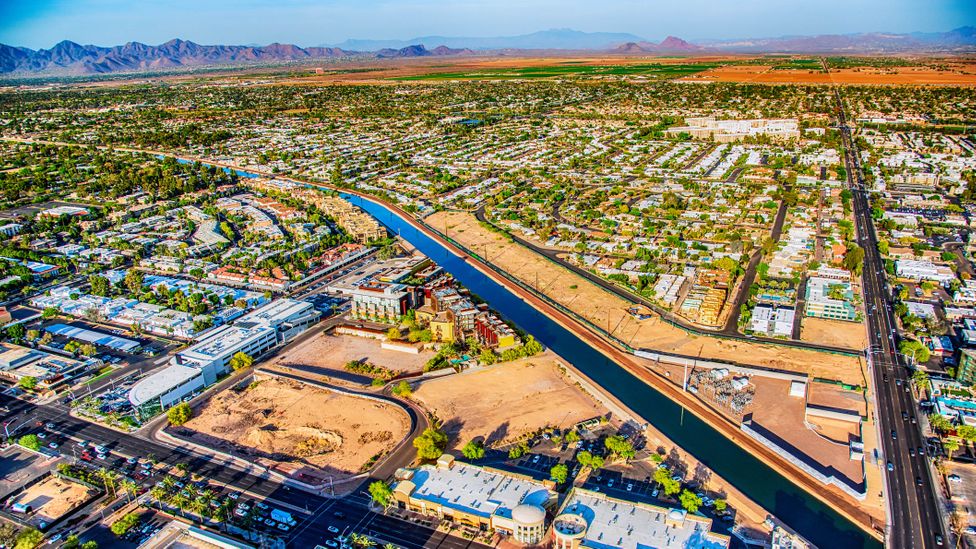
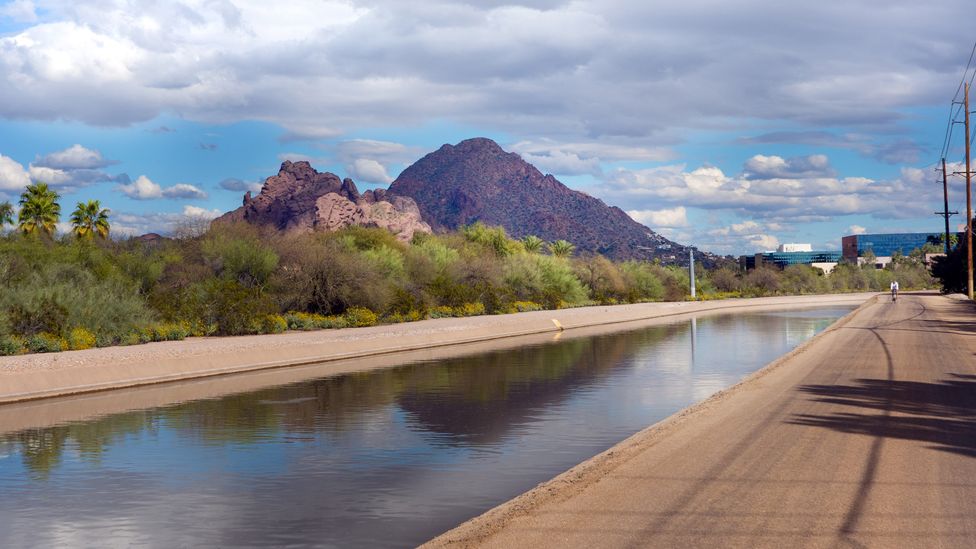
    Crisscrossing Phoenix, Arizona, are 180 miles of canals – more than twice as many as Venice and Amsterdam combined. As a native Phoenician, I've spent many hours bicycling their banks alongside joggers and fishermen casting for carp. I've joined wildlife watchers strolling the main Arizona Canal on a summer evening to watch Mexican free-tailed bats make a mass fluttering exodus from their roost. And I've chatted with long-time residents who fondly recall fashioning water skis from plywood, tying a tow rope to a pickup truck and jetting through their neighbourhoods in a spray of water and dust.

    The canals deliver irrigation and drinking water throughout the metro area, allowing millions of people to live in this sun-baked desert. They are a major reason Phoenix exists, and the city's name hints at their mysterious origins.


    In 1867, the city's founding father, Jack Swilling – a prospector who had fought on both sides of the Civil War – stood above the Salt River Valley and saw the remnants of irrigation channels squiggling across the landscape like stretchmarks. He realised that, centuries before, some society had farmed this desert. Soon after, Swilling began scouring out the debris-clogged ditches to bring agriculture back to the region.


    Three years later, Swilling and other Anglo pioneers met to consider names for their settlement. The top contenders were Pumpkinville and Stonewall. Luckily, eccentric English adventurer "Lord" Darrell Duppa proposed a name inspired by the resurrection of the canals. "A great race once dwelt here, and another great race will dwell here in the future," he mused. "I prophesy that a new city will spring, phoenix-like, from the ruins and ashes of the old."

    The canals that criss-cross Phoenix allow millions of people to live in the sun-baked desert (Credit: Art Wager/Getty Images)

    The canals that criss-cross Phoenix allow millions of people to live in the sun-baked desert (Credit: Art Wager/Getty Images)


    That great society was the Hohokam. Between 100 and 1450 CE, they constructed 1,000 miles of canals – the largest system of waterways in the Americas north of Peru. This sophisticated irrigation system harnessed river water and a meagre seven inches of annual rainfall and funnelled it to more than 100,000 acres of farmland. And they dug it all by hand with stones and sticks.


    "The engineering is phenomenal," said Kathy Henderson, principal investigator at Desert Archaeology, an Arizona-based cultural resources management and research company. "We don't see a sequence where they start small. The canals are being built to scale as early as 500 or 600 [CE]. They must have been very attuned to how to transport water a long distance."


    For Gary Huckleberry, a geologist and adjunct researcher at the University of Arizona, the water-wise Hohokam and their ancestors are still relevant today. "In the Southwest, we have some serious issues to deal with in terms of water," he said. "The Colorado River is the main source of water for the Southwest, and it's over allocated. You've got population growth and climate change. How are we going to deal with that? I think there's something to be learned by looking at past societies who managed water for thousands of years."

    Many of the city's modern canals were constructed by retracing the Hohokam's handiwork (Credit: Salt River Project)

    Many of the city's modern canals were constructed by retracing the Hohokam's handiwork (Credit: Salt River Project)

    Native Americans have been building canals in Arizona for at least 3,500 years. The oldest waterways archaeologists have found date to 1500 BCE and diverted water from the Santa Cruz River in Tucson. Through trial and error, these ancient river people accumulated knowledge that was passed down from generation to generation, Huckleberry notes. "So, by the time you get to the Hohokam, they were skilled hydraulic engineers."


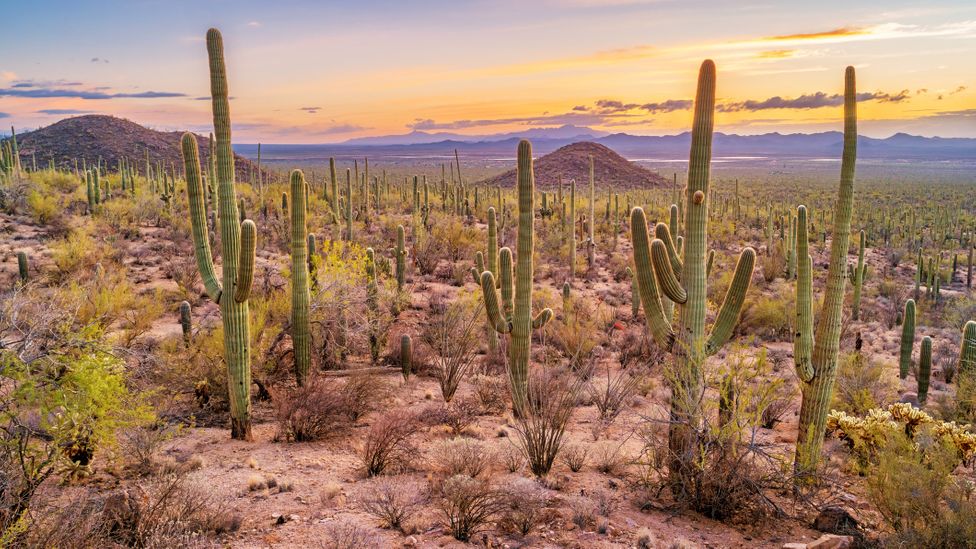
    Today, the dammed Salt River is mostly dry in Phoenix. But visit the north-eastern outskirts of the city – where kayakers paddle the Salt past sienna mountains, cottonwoods and wild horses splashing along the shore – and you can sense the possibilities that greeted the Hohokam when they migrated here from southern Arizona. The Sonoran Desert is the world's most biodiverse desert. It provided ample plants and animals, in addition to the Hohokam's staple crops of maize, squash, beans and cotton.

    Because the Hohokam had no draft animals, they carved the canals by hand using hafted stone hoes. With these simple tools, they created a precise downhill gradient of 0.3 to 0.5m every 1.6km. At the heart of the system, the Salt River, the channels started out large – more than 25m wide in some places. Then they slimmed as they branched into lateral canals and furrows, like watery arteries and capillaries writ large. These design features helped keep the flow at a consistent rate while minimising siltation and erosion.


    As the Hohokam expanded their network, they had to contend with the area's complex topography. Multiple mountain ranges tower around and through metro Phoenix, making it, to my mind, the best big city in the world for hiking. But it's a challenge for hydraulic engineers, especially since epic summer monsoons dump rain that rushes along rock-hard surfaces. Floods would have regularly broken through headgates and filled channels with sediment, which meant the Hohokam constantly repaired, cleaned and diverted the canals. This necessitated a highly coordinated society.

    The Hohokam were desert farmers, whose sophisticated irrigation system harnessed river water to bring agriculture to the region (Credit: Benedek/Getty Images)

    The Hohokam were desert farmers, whose sophisticated irrigation system harnessed river water to bring agriculture to the region (Credit: Benedek/Getty Images)

    "It requires cooperation, because all the users of the water from that canal have to agree not only to construct it, but also to maintain it," Henderson said. "An alliance of users would have to agree to certain conditions to keep the entire system going."


    For example, she explained, not all farmers could open the gates to their fields at the same time, because some people further down the line wouldn't get any water. So, the Hohokam committed to sharing water and put themselves on timetables. "This led to the development of water rights," she added.

    By the 13th Century, as many as 50,000 Hohokam people lived in villages that were regularly spaced along the canal system. This suggests to archaeologists that water and irrigation land was distributed fairly equitably amongst the community.


    Over the centuries, the canal system was reorganised numerous times, but its essential structure remained the same. However, after 1300, the society and the canals began to diminish, and by 1450 the population had plunged. 

    No one knows why. Climate may have played a role, but there's no evidence of especially intense climatic events at the time. And though some irrigation-based cultures have faced salinisation of their soils, evidence indicates the Hohokam managed salt build-up well. While archaeologists once believed the Hohokam population collapsed following a catastrophe, improved techniques now point to a very gradual decline resulting from a complicated combination of community coalescence, flooding, siltation, reduced wild food resources and conflict.

    The Grand Canal is getting spruced up as part of a project to connect Phoenix's east and west suburbs in a continuous multi-use trail (Credit: BCFC/Getty Images)

    The Grand Canal is getting spruced up as part of a project to connect Phoenix's east and west suburbs in a continuous multi-use trail (Credit: BCFC/Getty Images)

    Still, Huckleberry says, there's much to learn from the Hohokam and their ancestors, who utilised canal irrigation for 3,000 years. "That, to me, is the definition of sustainable," he said. "They learned how to sustainably farm, to manage water, to not destroy their soils in a way that is commendable and might give us insight into how we might deal with the current plight. I think one of the key lessons is that you don't put all your eggs in one basket; you plan for the worst, and you diversify your strategies."

    The Hohokam may have stopped managing their canal system, but they did not disappear. Their story continues with their descendants, the Akimel O'odham ("River People") and Tohono O'odham ("Desert People"), who live in central and southern Arizona today.


    Their legacy also lives on in the city's modern canals, many of which were constructed by retracing the Hohokam's handiwork. The Grand Canal is now getting spruced up as part of a project to connect Phoenix's east and west suburbs in a continuous multi-use trail. "Today we are integrating the canals into our communities to improve neighbourhood access, add new public art spaces and contribute to a healthier Phoenix by introducing them as a recreational amenity," announced Phoenix Mayor Kate Gallego in 2020.

    The Hohokam's heritage is also preserved in one of their villages, Pueblo Grande, a museum and archaeological park where visitors can see ballcourts, a platform mound (ceremonial house) and re-created adobe houses. Hikers can search for Hohokam petroglyphs of coyotes, mountain sheep and spirals along the trails of South Mountain Preserve and Deer Valley Petroglyph Preserve. And travellers can use the A Deeper Map app to swipe right on a modern map of Phoenix and reveal the Hohokam innovations hidden beneath their feet.

    But perhaps one of the Hohokam's most important legacies is less tangible: the idea that it's possible – through cooperation, commitment and shared knowledge – to live sustainably in this sun-baked desert."

    Ancient Engineering Marvels is a BBC Travel series that takes inspiration from unique architectural ideas or ingenious constructions built by past civilisations and cultures across the planet.

    Relief is on the way... but it's not retroactive

     Relief on one of the key components? NO LINK PROVIDED To get an application..


    www.mesanow.org

    Mesa Offers Limited Income Senior Rate Program

    2 minutes


    The City of Mesa's Limited Income Senior Rate Program (LISR) is a residential utility assistance program that provides a 30 percent discount on the water service rate, one of the key water rate components on a customer's bill. For the most common type of water service, the discount reduces the fixed monthly charge from $29.23 per month to $20.46 per month. That is an $8.77 monthly savings! The program does not change any other water rate component.

    "The Limited Income Senior Rate Program is a very effective and easy way to provide a significant discount to some of our senior residents in Mesa who face financial challenges," said Ed Quedens, City of Mesa Business Services Department Director.

    An applicant must be at least 60 years of age, the utility account holder, a permanent full-time resident at the service address and have a limited income that is 200% of the federal poverty level. If a customer qualifies, they won't need to reapply or requalify for five years.

    The LISR application is easy to download and includes the income qualifications. The new rate will be applied to the account if qualified and approved. The discount rate is not retroactive. 

    __________________________________________________________________________________________

    INSERT 


    View water results by state. U.S. Map. SELECT YOUR STATE.
    This program is a residential utility assistance program that provides a 30% discount on the Water. Service Rate, one of the water rate components on a ...


    Zelensky Calls for a European Army as He Slams EU Leaders’ Response

          Jan 23, 2026 During the EU Summit yesterday, the EU leaders ...