Tuesday, September 13, 2022

WORST WALL STREET DAY IN MORE THAN 2 YEARS!

 WHOA! 


Top stories

✓The Dow Jones Industrial Average sank nearly 4%, the S&P 500 dropped 4.3%, and the Nasdaq plunged more than 5%.

✓It marked the steepest day of declines since June 2020.


The Fed is widely expected to announce another large increase this month, a move analysts said was all but confirmed by latest report. But big rate increases also raise the risk of recession as the economy slows.

"Investors should brace themselves for even higher rates than they anticipated before today's release," said Ronald Temple, managing director, co-head of multi-asset and head of US equity at Lazard Asset Management.


"Despite the sharpest tightening of monetary policy in decades, the Fed still has more heavy lifting ahead."

www.bbc.com

US markets sink on unexpectedly high inflation

BBC News
5 - 6 minutes

Inflation in the US remained unexpectedly high last month, news that drove Wall Street to its worst day in more than two years.

The annual inflation rate, the pace at which prices rise, slipped to 8.3% in August, the Labor Department said.

That was down from 8.5% in July, driven by lower petrol costs.

But the costs of food, housing and medical care continued to surge, disappointing investors hoping for more widespread easing.


The Dow Jones Industrial Average sank nearly 4%, the S&P 500 dropped 4.3%, and the Nasdaq plunged more than 5%.

It marked the steepest day of declines since June 2020.

For US President Joe Biden, whose approval ratings fell below 40% earlier this year amid cost of living concerns, the report was also a troubling sign ahead of the national elections in November. They will determine whether Mr Biden's Democrats maintain their slim control of Congress.

While Mr Biden's ratings have recovered slightly in recent weeks as petrol prices have subsided, the issue remains "a huge problem", said pollster Chris Jackson.

For a president with approval ratings like Mr Biden's to see his party pick up seats in the mid-terms would be unprecedented, he added.

"Americans have been telling us for months now that it's the number one concern they have and, rightly or wrongly, they blame whoever's running the country for that," said Mr Jackson, senior vice president at the Ipsos polling firm.

Inflation in the US peaked at 9.1% in June, the fastest increase seen since the early 1980s. It fell to 8.5% in July, as petrol prices fell, easing again last month.

In a statement on Tuesday, Mr Biden focused on the improvement, saying: "Overall, prices have been essentially flat in our country these last two months: that is welcome news for American families, with more work still to do."

But money worries remain at the forefront of many consumers' minds..."


RELATED 


Stage Analysis Members Weekend Video – 11 September 2022 (1hr 34mins)

The weekend video begins with a detailed look at some of the weeks strong volume Stage 2 movers weekly charts and some interesting Stage 1 stocks too. Then an update on the major indexes developing Stage 1 base structures. What's moving in the US Industry Groups Relative Strength Rankings and the IBD Industry Groups Bell Curve – Bullish Percent...
Read More

Hizzoner Mesa Mayor John Giles (+ Rusty Bowers) scheduled for 2nd National Nonpartisan Conversation on Voter Rights

What have we here? Not one - but two mayors - from the State of Arizona for a so-called  "Non-Partisan" event in the hotly-contested border State of Texas

2 Conservative Republican Brethren are selected, invited and chosen from Mesa, Arizona where a latter day 7-generations-old Political Machine has controlled everything for more than 140 years. John Giles is the 40th mostly all-vanilla male  to occupy the Mayor's office since 1878 while the first Hispanic ever elected to the Mesa City Council never happened until 2012

. . . and the Mayor of Tucson from southern Arizona too!  

BTW does the City of Mesa have a great record for citizen engagement or public participation in government????


Mayoral Host Committee

j

THE HONORABLE

Sylvester
Turner

Houston, Texas

THE HONORABLE

Acquanetta
Warren

Fontana, California

THE HONORABLE

John
Giles

Mesa, Arizona


THE HONORABLE

Regina
Romero

Tucson, Arizona

THE HONORABLE

david
holt

Oklahoma City, Oklahoma

JJ

THE HONORABLE

Michael B.
Hancock

Denver, Colorado

It is our privilege to invite you to the 2nd National Nonpartisan Conversation on Voter Rights on September 19-21 in Houston, Texas. As a group of bipartisan mayors, we firmly believe it is incumbent upon us to continue the conversation that was started last year in Denver with stakeholders that include local elected officials, business leaders, and community activists on strategies to protect, defend, and promote voter rights education. As you know, in real time, we are witnessing the cornerstone of democracy—the right to vote—being challenged and access to free and fair elections being impeded by some of the most restrictive partisan legislation and efforts witnessed in decades.

Together, however, we are confident that our efforts and your participation in policy discussions, action plans, and strategic partnerships will help save our democracy by empowering, engaging, and educating voters. The Mayoral Host Committee and staff have been working diligently to plan a conversation that is impactful and edifying.  

We appreciate your consideration and would be honored by your presence 

YouTube Insert


www.houstontx.gov

Mayor Sylvester Turner Announces the National Nonpartisan Conversation on Voter Rights

4 - 5 minutes

Mayor's Office Press Release

Mayor Sylvester Turner Announces the National Nonpartisan Conversation on Voter Rights
Two–Day Event will Take Place in Houston, Texas

Voter Rights Conversation Logo

September 12, 2022 -- Houston Mayor Sylvester Turner will host the National Nonpartisan Conversation on Voter Rights alongside five leading mayors from across the country, including Michael Hancock (Denver, CO), Acquanetta Warren (Fontana, CA), David Holt (Oklahoma City, OK), Regina Romero (Tucson, AZ), and John Giles (Mesa, AZ).

The invitation-only event will take place from September 19-21, 2022, at the Hilton Americas Hotel in Houston.

This convening of invited elected officials, business leaders, community activists, and grassroots organizations will focus on strategies to protect, defend, and promote voter rights and access to the ballot box while equipping local leaders with tools to increase civic engagement in their communities.

The National Nonpartisan Conversation on Voter Rights will begin with opening remarks and a plenary session followed by a news conference.

The two-day conversation will feature prominent speakers and panelists, including Justin Levitt, White House Senior Policy Advisor for Democracy and Voting Rights; Russell “Rusty” Bowers, Arizona House Speaker; Derrick Johnson, President and CEO of the NAACP; Mayor Greg Fischer of Louisville, Kentucky; Annise Parker, President of Victory Fund and former Houston Mayor; Dexter Maryland, Jr., Texas Southern University Student Government Association President; and many others, to discuss redistricting and gerrymandering; historical disenfranchisement; safe, secure and reliable elections and other topics. 


“I am honored to welcome elected leaders, community activists, and other stakeholders to the City of Houston for the National Nonpartisan Conversation on Voter Rights. My fellow mayors are bipartisan champions from across the country, who courageously accepted the invitation to co-host this convening focused on voter education and access, especially among some of our nation’s most disenfranchised the disability, LGBTQ+, and Black and Brown communities,” said Mayor Sylvester Turner. “In Texas, the legislature has passed some of the most restrictive partisan legislation in the nation, making it harder for some individuals to exercise their right to vote. However, this nonpartisan conversation seeks to empower and equip local elected officials and all people with the tools to defend the cornerstone of democracy -- the right to vote.”

WHEN:
Opening Press Conference: Tuesday, September 20, 2022, at 11:30 a.m.

WHERE:
Hilton Americas-Houston
1600 Lamar St.
Houston, TX 77010
*See full schedule of events at Schedule-At-A-Glance - National Nonpartisan Conversation on Voter Rights (nncvr.com)

Media Registration: https://tinyurl.com/NNCVR-MEDIA-REGISTRATION

About the National Nonpartisan Conversation on Voter Rights 
In October 2021, Denver Mayor Michael B. Hancock and Chicago Mayor Lori Lightfoot served as co-chairs of the National Nonpartisan Conversation on Voter Rights (NNCVR).

At this convening, attendees of the NNCVR helped develop a list of 63 actions municipal leaders can implement, which were incorporated into the “Democracies Thrive When Cities Vote” playbook. This year, the conversation will focus on implementing the strategies introduced in the playbook while addressing challenges of access and fair elections due to restrictive partisan legislation.

Additional Resources: 

Democracies Thrive When Cities Vote: Playbook for Nonpartisan Voter Engagement (.pdf)

OUR POLITICAL MOMENT...“There are a bunch of major issues on which there are not both sides,”

Good point but what happened to 'fair-and-balanced' 

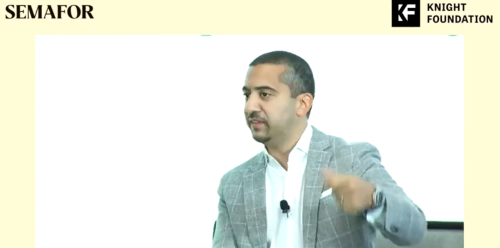
"There are two words we need to remove from our media vocabulary right now and that is ‘both sides,’” Hasan told Semafor’s Ben Smith, a former New York Times reporter, in a video posted on Twitter and YouTube. “This fundamental crutch, this reliance on ‘both sides’ as a kind of lazy way of covering our political moment is deeply dangerous.”

‘Deeply Dangerous’: MSNBC Host Says Media Needs To Stop Covering ‘Both Sides’ Of Issues

‘Deeply Dangerous’: MSNBC Host Says Media Needs To Stop Covering ‘Both Sides’ Of Issues


dailycaller.com

'Deeply Dangerous': MSNBC Host Says Media Needs To Stop Covering 'Both Sides' Of Issues

Harold Hutchison
2 - 3 minutes

MSNBC host Mehdi Hasan called for media outlets to not cover both sides of what he called “major issues” during a Wednesday forum.

“There are two words we need to remove from our media vocabulary right now and that is ‘both sides,’” Hasan told Semafor’s Ben Smith, a former New York Times reporter, in a video posted on Twitter and YouTube. “This fundamental crutch, this reliance on ‘both sides’ as a kind of lazy way of covering our political moment is deeply dangerous.” (RELATED: Liberals, Democrats Praise Biden For Speech Comparing GOP To Fascists)

“There are two words we need to remove from our media vocabulary right now & that is ‘both sides.’ This crutch, this reliance on ‘both sides’ as a kind of lazy way of covering our political moment is deeply dangerous.”

My comments to @semaforben this morning in DC – watch/share: pic.twitter.com/edPKXvAGFL

— Mehdi Hasan (@mehdirhasan) September 7, 2022

“There are a bunch of major issues on which there are not both sides,” Hasan continued. “There are not both sides on climate change. There are not both sides on white supremacy. There are not both sides to democracy. Ben, there are not both sides on the Holocaust.”

Hasan referenced comments by an administrator at the Carroll Independent School District in Southlake, Texas, in October 2021 that said students should learn opposing views about the Holocaust.

“That’s not what the bill says,” Republican State Sen. Bryan Hughes of Texas, who wrote the legislation that required providing contradictory views on controversial issues, told NBC at the time.

“On the big issues of our time, on whether people should be able to vote, on whether they should be able to get to a ballot box, on whether one party should be able to overturn elections, no there are not both sides,” Hasan said.

Content created by The Daily Caller News Foundation is available without charge to any eligible news publisher that can provide a large audience

mehdi hasan , knight foundation vidcon 2022 both sides from www.youtube.com
Duration: 0:51
Posted: 5 days ago

www.rt.com

MSNBC host blasts coverage of ‘both sides’

2 - 3 minutes

"The Holocaust and climate change are issues that do not have ‘another side’ worth reporting, a prominent journalist says

The words “both sides” should be “removed from our media vocabulary,” according to MSNBC host Mehdi Hasan. Some stories only have one view worth reporting, he believes.

Hasan, a British-born political journalist who previously hosted a show on Al Jazeera, made the argument against balanced reporting on certain issues during an event hosted by the Knight Foundation on Wednesday.

He called reliance on ‘both sides’ a “fundamental crutch” and a “lazy way of covering our political moment [that] is deeply dangerous.” There are a number of major issues that don’t have ‘both sides’, he said. Hasan gave as examples the Holocaust, climate change, universal suffrage, and the acceptance of election results by the losing side. 

The journalist also included in the list stories featuring ‘QAnon’ claims that “America is run by a cabal of media pedophiles,” in reference to the shadowy online fringe group known for its devotion to former US President Donald Trump.

However, questions such as “what the corporate tax should” be are “perfectly legitimate” issues for debate, and for a ‘both sides’ approach to coverage, Hasan said.

"There are two words we need to remove from our media vocabulary right now & that is 'both sides.' This crutch, this reliance on 'both sides' as a kind of lazy way of covering our political moment is deeply dangerous."My comments to @semaforben this morning in DC - watch/share: pic.twitter.com/edPKXvAGFL

— Mehdi Hasan (@mehdirhasan) September 7, 2022

He made the remarks during a discussion on political reporting in the US with Ben Smith, the former editor-in-chief of BuzzFeed News and former columnist for the New York Times.

The event was part of a series of conversations between Smith, who is now the editor-in-chief of news startup Semafor, and various media figures. Previous guests include Fox News host Tucker Carlson, John Harris, the founding editor of Politico, and Taylor Lorenz, the controversial technology columnist for the Washington Post and formerly the New York Times."


The Saints Holdings LLC: Expanding Their Kingdom of Deseret & The New Zion

An Eyesore (never explained)

kkk

Financing The Faith

Interesting to say the least:
Financing Faith: The Intersection of Business and Religion
Link > https://churchhistory.ce.byu.edu/ 

March 1–2, 2018   
Co-Chairs
Michael Hubbard MacKay
Brigham Young University
Matthew C. Godfrey
Church History Department
Committee Members
Mary Ann Woodger
Brigham Young University
Elizabeth Kuehn
Church History Department
coins    

In 1958, Leonard J. Arrington published Great Basin Kingdom, a seminal study in Mormon economic history. Arrington followed this work with several other studies pertaining to the economic history of The Church of Jesus Christ of Latter-day Saints and of the State of Utah. Other scholars have examined in detail financial operations of the church in Ohio, Missouri, and Illinois, including explorations of the law of consecration (first revealed to Joseph Smith in 1831) and its implementation, enterprises such as the United Firm and the Kirtland Safety Society, and the economic impact of creating new communities throughout the Great Basin. Picking up where Arrington and others left off, there are new and exciting developments in the study of sex, society, race, and the environment that can enlighten the financial aspects of Mormon history.
The 2018 Church History Symposium will explore the intersection of finance and religion in the LDS Church between 1830 and 1930. In doing so, we hope that scholars will take a fresh look at Mormon history through the vantage point of economics and finance. We hope that this symposium will add to, complicate, or even revise portions of the standard economic history narratives mentioned above, while also exploring other areas of Mormon history through an economic and spiritual lens. To view the full program scheduled March 1-2, click the link below.
2018 Church History Symposium Program
This event is sponsored by the Religious Studies Center at Brigham Young University, BYU Continuing Education,
BYU Church History and Doctrine, the Church History Library, and the Church History Museum.
________________________________________________________________________________
 
FinancingFaith
The Intersection of Business and Religion
CHURCH HISTORY SYMPOSIUM
Thursday, March 1, 2018
Conference Center, Brigham Young University, Provo, Utah
9:00–10:15 a.m.  CONCURRENT SESSIONS 1
SESSION 1A, 2258 CONF Economics in the Twentieth Century Chair: Mary Jane Woodger (Brigham Young University) • A Ministry of Debt Relief: Impact of Lorenzo Snow and Rudger Clawson, 1898–1901 (Glen Soren Larson, Jr., Independent Historian)  • “The Lord’s Way”: Genesis of the Church Security Plan, 1920– 1935 (Joseph F. Darowski, LDS Church History Department) • Philosophical or Financial? Academies or Seminaries and the Making of the Modern Church Educational System (Scott C. Esplin, Brigham Young University)  SESSION 1B, 2260 CONF Mormons in the Big Horn Basin Chair: Christian K. Heimburger (LDS Church History Department) • “Spiritual Salvation Plus Temporal Improvement”: Motivations of the Bighorn Basin Colonists of 1900 (Darcee Barnes, LDS Church History Department)  • How Much Does a Canal Cost? Mormons and Irrigation Projects in Wyoming’s Big Horn Basin (Brent M. Rogers, LDS Church History Department) 
SESSION 1C, 2265 CONF Evaluating Ideas and Economies Chair: Christopher Blythe (LDS Church History Department) • “When Did Mormons Become Capitalists?” (Jed Woodworth, LDS Church History Department) • A Blessing or a Curse: Misappropriating “Blessed” as a Sign of Economic Prosperity in the Early LDS Church, 1830–1844 (Bryce Taylor, Brigham Young University) • “Prospering” in the Land of Promise: The Cultural Significance of a Spiritual Ideal from Mormonism’s “Keystone” (Steven L. Olsen, LDS Church History Department) 
10:30–11:45 a.m.  CONCURRENT SESSIONS 2
SESSION 2A, 2258 CONF Revelations on Church Finance in the Twilight of the Ohio-Missouri Era Chair: Andrea G. Radke-Moss (Brigham Young University–Idaho) • Reconsidering the Salem Revelation and Kirtland’s Financial Narrative, 1836–1838 (Elizabeth A. Kuehn, LDS Church History Department) • Using the Partridge Estate Papers to Reconstruct a Sacred Mormon City (Jeffrey D. Mahas, LDS Church History Department) • Joseph Smith’s Tithing Revelation in Context (Mark AshurstMcGee, LDS Church History Department and David W. Grua, LDS Church History Department)
SESSION 2B, 2265 CONF The Mormon Economy in the 1830s Chair: Kay Darowski (LDS Church History Department) • “For the Express Purpose of Soliciting Donations”: The First Mission of the Twelve in 1835 (Maclane Heward, Claremont Graduate University) • Merchant and Church Agent: Hyrum Smith’s Kirtland and Nauvoo Stores, 1835–44 (Craig K. Manscill, Brigham Young University) • Business Transactions Between Kirtland Firms and New York City Merchants (Sharalyn D. Howcroft, LDS Church History Department)
SESSION 2C, 2260 CONF The Nauvoo Economy Chair: Casey Griffiths (Brigham Young University) • “Our Pecuniary Embarrassments”: Richard M. Young and the Financing of Mormon Redress Efforts, 1839–40 (Spencer W. McBride, LDS Church History Department) • The Nauvoo Economy, 1839–1846 (Caye Wycoff, Independent Historian) • Joseph Smith’s Commercial Rivalries in Nauvoo (Alex D. Smith, LDS Church History Department) • Facilitating the Trek West: An Analysis of the 1842 Bankruptcy Cases of Joseph Smith and Other Early Latterday Saints (April Maxwell, Maxwell Bankruptcy Law and Gerald Shelley, Fennemore Craig, P.C.)
Lunch (not provided) 1:00–2:15 p.m.  CONCURRENT SESSIONS 3 SESSION 3A, 2258 CONF Cooperating Communities: Mormon Economies in Transition Chair: Craig K. Manscill (Brigham Young University) • Cooperative Resistance: United Orders, Grange Societies, and Economic Resistance in Utah (Brett D. Dowdle, LDS Church History Department) • “With United Voice and Hands”: The Building of St. George in the 1860s and 1870s (Michael L. Shamo, University of Utah) • Mormonism’s Economic Elite in 1918 (Brian Q. Cannon, Brigham Young University) • The Influence of Church Economy on LDS Mexican Education (Barbara E. Morgan Gardner, Brigham Young University) SESSION 3B, 2265 CONF Brigham Young and the Utah Economy Chair: David W. Grua (LDS Church History Department) • Zion’s Co-operative Mercantile Institution: The Rise and Demise of the Great Retail Experiment (Jeffrey Paul Thompson, LDS Church History Department) • Economic Instruction in the Salt Lake School of the Prophets (LaJean Carruth, LDS Church History Department) • Brigham Young vs. John Taggart: Prophet, Seer, and Revenue Agent (Samuel D. Brunson, Loyola University Chicago School of Law)
SESSION 3C, 2260 CONF The Law of Consecration in Practice Chair: Jordan Watkins (LDS Church History Department) • W. W. Phelps: Uneven Experience with the Law of Consecration (Bruce A. Van Orden, Brigham Young University) • Consecration and Controversy: Joseph Smith’s Unpublished Revelation and Ezra Thayer’s Conflict over Frederick G. Williams’ Consecrated Farm (Gerrit Dirkmaat, Brigham Young University) • The Price of Equality in Economics: Isaac Morley’s Pursuit of a Zion Community (Douglas L. Major, Independent Historian)
FinancingFaith THE INTERSECTION OF BUSINESS AND RELIGION
Thursday, March 1, 2018 Continued Conference Center, Brigham Young University, Provo, Utah
2:30–3:45p.m.  CONCURRENT SESSIONS 4 SESSION 4A, 2258 CONF Self-Sufficiency in the Nineteenth Century Chair: Brett D. Dowdle (LDS Church History Department) • Striving for Obedience and Economic Improvement: The Straw Braiding Home Industry (Patricia Lemmon Spilsbury, LDS Church History Department) • Archeological Signatures of the Trade and Exchange of Locally Produced Utah Pottery: Capitalism and the Push for Self-Sufficiency in the Mormon Domain (Christopher W. Merritt, Utah Division of State History)
SESSION 4B, 2265 CONF Financial Endeavors in the Late Nineteenth Century Chair: Kenneth L. Alford (Brigham Young University) • Proposed Funding of the Jackson County Temple and the “Redemption of Zion” and the Bullion, Beck, & Championship Mining Company (R. Jean Addams, Independent Historian) • Andrew Jenson’s Business Model in Publishing His Church Chronology (Robin Scott Jensen, LDS Church History Department) • “We Cannot Sit Down Quietly and See Our Children Starve”: An Economic Portrait of Nineteenth-Century Mormon Polygamous Households in Utah (Sherilyn Farnes, Texas Christian University)
7:00–800 p.m.  PLENARY KEYNOTE ADDRESS, 2254 CONF (AUDITORIUM)
“Financing Faith: Mormonism and Banking in the 1830s and 1840s.” (Dr. Sharon Murphy, Providence College) Sharon Ann Murphy is a professor of history at Providence College, where she specializes in US history and its organizations, entrepreneurs, marketing campaigns, and financial panics and depressions. Since 2011 she has been an associate editor for Enterprise & Society: The International Journal of Business History published by Cambridge University Press. Her book Investing in Life: Insurance in Antebellum America (2010) won the 2012 Hagley Prize in Business History. She is also the author of Other People’s Money: How Banking Worked in the Early American Republic (2017).
Friday, March 2, 2018 LDS Conference Center, Little Theater, Salt Lake City, Utah
SESSION 1 THE RELIEF SOCIETY AND ECONOMICS 9:00–10:30 Chair: Elizabeth A. Kuehn (LDS Church History Department) • “No One Will Feel Ashamed of the Utah Women’s Exhibit”: Mormon Women, Sericulture, and the 1893 World’s Columbian Exposition (Andrea G. Radke-Moss, Brigham Young University–Idaho) • The Economics Behind Construction of the General Relief Society Building (Mary Jane Woodger, Brigham Young University) • From Gleaning Wheat to Protecting the Lives of Mothers and Children: The Public Health Legacy of Relief Society Grain Storage (Dave Hall, Cal State Fullerton) • Relief Society, Inc.: Practicing Mormon Femininity in the Marketplace, 1867–1942 (Kiersten Olson, University of Utah)
SESSION 2 PLENARY KEYNOTE ADDRESS
10:45–11:45 Gérald Caussé, Presiding Bishop (The Church of Jesus Christ of Latter-day Saints) Bishop Caussé received a master’s degree in business from ESSEC (1987). His career centered in the food industry, and at the time of his first call as a General Authority (Seventy) at age 44, he was the general manager of Pomona, a food distribution company in France. In his calling, Bishop Caussé works diligently to oversee temporal affairs of the Church such as building and maintaining Church properties, publishing books and manuals, helping members become self-reliant, and extending welfare support to refugees and others in need around the world. 
11:45–1:00 Lunch (not provided)
SESSION 3 THE ECONOMICS OF GATHERING 1:00–2:15 Chair: Robin Scott Jensen (LDS Church History Department) • He’s Been Working on the Railroad: A Case Study of Danish Mormon Immigrant Economies in the Utah Territory (Julie K. Allen, Brigham Young University) • The Economics of Gathering from “Hindustan” (Taunalyn Rutherford, Brigham Young University) • The Politics of Co-Operation: A History of the LDS and the United Farmers of Alberta (Brooke Brassard, University of Waterloo)
SESSION 4 THE UTAH WAR: COUNTING THE COST
2:30–3:45 Chair: Brent M. Rogers (LDS Church History Department) • The Mail and the Trail: Rise and Fall of the Y. X. Carrying Company (R. Devan Jensen, Brigham Young University Religious Studies Center) • Off-the-Books Warfare: Financing the Utah War’s Standing Army of Israel (William P. MacKinnon, Independent Historian)
Direct and Collateral Costs of the 1858 Move South (Kenneth L. Alford, Brigham Young University)
 
_________________________________________________________________________________