Intro:
Dow hits 2022 low as markets sell off on recession fears
By DAMIAN J. TROISE and ALEX VEIGA4 minutes ago

Top news


Dow hits 2022 low


✓
✓
The most recent complaint was filed yesterday by California-based Gabriele Willis and Louisiana-based Kerreisha Davis. A lawyer from their legal team at Girard Sharp LLP, Adam Polk, told Ars that it was an important case to stop Meta from getting away with concealing ongoing privacy invasions. In the complaint, the legal team pointed to prior Meta misdeeds in gathering user information without consent, noting for the court that a Federal Trade Commission investigation resulted in a $5 billion fine for Meta.
✓

Ashley Belanger / Ashley Belanger is the senior tech policy reporter at Ars Technica, writing news and feature stories on tech policy and innovation. She is based in Chicago.

"After Apple updated its privacy rules in 2021 to easily allow iOS users to opt out of all tracking by third-party apps, so many people opted out that the Electronic Frontier Foundation reported that Meta lost $10 billion in revenue over the next year.
Meta's business model depends on selling user data to advertisers, and it seems that the owner of Facebook and Instagram sought new paths to continue widely gathering data and to recover from the suddenly lost revenue. Last month, a privacy researcher and former Google engineer, Felix Krause, alleged that one way Meta sought to recover its losses was by directing any link a user clicks in the app to open in-browser, where Krause reported that Meta was able to inject a code, alter the external websites, and track "anything you do on any website," including tracking passwords, without user consent.
Now, within the past week, two class action lawsuits [1] [2] from three Facebook and iOS users—who point directly to Krause's research—are suing Meta on behalf of all iOS users impacted, accusing Meta of concealing privacy risks, circumventing iOS user privacy choices, and intercepting, monitoring, and recording all activity on third-party websites viewed in Facebook or Instagram's browser. This includes form entries and screenshots granting Meta a secretive pipeline through its in-app browser to access "personally identifiable information, private health details, text entries, and other sensitive confidential facts"—seemingly without users even knowing the data collection is happening.
The most recent complaint was filed yesterday by California-based Gabriele Willis and Louisiana-based Kerreisha Davis. A lawyer from their legal team at Girard Sharp LLP, Adam Polk, told Ars that it was an important case to stop Meta from getting away with concealing ongoing privacy invasions. In the complaint, the legal team pointed to prior Meta misdeeds in gathering user information without consent, noting for the court that a Federal Trade Commission investigation resulted in a $5 billion fine for Meta.
"Merely using an app doesn't give the app company license to look over your shoulder when you click on a link," Polk told Ars. "This litigation seeks to hold Meta accountable for secretly monitoring people's browsing activity through its in-app tracking even when they haven't allowed Meta to do that."
Meta did not immediately respond to Ars' request for comment. Krause told Ars he prefers not to comment. [Update: A Meta spokesperson provided Ars with a statement: "These allegations are without merit and we will defend ourselves vigorously. We have carefully designed our in-app browser to respect users' privacy choices, including how data may be used for ads."]
.jpg)
According to the complaints, which rely on the same facts, Krause's research "revealed that Meta has been injecting code into third-party websites, a practice that allows Meta to track users and intercept data that would otherwise be unavailable to it."
To investigate the potential privacy issue, Krause built a website called inappbrowser.com, where users could "detect whether a particular in-app browser is injecting code into third-party websites." He compared an app like Telegram, which doesn't inject JavaScript code into third-party websites to track user data in its in-app browser, with the Facebook app by tracking what happens in the HTML file when a user clicks a link.
In the case of tests run on Facebook and Instagram apps, Krause reported that the HTML file clearly showed that "Meta uses JavaScript to alter websites and override its users' default privacy settings by directing users to Facebook's in-app browser instead of their pre-programmed default web browser."
The complaints note that this tactic of injecting code seemingly employed by Meta to "eavesdrop" on users was originally known as a JavaScript Injection Attack. The lawsuit defines that as instances where "a threat actor injects malicious code directly into the client-side JavaScript. This allows the threat actor to manipulate the website or web application and collect sensitive data, such as personally identifiable information (PII) or payment information."
"Meta now is using this coding tool to gain an advantage over its competitors and, in relation to iOS users, preserve its ability to intercept and track their communications," the complaint alleges.
According to the complaints, "Meta acknowledged that it tracks Facebook users' in-app browsing activity" when Krause reported the issue to its bug bounty program. The complaints say that Meta also confirmed at that time that it uses data collected from in-app browsing for targeted advertising. . ."
.png)
READ MORE
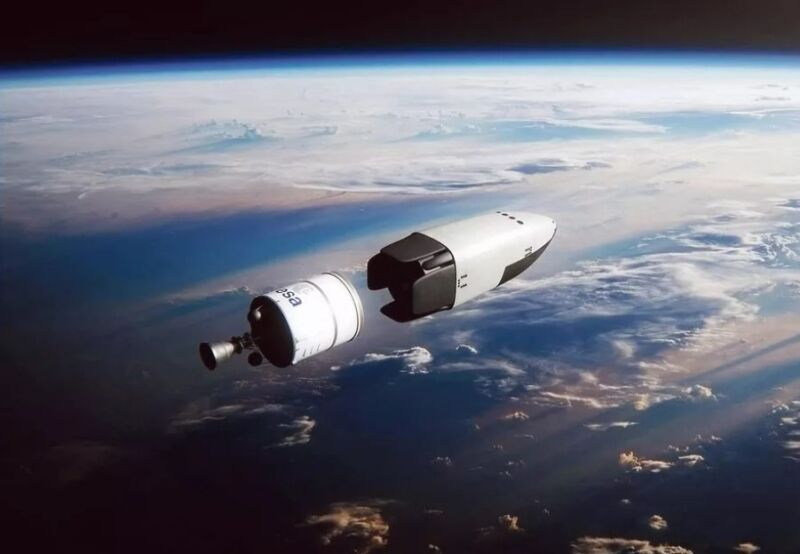
ArianeGroup seeks European funding to develop a reusable third stage for its launch vehicles.
ArianeGroup
Welcome to Edition 5.11 of the Rocket Report! Apologies for the lack of a report last week, but I was on assignment with the crew of the forthcoming Polaris Dawn mission. The upside is that this week's edition is extra-long—running to 2,500 words.
As always, we welcome reader submissions, and if you don't want to miss an issue, please subscribe using the box below (the form will not appear on AMP-enabled versions of the site). Each report will include information on small-, medium-, and heavy-lift rockets as well as a quick look ahead at the next three launches on the calendar.

SpinLaunch raises $71 million. The company developing a launch system that uses a centrifuge as a first stage announced this week that it has raised $71 million, Space News reports. This brings the total funding secured by the company to $150 million, allowing it to develop a system that accelerates vehicles to hypersonic speeds. After the vehicles are, for lack of a better word, yeeted upward they use conventional rocket engines to reach space. SpinLaunch says this approach can enable a much higher flight rate than conventional rockets while also being more environmentally friendly.
Building a bigger centrifuge ... SpinLaunch built a smaller version of its centrifuge at Spaceport America in New Mexico, 33 meters in diameter, for suborbital tests. The company projects beginning orbital launches with a much larger accelerator, 100 meters across, as soon as 2026, and presumably the new funds will get it closer to that goal. I am interested to see if this approach works, as it is technically feasible. However, the challenges ahead of the company are significant. (submitted by Ken the Bin)
European launch CEO takes shots at startups. In an interview with L'Echo, CEO André-Hubert Roussel of Europe institutional launch developer Ariane Group took aim at the numerous launch startups around Europe, decrying the fact that these companies were pulling resources away from Ariane. Roussel appeared to target German microlauncher companies Rocket Factory Augsburg, Isar Aerospace, and HyImpulse in particular, although he did not name them directly, the Europe in Space newsletter reports.
Bringing nothing to the table? ... Roussel complained that these companies were duplicating what was already being done in launch and that in supporting these companies Europe was encouraging competition that brought "nothing" in terms of innovation to the table. Frankly, this is a really lousy attitude to have toward one's competition, and if I'm being honest it's hard not to root for the upstarts against the established industry.
The easiest way to keep up with Eric Berger's space reporting is to sign up for his newsletter, we'll collect his stories in your inbox.
Some in Michigan worry spaceport talk is all hype. After three years and $2.5 million in public dollars to study the creation of a spaceport in northern Michigan, some state officials are concerned about a lack of progress, Bridge Michigan reports. The state is still awaiting a final report from the Michigan Launch Initiative, a part of the nonprofit Michigan Aerospace Manufacturers’ Association, which was paid $2.5 million to study building launch sites. The concerns focus on project leader Gavin Brown, who said he secured the contract in 2019 after pitching it privately to former Gov. Rick Snyder at the end of his administration.
Announcement coming soon? ... State Sen. Jeff Irwin (D-Ann Arbor) questioned whether Brown overpromised what he can deliver. “For me, the most important thing is for the people to get value for the investment,” Irwin said. “He’s now produced [work] that doesn’t seem to be worth $2.5 million.” Brown remains bullish, telling the publication that he’ll prove critics wrong and hinting that a big announcement is coming soon. This echoes cautionary tales we heard in other states that were promised great riches from new spaceports.
Skyrora to launch from Canada. Scotland-based Skyrora announced this week that it would launch its Skyrora XL rocket from a spaceport under development in Nova Scotia by Maritime Launch Services. The three-stage rocket is designed to loft a maximum of 350 kg into low Earth orbit, and Skyrora completed a successful second stage static hot fire test at Machrihanish Airbase in Scotland in August.
A transatlantic partnership ... As part of the agreement, Maritime Launch will purchase the vehicles and vehicle support staff from Skyrora for its satellite clients. Spaceport Nova Scotia will provide Skyrora a launch pad, ground and operations support, public safety services, regulatory approvals, and mission integration facilities and staff. Much work remains, but good luck to both. (submitted by JS)
PLD Space nears suborbital test. A Spanish company developing a small launch vehicle says it is ready to proceed with the launch of a suborbital mission after completing a static-fire test. PLD Space conducted a 122-second test of its Miura 1 rocket September 15 at a company facility in Teruel, Spain, Space News reports. That firing, called the full mission test, came after two earlier static-fire tests lasting 5 and 20 seconds. The series of tests confirmed the vehicle is ready for an actual flight.
A stepping stone to orbit ... With the static-fire test campaign complete, PLD Space is ready to proceed with the first flight of the suborbital vehicle. That launch is scheduled for as soon as December from the El Arenosillo site in Southwestern Spain. “Our plan is to do two test flights,” said Raúl Verdú, chief operating officer. PLD Space has advertised the Miura 1 as a sounding rocket that can carry 100 kilograms to an altitude of 150 kilometers, generating up to four minutes of microgravity time. Verdú said the primary purpose of Miura 1 is to demonstrate technology for its Miura 5 orbital launch vehicle under development. (submitted by Ken the Bin)
Revisiting the 2014 crash of SpaceShipTwo. On Medium, an author who analyzes plane crashes recently called attention to Virgin Galactic's fatal crash eight years ago. On October 31, 2014, an experimental space plane operating for Virgin Galactic abruptly disintegrated at an altitude of nearly 17 km during a test flight, scattering debris over a vast area of California’s Mojave Desert. Although one of the two test pilots was killed, the other remarkably survived, parachuting to safety against all odds.
Falling short of the stars ... The destruction of the VSS Enterprise and the death of one of its pilots promised to be a major setback for the commercial space flight industry, which was then, as now, in its infancy. I included this item in the Rocket Report not to call down scorn upon Virgin Galactic, but rather because it is an excellent analysis after the fact, complete with sobering photographs. It's a reminder of the challenges in this industry that we're all following with such avidity.
Ariane Group unveils reusable stage concept. At the International Astronautical Congress in Paris this week, ArianeGroup revealed a proposal for a Smart Upper Stage for Innovative Exploration, or "Susie" vehicle. Susie is an entirely reusable rocket stage project that replaces the payload fairing and is capable of going into space and carrying out many different types of missions there—whether automated or crewed—and coming back to land on Earth.
A versatile vehicle ... According to ArianeGroup, Europe's state-funded developer of rockets, Susie would be able to fly both the new Ariane 64 rocket as well as a launcher of the following generation, paving the way for fully reusable launchers in the future. Missions made possible by Susie include towing, inspecting and upgrading satellites and other payloads, and supplying fuel, food, and equipment to space stations. It will also be able to carry out crew changeovers and facilitate human in-orbit activities. There was no estimate of the costs, which likely would be in the billions of euros over many years if ArianeGroup won such a contract. The timing is perhaps not coincidental, with France saying it is willing to pay 25 percent more for space activities.
OneWeb nearing launch on Indian rocket. OneWeb's latest batch of 36 broadband satellites has arrived in India ahead of plans to launch them next month on the country’s largest rocket, Space News reports. The British startup anticipates the commercial arm of Indian space agency ISRO will launch the satellites on a GSLV Mark 3 rocket in October. The mission would be the first dedicated commercial launch for ISRO’s NewSpace India Limited using GSLV Mark 3.
Pivoting away from Russia ... OneWeb has been unable to expand its constellation since sanctions on Russia forced Arianespace to suspend Soyuz launches in March. Arianespace had deployed 428 of OneWeb’s planned 648 satellites before hitting the brakes on their 19-launch contract. Arianespace had planned to carry out six more Soyuz missions to complete the constellation. OneWeb pivoted to India and SpaceX to launch the remaining satellites it needs to provide global services, which the operator said will take place across five missions before the end of spring 2023. (submitted by Ken the Bin)
Rocket Lab will test engines at Stennis. Rocket Lab announced this week that it would test its new Archimedes engine at Stennis Space Center in Mississippi. This is the engine that will power the company's proposed Neutron vehicle, a medium-lift rocket with a reusable first stage and payload fairing. (The company provided more information about Neutron during an Investor Day presentation on Wednesday). The Archimedes Test Complex will include exclusive use and development of existing industrial NASA infrastructure and the center’s A-3 Test Stand for 10 years, with an option to extend the lease for 10 more years.
Modernizing in Mississippi ... "Creating a test complex from scratch to the scale and complexity needed to test and develop Archimedes would have had an inconceivably long lead time, so the fact that we’ve secured Stennis and can leverage its existing infrastructure and test stand puts us on the fast-track to Neutron’s first launch," said Rocket Lab Founder and CEO Peter Beck. It's great to see companies like Rocket Lab, Relativity Space, and others utilize existing facilities at Stennis, which is finding new life as a commercial propulsion test bed. (submitted by EllPeaTea and Ken the Bin). . ."
READ MORE
Here's everything you need >
Download the lastest pdf here

Many states have adopted policies intended to meet commitments to achieve major progress towards greenhouse gas emissions reductions, and growth in the use of clean and renewable energy.
This map summarizes those state policies that have been formalized by legislative and executive branch actions to date. The table shown below the map lists each jurisdiction’s decisions that are summarized in the map.
Readers are invited to notify NRRI of any changes to be included in the Map and Table. Please email or phone NRRI staff with any corrections or updates.
Sources for map (Updated August 30, 2021): American Council for an Energy Efficient Economy, Energy Efficiency Resource Standards [Web page, retrieved August 2021]; Clean Energy States Alliance, Guide to 100% Clean Energy States [Web page, retrieved August 2021]; District of Columbia Department of Energy & Environment, Climate Action Planning [Web page], and Code of the District of Columbia, §34–1432 – Renewable energy portfolio standard; National Conference of State Legislatures, Greenhouse Gas Emissions Reduction Targets and Market-based Policies [Web page, updated 3/11/2021]; National Conference of State Legislatures, State Renewable Portfolio Standards and Goals [Web page, updated 8/13/2021]; North Carolina Clean Energy Technology Center, Database of State Incentives for Renewables & Efficiency, Renewable Portfolio Standards and Clean Energy Standards [Map, Updated September 2020]; and United States Climate Alliance, Inventory of Climate and Clean Energy Policies—Policies by State [Web page, reporting 2019 status of states].
Summary of map data:
|
Jurisdiction1 |
GHG Policy2 |
Renewable or Clean Energy Portfolio Policy3 |
Comments & Recent Actions |
|---|---|---|---|
|
Arkansas |
|
Energy efficiency portfolio standard only. |
Under Arkansas Code § 23-4-422, public utilities (natural gas or electric) may propose and the Commission may approve economic development rates that meet certain conditions. |
|
Arizona |
|
15% by 2025 (Arizona Admin. Code §14-2-1801 et seq., Article 18) |
Commissioners voted 3-2 at the January Contingency Open Meeting to not move forward with energy rules that would have required Arizona’s regulated electric utilities to achieve 100% carbon-free energy by 2070. Related documents can be found in the Corporation Commission’s online docket at https://edocket.azcc.gov. Enter docket number RU-00000A-18-0284. Separately, the three largest regulated electric utilities all set voluntary GHG commitments for major emissions reductions. |
|
California |
Carbon neutral by 2045 |
33% by December 31 2020, 50% by December 31, 2026, and 60% renewable energy by December 31, 2030. 100% renewable and zero-carbon resources, for retail electricity sales, by 2045 (California 100 Percent Clean Energy Act of 2018) |
|
Get into it
.jpg)
✓
The United States gets about 40 percent of its electricity from carbon-free sources, including renewables and nuclear, and researchers have a pretty good idea of how to cost-effectively get to about 90 percent.
.jpg)
But that last 10 percent? It gets expensive, and there is little agreement about how to do it.
A new paper in the journal Joule identifies six approaches for achieving that last 10 percent, including a reliance on wind and solar, a build-out of nuclear power, and development of long-term energy storage using hydrogen.
This isn’t a matter of one pathway winning out over the others, said Trieu Mai, the paper’s lead author and senior energy researcher for the National Renewable Energy Laboratory in Golden, Colorado.
“A 100 percent carbon-free power system will require a portfolio of resources,” he said. “But humility is needed to accept that we don’t know what the optimal mix to solving the last 10 percent” is going to be.
.jpg)
The larger point, he said, is that researchers and industry need to be doing the work now to figure out which technologies are the most viable in order to meet the goal, set by the Biden administration, to get to net-zero emissions in the electricity sector by 2035.
.png)
Here are the six options from the paper, along with what I see as their pluses and minuses:
The “last 10 percent” challenge is nothing new. What is new is the need to serve the last 10 percent with carbon-free resources.
In the current grid, more than one-third of the country’s power plant capacity is needed to meet roughly the last 10 percent of demand, according to the NREL paper. This means there are hundreds of power plants that sit idle most of the time but are an essential resource for making sure that there is enough electricity to meet demand on the hottest and coldest days of the year.
Much of this “peak power” is provided by natural gas power plants, which can ramp up and down on short notice. But those plants will need to close or find a way to store their emissions in a carbon-free grid.
The paper is diplomatic as it wades into some of the most contentious debates in the energy world.
A growing segment of energy researchers say that the electricity system can run on 100 percent renewable energy, which would mean renewables and energy storage would provide the last 10 percent. This approach sees no good reason to build new nuclear plants or to use carbon capture systems on fossil fuel plants, citing high costs and a variety of other concerns.
At the same time, a sizable group of energy researchers maintain that nuclear and carbon capture are essential parts of getting to carbon-free electricity. This side has doubts about the ability of renewable sources to meet all needs, citing concerns about the availability of land and the intermittent nature of wind and solar. They note that wind and solar are not a low-cost option when taking into account the amounts of storage and power line capacity needed to make those resources reliable for meeting peak demand.
Mai acknowledged the strong feelings surrounding some of these questions.
“We just want people to recognize that within each option, there are tradeoffs,” he said. “We recognize the degree of uncertainty with all of these technologies, and we need to lay that out on the table.”
Also, he pointed out that the paper is asking a specific question about meeting the last 10 percent of electricity demand and that there is a separate, and also important, question about the right mix of resources for getting to 90 percent carbon-free electricity.
To get to 90 percent, roughly double the current share, he thinks wind, solar, and battery storage will play major roles, along with additional interstate power lines.
So it’s possible to say that the country should have much more renewable energy than it does today, and also say that it’s an open question whether wind and solar are well-suited to provide the last 10 percent.
Within all of this is something encouraging: Researchers and energy companies have figured out how to start the transition to 100 percent carbon-free electricity, and they have a pretty good idea of what the in-between steps will look like. Now, they are beginning to dig deep on how this journey to a carbon-free grid may end.
This story originally appeared on Inside Climate News.
Inside Clean Energy is ICN’s weekly bulletin of news and analysis about the energy transition. Send news tips and questions to dan.gearino@insideclimatenews.org.

". . .Since the outbreak of hostilities, Ukraine has been trying to present Russia’s actions to the ‘international community’ as an attack by a great power on a small state that is unable to defeat the huge Russian army because it has never had aggressive intentions either against the Russian Federation or any other country. This statement is refuted by ‘Ukraine’s Military Security Strategy’, which states in black and white, for example, that KI’ve may enter into a war with the Russian Federation if Russia tries to “keep the Republic of Belarus in its sphere of political influence.”
The goal of Ukraine’s accession to NATO is also clearly outlined. Of course, as a sovereign state, Ukraine has the right to join any international organization. But the issue is that Kiev sees the goal of NATO membership as the US-led bloc’s participation in a war against Russia. This has been confirmed by an adviser to the president of Ukraine, Alexey Arestovich, who, in explaining the purpose of the DEFENDER Europe 2021 exercises, stated that “in the waters from the Baltic to the Black Sea, we are working out – let’s not beat around the bush – how to carry out an armed conflict with Russia, a war with Russia.”

Plans concocted by the special services reveal Kiev’s aggressive strategy over many years
The best defense is a good offence. So goes one of the oldest principles of international relations.
And as Ukrainian documents now at the disposal of the media show, Moscow apparently had something to defend itself from when it launched its offensive in Ukraine. Over the past eight years, Kiev’s military and special services have been preparing numerous operations aimed at undermining Russia’s international ties, and internal peace itself.
In June, a hacker Telegram channel dubbed ‘Beregini’ published the action plan of the Information and Psychological Operations Department of the Armed Forces of Ukraine’s Special Operations Forces (SSO). According to official information, the tasks of this unit include working with the population of foreign countries, creating agent networks, and infiltrating special services and military organizations to conduct espionage and destroy people who pose a threat to the Ukrainian government (including in other countries), as well as preparing coups and the overthrow of regimes.
The SSO plan was prepared back in 2017, and this is just one of many similar secret documents created by Ukrainian spooks. It was just one that became public. But the presence of these plans and the real political and military steps taken by Ukraine, which coincide with SSO programs to a surprising extent, indicate that KI’ve has been actively carrying out anti-Russian activities since at least 2014, when a Western-backed coup took place in the country.

Operation ‘Zaslon’ describes a scheme to influence the family members of Donbass soldiers and militiamen, as well as Russian army personnel. The operation’s main goals include blocking military units and encouraging desertion and resignations in the militaries of ‘Eastern,’ the document’s code word for Russia and the Donbass republics.
In the event of an outbreak of hostilities, a transition to Operation ‘Bolotnaya Square’ was planned. This consists of cultivating distrust of Russia’s military and political leadership among the country’s population, as well as fomenting dissent “against the aggressive policy of the ‘Eastern’ president and his entourage,” in order to incite mass protests.
Ukraine’s actual actions confirm the authenticity of these plans. Even after Crimea’s reunification with Russia, Russian citizens could be found who sided with Kiev.

It is noteworthy that in 2018, a fake news story claiming that 300 people had died in a fire at Kemerovo’s Winter Cherry shopping center originated in Ukraine. No less revealing is the story of a Ukrainian Special Forces employee who called on Russians to protest against “pension genocide,” but forgot to change his Ukrainian IP address.
The number of Ukrainian sympathizers in Russia is unlikely to have increased this year. Sociological studies indicate that citizens’ support for the Russian government has only been growing. By the beginning of the summer, 72 percent of Russians supported the military campaign, while Russian President Vladimir Putin’s popularity rating had risen, settling at 82 percent.
But if Ukraine has failed in killing support for the offensive, it doesn’t mean it hasn’t tried. For example, the command of Ukraine’s Special Operations Forces has been implementing the ‘Smuta’ project since January of 2022. The documentation contains a detailed report on materials published in the Russian media and social networks aimed at destabilizing the country, provoking discontent among its population, and discrediting the authorities.
After the outbreak of hostilities, Operation ‘Steppe Wind’ was activated. As stated in the SSO documents, its task is to demoralize the enemy and create tension between the Russian military and DPR and LPR fighters. According to Oleg Matveichev, a professor at the Higher School of Economics, “in fact, there are about 80,000 accounts maintained by Ukrainian students [on the Russian-language internet], but they pretend to be locals: ‘ordinary residents’ of Penza, Kurgan, Chita, and Khabarovsk.”

Relatives of Russian servicemen have been terrorized by telephone scammers who report the death of their loved ones in Ukraine or demand money for their “release from captivity.” As reported by ombudsman Tatiana Moskalkova, relatives of Russian soldiers have also received videos showing prisoners being abused. The Ukrainian special services have created several Telegram channels, where unverified data on Russian casualties and prisoners is published. The Ombudsman also said she has received more than 100 appeals concerning prisoners of war, of which about half have been confirmed.
Operation ‘Gentle Dew’, which is aimed at residents of territories not controlled by Ukraine, deserves special mention. Its mission is to “form pro-Ukrainian sentiment among the population of the occupied territories and encourage protest movements directed against the ‘Eastern’ and the occupation authorities.”
However, there has been no success in implementing this plan. The main reason for this lies in the difference between Kiev’s and the Donbass republics’ views on and approaches to the possible reintegration of the regions with Ukraine. In March 2021, President Vladimir Zelensky signed a decree approving a ‘Strategy for De-occupation and Reintegration of the Temporarily Occupied Territory of the Autonomous Republic of Crimea and the City of Sevastopol.’ The document, which consists of 158 paragraphs, will give you an idea of how the authorities in Kiev intend to treat the residents of the regions that have left Ukraine.
The document proposes to exclude persons who “were part of or collaborated with the occupation administrations” from holding any position in government or civil service. This is a very wide range of people, ranging from members of the 2014 referendum commissions to teachers and doctors working in municipal schools and hospitals. ‘De-occupation’ also involves extending the statute of limitations on criminal cases that were conducted by Ukrainian police before the referendum on the return of Crimea to Russia, as well as pursuing criminal cases within the competence of the Security Service of Ukraine.
Translated from legal to layman’s language, this means purposeful persecution of all officials who worked in Crimea in February 2014, as well as participants in mass rallies supporting the reunification of Crimea with Russia, volunteers who helped DPR and LPR residents during the civil war, and so on.
While opening opportunities for the residents of Crimea and Donbass to study at Ukrainian universities, Kiev refuses to recognize any educational documents obtained on the peninsula. The question of whether these conditions will make residents of Crimea and Donbass want to return to Ukraine is purely rhetorical.

While it is unknown whether the SSO intends to continue implementing its plan to foster pro-Ukrainian sentiment among the residents of Crimea and Donbass, we do know for sure that the Ukrainian side sharply increased its attacks on cities in these regions after the start of Russia’s Special Military Operation. So far, this ‘Gentle Dew’ has only fallen on the region in the form of MLRS Grad shells and Tochka U missiles.
Ukraine’s SSO has also carried out several special operations in the foreign policy field. One of them is operation ‘Caspian’, whose purpose is to sow and deepen disagreements between the Russian Federation and certain ‘Fawn,’ which are presumably countries in the Caspian region. The operation is to be considered successful if it leads to “actions indicating the refusal of ‘Fawn’ from interacting with ‘Eastern’.”
In general, it is difficult to assess where the line lies between Ukraine’s efforts to disrupt Russia’s relations with its partners and the natural difficulties that arise in the dialogue between any countries. Nevertheless, it is worth noting that during the riots that took place in Kazakhstan in January this year, at least some of the protesters’ actions were coordinated with Ukraine, where Kazakh oppositionists found refuge.

If we analyze the content of the ‘Strategy of Ukraine’s Foreign Policy Activity’ adopted in July 2021, we can see not the defensive, but the aggressively offensive nature of Kiev’s foreign policy actions. For example, to offer experience “acquired over years of countering Russian aggression” to NATO countries and the Baltic-Black Sea region. Or to assist in fighting Russian “disinformation” in neighboring countries, to support the “people of Belarus,” to “democratize” Russia itself, and to strengthen “pressure on and deterrence of the Russian Federation on the basis of a broad international coalition.” This, by the way, is also included in SSO plans called ‘The Voice of Reason’.

Even in bilateral relations, where Ukraine should seemingly focus on developing trade, industrial cooperation, and cultural exchanges, the Foreign Ministry is tasked with “ensuring support from African and Middle Eastern states in countering the aggression of the Russian Federation.”
Since the outbreak of hostilities, Ukraine has been trying to present Russia’s actions to the ‘international community’ as an attack by a great power on a small state that is unable to defeat the huge Russian army because it has never had aggressive intentions either against the Russian Federation or any other country. This statement is refuted by ‘Ukraine’s Military Security Strategy’, which states in black and white, for example, that KI’ve may enter into a war with the Russian Federation if Russia tries to “keep the Republic of Belarus in its sphere of political influence.”
The goal of Ukraine’s accession to NATO is also clearly outlined. Of course, as a sovereign state, Ukraine has the right to join any international organization. But the issue is that Kiev sees the goal of NATO membership as the US-led bloc’s participation in a war against Russia. This has been confirmed by an adviser to the president of Ukraine, Alexey Arestovich, who, in explaining the purpose of the DEFENDER Europe 2021 exercises, stated that “in the waters from the Baltic to the Black Sea, we are working out – let’s not beat around the bush – how to carry out an armed conflict with Russia, a war with Russia.”
Although, back in 2017, the SSO created a ‘Voice of Reason’ plan, which included a task to ensure that “statements confirming readiness to negotiate a peaceful settlement of the situation” appeared in the West. In fact, the West never rejected this idea. After the outbreak of hostilities, it was Kiev that refused peace talks, preferring to wage war with Russia. Ukrainian President Vladimir Zelensky repeated this policy line in Paris, stressing that the conditions for negotiating with Russia hadn’t yet “matured,” as he wanted to take a “stronger position.”


