"Alphabet Inc.’s
Google will pay $85 million to resolve a consumer privacy suit by
Arizona claiming the technology giant surreptitiously collects data on
users’ whereabouts for targeted advertising.
The settlement comes
as Google is facing similar complaints by a group of state attorneys
general, including Texas, Indiana and Washington D.C., in their
respective state courts, over user location data. . ."
19 minutes ago · Google will pay $85 million to settle claims brought against the company under the Arizona Consumer Fraud Act in State of Arizona v. Google
Bill "Quick Jab" Jabjiniak, Economic Director for City of Mesa Government
Technology giant Google is
coming to Mesa, lured by a tax incentive agreement to build a massive
data center in the emerging Elliot Road Technology Corridor.
In
a major coup for Mesa, Google will join fellow tech heavyweight Apple,
which already operates a large data center in the same area of southeast
Mesa.
The Mesa City Council is primed to approve the Google development agreement at its meeting on Monday.
Steve Wright, a city spokesman, said he does not know specifically how many jobs will be created at the Google data center.
He
said the city is limited on how much it can say about the project and
that more details may become available when the agreement comes before
the council Monday night.
“They’re very guarded in what
they say,’’ Wright said. “Obviously, building out the facility, there
will be a lot of jobs in construction.’’
Google issued a statement acknowledging the company’s interest in the data center, but it provided few details.
“Google
is considering acquiring property in Mesa, AZ., and while we do not
have a confirmed timeline for development for the site, we want to
ensure that we have the option to further grow should our business.. .
“In terms of a financial deal, this is home run. This is a
great day,’’ Mayor John Giles said, after the council discussed the deal
Thursday during an hour-long executive session.
Giles
said there are still elements of the project that need to be worked out,
such as Google buying the property, 186 acres located at Elliot and
Sossaman roads in southeast Mesa.
Giles said Google’s
decision to build the data center in Mesa means that the Elliot Road
Tech Corridor will be anchored at each end by one of the world’s largest
tech companies, Apple and Google.
“There’s no city that wouldn’t be envious of that,’’ Giles said.
He
said the project has been known to insiders by a code name, “Project
Red Hawk,’’ for more than a year because Mesa signed a confidentiality
agreement with Google.
Vice Mayor Mark Freeman said that
Google would be buying the property from the Morrison family, long time
farmers in the southeast Valley who have been selling off parts of
their holdings for different types of developments — including the
Morrison Ranch subdivision in southeast Gilbert.
Bill Jabjiniak, Mesa’s economic development director, played a major role in the negotiations...
Jabjiniak said during his presentation that the data center would cover a staggering 750,000 square feet.
“Data centers are the engines of the internet,’’ Jabjiniak said. “We are talking about a $1 billion corporate investment.’’
He said Google would join Apple, AT&T, and Boeing as top Fortune 500 corporations with operations in Mesa.
The
agreement also requires Mesa to make available 1,120-acre feet of water
to Google initially, and that the amount of water can eventually grow
to 4,480-acre feet per year if Google reaches certain development
milestones.
Jabjiniak said data centers use the water
for evaporative cooling. He said the availability of electricity from
Salt River Project also was vital in Mesa’s efforts to recruit Google.
As a law professor for more than 30 years, Elizabeth taught courses
on commercial law, contracts, and bankruptcy. She has written more than a
hundred articles and eleven books, including four national
best-sellers, This Fight Is Our Fight, A Fighting Chance, The Two-Income Trap, and All Your Worth.
Elizabeth
learned first-hand about the economic pressures facing working
families, growing up in a family she says was "on the ragged edge of the
middle class." She got married at 19, and after graduating from
college, started teaching in elementary school. Her first baby, a
daughter Amelia, was born when Elizabeth was 22. When Amelia was two,
Elizabeth started law school. Shortly after she graduated, her son Alex
was born. Elizabeth hung out a shingle and practiced law out of her
living room, but she soon returned to teaching.
Elizabeth is a
graduate of the University of Houston and Rutgers School of Law.
Elizabeth and her husband Bruce Mann have been married for 41 years and
live in Cambridge, Massachusetts with their golden retriever, Bailey.
They have three grandchildren.
--- (Official Portrait About Elizabeth)
Elizabeth Warren, a fearless consumer
advocate who has made her life's work the fight for middle class
families, was re-elected to the United States Senate for a second term
on November 6, 2018, by the people of Massachusetts.
Elizabeth is
one of the nation’s leading progressive voices, fighting for big
structural change that would transform our economy and rebuild the
middle class.
✓ She has put forward bold, ambitious plans to:
End
lobbying as we know it and make other sweeping changes to eliminate the
influence of money in our federal government through the most
comprehensive anti-corruption legislation since Watergate;
Impose
an ultra-millionaire tax on fortunes worth over $50 million to generate
$2.75 trillion in revenue over ten years—enough to pay for universal
child care, student debt relief, and a down payment on a Green New Deal;
Address
the nation’s housing crisis by building more than 3 million new homes,
cutting rents nationwide by 10%, and taking the first steps towards
healing the legacy of housing discrimination through historic new
investments in federal housing programs;
Extend criminal accountability to corporate executives who oversee and direct illegal scams;
Give
workers a greater say in the decision-making process at the nation’s
biggest corporations by empowering them to elect 40% of the board at the
company where they work;
Require every public company to disclose climate-related risks;
Provide Puerto Rico with a path to comprehensive debt relief and rebuild the island’s infrastructure;
Allocate $100 billion to solve the opioid and substance use crisis; and
Address skyrocketing prescription drug costs, including through the public manufacturing of generic drugs.
Elizabeth
consistently reaches across the aisle to deliver wins for
Massachusetts, making her one of the most effective members of the
Senate. She helped secure $750 million in debt relief for students who
were cheated by predatory, for-profit colleges, including 4,500
Massachusetts students and more than 28,000 students across the country.
Elizabeth has also helped pass legislation to double federal funding
for child care, make hearing aids available over the counter, reduce
out-of-pocket costs for high school students enrolled in career and
technical education programs, and put over $6 billion dollars in federal
funding towards the fight against the opioid epidemic.
Elizabeth
has used her platform to hold some of the nation’s largest corporations
and most powerful government agencies accountable for fraud, waste, and
abuse. In the wake of the fake accounts scandal at Wells Fargo, her
relentless public pressure led to the resignation of two Wells Fargo
CEOs, John Stumpf and his successor, Tim Sloan. Elizabeth also launched
an investigation to hold Equifax accountable for a data breach that
exposed the personal financial information of over 140 million customers
and wrote legislation to keep it from happening again. Through her
oversight work, she has exposed fraud and abuse perpetrated by Trump
Administration officials, including at the Department of Education,
Environmental Protection Agency, and Department of Defense, and has
successfully overturned rules that harm consumers and students.
✓ (Excerpt: Brookings’ 2021 annual report says
it received money from Australia, the United Kingdom, Denmark, Norway,
Japan, South Korea, Switzerland, Finland, and France, as well as from
the US government, in the preceding year.)
A top DC think tank took millions from foreign governments. Now lawmakers want answers.
Ari Berman
6 - 7 minutes
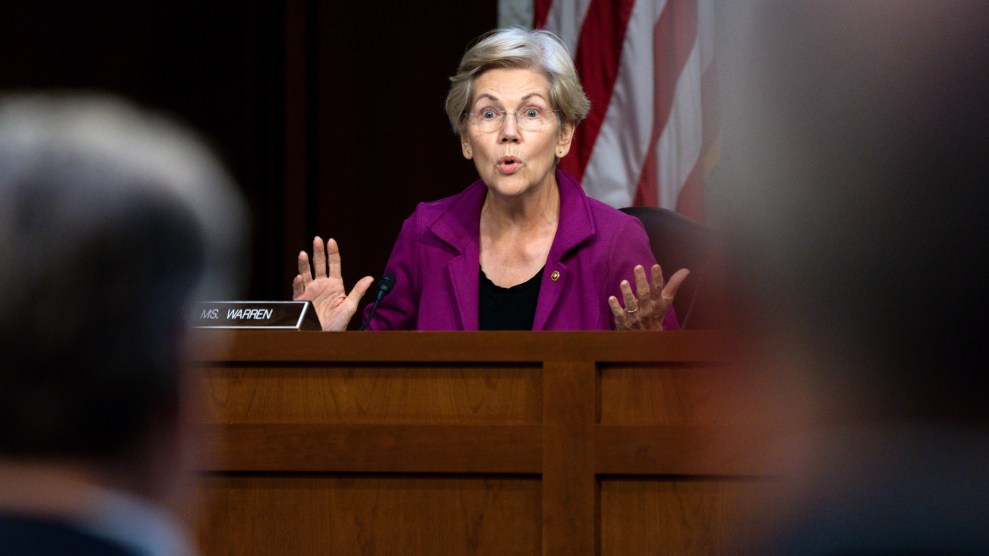
Sen. Elizabeth Warren, questions witnesses at a Senate Banking Committee on Thursday, Sept. 22, 2022.Jacquelyn Martin/AP
Fight disinformation: Sign up for the free Mother Jones Daily newsletter and follow the news that matters.
"Senators in both parties
are taking aim at the Brookings Institution, demanding details on
funding agreements that, according to the lawmakers, could have allowed
foreign governments to secretly influence policy prescriptions produced
by the renowned establishment think tank.
The scrutiny follows the June resignation from Brookings of retired four-star general John Allen after news emerged that the Justice Department was investigating
whether Allen violated foreign lobbying laws by advocating for Qatar
while seeking payments from the Gulf state. The alleged lobbying
occurred in 2017, while Allen, the former commander of US forces in
Afghanistan, was a fellow at Brookings. Brookings listed
Qatar as one of its top donors that year, with contributions of
“$2,000,000 and above.” Brookings officials have said they did not know
of Allen’s actions. Allen, who has not been charged with any crimes,
denies that he acted as a Qatari agent. But the scandal has drawn
attention to the think tank’s decades of ties to Qatar, as well as its
funding from other countries.
In a letter
Monday, Sen. Elizabeth Warren said she has “significant concerns about
agreements that Brookings has in place with foreign governments” and
questioned if those deals undermine the organization’s independence. She
asked Brookings to give her details of those agreements.
“Foreign governments, billionaire corporations, and the super
wealthy should not be able to hide behind think tanks to secretly peddle
influence and shape policy, and the Brookings Institution needs to
fully disclose all of its funding agreements or it risks undermining its
reputation,” the Massachusetts Democrat said in a statement to Mother Jones.
Think tanks have long offered foreign states a sort of backdoor means to advocate for their interests in Washington. Critics contend
that by funding think tank programs, governments can effectively hire
these organizations as lobbyists. The lawmakers’ scrutiny of Brookings
is part of an intermittent effort by Congress to crack down on this
practice.
Brookings has responded to criticism by noting it has internal
policies aimed at ensuring that donors do not compromise the
independence of its scholars. “Brookings will respond to Senator
Warren’s inquiry to assure her of our full commitment to upholding the
independence and integrity of our work,” a spokesperson for the
organization said Monday. “As a leading global think tank, we remain
interested and available to work with Members and Senators on important
public policy questions in this regard.”
Warren and other senators have previously raised concerns about a
2007 agreement through which Qatar pledged $5 million to help Brookings
set up an outpost in Doha. Politico reported in June on a memorandum of understanding
between Brookings and Qatar that gave the Qataris substantial influence
over that center. The agreement required the head of the center to
“engage in regular consultation” with Qatar’s foreign ministry and gave
the ministry power to approve the center’s budget and programing.
Sen. Chuck Grassley of Iowa, the top Republican on the Senate Judiciary Committee, last week introduced legislation
that would require nonprofits working to influence US policy or public
opinion to publicly report all funds received from foreign governments
or organizations. It would also require them to make public “all written
contracts, agreements, or memoranda of understanding…with any foreign
principal.” The bill text cites Brookings’ 2007 agreement with Qatar to
explain why such disclosures are needed. “Congress currently is unable
to determine what other agreements that the Brookings Institution or
other influential think tanks have with foreign governmental entities, a
void which has already been exploited by at least Qatar,” the bill
says.
Grassley, along with GOP senators Ted Cruz (Texas), Tom Cotton (Ark.), and John Cornyn (Texas), argued in an August 16 letter
to the Justice Department that Brookings had violated the Foreign
Agents Registration Act, or FARA, by failing to register as a lobbyist
for Qatar following the 2007 agreement. Qatar exercised control over the
center, which worked to influence US policy, the senators argued.
“The Brookings Institution appears to be a foreign agent for the State
of Qatar for purposes of FARA and should register as such with DOJ,” the
letter said.
Brookings has said that it ended its connection to its Doha Center
last year. A Grassley spokesperson, in an email, said Brookings should
still register retroactively.
Warren wrote
Brookings about Allen and Qatar in July, asking if the think tank had
memorandums of understanding with countries other than Qatar. In an
August 22 response, Amy Liu, Brookings’ interim president, said that
Brookings does in fact have “funding agreements” with other foreign
states. Liu said those agreements “require donors, including foreign
governments, to acknowledge the Institution’s research independence.”
But she did not say what the agreements require from Brookings, further
delineate their terms, or name the countries involved.
Elizabeth Ann Warren is an American politician and former law professor who is the senior United States senator from Massachusetts, serving since 2013.
She was previously a law professor for more than 30 years and has written 11 books, including four bestsellers. Forbes Lists. 50 Over 50 - Investment ...
Jared
Del Rosso is an associate professor at the University of Denver. During
his time at DU, Del Rosso has researched the politics of torture in the
U.S. His scholarly articles and first book, "Talking About Torture"
(Columbia University Press, 2015), reveal the forms of denial and
acknowledgment used in debates about waterboarding, force feeding, and
other forms of torture employed during the war on terror. A new book on
the sociology of denial, "Denial: How We Hide, Ignore, and Explain Away
Problems," was published by NYU Press in July 2022.
How to get away with insurrection: The techniques of denial and distraction that politicians use to manage scandal
Jared Del Rosso
8 - 10 minutes
"The U.S. House select committee investigating the Jan. 6, 2021 insurrection intends to hold another public hearing,
likely the last before it releases its official report. The hearing had
been scheduled for Sept. 28, 2022 but was postponed because of
Hurricane Ian.
Through earlier hearings this past summer, the committee has shown how former President Donald Trump and close associates spread the “big lie” of a stolen election. The hearings have also shown how Trump stoked the rage of protesters who marched to the U.S. Capitol and then refused to act when they breached the building.
As a sociologist who studies denial,
I analyze how people ignore clear truths and use rhetoric to convince
others to deny them, too. Politicians and their media allies have long
used this rhetoric to manage scandals. Trump and his supporters’
responses to the Jan. 6 investigation are no exception.
✓ Stages of denial
Commonly, people think of denial as a state of being: Someone is “in
denial” when they reject obvious truths. However, denial also consists
of linguistic strategies that people use to downplay their misconduct and avoid responsibility for it.
These strategies are remarkably adaptable. They’ve been used by both
political parties to manage wildly different scandals. Even so, the
strategies tend to be used in fairly predictable ways. Because of this,
we can often see scandals unfold through clear stages of denial.
✓ In my previous research on denial and U.S. torture,
I analyzed how the George W. Bush administration and supporters in
Congress adjusted the forms of denial they used as new allegations and
evidence of abuses in the global “war on terror” became public.
✓ For instance, after photographs of torture at the Abu Ghraib prison in Iraq were released in the spring of 2004, Abu Ghraib was described as a deplorable but isolated incident. At the time, there wasn’t serious public evidence of detainee abuse at other U.S. facilities.
✓ Later revelations about the use of torture at Guantánamo Bay and secret CIA black sites
changed things. The Bush administration could no longer claim that
torture was an isolated incident. Officials also faced allegations that
they had directly and knowingly authorized torture.
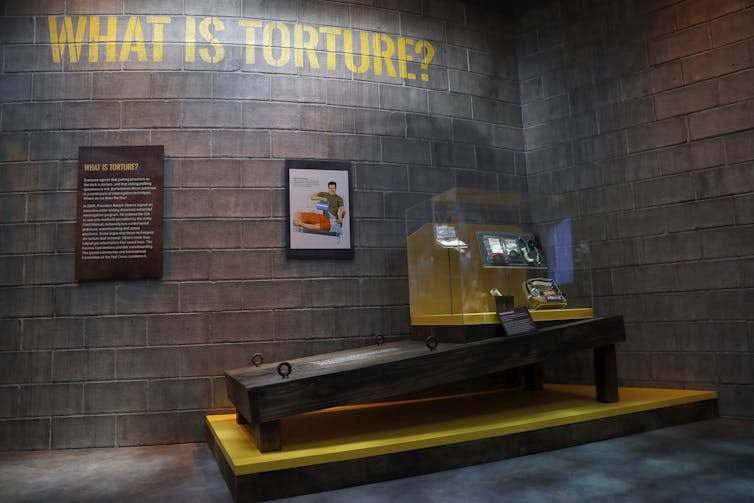
An exhibit on torture includes a section on waterboarding in the International Spy Museum in Washington in 2019. AP Photo/Jacquelyn Martin
Facing these allegations, Bush and his supporters began justifying
and downplaying torture. To many Americans, torture, once deplorable,
was rebranded as an acceptable national security tool: “enhanced interrogation.”
As the debate about torture shows, political responses to scandal
often begin with outright denials. But rarely do they end there. When
politicians face credible evidence of political misconduct, they often
try other forms of denial. Instead of saying allegations are untrue,
they may downplay the seriousness of allegations, justify their behavior
or try to distract from it.
It’s not just Republican administrations that use denial in this way. When the Obama administration could no longer outright deny civilian casualties caused by drone strikes, it downplayed them. In a 2013 national security speech,
President Barack Obama contrasted drone strikes with the use of
“conventional air power or missiles,” which he described as “far less
precise.” He also justified drone strikes, arguing that “to do nothing
in the face of terrorist networks would invite far more civilian
casualties.”
Scandal strategies in play
Americans watched the Jan. 6 insurrection on TV and social media as
it happened. Given the vividness of the day, outright denials of the
insurrection are particularly far-fetched and marginal – though they do
exist. For example, some Trump supporters have claimed that left-wing “antifa” groups breached the Capitol – a claim many rioters themselves have rejected.
Some of Trump’s supporters in Congress and the media have repeated the claim that the insurrection was staged to discredit Trump. But given Trump’s own vocal support for the insurrectionists, supporters usually deploy more nuanced denials to downplay the day’s events.
So what happens when outright denial fails? From ordinary citizens to
political elites, people often respond to allegations by “condemning
the condemners,” accusing their accusers of exaggerating – or of doing
worse things themselves, a strategy called “advantageous comparisons.”
Together, these two strategies paint those making accusations as untrustworthy or hypocritical. As I show in my new book on denial , these are standard denials of those managing scandals.
“For months, our cities burned, police stations burned, our
businesses were shattered. And they said nothing. Or they cheer-led for
it. And they fund-raised for it. And they allowed it to happen in the
greatest country in the world,” Republican Rep. Matt Gaetz said during Trump’s second impeachment. “Now, some have cited the metaphor that the president lit the flames. Well, they lit actual flames, actual fires!”
These forms of denial do several things at once. They direct
attention away from the original focus of the scandal. They minimize
Trump’s role in inciting the violence of Jan. 6 by making the claim that
Democrats incite even more destructive forms of violence. And they
discredit the investigation by suggesting that those leading it are
hypocrites, more interested in scoring political points than in
curtailing political violence.
Trump
supporters and members of the far-right group Proud Boys gather during a
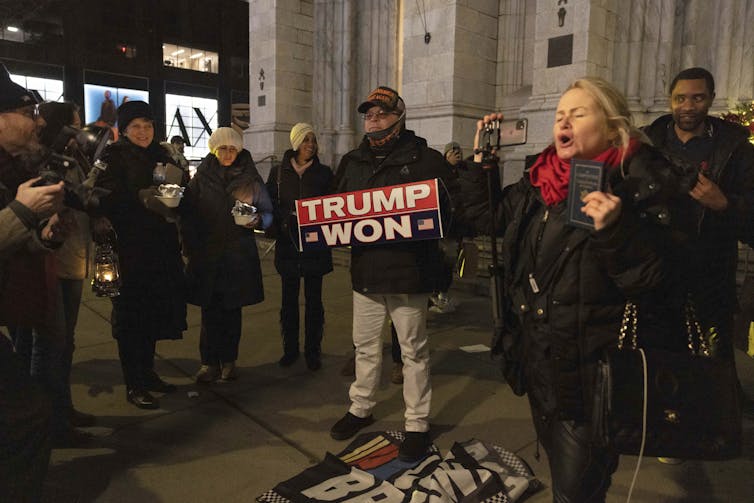
‘Justice for January 6th Vigil’ in New York on Jan. 6, 2022. AP Photo/Yuki Iwamura
Trickle-down denial
These denials may not sway a majority of Americans. Still, they’re
consequential. Denial trickles down by providing ordinary citizens with
scripts for talking about political scandals. Denials also reaffirm
beliefs, allowing people to filter out information that contradicts what
they hold to be true. Indeed, ordinary Americans have adapted “advantageous comparisons” to justify the insurrection.
This has happened before. For example, in a study of politically active Americans, sociologists Barbara Sutton and Kari Marie Norgaard
found that some Americans adopted pro-torture politicians’ rhetoric –
such as supporting “enhanced interrogation” and defending practices like
waterboarding as a way to gather intelligence, even as they condemned
“torture.”
For this reason, it’s important to recognize when politicians and the
media draw from the denial’s playbook. By doing so, observers can
better distinguish between genuine political disagreements and the
predictable denials, which protect the most powerful by excusing their
misconduct."
Early Voting for the City of Mesa General Election
2 minutes
The
City of Mesa Clerk's Office is prepared for the 2022 General Election.
Through continuous education, staff members strive to uphold election
regulations, establish innovative process improvements, promote
transparency to citizens and provide responsive and reliable
information.
Early voting for the General Election begins on
Wednesday, Oct. 12 and ends on Friday, Nov. 4.
In-person early voting at
Mesa City Plaza is not available this election year; however, the City
Clerk's Office will be providing a secure ballot Drop Box in the Mesa
City Plaza lobby, 20 E. Main St., Monday through Thursday 7 a.m. to 6
p.m., beginning Oct. 12, and 6 a.m. to 7 p.m. on Election Day, Nov. 8.
Maricopa County Election Department will offer "vote anywhere" Vote
Centers, which allow voters to choose from any open location, instead of
one assigned location.
The City of Mesa has four issues on the General Election ballot:
Question 1 - Alternative Expenditure Limitation (Home Rule) Question 2 - General Obligation Bonds Proposition 476 - City Charter Section 205 (D) (Meet and Confer) Proposition 477 - City Charter Section 609 (:Purchasing Requirements)
✓ District 4 residents will also be deciding on their representative on the Mesa City Council.
The last day to register to vote is Tuesday, Oct. 11, 2022.
For more
information, please contact the Mesa City Clerk's Office at 480-644-4868