Monday, October 10, 2022

SPACE NEWS (Recent): Daily coverage of the global space industry with an emphasis on business and political news


Most Read (past 7 days)

  1. SpaceX says 5G plan could disrupt Starlink more than previously thought
  2. SpaceX to upgrade Cape Canaveral pad for crew and cargo missions
  3. Report highlights U.S. concerns over China’s space infrastructure in South America
  4. Sherpa tug yet to start raising orbit a month after launch

✓ 

SpaceX deploys two of six C-band satellites Intelsat is launching this year
by  — 

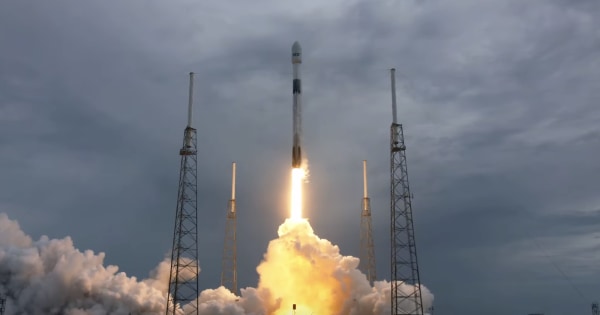
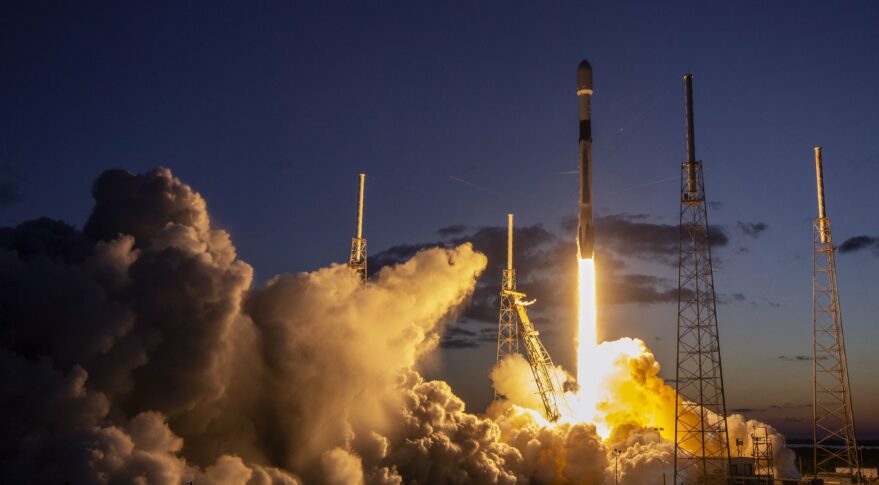
TAMPA, Fla. — SpaceX Oct. 8 successfully deployed the first two of seven satellites Intelsat needs to clear C-band spectrum in the United States, keeping the operator on course to launch all but one of them before the end of this year.

A Falcon 9 carrying Galaxy 33 and Galaxy 34 lifted off at 7:05 p.m. Eastern from Cape Canaveral, Florida, and deployed the satellites into geostationary transfer orbit about 40 minutes after liftoff.

The rocket’s reusable first stage also successfully landed on a SpaceX drone ship in the Atlantic Ocean following a record-tying 14th flight.

A helium leak had forced SpaceX to scrub a previously planned Oct. 6 launch, and a follow-up flight Oct. 7 was also postponed.

It will take about two weeks for the satellites to use onboard propulsion to reach their final geostationary orbit, according to Jean-Luc Froeliger, Intelsat’s vice president of space systems engineering and operations.

Northrop Grumman built the satellites, which will help Intelsat move broadcast customers into a narrower swath of its C-band spectrum to give more frequencies to terrestrial 5G operators in the United States.

Intelsat stands to get nearly $5 billion from the Federal Communications Commission if it can fully vacate the lower 300 MHz slice of C-band by the regulator’s Dec. 5, 2023, deadline.

Rival satellite operator SES is in line for nearly $4 billion if it can clear its C-band spectrum in time — after recently losing a legal challenge for an equal split.

SpaceX launched the first of five C-band replacement satellites in June that SES needs in orbit for its spectrum-clearing efforts, and United Launch Alliance deployed another two Oct. 4. 

SES CEO Steve Collar recently said he expects SpaceX will launch its final two C-band satellites late this year or early next.

“Intelsat might not have launched the first C band satellites but is planning to launch 6 of the 7 c band satellites before the end of the year,” Froeliger told SpaceNews via email.

“By the end of 2022 Intelsat will have launched more C band replacement satellites than SES. In any case what is important is to have all these new C band spectrum clearing satellites in service before the FCC deadline of December 5th, 2023, which Intelsat is on track to do.”

Maxar is providing Intelsat’s remaining five C-band replacement satellites.

SpaceX is slated to launch two of them in November, according to Intelsat, and Arianespace is due to deploy another pair in the fourth quarter of this year.

Intelsat said SpaceX will launch its final C-band replacement spacecraft in the second quarter of 2023. 

email sharing button Email
reddit sharing button Share
linkedin sharing button Share
twitter sharing button Tweet

✓ 

Former SES CEO joins megaconstellation startup E-Space
by  — 

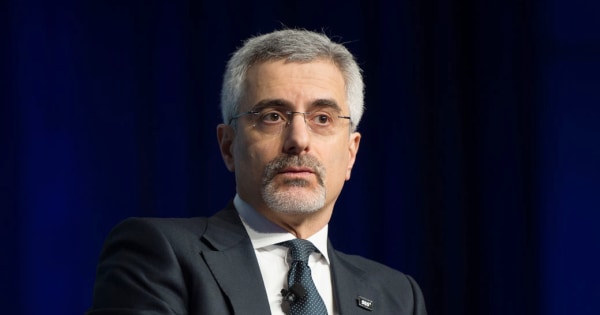
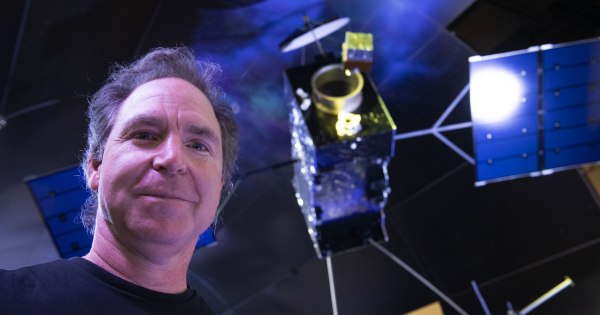
TAMPA, Fla. — Former SES CEO Karim Michel Sabbagh has returned to the space industry to oversee strategy in Europe and the Middle East for E-Space, the connectivity startup plotting a network of hundreds of thousands of satellites.

✓ Sabbagh left SES in April 2018 after four years with the Luxembourg-based satellite operator to head Abu Dhabi-based cybersecurity company DarkMatter.

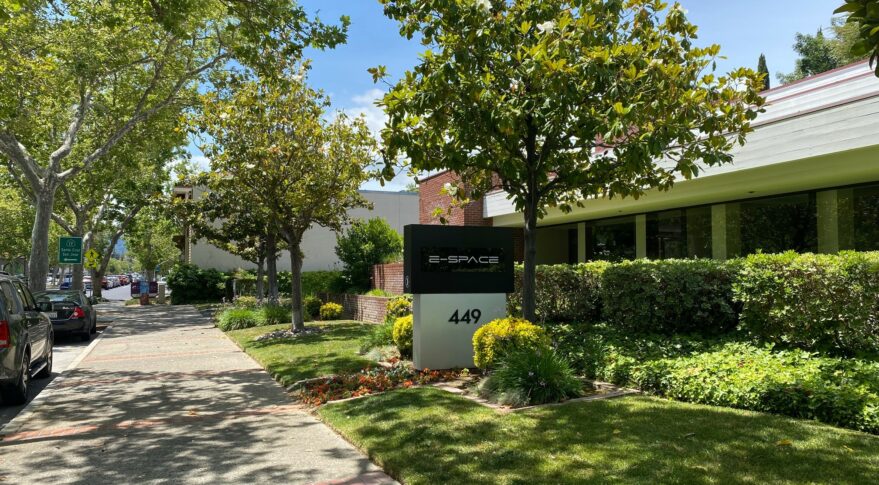
Karim Michel Sabbagh, E-Space’s managing director of Europe and Middle East. Credit: E-Space

He more recently served as a senior advisor on policy matters and investment strategies in the Middle East, E-Space said, and was also engaged in a think tank and academic activities before joining the startup.

E-Space CEO Greg Wyler, who founded medium Earth orbit broadband operator O3b Networks now owned by SES, said Sabbagh will help “disrupt traditional NewSpace markets” as the startup plots serial satellite production next year.

Sabbagh will support regional corporate development, technical, and manufacturing team activities, the venture said in an Oct. 10 news release.

✓ Florida-headquartered E-Space has Rwanda-backed spectrum filings for 300,000 low Earth orbit satellites, which it says would have significantly smaller cross-sections than other constellations to reduce their environmental impact.

The startup remains cryptic about the size and exact function of these “multi-application communication satellites” in non-geostationary orbit (NGSO).

Sabbagh said E-Space’s “focus is directed on enabling an entirely new class of ubiquitous, real-time communications and Internet of Things services to support everything from basic messaging up to advanced voice, video and data communications.”

SES took an initial stake in O3b in 2009 and took full ownership of the operator in 2016 during Sabbagh’s tenure as CEO.

“I have known Karim since working with SES,” Wyler said in the Oct. 10 news release, “when he had the foresight to see how NGSO systems were going to change the industry.”

In addition to overseeing strategy in Europe and the Middle East, E-Space said Sabbagh will support Wyler in defining key programs, operational actions, and general management functions.

Wyler has been busy expanding E-Space’s leadership team after announcing $50 million in seed financing in February to fund operations into next year.

The venture said in August that it had hired 60 employees, including a chief financial officer and chief satellite systems engineer, with a goal to nearly double its team to 100 before the end of 2022.

After deploying its first three prototype satellites in May, E-Space plans to launch another batch of spacecraft on an undisclosed rocket in the first half of 2023, before moving into an initial phase of serial production.

Wyler also founded NGSO broadband operator Oneweb, which builds its satellites at a high-volume facility in Florida via a joint venture with Airbus.
email sharing button Email
reddit sharing button Share
linkedin sharing button Share
twitter sharing button Tweet

✓ 

Launch on demand: If satellites are shot down, will Space Force be ready to restock?

by  — 

A small satellite mission the U.S. Space Force plans to launch in 2023 will test the ability of the commercial space industry to deploy a payload on an extraordinarily compressed timeline.

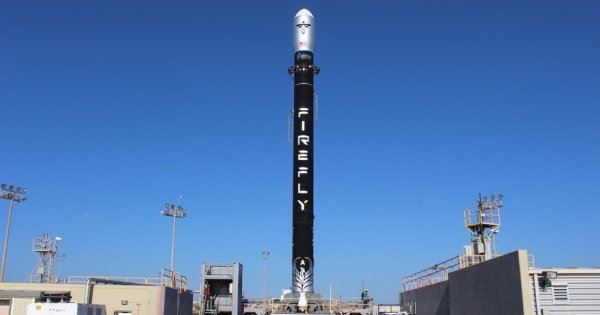
✓ A contract for the mission, code-named Victus Nox, was awarded Sept. 30 to launch services provider Firefly Aerospace and satellite manufacturer Millennium Space. Once the Space Force decides when the mission must launch, it will give Millennium a few months to produce the spacecraft and Firefly will only get 24 hours’ notice to get ready for liftoff.

-- The point of Victus Nox — Latin for ‘conquer the night’ — is to demonstrate fast turnaround launch operations, known as tactically responsive space, and to help planners figure out the front-end processes leading up to the launch. This capability, strategists warn, will be needed during an armed conflict to augment constellations or replace satellites that adversaries would damage or blow up.

“We need to be able to get to the point where we can go launch a rocket, a mission in 24 hours and get that data flowing,” Brig. Gen. Stephen Purdy, the Space Force’s program executive officer for assured access to space, said Sept. 20 at the Air & Space Forces Association annual conference.

A 24-hour call-up is “almost unobtainium right now,” he said. “But we need to get to that point.”

✓✓ The idea of responsive space launch has been talked about for years but is now gaining attention due to congressional and industry advocacy, as well as world events that have shown the strategic value of satellites, making them more attractive targets.

Congress has criticized the Pentagon for not moving more quickly in this area and, over the past two years, inserted $65 million into the defense budget for tactically responsive spaceflight demonstrations. For 2023, the House Armed Services Committee and the Senate Appropriations defense subcommittee are proposing $100 million, although the final amount has yet to be negotiated.

“As vividly demonstrated by Russia’s 2021 destructive anti-satellite test, threats to our critical national security space assets continue to increase, both from adversary on-orbit and terrestrial counter-space capabilities and from space debris,” a bipartisan group of 25 lawmakers wrote in a letter sent in January to appropriators.

Meanwhile, the United States is “not currently positioned with an operational capability to rapidly replace assets in orbit that are degraded, disabled, or destroyed or to rapidly launch satellites for urgent new missions,” the letter said.

Small-satellite launch companies like Virgin Orbit and Rocket Lab have lobbied for this funding, arguing that the Defense Department should create a program of record with long-term budgets for tactically responsive launch. The letter to appropriators said, “robust investment in tactically responsive small launch in 2022 will help accelerate this emerging industry’s efforts to lower launch costs.”

Amid congressional pressure to accelerate responsive launch demonstrations, the Space Force, in June 2021, conducted the Tactically Responsive Launch-2 (TacRL-2) mission on a Northrop Grumman air-launched Pegasus XL rocket from Vandenberg Space Force Base, California.

Northrop Grumman was given 21 days’ notice to get ready to launch a small surveillance satellite to low Earth orbit.

The Space Force has since renamed the program Tactically Responsive Space, so Victus Nox will be TacRS-3. The name change emphasizes that launch is just one piece of what it takes to accelerate space missions.

IT’S MORE THAN JUST LAUNCH

Gen. John “Jay” Raymond, chief of space operations of the U.S. Space Force, has been a long-time proponent of using commercial systems to speed up the military’s much slower development cycles.

In an interview with SpaceNews, Raymond noted that responsive space is far from a new concept, but it is now more achievable because of the technology and business practices introduced by the commercial industry.
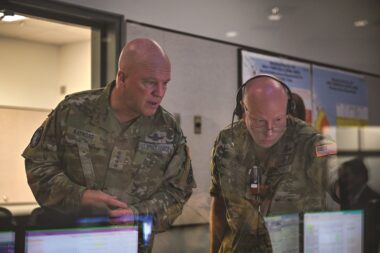
U.S. Space Force Gen. John W. “Jay” Raymond, left, chief of space operations, speaks with Brig. Gen. Stephen Purdy, Space Launch Delta 45 commander, at Cape Canaveral Space Force Station, Florida, in May 2021. Credit: U.S. Space Force photo by Airman 1st Class Thomas Sjoberg

In 2005 when Raymond was a strategist at the Defense Department’s Office of Force Transformation, he co-authored a paper with the office director, Adm. Arthur Cebrowski, titled “Operationally Responsive Space: A New Defense Business Model.”

The paper said DoD should have the ability “to reconstitute larger space capabilities if adversaries succeed in finally developing capabilities to negate them.”

Raymond said that paper was ahead of its time because the technology was not available to do responsive space missions. “Now, if we do this right, it will allow us to capitalize more on commercial capabilities.”

Even to this day, national security space launch is a process that begins years in advance and relies on expensive, fixed infrastructure, he noted. There are now more flexible launch options like airplanes that deploy small rockets and small vertical launch vehicles that can operate from multiple locations.

But what still has to be worked out is the “end to end” process for responsive space, Raymond said. No matter how quickly rockets can get to the pad, it doesn’t matter if the satellites are not ready, and there are regulatory requirements that have to be coordinated.

The next major step for responsive space is to “develop the operational concept for how you replenish these constellations and how you might use responsive capabilities,” said Raymond.Also needed is a clearly articulated requirement that has to be approved by the Pentagon in order to get funded, he said. “We’ve got to figure out the operational concepts and then have the requirements as we continue to experiment.”

A requirement is being drafted by U.S. Space Command, the organization responsible for determining a response plan if satellites come under attack. Raymond said demonstrations like TacRS-3 would help the command understand the art of the possible. There will likely be more demo flights, “but I want to progress from just doing experiments to no-kidding, real capability.”

Raymond’s successor as chief of space operations, Lt. Gen. B. Chance Saltzman, said he intends to continue to support tactically responsive launch efforts.

“If confirmed, the most critical issue I would address is expanding the scope of tactically responsive space to ensure we generate complete operational capabilities,” he said in written testimony submitted to the Senate Armed Services Committee for his Sept. 13 confirmation hearing.

“We must have end-to-end capabilities that include launch vehicles, satellites, ground systems and operational concepts,” he said. “And most importantly, the specific requirements of the combatant commanders, that enable a tangible response to potential adversary destabilizing actions in space.”

TABLETOP EXERCISE AT CAPE CANAVERAL

The Space Systems Command in September held a three-day tabletop exercise at Cape Canaveral Space Force Station, Florida, to examine the processes and the bureaucratic ins and outs of launching payloads on short notice.

Col. James Horne, Space Systems Command’s deputy director of operations, said the lessons from this exercise would help plan the TacRS-3 mission and inform future budgets.

A takeaway from the tabletop exercise, said Horne, is the need to involve all stakeholders, including the Space Force, U.S. Space Command, the Federal Aviation Administration, the Federal Communications Commission, and other agencies that have regulatory responsibilities.

“We looked at how we would execute a responsive launch, all the way from receiving orders from the combat commanders to delivering usable data to the warfighter with boots on the ground,” said Capt. Benjamin Vowell, chief of wargames and exercises at Space Systems Command.

“We learned that there are organizational things that we need to work through,” said Vowell. “This exercise was a way for us to pull the various threads and understand how we can enable responsive space.”

A central question, for example, is what it will take to integrate a satellite on the rocket so the launch provider can meet the 24-hour call-up. Processes like frequency allocation and approval and notifications to ships and aircraft would have to be dramatically accelerated.

The infrastructure needed to conduct rapid launches is another major issue, said Master Sergeant Travis Ferguson, launch operations manager at Space Systems Command.

“Our first option may be to just turn to a commercial contract and buy a capability depending on what mission area you’re talking about,” he said. “Or we could turn to an ally and ask them if we can use their assets.”

Lt. Gen. Michael Guetlein, head of Space Systems Command, said the demonstration in 2023 will give decision makers a better grasp of “where tactically responsive space can fill a wartime or crisis requirement.”

Back in 2018, similar questions were raised by the Defense Advanced Research Projects Agency when it announced a Launch Challenge prize competition.

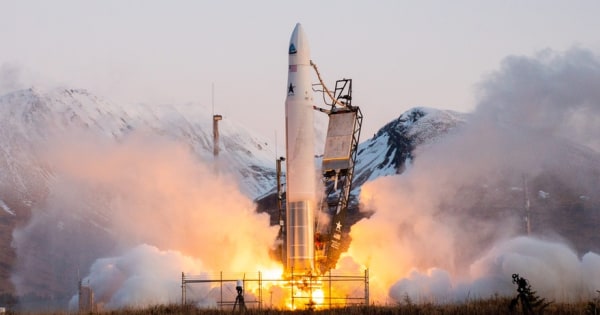
DARPA offered $10 million to any space company that could launch a payload to low Earth orbit with just a few days to prepare and do it again a couple weeks later. The effort was unsuccessful and ended when Astra, the lone challenge participant, scrubbed its launch in Kodiak, Alaska, less than a minute before liftoff.

Chris Bassler, a senior fellow at the Center for Strategic and Budgetary Assessments, said DARPA’s launch challenge shined a spotlight on responsive space but didn’t drive any policy or funding decisions at DoD.

The proliferation of anti-satellite weapons means it’s just a matter of time before the United States faces a real-world situation when it will need to restock, Bassler said.

DoD and the Space Force have stood by over the past couple of years while Congress has kept adding money to the program, Bassler said. The Space Force’s explanation that it doesn’t have specific requirements for rapid-response launch, he said, is a weak excuse.

“They do have a requirement to provide space capability even if attacked or degraded, so it’s implicit that they need replenishment options, and that is something that should be funded,” he added.

Investments in spaceports and agreements to launch from foreign countries would be needed in order to move away from DoD’s dependence on East and West Coast ranges, he said. The Space Force also needs to start working with multiple launch providers to try out different concepts and should accelerate the use of in-orbit servicing so satellites can be repaired.

The responsive space demonstration missions are a step in the right direction, Bassler said. However, things are still “moving very slowly considering the threat pace that keeps being talked about, China clearly being the most concerning.”

DOD IS AN ESSENTIAL CUSTOMER FOR SMALLSAT LAUNCHERS A military program focused on launching payloads in short order creates a major opportunity for small vehicles that can deploy from nontraditional spaceports, said Mandy Vaughn, industry consultant and former president of Virgin Orbit’s national security launch business.

DoD efforts in this area would be welcomed by small satellite launchers that are facing lagging demand in the commercial sector, she said. The Space Force “definitely realizes that the small and medium portions of the launch market are part of the architecture that they need moving forward,” she said. “They need a diversity of solutions and modalities.”

Despite the popularity of big-rocket rideshares, for responsive launch, they will need dedicated vehicles to reach specific orbits, Vaughn noted.

Rocket Lab, for example, in April changed the target orbit of two BlackSky imaging satellites at the last minute after the customer decided it needed to increase coverage over Ukraine.

“This shows that having a diversity of launch solutions is important,” said Vaughn.
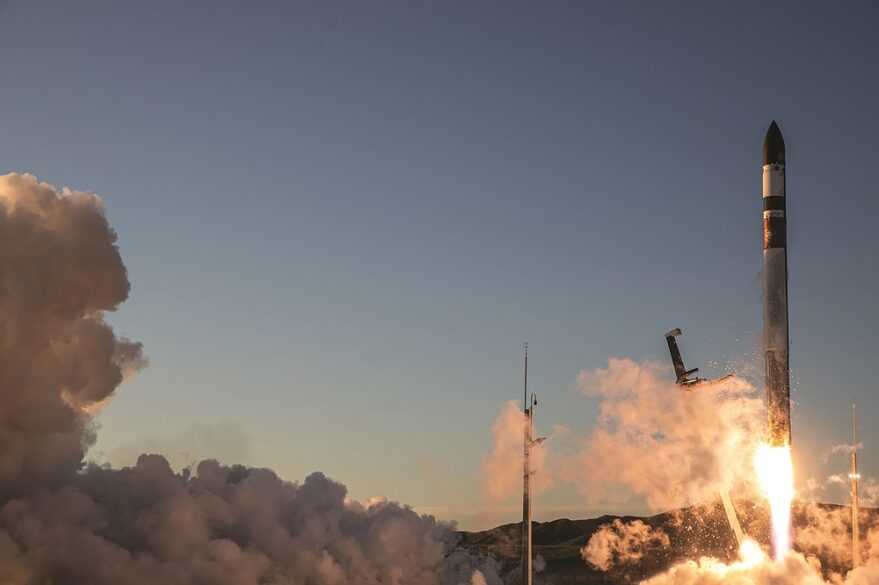
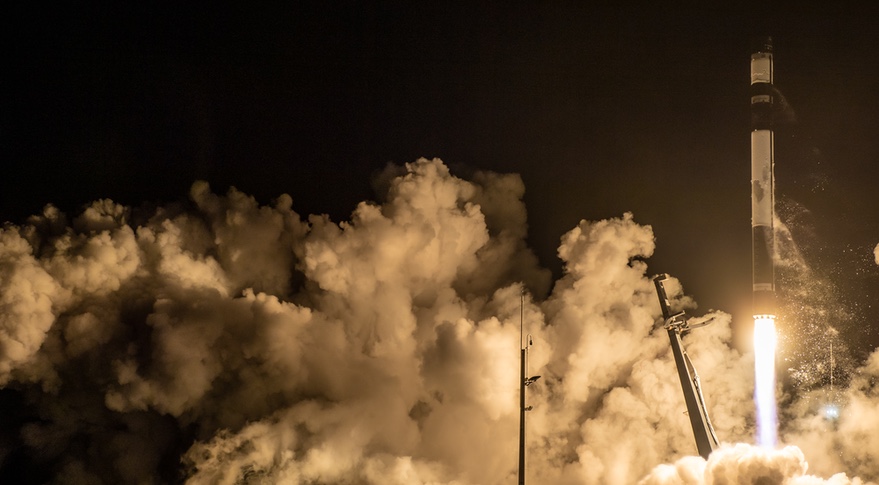
NROL-199, launched Aug. 4, was the second of two back-to-back Rocket Lab missions for the National Reconnaissance Office. The first mission, NROL-162 launched on July 13. Credit: Rocket Lab

Small launch vehicles currently in operation include Northrop Grumman’s Minotaur 1 and Pegasus XL, Rocket Lab’s Electron, Virgin Orbit’s Launcher One, and the winner of TacRS-3, Firefly, which performed its first successful orbital launch Oct. 1 just hours after the Space Force announced the $17.6 million contract award.

“We are honored to be chosen by Space Force for this important national security mission,” Bill Weber, CEO of Firefly Aerospace, said in a statement. “Now more than ever our country needs the ability for quick response capabilities to combat threats in space.”

Rocket Lab and Virgin Orbit recently rolled out marketing campaigns focused on responsive launch services.

In July, Rocket Lab, which also builds small satellites, announced a “24/7 rapid call-up launch capability and streamlined satellite build and operation options.” The company touts its ability to launch from New Zealand and Virginia’s Wallops Island.

On July 13 and August 4, Rocket Lab launched two separate national security missions for the National Reconnaissance Office. The company said the rapid turnaround between those launches demonstrated responsive space.

Virgin Orbit, which deploys small rockets from a Boeing 747 aircraft, in August released a marketing video on responsive launch featuring the company’s strategic advisers, former U.S. defense secretary Ash Carter, former director of national intelligence Dennis Blair, and retired Air Force lieutenant general Susan Helms.

“Our current space posture is too vulnerable to attacks that could occur too quickly,” Carter said in the video. “And that is where the ability to launch rapidly, to launch from anywhere, and to launch into any orbit is so important.”

Helms recalled participating in wargames of conflict scenarios in the South China Sea. “What we didn’t really have was responsiveness of launch, something everybody knew would help us in the exercise,” she said.

Dan Piemont, president and co-founder of ABL Space, said the company did not compete for the TacRS-3 contract because its RS1 launch vehicle is not yet operational. “But we’re definitely interested in the program long term,” he said. “We’ve been engaged with leadership of the Space Force and other agencies that are interested in this type of capability as well.”

Responsive space has been a talking point for years, said Piemont, but with these upcoming experiments, “the focus is understanding what needs to be done to conduct a useful launch within 24 hours of a call-up.”

The Space Force and the industry need to figure out what level of readiness they would need in wartime, said Piemont. “You would likely need the rocket basically pre-positioned and maintained at a high state of alert.”

CONGRESS KEEPS PUSHING

In a July report, Senate appropriators chided DoD for not moving more quickly to create a responsive space program. The defense appropriations subcommittee, which recommended adding $100 million in fiscal year 2023, said a responsive launch program of record is needed to ensure U.S. combatant commanders can “rapidly place and reconstitute space assets.”

Defense appropriators also noted that the Secretary of the Air Force failed to provide an acquisition strategy for responsive space as the 2022 National Defense Authorization Act directed. Meanwhile, the fiscal year 2023 president’s budget request “does not include any resources to establish the program despite a need to counter adversarial launches of disruptive technologies in a tactically relevant timeline.”

The House version of the 2023 NDAA calls for a long-term budget line for tactically responsive space and for the Space Force to lay out a program with wargames, tabletop and operational exercises.

“Given the successful Tactically Responsive Launch-2 mission,” said the House bill, “the Space Force should continue to broaden tactically responsive space efforts with a focus on rapid reconstitution and responsiveness.”

This article originally appeared in the October 2022 issue of SpaceNews magazine.
email sharing button Email
reddit sharing button Share
linkedin sharing button Share
twitter sharing button Tweet

✓ 

Firefly says Alpha launch a success despite payload reentries
by  — 

WASHINGTON — Firefly Aerospace says its Alpha launch early this month was a success despite the fact that its payloads, placed in a lower orbit than planned, reentered within several days.

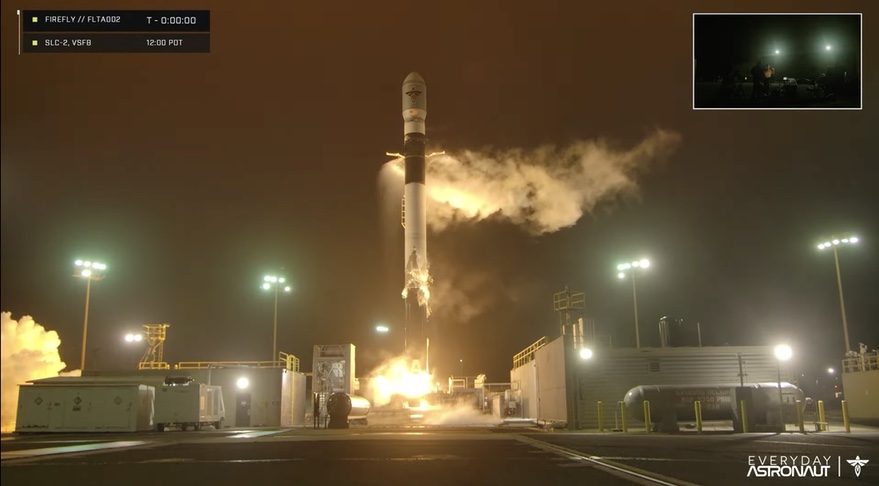
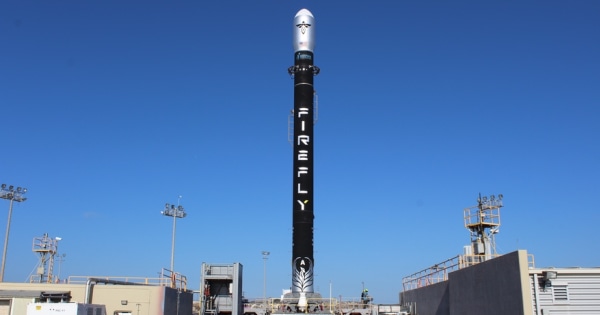
The Alpha rocket lifted off Oct. 1 from Vandenberg Space Force Base in California on the second flight of the vehicle, after the inaugural Alpha launch 13 months earlier failed when a first-stage engine shut down shortly after liftoff. On this launch, Alpha’s upper stage reached orbit and deployed its payloads, and the company declared the launch a success.

The launch carried three satellite payloads: a 3U educational cubesat called Teachers in Space (TIS)-Serenity, a 3U NASA technology demonstration cubesat named TechEdSat-15 and PicoBus, a deployer from the Libre Space Foundation carrying five PocketQube piosatellites. The U.S. Space Force ultimately cataloged five objects from the launch, including the Alpha upper stage, with two of the other four provisionally identified as TIS-Serenity and TechEdSat-15.

The satellites, though, appeared to be in lower orbits than originally planned. The press kit distributed by Firefly ahead of the launch said that the satellites would be placed in a 300-kilometer orbit after the upper stage performed a circularization burn. However, Space Force tracking data initially placed the objects into orbits with a perigee of about 220 kilometers and apogee of 275 kilometers.

Those orbits caused the payloads to decay rapidly. According to the Space Force’s Space-Track database, three of the objects reentered by Oct. 5 and the fourth, the Alpha upper stage, reentered on Oct. 7. Only the payload labeled as “Object A”, at one point identified as TIS-Serenity, is still listed in orbit according to Space-Track, although other sources list it as also having reentered.

That’s led to speculation that there was a problem with the launch. Seradata, a firm owned by space traffic management company Slingshot Aerospace that runs a leading satellite database, announced Oct. 6 it considered the launch a failure “due to the likely life loss for the seven satellites aboard when compared to their design lives.”

Firefly, though, reiterated the launch was a success. “First stage and second stage performance was in-line with our flight 2 requirements and therefore successful,” the company said in response to questions from SpaceNews about the mission.

There had been discussion immediately after the launch about a potential stage separation issue, with onboard video showing the nozzle of the upper stage engine appearing to nearly hit the interstage. Firefly, though, said there were no issues with stage separation: “Stage separation relative motion remained within vehicle requirements and expected from component level qualification and therefore successful for this test flight.”

“Our primary objective for the Alpha FLTA002 mission was to achieve a pre-defined elliptical orbit, following the second stage burn, which was 100% successful,” the company added, omitting the circularization burn mentioned in the press kit. “Our data review continues, but we are excited by our preliminary review showing that we will only need to make very minor tweaks for our next mission.”

NASA spokesperson Rachel Hoover confirmed Oct. 7 that TechEdSat-15 had deorbited. She added, though, that the spacecraft’s mission had been expected to last less than 10 days.

The primary purpose of TechEdSat-15 was to test an “exo-brake,” a drag device to aid in the deorbiting of satellites. The exo-brake is designed to operate at higher temperatures than other drag devices to enable more precise targeting of satellite reentries. The low orbit the spacecraft was placed in, though, led some to wonder if the exo-brake could be tested.

“TechEdSat-15 was delivered to an orbit that allowed the project to achieve its objectives,” Hoover said. “The team is now analyzing the flight data to study performance of the latest iteration of its exo-brake technology.”
email sharing button Email
reddit sharing button Share
linkedin sharing button Share
twitter sharing button Tweet
U.S. Arctic strategy calls for investment in climate monitoring, communications technologies
CAPSTONE attitude control restored
Eutelsat says satellite jammers within Iran are disrupting foreign channels
Rocket Lab launches Argos tracking payload
Ariane 6 upper stage testing underway
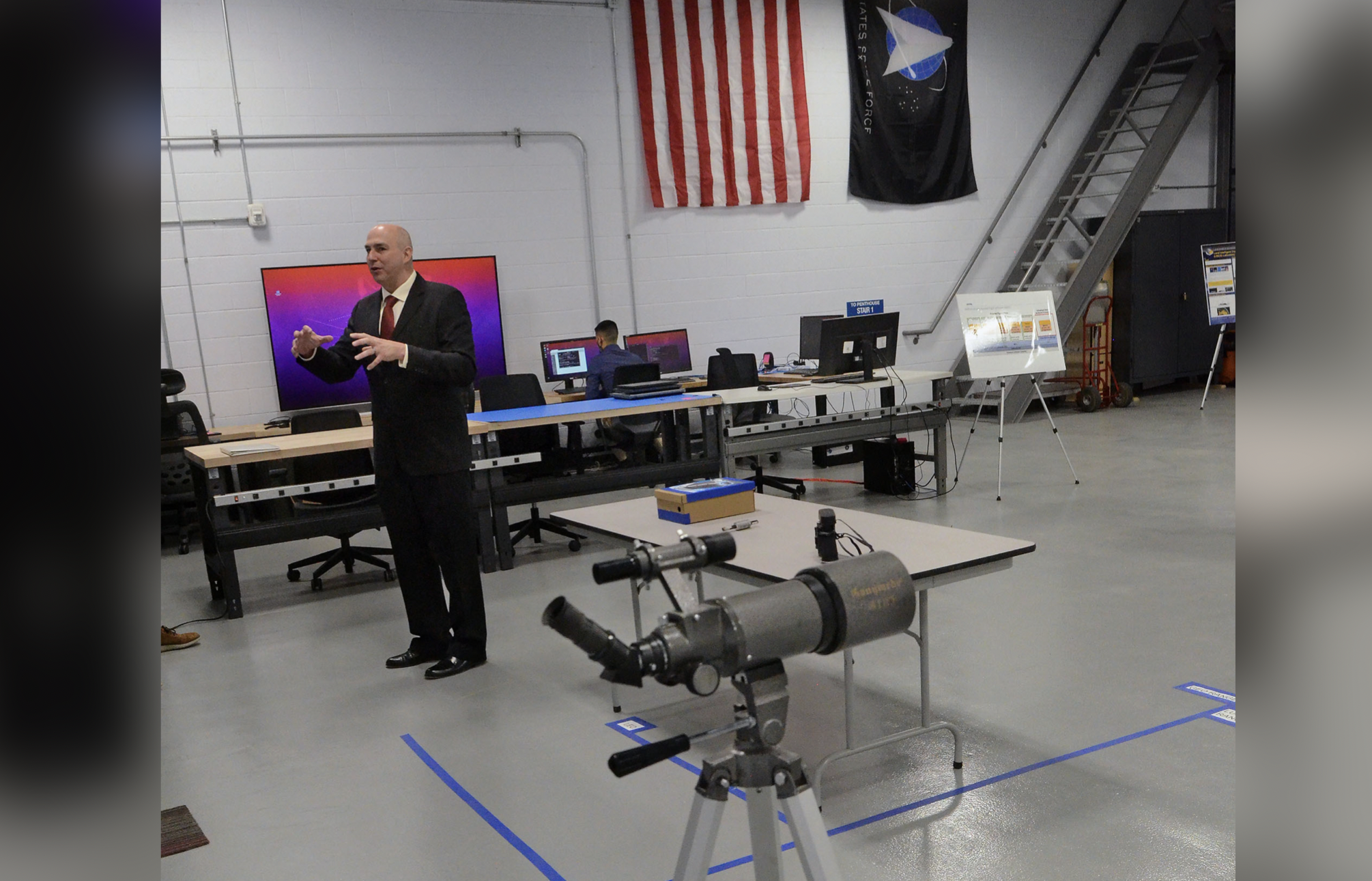
AFRL developing ‘cyber range’ for space operators

Sunday, October 09, 2022

GENERATION ALPHA?...Hmmm personalized virtual banking that connects one-on-one.

Please Note: The post Banks can’t afford to roll their eyes at the metaverse appeared first on Venture Beat.

"...But it’s the next generation of customers that banks should be preparing for. Generation Alpha is the newest member of the family unit, the children of millennials and the siblings of Gen Z. Gen Alpha’s oldest members were born in 2010 — the same year as the iPad — and they’re the first generation born entirely within the 21st century. For the under-12 set, it’s possible that all banking will take place in virtual worlds..."

dnyuz.com

Banks can’t afford to roll their eyes at the metaverse

 
5 - 6 minutes

"With virtual assets already being traded and sold in the metaverse, there is an inevitable demand that financial services, specifically banking, ensure secure payments, investments and transactions for all customers. We take physical and online banking security measures for granted, but how do these regulations and safeguards translate to a virtual world?

Luckily, banks have a long history of dealing with fraud in the real and online markets. Forward-thinking banks are already thinking about the metaverse as well, as they seek to capitalize on the untapped potential that an immersive, memorable and personalized customer experience offers. Pilot programs are already underway for connected experiences in areas such as 3D banking and personalized virtual banking. Innovative payment platforms and decentralized autonomous organizations (DAOs) will also make their way to the metaverse, creating a safe and engaging banking experience for the next generation of customers.

At first glance, banking and the metaverse may seem unlikely allies. After all, banking is a conservative, heavily regulated industry. Yet in some ways, banking is an obvious metaverse participant, as the backbone for safe and secure virtual transactions, enabling other industries to thrive. Delivering financial services through Web3 — the decentralized internet owned by communities of users and coordinated through mechanisms such as tokens and non-fungible tokens (NFTs) — is a natural way to meet the demands of young consumers primed for interactive experiences.

Consider that millennials, who led the way in disrupting personal finance through mobile banking, now have a greater awareness of the metaverse than their younger counterparts. They take their money seriously — 75% report they work with a professional financial advisor — and Gen Z isn’t far behind. Among those aged 18 to 24, 70% check their finances daily. They’re likely to follow “fin-fluencers” on platforms such as Discord, Reddit and Instagram. Also, 41% percent have sought financial advice on TikTok. (Yes, “FinTok” is real.)

But it’s the next generation of customers that banks should be preparing for. Generation Alpha is the newest member of the family unit, the children of millennials and the siblings of Gen Z. Gen Alpha’s oldest members were born in 2010 — the same year as the iPad — and they’re the first generation born entirely within the 21st century. For the under-12 set, it’s possible that all banking will take place in virtual worlds.

Tapping new markets and customers

The metaverse is an inevitability, and it’s essential for banks to prepare the foundation and capabilities to be ready when it ultimately explodes into reality. The good news for payment providers and retail and commercial banks is that there are very few obstacles preventing them from getting metaverse-ready. By building the infrastructure to support a holistic view of customers’ accounts (both flat and digital), banks can prepare their organizations for the connected, immersive experiences customers will be looking for. Integration between digital assets and mainstream finance is at the heart of banks’ ability to tap new markets and customers — and it’s gaining a foothold among young consumers and institutions alike.

One in five Americans has invested in, traded or used digital assets. More consumers aged 13 to 39 have invested in cryptocurrencies and NFTs than in stocks. And Wells Fargo pointed out in a recent note that while crypto’s role in the financial ecosystem is still up for debate, wide-scale adoption of crypto and blockchain products is underway at some of the largest global institutions. Within banks’ IT and process infrastructures, integration is a safe way to begin tapping new markets and opening the door to the connected experience consumers are looking for. With integration, banks and their customers take another step away from physical branches and 2D online banking and closer to personalized virtual banking that connects one-on-one.

Much remains unknown about how virtual worlds will evolve. Yet even amid global inflation and monetary tightening in the US, integration between digital currency and mainstream finance continues to grow. Consumer banks must act now to leverage the metaverse to give young and future customers the personalized and immersive experience they want.

Chander Damodaran is CTO at Brillio.

 
,.....
 
8 - 10 minutes

"Which country is Germany’s most important trading partner? 

✓ China, for the past six years. Which country sends the most foreign students to German universities? China again, with 43,629 arrivals in the last winter semester alone. With which country has Germany elevated its relations to the level of “comprehensive strategic partnership?” China. On its website, the German Foreign Ministry describes relations with China as “multi-faceted and intense”. China is at once a partner, a competitor, and a “systemic rival.”

All of this could barely have been imagined when on October 11, 1972, then-German Foreign Minister Walter Scheel and his Chinese counterpart Ji Pengfei exchanged documents for mutual diplomatic relations in Beijing. The People’s Republic of China was not the economic superpower we know today. Half a century ago it was a poor developing country, paralyzed by years of the Cultural Revolution and governed by an ageing Mao Zedong, who had long lost touch with the population, from a wing of the former imperial palace in Beijing.

There was no talk of a “values-based foreign policy.” It was the time of the Cold War. Germany and Europe were divided. The US and the Soviet Union were irreconcilably opposed. Perhaps following the proverb “the enemy of my enemy is my friend,” then-US President Richard Nixon made a surprise visit to Beijing in February 1972. China had had a falling out with its fellow communist state the Soviet Union, and Nixon’s historic visit triggered a diplomatic race to Beijing, and Germany was right in it.

Duisburg on the Silk Road

Half a century later, the “multi-faceted and intense” relationship has been demonstrated by over 100 partnerships between German and Chinese cities. For example, there is one between Duisburg and Wuhan, which size-wise are as different as Germany and China: With about half a million people in Duisburg and more than 8 million in Wuhan.

Duisburg has set up a special China unit to further build relations, and strong connections have already been made. Duisburg Zoo is proud of not only its red pandas, but also of its Chinese garden – complete with a water pavilion, arched bridge, and lion statues as a gift from its sister city. The University of Duisburg-Essen maintains cooperation with Chinese partners.

Most of all, Duisburg has become a junction on the new Silk Road. Every week, 60 goods trains arrive from China. When the first train from the far east pulled into Duisburg’s station in 2014, decked in garlands, Chinese President Xi Jinping stood on the platform, escorted by then-German Foreign Minister Sigmar Gabriel.

Changing political winds

But those images are from a bygone era. The political winds have changed – and become significantly harsher. A wide variety of delegations from both sides used to whizz back and forth between Germany and China. Today, meetings between German and Chinese politicians have become rare. The coronavirus pandemic, with China’s strict zero COVID strategy and restrictive entry requirements, has played a role. But it is not only that.

It is mostly because the elements of partnership and competition have receded in recent years, while systemic rivalry has increasingly come to the fore.

Whether it’s China’s threatening gestures toward Taiwan, the persecution of its Uyghur minority, the massive oppression of the democratic movement in Hong Kong or Beijing’s aggressive conduct in the South China Sea: The perceived triggers for confrontations with China are growing – and the common ground is crumbling.

The divergent interests of Chinese and international partners in joint ventures used to be described as “sleeping in the same bed but dreaming different dreams.” Now it seems like Germany and China have made their beds in different rooms.

Competing systems

For a long time, it was assumed that by being integrated into a globalized economy, China would draw nearer to the West politically as well as economically, explained Bernhard Bartsch from the Berlin-based think tank the Mercator Institute for China Studies (MERICS).

“Many people in China thought this too,” the China analyst told DW. But this has changed fundamentally in recent years under Xi Jinping. “Ultimately China is saying: ‘We have our own system. And we want to change the global order and the rules that go along with it.’ They no longer want to acknowledge and accept the – as the Chinese see it – Western-dominated system.” 

President Xi Jinping has an ambitious goal for his country: by the 100th anniversary of the People’s Republic of China in 2049, China is to be a mature, modern, socialist power with the ability to set and shape rules, leading the world economically and technologically. Its desire to be at the center of the world order brings China into conflict with the hitherto hegemonic power, the US.

For Berlin, the conflict playing out between its most important economic partner and its most powerful ally is problematic. China expert Bartsch notes: “Germany and Europe are more frequently facing the question: whose side are you on?” In the Angela Merkel era, Berlin tried to avoid being pressured into making such a decision, Bartsch said. But since then, it has become increasingly difficult to avoid. “Germany’s relationships with China and the US are not equidistant,” Bartsch explained. “We are much closer to the US than to China. Nevertheless, we do not want to miss the opportunities offered by the relationship with China.”

The struggle for distance

In the meantime, it is becoming apparent that Berlin is distancing itself from Beijing. German Economy Minister and Vice Chancellor Robert Habeck, of the Green Party, has already announced a “more robust trade policy” toward China. At a meeting of G7 economy ministers in September, Habeck declared: “The naivety toward China is over.”

Habeck had already denied the VW group guarantees for investments in China back in May, which was a shock for the economy. For decades, German companies’ business in China had been facilitated by guarantees on investments as well as exports. Germany and China’s relationship revolved around these flourishing economic ties. Top German political leaders were regularly accompanied by large business delegations on their trips to China; the signings of new cooperation projects were celebrated. About 5,000 German companies are active in China today – with investments of about €90 billion ($88 billion).

Today the mood is gloomy. In a position paper presented in mid-September, the European Chamber of Commerce in China complained that business was becoming increasingly politicized. “While China once shaped globalization, the country is now considered less predictable, less reliable and less efficient,” the paper said.

The Chamber’s president, Jörg Wuttke, lamented to DW that “Europeans and Chinese can barely exchange ideas anymore. Hardly any Chinese dignitaries are flying to Europe. That was always incredibly important for a reality check,” he said. On the other hand, fewer German students are being drawn to China. “This means we are missing out on each other,” he concluded.

As a member of the German-Chinese parliamentarians’ group, Social Democrat (SPD) lawmaker Dagmar Schmidt has observed this estrangement first-hand. “When I was chairperson in 2014, we still had a very lively exchange. We received many delegations from China, offered talks, led discussions. It was always very rewarding,” Schmidt told DW. But the meetings became less frequent – and more boring. “People no longer spoke as freely, instead they just read from notes; it was all much more controlled.” The exchange deteriorated further through the pandemic – occasional video conferences are no match for face-to-face meetings.

Europe and China are already at opposite ends of a vast continent. Yet, 50 years since diplomatic relations began, they seem to be drifting even further apart.

While you’re here: Every Tuesday, DW editors round up what is happening in German politics and society. for the weekly email newsletter Berlin Briefing.

The post Germany and China showing strain in 50-year relationship appeared first on Deutsche Welle.

U.S. economy is "on a bumpy journey to a better destination" – unless the U.S. Federal Reserve makes another misstep

Intro: Economist Mohamed El-Erian said Sunday that despite the recent market volatility, the U.S. economy is "on a bumpy journey to a better destination" – unless the U.S. Federal Reserve makes another misstep. . .He said the agency’s first error was to mischaracterize inflation as "transitory," meaning that it would be temporary. Its second blunder, he said, was that it did not act in a meaningful way after inflation remained persistent and high.

"As a result, we risk mistake number three, which is by not easing the foot off the accelerator last year, they are slamming on the breaks this year, which would tip us into recession," El-Erian said.


3 hours ago · He is the chief economic adviser at financial services company Allianz. He is also president of Queens College in Cambridge. He's good enough to ...


We are joined by Allianz Chief Economic Adviser Mohamed El-Erian to discuss the cooling economy and high inflation this Sunday at 10:30a E.T..


www.foxbusiness.com

Economist Mohamed El-Erian says US economy ‘on bumpy journey to better destination’

Stephen Sorace
2 - 3 minutes

El-Erian says markets worried Fed may overreact to good economic news and tip us into recession

"Economist Mohamed El-Erian said Sunday that despite the recent market volatility, the U.S. economy is "on a bumpy journey to a better destination" – unless the U.S. Federal Reserve makes another misstep.

El-Erian, chief economic advisor at Allianz, appeared on CBS's "Face the Nation" to discuss what caused instability in the markets last week.

"The main source of this volatility is changing perceptions of the Federal Reserve," El-Erian said. "We are in this amazing situation … where good news for economy is bad news for the markets."

El-Erian said the markets are worried that the Fed will tip us into a recession by overreacting to strong economic news.

US JOB GROWTH SLOWS AGAIN IN SEPTEMBER WITH JUST 263,000 POSITIONS ADDED

Mohamed El-Erian, Chief Economic Adviser of Allianz

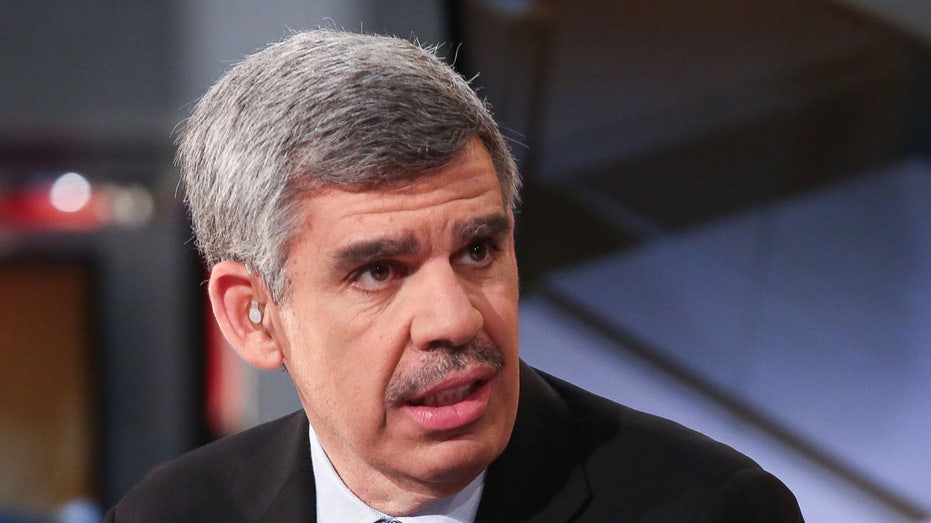
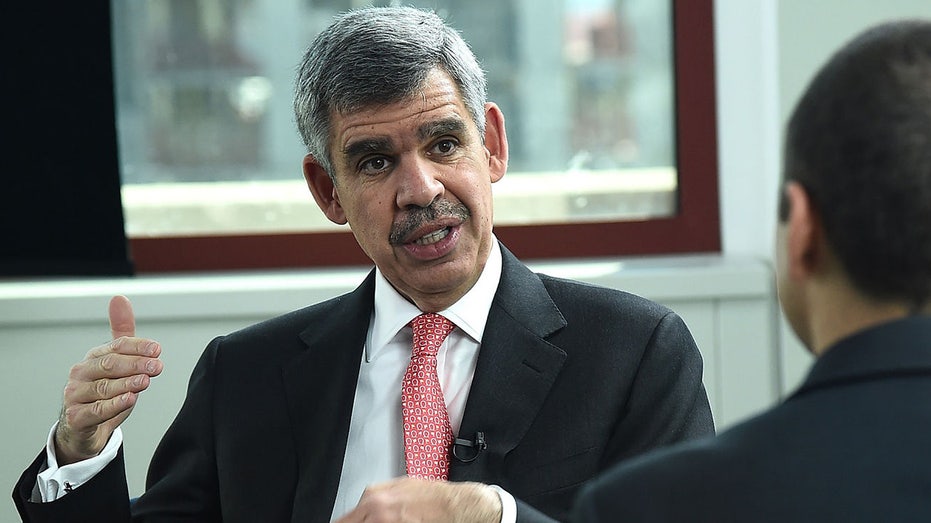
Mohamed El-Erian, the chief economic adviser of Allianz, said he believes that market volatility is being caused over concern that the U.S. Federal Reserve may overreact to good economic news and tip us into a recession. (Photo by Rob Kim/Getty Images / Getty Images)

"There is a possibility that the Federal Reserve makes another mistake and that that bumpy journey actually changes the destination," the economist said. "That’s why the markets are on edge."

El-Erian said the fed has already made "two big mistakes" that he thinks will "go down in the history books."

SEPTEMBER JOBS REPORT COULD SOLIDIFY ANOTHER SUPER-SIZED FED RATE HIKE

Mohamed A El Erian

Mohamed El-Erian said he believes the U.S. economy is on "a bumpy journey to a better destination" – that is, unless the Fed changes that destination. (Theo Wargo/Getty Images / Getty Images)

He said the agency’s first error was to mischaracterize inflation as "transitory," meaning that it would be temporary. Its second blunder, he said, was that it did not act in a meaningful way after inflation remained persistent and high.

GET FOX BUSINESS ON THE GO BY CLICKING HERE

"As a result, we risk mistake number three, which is by not easing the foot off the accelerator last year, they are slamming on the breaks this year, which would tip us into recession," El-Erian said."

2 Arizona Candidates appear on CBS News (Back to Back)

Both Lake and Hobbs appeared on “Face the Nation” for back-to-back interviews, during which they discussed the top issues facing voters. Here’s what they had to say. . .


“Face the Nation” Guest Lineup:

  • Katie Hobbs — (D-Ariz.) Candidate for governor

  • Kari Lake — (R-Ariz.) Candidate for governor

  • Peter Baker — New York Times chief White House correspondent

  • Susan Glasser — The New Yorker staff writer 

  • Mohamed El-Erian — Allianz chief economic adviser 


Latest CBS News Battleground Tracker with:

  • Anthony Salvanto — CBS News elections and surveys director


First, some reviews 


1 hour ago · The following is a transcript of an interview with Kari Lake, Republican candidate for governor in Arizona, that aired on Sunday, Oct. 9, ...

 ✓

1 hour ago · The race is between Kari Lake, who has denied the results of the 2020 election, and Katie Hobbs, who was secretary of state at the time.


21 hours ago · Democrat Katie Hobbs won't debate her opponent in Arizona's race for governor, yet Republican Kari Lake tried to make it happen at a ...


4 hours ago · Kari Lake — (R-Ariz.) Candidate for governor. Peter Baker — New York Times chief White House correspondent. Susan Glasser — The New Yorker staff ...


dnyuz.com

Arizona gubernatorial candidates on abortion, immigration and the economy

8 - 10 minutes

Washington — Arizona gubernatorial candidates Katie Hobbs, a Democrat, and Kari Lake, a Republican, discussed Sunday on “Face the Nation” the top issues facing voters in the state one month ahead of Election Day, making their pitch for why they should serve as Arizona’s chief executive in one of the most closely watched races this cycle.


CBS News poll of likely voters published Wednesday found Hobbs and Lake deadlocked at 49%. Among registered voters in Arizona, Lake, however, trails Hobbs by nine points on how she handles herself personally.

Hobbs, who serves as Arizona’s secretary of state, declined an invitation to debate Lake, who has embraced former President Donald Trump’s false claims the 2020 presidential election was stolen. 


Hobbs told “Face the Nation” during an interview Sunday she has “no desire to be a part of the spectacle” surrounding her Republican gubernatorial opponent and accused Lake of creating a “circus” that does not benefit Arizona voters.

“At this point in the race with 30 days to go, our schedule in terms of forums is pretty much set. And I’m really happy with where we are in the plans we have to continue talking directly to the voters of Arizona,” she said.


But Lake, who will participate in a one-on-one interview Wednesday, said she has agreed to participate in “any and all” debates with Hobbs.

“I would love it if she would show up because I think there’s a lot of important issues that the people of Arizona need to hear about,”  she said.


Election denialism

Arizona was among the states key to President Biden’s 2020 presidential win, and he became the first Democrat to win the state since 1996. The results of the presidential election in Arizona were certified, and reaffirmed through a hand recount and review commissioned by Republicans in the state.

Lake, who has repeated Trump’s baseless claims the 2020 election was rife with voter fraud, said Sunday that there are “major problems” with the state’s election system.

“We can’t speak out against our own elections,” she said. “All I’m asking for is the ability to speak out when our government does something wrong. We should be able to speak out against it.”

Lake said there has to be “honesty” restored in elections.

Unsupported claims about the integrity of elections has led to threats against election workers, and last week, a 64-year-old Iowa man was arrested after he was accused of threatening to kill Maricopa County Supervisor Clint Hickman. 

Asked whether she supports federal and state prosecution of people who threaten election workers, Lake said “anyone who threatens anyone’s life should be detained and questioned.”

“I think we need to get back to where we have free speech and we shouldn’t be threatening people, and I hope that they arrest that man and detain him,” she said.


The economy

The economy and inflation are top issues for likely voters in Arizona, according to the CBS News poll, and voters most concerned about immigration and the economy favor the Republican candidate.

Hobbs said she and her husband know acutely the struggles Arizona families face amid high consumer prices, having raised their family “through financial ups and downs.”

“We have a comprehensive plan to address the rising costs that Arizonans are facing right now that will put money back in their pockets,” she said. “We cut taxes on all kinds of everyday items like over the counter medication, school supplies, diapers, feminine hygiene products, we provide a state level child tax credit, and tax credits for people who want to go back to work in higher paying jobs to get career and technical education.”


Abortion

The CBS News poll found the 60% of Arizona voters believe abortion should be legal in all or most cases, and abortion is a top issue for Democratic voters in the state, though it does not rank as high among all voters when compared to the economy, inflation or immigration.

Lake told “Face the Nation”  that she would “follow the law” on limits to abortion in Arizona, which currently prohibits the procedure after 15 weeks of pregnancy. 

“We need to draw the line somewhere. I am going to be the executive of the state, the chief executive officer, and I will follow the law,” she said. “The law right now as it stands is Gov. Ducey’s law at 15 weeks, so we’ll follow the law.”

Lake said supports giving women choices when confronted with an unplanned pregnancy and argued that when women go to abortion clinics, “they’re only given one choice.”

“I will uphold the law, whatever that law is. And I want to see to it that we’ve save more lives,” she said.

Hobs said on “Face the Nation” that she does not support Arizona’s 15-week abortion ban and accused Lake of “entirely misconstruing” her position on abortion.

“Under a Kari Lake administration, we would have government-mandated forced births that risk women’s lives. And her position is the one that’s extreme,” Hobbs said. “It’s out of touch with where the majority of Arizonans are who support access to safe and legal abortion. And under her administration, women would not be safe.”

Hobbs said abortion is a “very personal decision that belongs between a woman and her doctor.” 

“The government and politicians don’t belong in that decision, we need to let doctors perform the care that they are trained and take an oath to- to perform,” she said.

✓ 

Immigration

Lake has proposed Arizona join a compact with other like-minded states to carry out immigration enforcement at the U.S.-Mexico border and said that she has spoken with other governors who have pledged to help Arizona.

“Article 4, Section 4 calls for the federal government to protect us from invasion, and under Joe Biden’s lack of leadership, we just aren’t seeing that,” she told “Face the Nation.” “And we have an invasion at our border, the cartels, these narco-terrorist groups have operational control. And they’re using Arizona to smuggle people, to traffic children and to traffic the most dangerous drug we’ve ever seen, fentanyl. And so we’re going to invoke our Article One, Section 10, basically, authority to take care of our own border and protect our own border.”

Lake told “Face the Nation” that a failure of immigration policy by the Biden administration has led to a surge of fentanyl coming across the southern border, impacting not only people in Arizona but across the country as the drugs flow to other states.

“We’re not going to back down and let our people be overrun with drugs, watch our children die,” she said. “We can’t keep having this happen. We’re losing our young generation. So I hope that Joe Biden doesn’t fight us because then it would really look like he is on the side of the cartels. And I don’t think he wants the people to think that.”

Hobbs, meanwhile, said Arizona has born the brunt of the failures of U.S. immigration policies, but she told “Face the Nation” that there has been “bad” immigration policy for decades.

“Trump has centered his whole immigration policy around finishing the wall and it’s not done. But Biden does need to step up immigration and border security. Absolutely,” she said. “Arizona is bearing the brunt of illegal drug trafficking, gun trafficking and smuggling. And we do need more border security. It’s not going to get done by declaring an invasion at the border or dismantling the F.B.I., which is another thing that my opponent has called for.”

Hobbs criticized Lake’s plan, saying her positions are “empty rhetoric.”

“She’s not offering real solutions. When she talked about invoking the constitutional authority of the state, she’s talking about declaring an invasion at our southern border,” she said. “That would do absolutely nothing to increase border security, but it would bring untold levels of chaos into our state. It’s not a real solution.”