Saturday, November 26, 2022

Visual Capitalist: DEMOGRAPHICS

 DEMOGRAPHICS

3D Map: The World’s Largest Population Density Centers

Published


on


Mapping 3d global population density spikes

Click here to view the full version of this graphic

A 3D Look at the Largest Population 

DEMOGRAPHICS

3D Map: The World’s Largest Population Density Centers

Published


on


Mapping 3d global population density spikes

Click here to view the full version of this graphic

A 3D Look at the Largest Population Density Centers

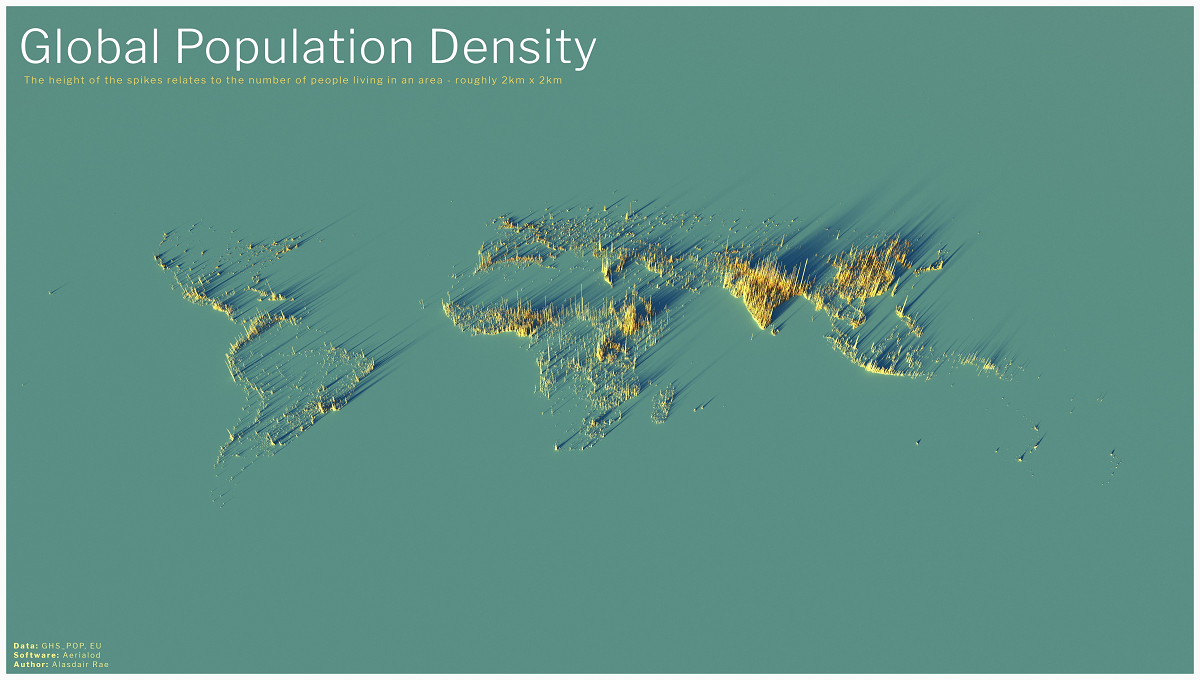
It can be difficult to comprehend the true sizes of megacities, or the global spread of 8 billion people, but this series of population density maps makes the picture abundantly clear.

Created using the EU’s population density data and mapping tool Aerialod by Alasdair Rae, the 3D-rendered maps highlight demographic trends and geographic constraints.

Though they appear topographical and even resemble urban areas, the maps visualize population density in squares. The height of each bar represents the number of people living in that specific square, with the global map displaying 2km x 2km squares and subsequent maps displaying 1km x 1km squares.

Each region and country tells its own demographic story, but the largest population clusters are especially illuminating.

China vs U.S. — Clusters vs Sprawl
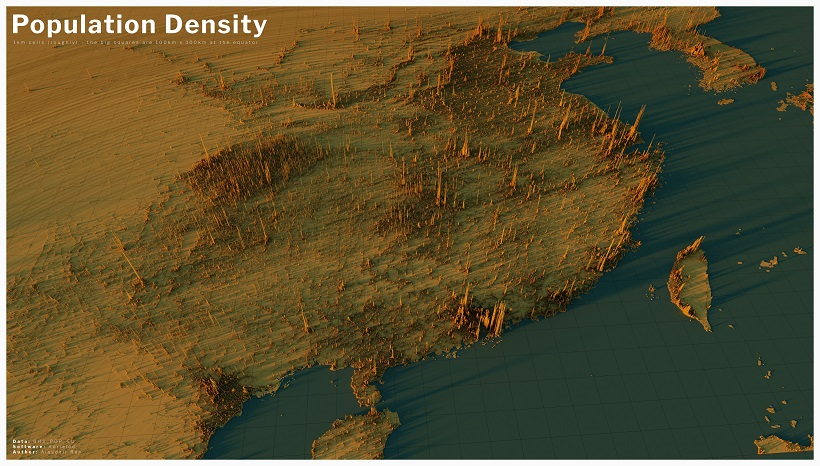
population density spikes around China

Click here to view the high resolution version.

Zooming into the most populated country in the world, China and its surrounding neighbors demonstrate massive clusters of urbanization.

Most people are familiar with the large density centers around Hong KongGuangzhou, and Shanghai, but the concentration in central China is surprising. The cities of Chengdu and Chonqing, in the Sichuan Basin, are part of a massive population center.

Interestingly, more than 93% of China’s population lives in the Eastern half of the country. It’s a similar story in neighboring South Korea and Taiwan, where the population is clustered along the west coasts.
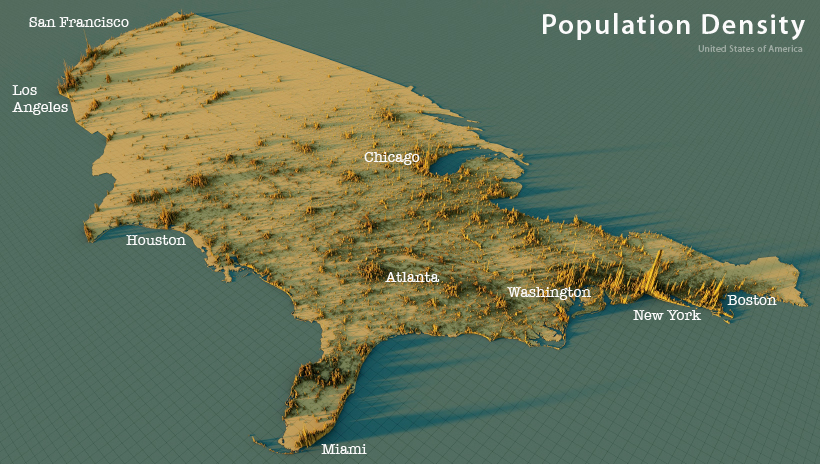
population density spikes in the united states

Click here to view the high resolution version.

The U.S. also has large population clusters along the coasts, but far more sprawl compared to its Asian counterparts. Though the Boston-Washington corridor is home to over 50 million residents, major centers spread out the population across the South and the Midwest.

Clearly visible are clusters in Florida (and not exclusively focused around Miami like some might believe), Illinois, Georgia, and Texas. The population is sparse in the West as expected, but California’s Los Angeles and Bay Area metros make up for the discrepancy and are just behind New York City’s density spikes in height.

India & Southeast Asia — Massive Density in Tight Areas
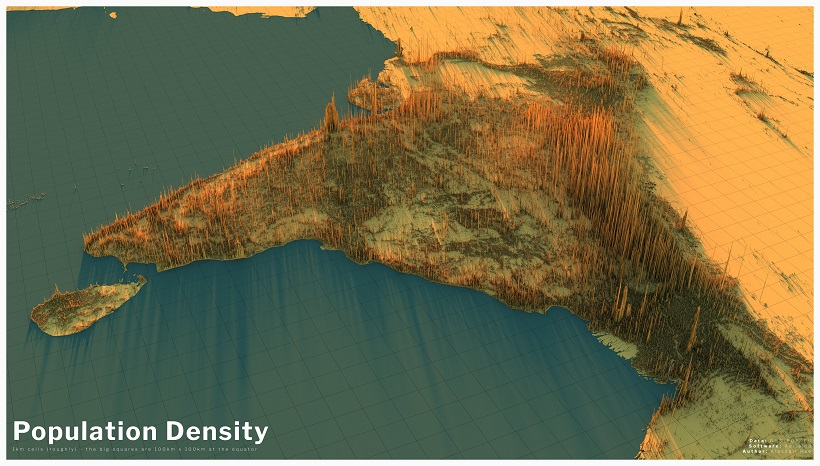
population density spikes around India

Click here to view the high resolution version.

At 1.38 billion people, India’s population is just behind China’s in terms of size. However, this sizable population fits into an area just one-third of China’s total land area, with the above map demonstrating what the same amount of people looks like in a smaller region.

On one hand, you still have clear clusters, such as in MumbaiNew DelhiKolkata, and Bangladesh’s Dhaka. On the other, there is a finite amount of room for a massive amount of people, so those density “spikes” are more like density “peaks” with the entire country covered in high density bars.

However, we can still see geographic trends. India’s population is more densely focused in the North before fading into the Himalayas. Bangladesh is equally if not more densely populated, with the exception of the protected Sundarbans mangrove forest along the coast. And Pakistan’s population seen in the distance is clustered along the Indus River.
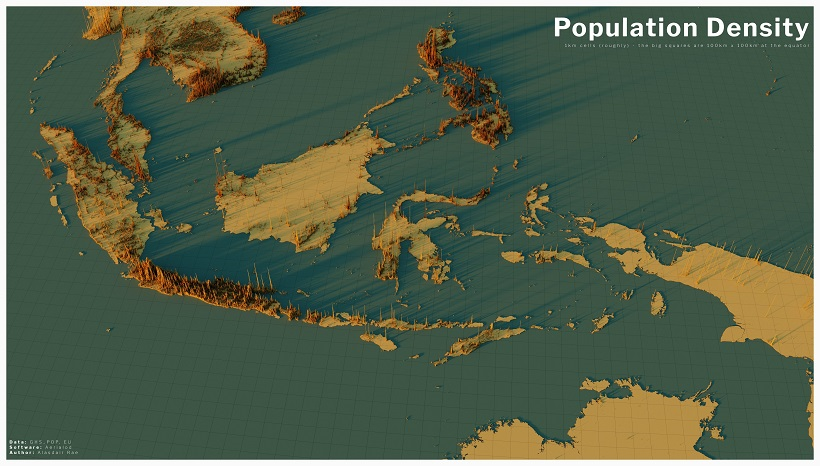
population density spikes in Southeast Asia

Click here to view the high resolution version.

Geographic constraints have always been the biggest deciding factor when it comes to population density, and nowhere is this more apparent than Southeast Asia.

Take Indonesia, the fourth largest country by population. Despite spanning across many islands, more than half of the country’s 269 million inhabitants are clustered on the single island of Java. The metros of Jakarta and Surabaya have experienced massive growth, but spreading that growth across oceans to entirely new islands (covered by rainforests) is a tall order.

When the distance is smaller, that cross-water growth is more likely to occur. Nearby in the Philippines, more than 100 million people have densely populated a series of islands no bigger than the state of Arizona.

Indeed, despite being one of the most populated areas in the world, each country in Southeast Asia has had its own growing problems. Some are limited by space (Singapore, Philippines), while others are limited by forests (Thailand, Vietnam).

A World of Different Density Pictures

Though the above maps cover the five most populated countries on Earth, accounting for nearly half of the world’s population, they only show a small part of the global picture.

As the full global density map at the top of the page highlights, the population patterns can accurately illustrate some geographic patterns and constraints, while others need further exploration.

For example, the map clearly gives an outline of Africa and the sparse area that makes up the Sahara Desert. At the same time, landmasses like Australia and New Zealand are almost invisible save for a few clusters along the coast.

To get a closer and more intricate picture of each country’s density map, head to Alasdair Rae’s long thread of rendered maps and start scrolling up to find yours!

green check mark icon

This article was published as a part of Visual Capitalist's Creator Program, which features data-driven visuals from some of our favorite Creators around the world.

Subscribe to Visual Capitalist

Friday, November 25, 2022

For Last Year: BEA Announcement: New and Revised Statistics of the U.S. Digital Economy, 2005–2021


BEA Announcement: New and Revised Statistics of the U.S. Digital Economy, 2005–2021


BEA released a report today describing new and updated digital economy statistics for 2005-2021.
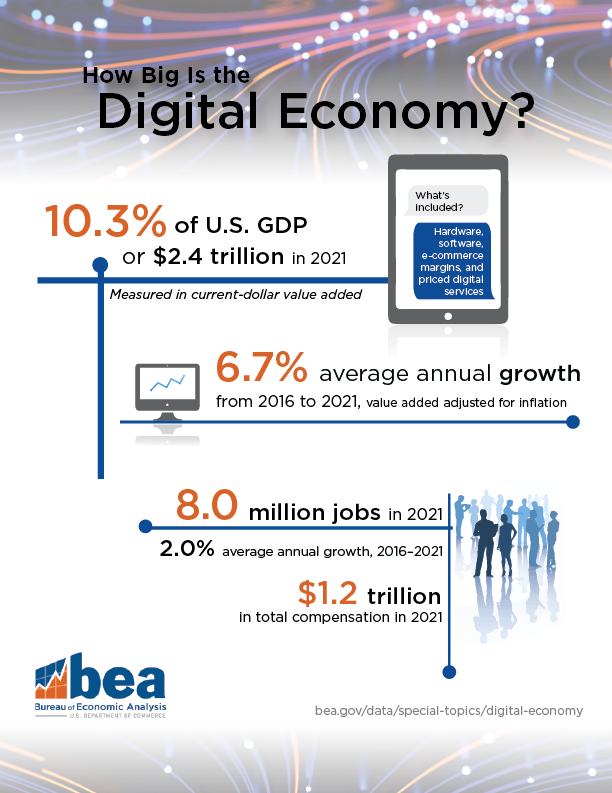
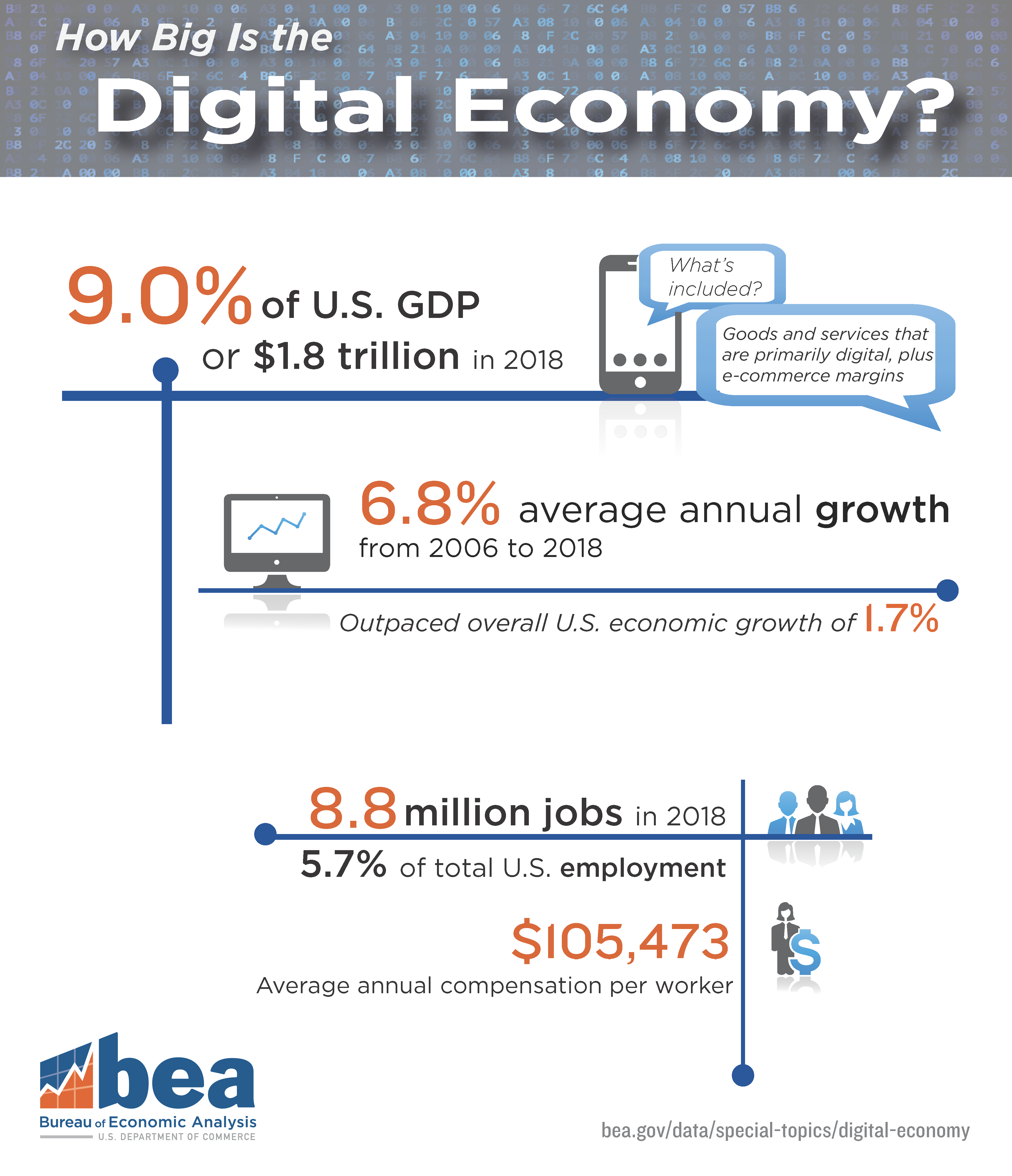
The digital economy accounted for 10.3 percent of U.S. gross domestic product, or $2.41 trillion in current-dollar value added, in 2021, according to new statistics from BEA. The inflation-adjusted average annual growth rate from 2016 to 2021 was 6.7 percent. The updated Digital Economy Satellite Account includes detailed data tables and research on methodology for measuring the digital economy.
The report, along with associated data tables, can be found at: https://www.bea.gov/data/special-topics/digital-economy
www.bea.gov

Digital Economy | U.S. Bureau of Economic Analysis (BEA)

11 - 14 minutes

Digital Economy Satellite Account

Update

A new report with statistics covering the period from 2005 to 2021 was released in November 2022. This report introduces updated digital economy estimates and replaces earlier estimates.

BEA includes in its definition of the digital economy four major types of goods and services:

  • Infrastructure, or the basic physical materials and organizational arrangements that support the existence and use of computer networks and the digital economy, primarily information and communications technology (ICT) goods and services.
  • E-commerce, or the remote sale of goods and services over computer networks.
  • Priced digital services, or services related to computing and communication that are performed for a fee charged to the consumer.
  • Federal nondefense digital services represents the annual budget for federal nondefense government agencies whose services are directly related to supporting the digital economy.

BEA is continuing to explore data and methodology to expand the coverage of the digital economy estimates. For more information on the goods and service currently included in the BEA estimates, please see the latest report "New and Updated Digital Economy Statistics—November 2022PDF".

Please email all comments to DigitalEconomy@bea.gov

International Trade in ICT and Potentially ICT-Enabled Services

BEA's statistics on trade in information and communications technology (ICT) and potentially ICT-enabled services complement its standard presentation of international trade in services statistics by examining the extent to which ICT may be used to facilitate trade in services. ICT services are those used to facilitate information processing and communication; potentially ICT-enabled services are services that can predominantly be delivered remotely over ICT networks. BEA measures potentially ICT-enabled services rather than ICT-enabled services themselves because for many types of services the actual mode of delivery is unknown.

  • Previously Published Estimates XLS
    Country estimates in these files use a slightly different definition of ICT and potentially ICT-enabled services than in the interactive data.

Price Measurement of High-Tech Goods and Services

BEA is consistently working toward improving price measurement, especially for high-tech goods and services which frequently experience changing characteristics, improved quality, and price changes relative to other goods and services.

AeroSpace & Defense News Fri 25 Nov 2022

 Here's one highlight to get started

Nov 23, 2022

NGC's IBCS Uses New Weapons Data Link to Engage Patriot Missile During Flight Test, Removing Existing Dependencies

During two separate tests at White Sands Missile Range (WSMR), New Mexico, Northrop Grumman Corporation’s (NYSE: NOC) Integrated Battle Command System (IBCS) proved again the system’s modular, open architecture integrates with any networked sensor and effector from past, present or future.

The first live target engagement involved a Sentinel radar tracking a cruise missile target across the desert. IBCS then engaged the target using Lockheed Martin’s Remote Interceptor Guidance (RIG-360) prototype as the uplink to the Patriot Interceptor. This was accomplished through Northrop Grumman’s investment in internal research and development to perform the engineering necessary to integrate RIG-360 with IBCS.

The success of this test removes the dependency of the Patriot radar in IBCS’ architecture to provide the communication link to and from the interceptor and further proved IBCS’ ability to rapidly integrate with emerging technology.

Missiles - Market and Technology Forecast to 2029

Missiles - Market and Technology Forecast to 2029

Market forecasts by Region, Technology, System, Platform, Component, Guidance System, and End-User. Market and Technology Overview, Opportunity and Scenario Analysis, and Leading Company Profiles

Published: August 2021 - Pages: 241 pages

“IBCS’ ability to integrate with any available networked sensor and effector provides the warfighter flexibility, time and dominance in the battlespace,” said Christine Harbison, vice president and general manager, combat systems and mission readiness, Northrop Grumman. “With every unique system test, the IBCS architecture has proven that the system is defining the possibilities of providing command and control across domains.”

During the second live target test, a ground launched cruise missile surrogate was effectively detected, tracked, engaged and destroyed using IBCS. Using a Patriot Interceptor, IBCS created a fire quality track and common operating picture to eliminate the threat.

IBCS implements a modular, open and scalable architecture that is foundational to integrating available assets in the battlespace, regardless of source, service or domain. Its architecture enables the efficient and affordable integration of current and future systems and extends the battlespace by disaggregating sensors and effectors. Through numerous successful tests and demonstrations, IBCS has validated the ability to connect and fuse multi-service sensor data to multi-service weapons, demonstrating JADC2 capabilities.


Northrop Grumman Corporation
View original News release

National Summit on Hypersonic Weapons Systems 2023

National Summit on Hypersonic Weapons Systems 2023

Washington, DC
Apr 25 - 26, 2023

National Congress on Counter UAS Technology 2023

National Congress on Counter UAS Technology 2023

Washington, DC
May 23 - 24, 2023

NYT Columnist Thomas Friedman: “The World Will Push Back” Against Trump ...

    Jan 27, 2026 #amanpourpbs From ICE's violent crackdown in Minneapolis to President ...