Thursday, December 01, 2022

21st Century -- Drone War Accelerates Over Ukraine


insideunmannedsystems.com

Drone War Accelerates Over Ukraine

Sébastien Roblin
21 - 26 minutes

Both sides get better at killing drones – and need them more than ever
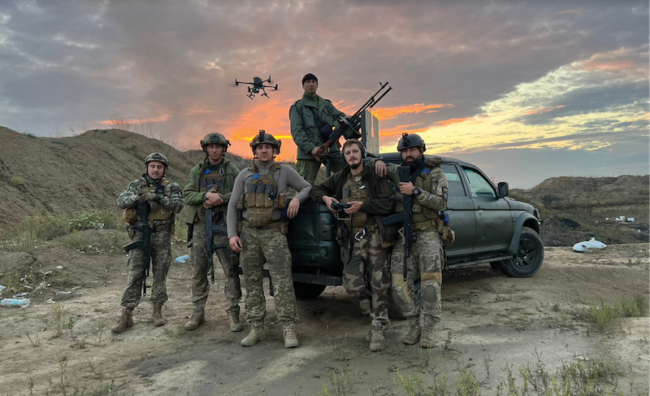
A mobile drone team from Ukraine’s 72nd Mechanized Brigade, with its DJI Matrice 300 improvised “bomber” and a “technical” truck. Photo courtesy of Ukrainian military.

After a summer of grinding attrition warfare, Russia’s invasion of Ukraine entered a dramatic new phase this fall: In a stunning battle of maneuver, a Ukrainian counteroffensive routed Russian forces in Kharkiv province, and then northern Kherson province. Kyiv’s battlefield fortunes have so improved that many analysts believe the forthcoming infusion of poorly-trained Russian conscripts can only delay eventual defeat.

Nevertheless, Putin has doubled down on his calamitous war by announcing a partial mobilization aimed at conscripting 300,000 (and possibly many more) troops for Russia’s increasingly depleted military. He also has ordered missile, manned bomber and drone attacks on major Ukrainian cities and infrastructure.

Unmanned aerial vehicles large and small continue to play a dominant role in this terrible conflict. Missile-armed unmanned combat air vehicles (UCAVs) and loitering munitions have shown their value. Russia has been running low on conventional stand-off range missiles it can only build in single digits monthly, prompting it to purchase hundreds of “kamikaze drones” from Iran and fly them into action; Starting in September, at least 200 have carried out attacks on Kviv, Odessa and beyond. Also disruptive has been the adaptation of cheap, commercial off-the shelf (COTS) drones by both sides to execute surprisingly effective tactical-range strikes and, even more lethally, to acquire targets for artillery fire of unprecedented precision and speed.

This has resulted in an indirect-fire-centric battlefield, in which even main battle tanks are more likely to be knocked out by drone-assisted howitzers than by anti-tank missiles, air strikes and enemy tanks.

Events are unfolding rapidly on the UAS front. In mid-October, Ukrainian President Volodymir Zelensky claimed Russia plans to order 2,400 more loitering munitions, indicating a desire to sustain a campaign of strategic attacks on Ukrainian cities and civilian infrastructure—even as both sides have become much more effective at destroying them.
ELECTRONIC WARFARE VS. DRONES

While counter-drone air defense underperformed in the war’s first weeks, by late spring both sides’ UAVs began to suffer heavy attrition. A study published in July by Jack Watling and Nick Reynolds of the UK’s RUSI think tank found that a Ukrainian drone averaged just 7 days of combat activity before being lost.

That attrition imposed difficult choices for Ukrainian commanders. As the study states: “…many Ukrainian units are forced to choose between having a live feed from their UAVs and thereby risking a high likelihood of losing the platform or sending UAVs out on pre-set flight plans and analyzing the images they take on their return to a pre-set location.”

Of course, fully automated flight plans assisted by inertial navigation systems (INS) to compensate for Russian GPS-jamming allow UAVs to operate independently of a command signal—but without the benefit of situational reactivity. Overall, the resulting intel is less useful, particularly for mobile targets, and processing hours of recorded footage is time consuming.

Thus, Ukrainian command center operations have become dependent on windows of opportunity where/when Russian electronic warfare (EW) is weak. Reliance on the Starlink satellite network, so far impervious to Russian jamming, has enabled Ukraine units to reliably relay targeting data to friendly forces.

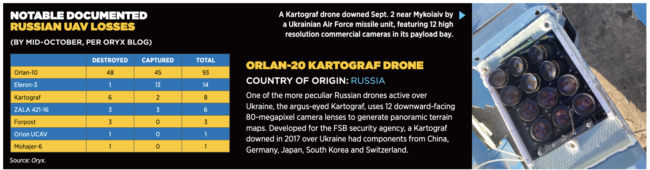
The Oryx blog found images confirming destruction of at least 14 Bayraktar TB2 combat drones, and the loss or capture of eight Ukrainian-built A1-SM Fury and three Leleka-100 ISR drones by early September.

Russian tracked R-330Zh Zhitel and phone-tower mounted Pole-21 systems provide near-constant, generalized area jamming affecting drones and GPS. More targeted EW attacks against Ukrainian drones are executed by a variety of tactical jammers, from the Repellant-1 truck (allegedly only effective within 1.6 miles) to space-age counter-UAS guns.

But according to the RUSI study, Russia’s most important tactical counter-UAS system is the truck-mounted Shipovnik-Aero tactical jammer, which can engage two drones simultaneously and also suppress local communications networks. When an Aero detects a drone, it takes about 25 seconds to classify the type, then employs an appropriate transmitter to disrupt its command frequency along a 3-degree azimuth. Sometimes, it can even redefine the drone’s “home base” to a point under Russian control, enabling capture of the UAV.

Russia first deployed Shipovnik-Aero in Ukraine in 2016. By the summer of 2022, according to Watling and Reynolds, “their presence has become widespread, limiting the airspace that Ukrainian UAVs are able to penetrate and monitor,” though its 40-minute deployment time offers an Achilles’ heel.

On the Russian side, photos show loss of well over 100 mostly reconnaissance drones. Actual total losses for both sides surely number in the hundreds, particularly factoring in smaller copter-style UAVs.

A high ratio of captured drones reveals Russian units too are feeling the sting of electronic warfare, with some operators concluding it was safer to simply hover drones above friendly positions to avoid losses. One video released by a Russian military journalist shows a drone team helplessly looking through a video feed as Ukrainian forces hijack its drone. Their position compromised, they hastily decamp to avoid attack.

What can operators do to curb the counter-drone war? Samuel Bendett, an expert on AI and unmanned systems advising the Russia Studies Program at the Center for Naval Analyses, wrote to me: “Both sides are now reworking their drone software to make quadcopters more EW-resistant and sharing battlefield lessons with other operators, especially on avoiding the other sides’ defenses.”

However, quantitative solutions may be more practical than qualitative ones. “In the end, many EW systems cannot be overcome,” Bendett continued. “The simplest method is to replace lost drones, especially cheaper quadcopters.”

Of course, UAVs are also responsible for a substantial share of EW and air defense systems destroyed, using both direct attacks or by calling in and adjusting indirect fires.

Kinetic air defenses, including costly ground-based air defense missiles, are also accounting for many drone losses. Though many drones cost less than the missile fired at them, the potential destruction an accurate artillery strike called in by a drone could wreak makes it worth using whatever means at hand.

Still, the importance of fielding more diverse and cost-efficient counter-drone weapons is clear. Drones have been destroyed by small arms fire, flak, cannons and jet fighters. Supporters of Ukraine are sending laser-guided rockets and vehicle-mounted jammers. Soldiers from both sides are employing counter-UAS guns often obtained outside regular military procurement channels.

As small UAVs can be difficult to detect compared to manned aircraft, combat experience from this war arguably makes a case that even-smaller tactical formations such as infantry companies should integrate lightweight radars and EO/IR sensors to more reliably detect nearby UAVs without depending on external air defense attachments.
LOGISTICS AND TRAINING FOR THE FUTURE DRONE FORCE

Despite—or because of—massive attrition, the demand from frontline troops for more drones is voracious. Russian military bloggers have fumed at the inadequate numbers of Orlan-10 ISR drones—reportedly often no more than one per battalion—the loss of which can be crippling.

Russian forces are also heavily reliant on civilian donations due to a procurement gap pertaining to smaller, shorter-range ISR drones. A list circulating on Russian social media of suggested gear for newly conscripted soldiers recommends bringing a drone along with an extra pair of socks.

The government of Buryatia (a minority region in Russia disproportionately represented among frontline soldiers) spent $3.4 million of its own funds to provide drones and other equipment to its soldiers, reflecting popular awareness that the Russian military is failing to adequately equip them.

Russia’s military is taking steps to procure more UAVs, but also is suffering a shortage of drone pilots. Between September 1-5, veteran drone operators assembled at Lake Ilmen, Russia, for the Dronnitsa conference to share best practices toward the ultimate goal of creating a professional instructor corps and developing a standardized training curriculum. Moscow has announced measures to scale up drone production, as well as to integrate education on using drones into school curricula.

A few days earlier, Ukraine had held its own “hackathon,” gathering 150 operators, engineers and programmers in Kyiv to share exchange ideas on leveraging Ukraine’s sizeable tech sector to improve effectiveness of unmanned operations.

These moves show both sides recognize how even small civilian-class drones have become a key component of military power, and that governments must standardize training and procurement of capabilities that heretofore had evolved organically from improvisations in the field.
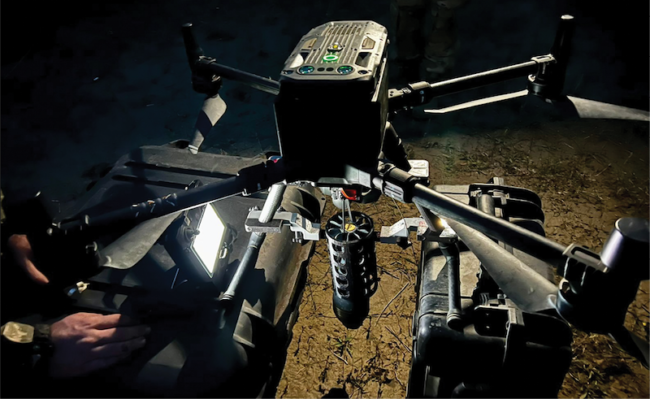
A September photo of a Ukrainian quadcopter loaded with a mortar bomb. Photo courtesy of Ukrainian Ministry of Defense.

LOITERING MUNITIONS: THE BIGGER, THE BETTER?

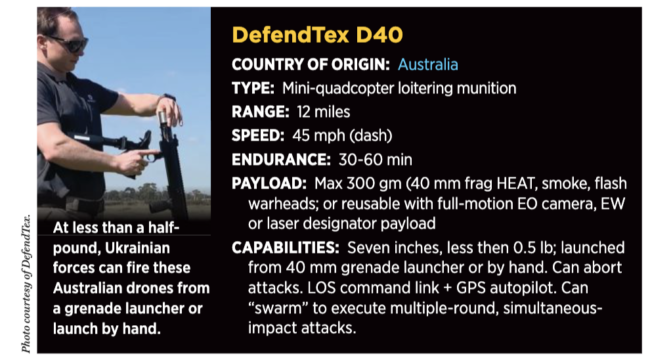
Loitering munitions (or kamikaze drones) have taken on an expanding role as both Ukraine and Russia turn to them to perform penetrating strikes—operations both sides consider near-suicidal for manned aircraft due to ground-based air defense.

Media showing the effective use of smaller loitering munitions early in the war remains sparse, however. The few videos of Switchblade-300s given in the hundreds to Ukraine show them picking off individual soldiers. Russia’s delta-winged ZALA KUB displayed poor accuracy and lacked the punch to reliably disable a towed howitzer.

But a caution: “Limited video evidence of their use,” Bendett said, “does not mean that such loitering drones are not used on a larger scale.”

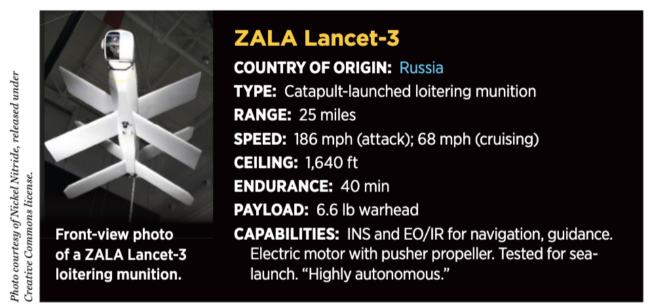
During the summer, Russia began employing the newer, missile-like ZALA Lancet-3 with a larger warhead to greater apparent affect. Recordings show Lancet-3s ramming into towed howitzers, on-the-move self-propelled artillery and vans, entrenchments and even a Bayraktar radio repeater tower.

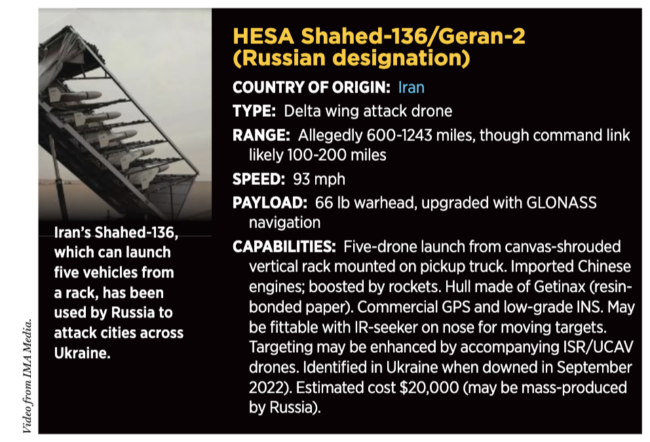
Then, in September, Russia began deploying Iranian-built Shahed-136 munitions (redubbed the Geran-2) to some success according to the commander of Ukraine’s elite 92nd Brigade, who told the Wall Street Journal that in just a few days Shahed-136s (see “HESA Shahid” box) destroyed four self-propelled howitzers and two APCs. Older Shahed-131s loitering munitions (smaller but otherwise similar to Shahed-136s) were also apparently transferred.

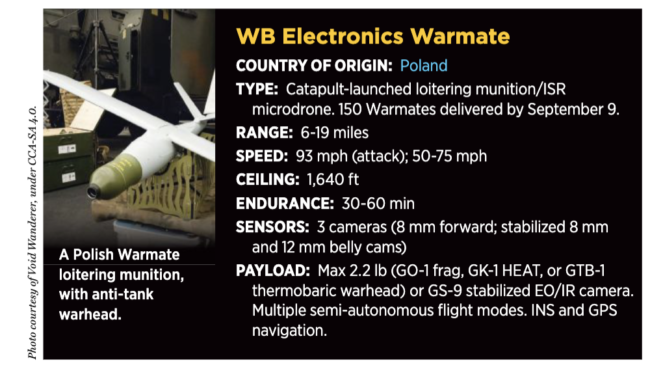
Meanwhile, Ukrainian forces are reportedly satisfied with the Polish Warmate loitering munition (see “Warmate” box). They’ve received a small number of Switchblade-600s, which have required time to enter production. Kyiv has also obtained hundreds of secrecy-shrouded, backpackable Phoenix Ghost loitering munitions. Ukrainian presidential adviser Oleksii Arestovysch, in July, ascribed a 60% kill rate to the “back-packable” munition.

In October, Ukraine debuted the recoverable RAM-II munition derived from the Leleka-100, recorded destroying an Osa air defense vehicle. Ukrainians have also employed first-person-view racing drones, and their specialized user goggles, as loitering munitions capable of attacking targets inside buildings.

Clearly, militaries should field a tiered mix of loitering munitions ranging in cost, range and hitting power, with at least one “medium” option that can be used cost-efficiently for tactical strikes on artillery and armored vehicles. Such munitions are particularly intriguing when they can be built at a similar or lower price than, say, a Javelin missile ($80,000+ not including launcher) or Excalibur artillery shell ($112,000 per).

RUSSIA’S IRANIAN DRONE ATTACK

Iran deployed its first crude bomb-toting UCAVs in combat in the 1980s. Today, it fields a broad variety of UAVs, UCAVs and micro-missiles produced by rival manufacturers. Tehran has used these to project power over the Persian Gulf and Syria, and to arm overseas allies like Hamas, Hezbollah and Houthi insurgents in Yemen. According to posts by military aviation historian Tom Cooper, Iran’s drones, sensor turrets and munitions have developed considerably since 2016, thanks to technology transfers from China.

As Russia’s UCAV capability via the Orion platform only entered service in 2021, this July Moscow looked to quickly procure more combat and ISR drones from Iran, possibly in exchange for Su-35 jet fighters. The first Iranian drones were delivered mid-August, with Russian personnel training in Iran to operate the UAVs.

Then, on October 8, an estimated 24 Shahed-129 UCAVs and Shahed-136 kamikaze drones based in Crimea and Belarus were employed on targets across Ukraine, the drones possibly assisting with missile targeting. Ukraine’s military claims 12 UAVs were downed by air defenses, including nine of 12 Shahed-136s.

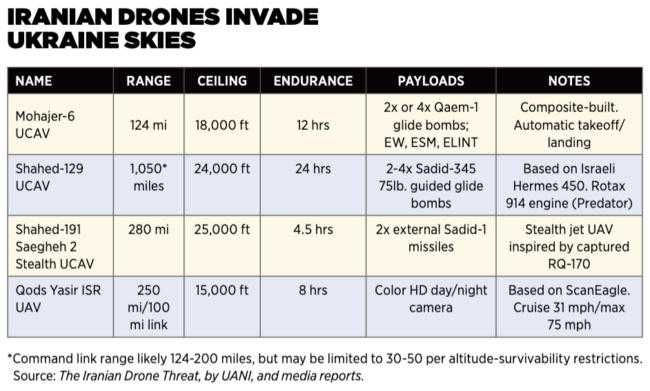
The three runway-using Iranian UCAVs identified as being delivered to Russia have seen prior combat use and are equipped with the requisite electro-optical sensor turrets and small guided missiles in laser, IR and TV-guided variants (see “Iranian Drones Invade Ukraine Skies” box).

However, intelligence sources cited by the Washington Post suggest Russia has been “not satisfied” with the Iranian UCAV’s for experiencing “numerous failures,” echoing reports that Mohajer-6s imported by Ethiopia in 2021 performed poorly. On Sept. 23, Ukraine shot down a Mohajer-6 UCAV over water, recovering it intact with its Qaem-5 (or Ghaem) TV-guided glide bomb, sensor turret and Austrian-built Rotax engine. Furthermore, Russian drone footage seemingly betrays the use of Iranian Qods-Yasir ISR drones, the “Iranian ScanEagle.” Qods was test-converted for use as a kamikaze drone, but its operational use in that capacity is unclear. Russia allegedly plans to buy the larger Arash-2 loitering munition from Iran.
UCAVS OVER UKRAINE

Both Russia and Ukraine continue to employ UCAVs in combat, the latter more prominently, with a decisive impact on Ukraine’s siege of the Russian garrison on Snake Island and penetrating attacks onto annexed Crimea or Russian soil. These raids have occasionally caused spectacular damage, appealingly with little loss of life, but weakening Putin politically.

However, density of air defenses and electronic warfare environment has prevented unrestricted use of UCAVs, and neither Ukraine’s Bayraktars nor Russia’s Orion and Forepost-R drones have wreaked the mass destruction achieved against Armenian and Syrian ground forces in 2020. Both sides’ UCAV fleets are too small to “trade off” against more numerous air defenses in a battle of attrition. Ukrainian fighter pilots have evenargued that procurement of more UCAVs is pointless under these circumstances, though they may have a professional bias.

Nonetheless, both sides can and do accept greater risks with UCAVs than with their combat aircraft. Furthermore, Ukraine has conducted standoff strikes on Russian air defenses using HIMARS, Neptune and HARM missiles to create windows of opportunity to deploy UCAVs in its ongoing Kherson offensive.

Russia, arguably, could benefit from UCAVs even more; their combination of long-endurance ISR and strike capability and expendability compared to manned aircraft would make them an ideal platform for hunting down and destroying precise western artillery and GPS-guided rocket systems (HIMARS, MARS) that have been relentlessly destroying Russian ammunition depots and HQ buildings. In practice, though, Russia has not provided convincing evidence that its UCAVs have located and destroyed any HIMARS systems, perhaps due to Ukraine’s effective use of wooden decoys to absorb Russian attacks.

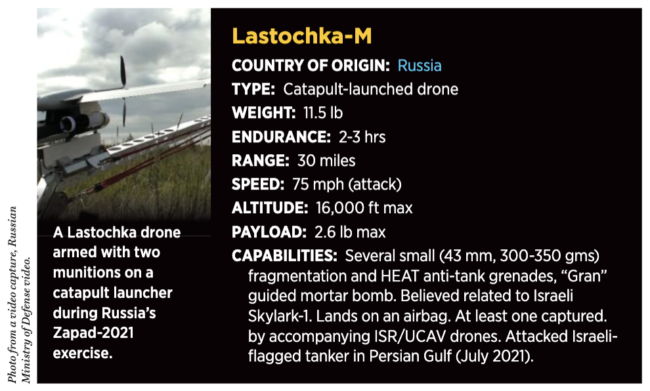
Over the summer, Russia developed a method to arm Orlan-10 ISR drones with grenades, and began deploying a new small Lastochka-M attack drone dropping unguided munitions. By 2023, Russia hopes to ramp up production of Orion UCAVs, and install satellite links and develop autonomous air-to-air refueling technology to extend the range of its drones.
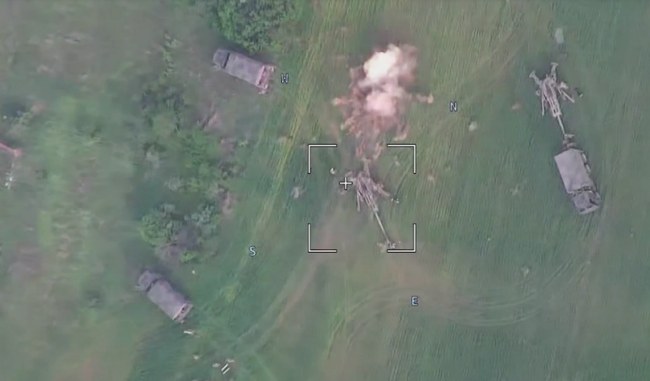
An attack by a KYB kamikaze drone on May 18 failed to directly hit an M777 howitzer supplied to Ukraine. Any damage was unclear. Photo capture from video released by Russian Ministry of Defense.

✓✓ GREY EAGLE: TOO SENSITIVE FOR UKRAINE 


Washington would like to give Ukraine four Hellfire missile-armed General Atomics MQ-1C Grey Eagles, the U.S. Army’s in-house UCAV, with greater capability than the Bayraktar. The transfer has been under review since June, however, because of concerns Ukraine’s military might be unable to properly support the system, and that Russia might acquire sensitive technologies from downed MQ-1Cs. General Atomics has proposed an intense five-week cram course (12 hours a day, no days off) to rapidly familiarize Ukrainian operators and technicians.

AI is another edge technology that has been used in Ukraine for collation of battlefield intelligence. But when it comes to unmanned systems, Rita Konaev, a military AI expert at the Center for Security and Emerging Technology (CSET), noted in a tweet: “It’s hard to tell whether these are in fact autonomous or automated, and if they’re even being used; or are they mostly if not fully remotely operated.”
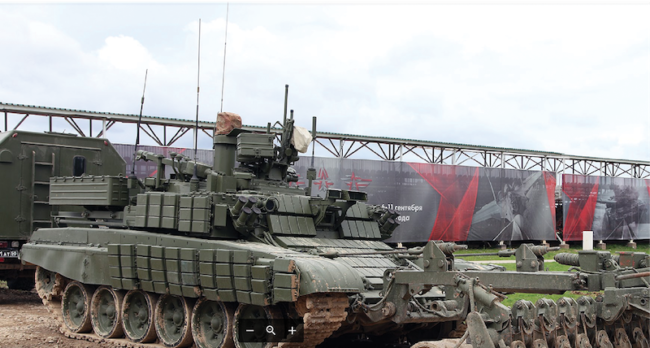
Prokhod-1 de-mining Russian UGV, based on the BMR-3/T-90A tank, at an Army expo. Photo courtesy of Vitaly Kuzmin, CCL 4.0-SA.

WAR OF THE CAMERA DRONES

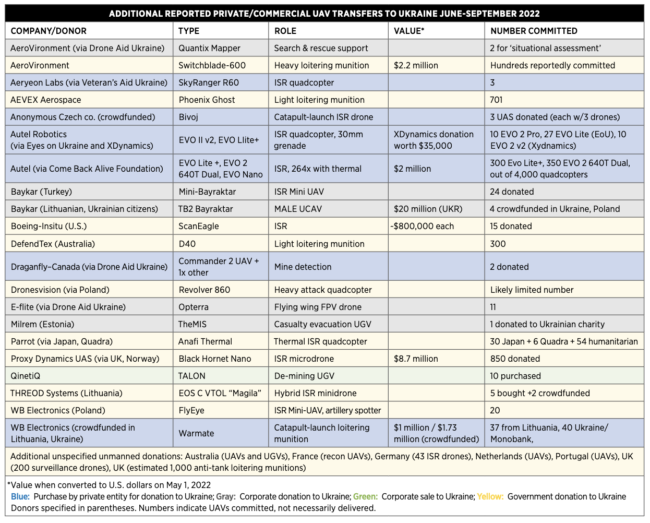
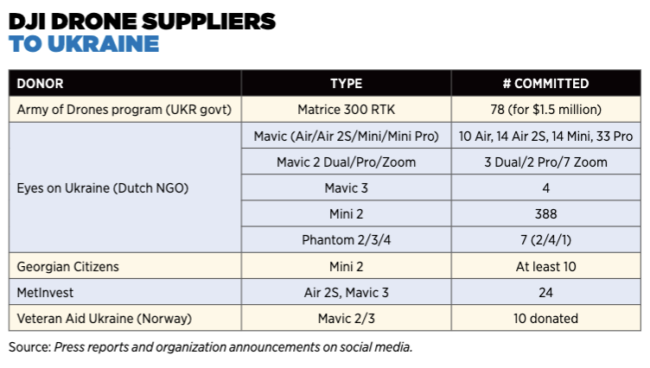
Despite producing various indigenous fixed-wing drone platforms, both Ukraine and, increasingly Russia, are heavily dependent on purchase or donation of UAVs large and small from overseas—whether through privately crowdfunded drives, transactional arms sales and, in Ukraine’s case, free-of-charge government-to-government military aid.

Most numerous are cost-efficient DJI camera drones built in China. Wartime demand has reportedly caused the price of drones to at least double in Russia, particularly after DJI halted sales to Russia and Ukraine in April. Nonetheless, the Russian embassy in China praised the DJI Mavic on social media as “a symbol of modern warfare.” Autel Robotics’ EVO series of drones (U.S.-based but Chinese-owned) are also used prolifically by Ukraine.

Moscow has its ways of circumventing bans and sanctions. “Russians are specifically instructing volunteers to procure DJIs at different online and physical marketplaces in eastern Europe and Asia,” Bendett explained—particularly Belarus, and southeast Asia. “With so many DJI Mavics sold all over the world, there is a massive supply that can potentially flow to the front.”

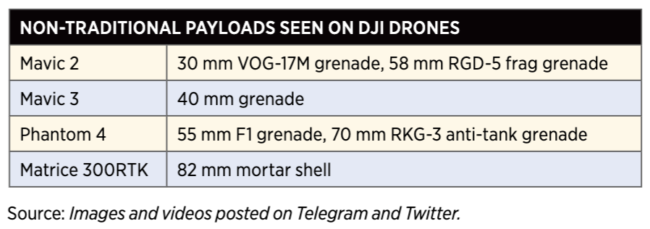
Commercial quad- and octocopters have also proven readily convertible into precision strike weapons. Videos posted by both Ukrainian and Russian soldiers continue to display outrageous feats of gravity bombing, dropping tiny antitank grenades through the open hatches of main battle tanks and other vehicles with absurdly destructive results. In some cases, the attacks target abandoned vehicles, but their destruction is nonetheless useful in places where they can’t be safely recovered.

Just as Ukraine’s military learned and improved on drone tactics Russian separatists employed in the 2014-2015 war, videos are showing Russia copying Ukraine’s improved methods.

Massive use of DJI products could theoretically be compromised should the company, or state regulators, attempt to impose geographic locks. However, Ukraine has reportedly developed a hack to “reflash” DJI drones and remove safety software Russia exploited in the past to locate and disable drones or attack their operators.

Ukraine and Russia could produce similar camera drones domestically, but production quality, scale and cost-efficiency would likely not be the same, Bendett advised—especially for Russia as it struggles to obtain microelectronics because of international sanctions.

Nonetheless, Russian arms manufacturer Almaz-Antey announced it was testing a self-developed quadcopter with 90% domestic parts made of lightweight polymers and carbon fibers that could eventually serve as a “Russian DJI.”
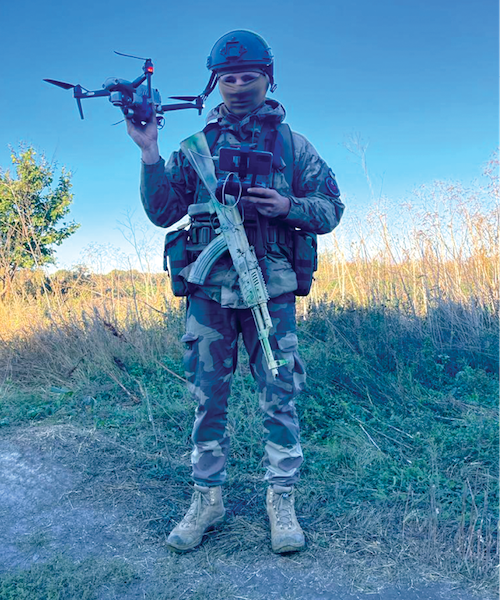
Soldier fits a 30-millimeter VOG-17 grenade to a DJI Mavic 2 Pro quadcopter. Photo posted to Facebook by Ukraine’s 17th Tank Brigade.

UNMANNED LAND AND SEA VEHICLES

To supplement its Uran-6 de-mining vehicles, Russia has begun using the remote-controlled 45-ton Prokohd-1 UGV, a disarmed T-90A tank equipped with KTM-7 or -8 mine-rollers—possibly the heaviest operationally deployed UGV so far. Ukraine, meanwhile, is reportedly deploying the Roomba-like Temerland GNOM kamikaze mine. Directed via a quadcopter, it’s designed to roll under armored vehicles and detonate a TM-62 anti-tank mine. A machine-gun-armed variant of GNOM may see patrol use, while Russia says it’s preparing a 3-ton Marker 2 UGV for eventual combat deployment in Ukraine.

At sea, around two dozen mostly unspecified UUVs and USVs, donated to Ukraine by the U.S., U.K. the Netherlands and Germany, play a quiet but strategically high-stakes role mitigating risks from mines or clandestine sabotage attacks on Ukraine’s grain shipping.

Furthermore, on September 21, a novel USV ran aground near Russia’s major naval base at Sevastopol, in Crimea. According to submarine expert H.I. Sutton, the stealthy (median radar cross-section around 0.6 sqaure meters) USV was likely Ukrainian and intended for an explosive kamikaze attack. If Ukraine manages to use UUVs/USVs to damage valuable Russian naval assets in port, that could further weaken the Russian Black Sea Fleet’s posture after the loss of flagship missile cruiser Moskva.
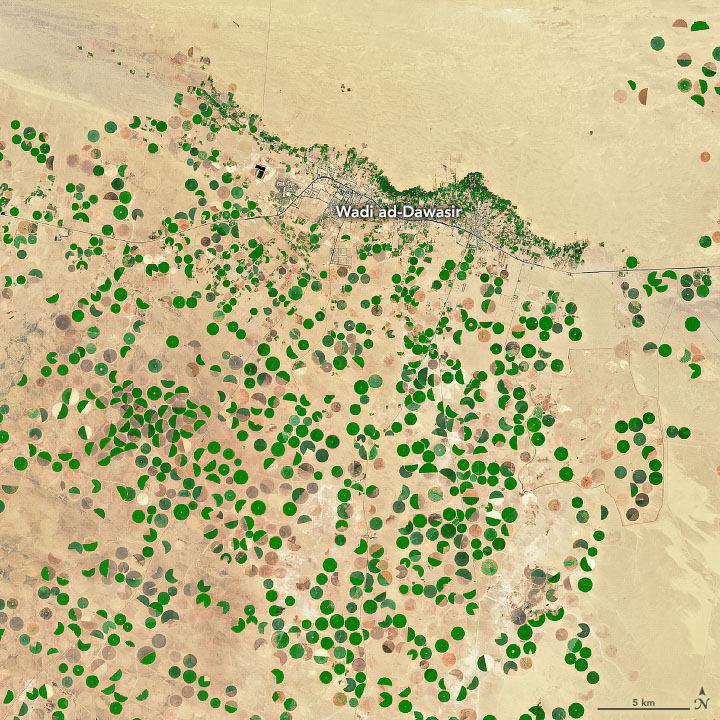
Earth Observatory: Depleting Groundwater In Saudi Arabia's Aquifers

In 2015, researchers used GRACE satellite data and other sources to show that the Arabian Peninsula ranked as the most stressed of the world's 37 largest aquifers. . . Saudi Arabia has squandered it's underground Aquifers

earthobservatory.nasa.gov

Desert Crops Thrive as the Aquifer Shrinks

5 - 6 minutes

"The Kingdom of Saudi Arabia spans 2.1 million square kilometers (830,000 square miles)—an area larger than Alaska and Texas combined—yet it has no permanent rivers or standing lakes. What it does have are wadis, valleys that are transformed into ephemeral rivers after storms, and aquifers with groundwater.

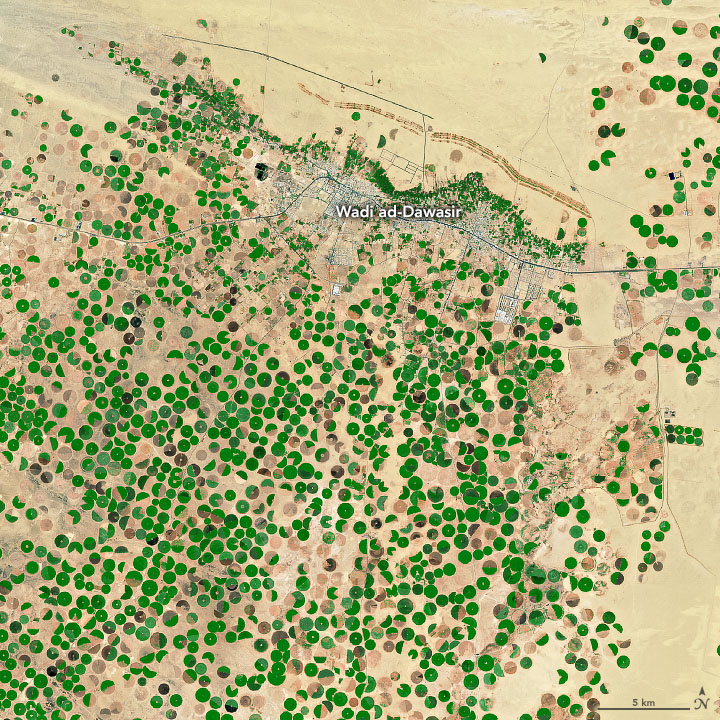
This pair of images captures the spread of agriculture around the town of Wadi ad-Dawasir. Groundwater and irrigation have been used to green-up portions of the desert in Saudi Arabia. The images were acquired by the Advanced Spaceborne Thermal Emission and Reflection Radiometer (ASTER) on NASA's Terra satellite in 2000 and 2017. 

✓ Since the area receives less than 200 millimeters (8 inches) of rain per year, farmers make use of pumped groundwater and center-pivot irrigation systems to grow crops—mainly wheat, alfalfa, and vegetables.

Carbon-14 dating indicates that the groundwater being used is more than 30,000 years old; hydrologists consider it to be paleowater or “fossil water.” The sustained pumping of this water has had a major impact on the aquifer beneath Wadi ad-Dawasir. 

✓ According to one United Nations report, the water table in this area has dropped by as much as 6 meters (20 feet) per year since the 1980s, fast enough that hydrologists think the aquifer could be depleted within a few decades.

In 2015, researchers used GRACE satellite data and other sources to show that the Arabian Peninsula ranked as the most stressed of the world's 37 largest aquifers. In September 2019, another GRACE-based study pointed out that the problem is particularly severe in the central and northern part of the aquifer, which includes Wadi ad-Dawasir.

NASA Earth Observatory images by Joshua Stevens, using data from NASA/METI/AIST/Japan Space Systems, and U.S./Japan ASTER Science Team. Story by Adam Voiland.


earthobservatory.nasa.gov

Smart Phones Bring Smart Irrigation

6 - 8 minutes

Smart Phones Bring Smart Irrigation

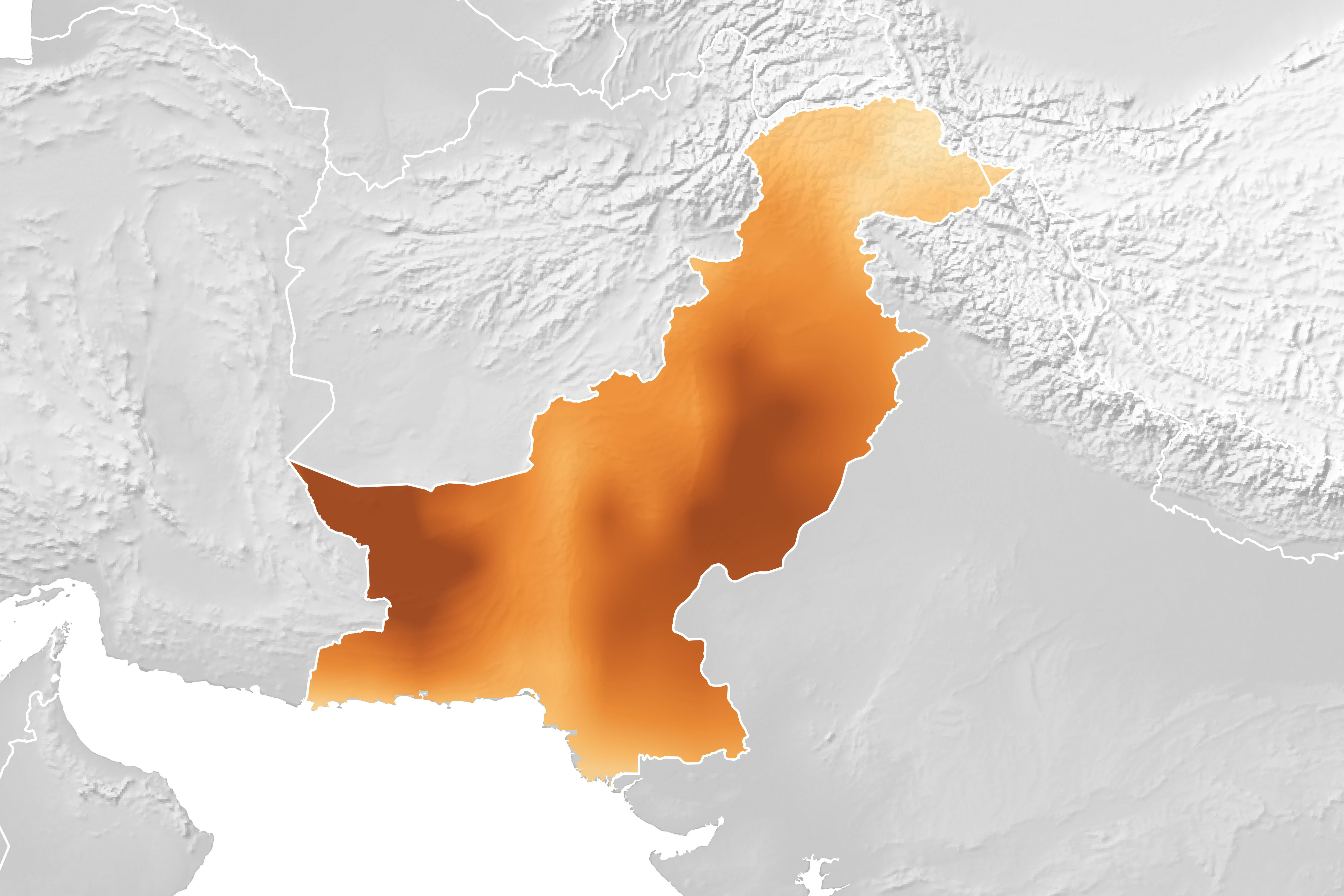
When Haji Nazeer Ahman Qazi opened his cellphone, he received a text message that would help him manage the ten acres of wheat growing on his farm near Sargodha, Pakistan. The text message—beginning “Dear farmer friend”—stated that 1.3 centimeters (0.5 inches) of rainfall were expected in his area in the upcoming week. Those few words would help him save water and improve his crop yield.

“Keeping in view of the expected rainfall and last week’s water consumption, I skipped my last irrigation for wheat,” recounted Qazi. “The rainfall forecast proved right, which not only saved me irrigation, but protected [my] wheat from waterlogging, as nearby farmers suffered.”

Qazi is one of 20,000 farmers who receive weekly text messages from the Pakistan Council of Research in Water Resources (PCRWR). The notifications, partly based on NASA satellite data, provide information on current and future weather conditions, as well as advisories on how to water certain crops. The texts are designed to help prevent a serious problem facing Pakistani farmers: overwatering.

“Farmers are giving 40 to 50 percent more water than what is needed,” said Faisal Hossain, the head of the Sustainability, Satellites, Water, and Environment (SASWE) research group at the University of Washington. “The overwatering comes from what they have learned from their fathers and grandfathers, from an era when water was abundant.”

Hossain and his colleagues are collaborating with the PCRWR to analyze satellite data, ground-based measurements, and weather models to calculate how much water various crops will need and how much they are likely to get. The PCRWR Irrigation Advisory system, initially funded by NASA’s Applied Science Program, distributes this information via text alerts with simple messages such as: “We would like to inform you that the irrigation need for your banana crop was 2 inches during the past week.” Each simple message is derived from a complex analysis of numerous weather variables.

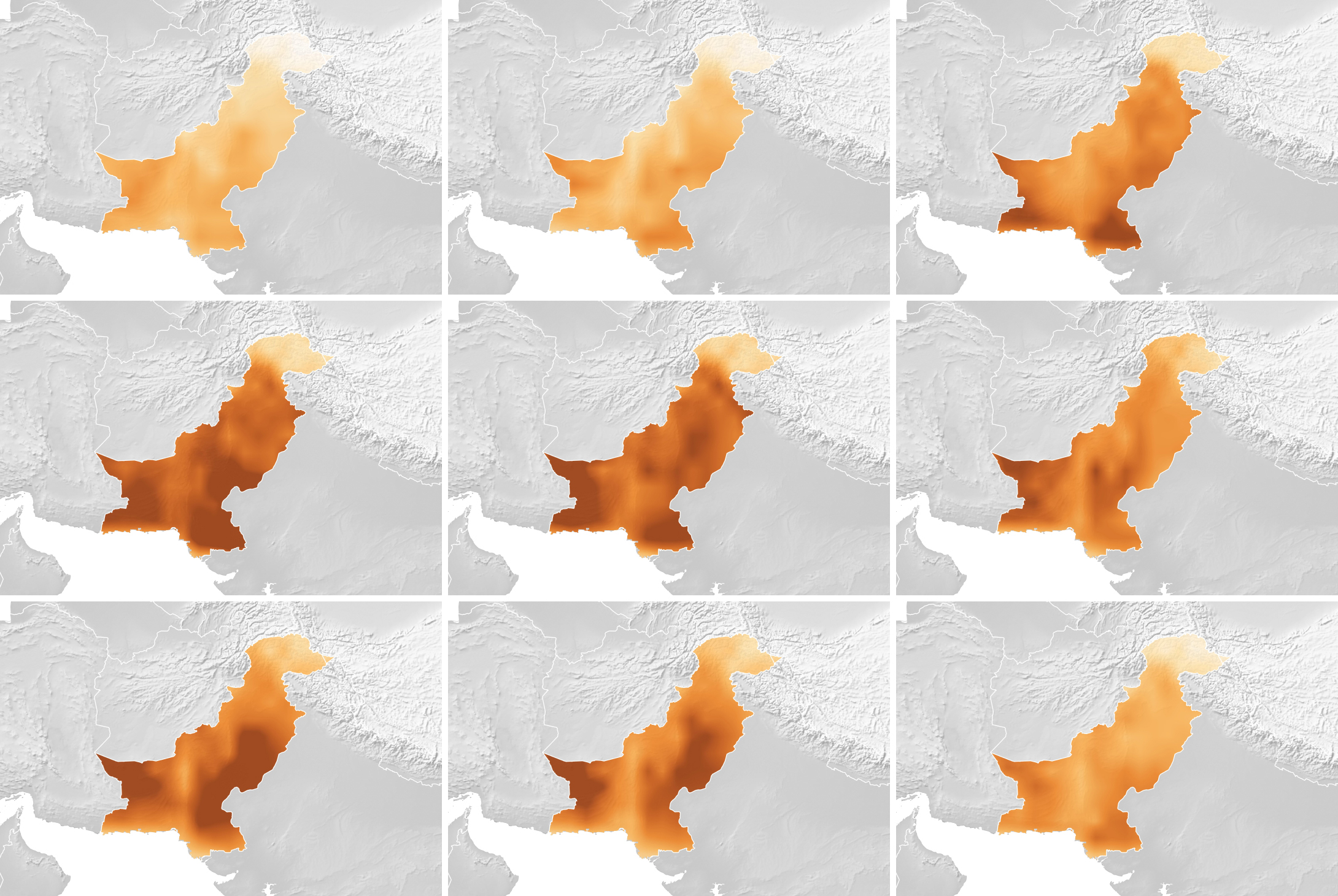
The maps on this page show one of those variables, evapotranspiration, which is an indication of the amount of water vapor being removed by sunlight and wind from the soil and from plant leaves. Hossain’s team uses evapotranspiration to assess the water demand for specific crops.

References & Resources

 RELATED CONTENT


www.vox.com

Saudi Arabia squandered its groundwater and agriculture collapsed. California, take note.


Brad Plumer@bradplumerbrad@vox.com
7 - 8 minutes

Many of the world's most important farming regions can't rely on rain alone to water all their crops. So they also pull freshwater from underground aquifers that have slowly filled up over many thousands of years. Notable examples include the Central Valley in California or the Indus Basin in Pakistan and India.

The problem is that these underground aquifers take a long, long time to recharge. So if farmers are drawing water faster than it gets replenished, the basins will eventually run dry..." 

READ MORE 


picture
Online
Open Access
book
The United Nations World Water Development Report 2022: groundwater: making the invisible visible
ISBN :
978-92-3-100507-7
Collation :
225 pages : illustrations, maps
Language :
English
Also available in :
Year of publication :
2022
Licence type :
Type of document :
book

BACK HOME IN ARIZONA: Thomas Galvin - Partner in The Rose Law Group - Lobbyist Disclosure


State lobbying disclosures show that Galvin is a partner at Rose Law Group, which lobbied on behalf of a subsidiary of the Saudi corporation Almarai currently tapping U.S. groundwater in drought-stricken Arizona and California to grow alfalfa 

“My law practice consists nearly entirely of practicing land use law, and I am also a registered lobbyist with the state along with several other attorneys at Rose Law Group.” Galvin wrote in an email to The Intercept. “Lobbying is not a major aspect of my legal career and takes up little of my time in comparison to my core practice area. Rose Law Group is a registered lobbyist for Fondomonte Arizona with the state of Arizona. I am one of several attorneys at Rose Law Group that are covered under that registration.”

✓ In response to his role on behalf of Fondomonte and its intersection with the board of supervisors, Galvin wrote, “their farming operation is located outside of the County I represent – in fact it is more than 100 miles from my district. In addition, counties in Arizona have limited powers related to water policy and are not even a water provider. 

✓ Maricopa County does not lease state land and does not have control over water charges or policies enacted by state agencies. I will continue to recuse myself in any case where a client of my law firm has business before Maricopa County.”

theintercept.com

Lobbyist for Saudi Alfalfa Company Desiccating Arizona Was Elected to Maricopa County Board of Supervisors 


Daniel Boguslaw
7 - 9 minutes

"An official recently elected to the Maricopa County Board of Supervisors, where he holds sway over an ongoing water dispute, was also a lobbyist for a Saudi company looking to protect its extraction of precious groundwater. Thomas Galvin, elected in the midterms to the post he was first appointed to in 2021, lobbied on behalf of the Saudi-owned farming company, which is using Arizona’s most depleted natural resource for foreign exports.

State lobbying disclosures show that Galvin is a partner at Rose Law Group, which lobbied on behalf of a subsidiary of the Saudi corporation Almarai currently tapping U.S. groundwater in drought-stricken Arizona and California to grow alfalfa. The animal feed, which is grown in harsh desert environments, is shipped overseas to support livestock on Saudi dairy farms. In 2014, Almarai bought almost 10,000 acres of farmland in Vicksburg, Arizona, through its wholly owned subsidiary Fondomonte, spending nearly $50 million on the purchase. 

✓ The near-nonexistent water regulations in La Paz County, where Vicksburg is located, mean that Fondomonte can pump vast amounts of water out of Arizona’s water table, which has declined by over 50 feet in the past two decades.

✓ Before joining the board of supervisors, Galvin appeared at the Arizona state legislature to lobby against H.B. 2520, a bill instructing the Arizona Department of Water Resources to monitor the wells and water levels in the Upper Colorado River water planning area. At the hearing, Galvin told Land, Agriculture and Rural Affairs Committee members, “I am not sure that this bill is right for this time right now. … I’m afraid that, if this bill passes, what we’ll be doing is singling out farms and large agricultural users. You might actually be forcing farms to release proprietary data.” The bill ultimately failed, but not before Galvin called residents concerned about foreign capital draining their aquifers racist.

“My law practice consists nearly entirely of practicing land use law, and I am also a registered lobbyist with the state along with several other attorneys at Rose Law Group.” Galvin wrote in an email to The Intercept. “Lobbying is not a major aspect of my legal career and takes up little of my time in comparison to my core practice area. Rose Law Group is a registered lobbyist for Fondomonte Arizona with the state of Arizona. I am one of several attorneys at Rose Law Group that are covered under that registration.”

In response to his role on behalf of Fondomonte and its intersection with the board of supervisors, Galvin wrote, “their farming operation is located outside of the County I represent – in fact it is more than 100 miles from my district. In addition, counties in Arizona have limited powers related to water policy and are not even a water provider. Maricopa County does not lease state land and does not have control over water charges or policies enacted by state agencies. I will continue to recuse myself in any case where a client of my law firm has business before Maricopa County.”

Water has become so scarce in Arizona and neighboring states that plans have been floated to pump water from the Mississippi River across the country to supply drought-stricken residents. Fondomonte in particular has become a flashpoint in statewide water politics, with the Democratic candidate for attorney general, Kris Mayes, calling for an investigation and possible sanction on the Saudi company’s water use.

Large scale farming of hay and alfalfa located on the borders of Arizona and Nevada, on March 10, 2021 in Needles. This desert valley is being farmed for hay and alfalfa using groundwater pulled from the Colorado River, with much of the hay exported to feed animals in countries such as Saudi Arabia.

Large-scale farming of hay and alfalfa located on the border of Arizona and Nevada, on March 10, 2021 in Needles. The desert valley has been farmed for hay and alfalfa using groundwater pulled from the Colorado River, with much of the hay exported to feed animals in countries such as Saudi Arabia.

Photo:George Rose/Getty Images

Four years after Galvin’s testimony, the Maricopa County Board of Supervisors finds itself adjudicating an increasingly tense situation that pits residents, politicians, and transporters against each other over who has a right to water and how each interest group should pay for access. In December 2021, Galvin was appointed to the board of supervisors by the sitting board in a unanimous vote. In January of this year, Galvin found himself in the middle of the standoff, with politicians and residents on all sides of the water divide demanding action on a water redistricting plan that would affect the price paid by hundreds of Maricopa residents, some of whom rely on water hauled for miles and distributed into tanks below their drought-stricken homes.

After the federal Bureau of Reclamation declared a water shortage from the Colorado River last year, Scottsdale — where many Rio Verde Foothills residents draw their water from — declared that their own water supply would be off limits to the tenders who deliver water to individual resident tanks in Rio Verde. In light of the looming shut-off, citizens of Rio Verde attempted to garner Galvin’s support to designate a new water district that would allow pumping from Harquahala Valley.

While Galvin was fast to support unlimited pumping by Fondomonte before he was appointed to the board, Rio Verde residents found a less sympathetic ear once he was on it. Neither the residents who support the new water district nor the water haulers who oppose it were able to get Galvin to make a determination in the process for weeks.

As the January 1 water shut-off for Rio Verde residents rapidly approaches, Galvin and the rest of the Maricopa supervisors have failed to secure a resolution to the water crisis, in part due to the complex and overlapping matrix of regulatory authorities that govern Arizona’s water use. In August, Maricopa supervisors unanimously voted down a proposal to create a new water district. Galvin endorsed the idea of a privately held water utility, like the Canadian-owned Epcor, supplying the water, but some residents are opposed to the construction burden and the multiyear timeline that the plan would necessitate. In 2021, Rose Law helped facilitate Epcor’s purchase of Johnson Utilities on behalf of land owners and home builders in and around the San Tan Valley south of Phoenix.

Of the dozens of companies represented by Rose Law Group, many fall under the category of water-reliant industries including horse breeding, real estate development, mining, and fossil fuels. The firm also lists conservative political clients including Romney for President, Senator Marco Rubio for President of the United States, and Build America’s Fence.

Galvin’s election to the board follows increased scrutiny of Saudi Arabia’s influence on American politics and a shifting consensus on a gulf state that was once one of America’s closest guarded energy allies. A month before the midterm elections, Saudi Arabia announced a massive cut in oil production that both politicians and policy experts described as a political attack on President Joe Biden’s agenda and Democrats’ electoral odds. After the Biden administration signaled its support for Saudi leader Mohammad bin Salman receiving sovereign immunity in a lawsuit targeting the slaying of journalist Jamal Khashoggi, reports emerged that Saudi Arabia is considering increasing its oil production in the coming winter months." READ MORE

2016 RELATED CONTENT

Saudi Arabia buying up farmland in US Southwest

Jeff Daniels
6 - 8 minutes

Saudi Arabia and other Persian Gulf countries are scooping up farmland in drought-afflicted regions of the U.S. Southwest, and that has some people in California and Arizona seeing red...

 "We're not getting oil for free, so why are we giving our water away for free?" asked La Paz County Board of Supervisors Chairman Holly Irwin, who represents a rural area in western Arizona where food companies affiliated with the Saudis and the United Arab Emirates have come to farm alfalfa for export.

Privately held Fondomonte California on Sunday announced that it bought 1,790 acres of farmland in Blythe, California — an agricultural town along the Colorado River — for nearly $32 million. Two years ago, Fondomont's parent company, Saudi food giant Almarai, purchased another 10,000 acres of farmland about 50 miles away in Vicksburg, Arizona, for around $48 million.

They will continue to come over here and buy properties where they can grow good-quality alfalfa hay and ship it back to the Middle East. It makes logical sense for them to do that because they're not going to be able to grow it in Saudi Arabia, especially for milk production.

Joseph Dutra, President, Westec

But not everyone likes the trend. The alfalfa exports are tantamount to "exporting water," because in Saudi Arabia, "they have decided that it's better to bring feed in rather than to empty their water reserves," said Keith Murfield, CEO of United Dairymen of Arizona, a Tempe-based dairy cooperative whose members also buy alfalfa. "This will continue unless there's regulations put on it."

In a statement announcing the California farmland purchase, the Saudi company said the deal "forms part of Almarai's continuous efforts to improve and secure its supply of the highest quality alfalfa hay from outside the (Kingdom of Saudi Arabia) to support its dairy business. It is also in line with the Saudi government direction toward conserving local resources."

. . .

'Beneficial use'

However, the issue of land rights comes into play. As the owners of the land, the Saudis appear to be playing by the rules. The area of the Arizona desert where the Saudis bought land is a region with little or no regulation on groundwater use. That's in contrast to most of the state, 85 percent of which has strict groundwater rules.

Local development and groundwater pumping have contributed to the groundwater table falling since 2010 by more than 50 feet in parts of La Paz County, 130 miles west of Phoenix. State documents show there are at least 23 water wells on the lands controlled by Alamarai's subsidiary, Fondomonte Arizona. Each of the wells is capable of pumping more than 100,000 gallons daily.

"You can use as much water as you'd like, as long as it's put to a beneficial use, and you're not required to report your water use," said Michelle Moreno, a spokesperson for the Arizona Department of Water Resources, . .

Blythe Mayor Joseph DeConinck said between 10 percent to 15 percent of the hay grown in his region is exported overseas, but insists the practice is not contributing to the state's drought. ✓ The mayor, who also grows alfalfa, said he isn't concerned about the Saudis buying up land in his community.

"They are buying the ground to farm. There's abundant supplies of water in Blythe for farmers from the Colorado River," he said. "Our valley has the first water rights on the river."

READ MORE 

www.motherjones.com

Foreign firms sucking "virtual" water from America's parched Southwest

Angelika Albaladejo
17 - 21 minutes

David McNew/Getty

This article was originally published by Undark and is reproduced here as part of the Climate Desk collaboration. 

Driving into Southern California’s Palo Verde Valley from the Arizona border, fields of vibrant green appear out of the desert like a mirage. Near the town of Blythe, water from the Colorado River turns the dry earth into verdant farmland, much of it to grow a single crop—alfalfa, a type of plant used mainly to feed dairy cows.

For decades, a significant portion of alfalfa grown here and elsewhere in the western United States—as much as 17 percent in 2017—has been loaded onto trucks, driven hundreds of miles to ports on the west coast, and shipped around the world, mainly to China, Japan, and Saudi Arabia. A little over five years ago, one company decided it made more sense to own the land, and the water that came with it, outright.

The company, a Saudi Arabian dairy firm called Almarai, purchased 1,790 acres in the Palo Verde Valley to secure a supply of alfalfa for its dairy cows. Soon after, Saudi Arabia began phasing out domestic alfalfa production to preserve its water supplies, which were dwindling after years of overuse for agriculture. The purchase made headlines as critics including local politicians and environmentalists questioned whether it was fair for a foreign entity to use up valuable groundwater resources for products that wouldn’t ultimately benefit Americans.

But the company is far from alone. Foreign corporations are increasingly purchasing land in the US; in the Southwest, thanks to longstanding laws on water rights, these purchases often come with unlimited access to the valuable water underneath the soil. . " READ MORE

THE EISENHOWER WARNING: Mad Dogs & Generals in The American Military-Industrial Complex

✓ Conceding the massive, unprecedented U.S. military shipments and other support to Ukraine, it is undeniable that President Joe Biden has at key points treaded cautiously in his stance toward Moscow. He and other U.S. officials have consistently said they do not want to risk direct military conflict with Russia. 

" The NDAA now before Congress is a reminder of the prescience exhibited by President Dwight Eisenhower in his January 1967 farewell address. “This conjunction of an immense military establishment and a large arms industry is new in the American experience,” Eisenhower said. “We recognize the imperative need for this development. Yet we must not fail to comprehend its grave implications.” Eisenhower warned that “we must guard against the acquisition of unwarranted influence, whether sought or unsought, by the military-industrial complex.”

theintercept.com

War Industry Looking Forward to “Multiyear Authority” in 


Jeremy Scahill
11 - 14 minutes

"Gen. Mark Milley, chair of the Joint Chiefs of Staff, recently offered some matter-of-fact observations about the immense human suffering and death caused by Russia’s invasion of Ukraine and placed the responsibility for ending the war squarely on Moscow’s shoulders. “There’s one guy that can stop it — and his name is Vladimir Putin,” Milley said. “He needs to stop it.”

But then Milley crossed what he most certainly never imagined to be a tripwire when he said, “And they need to get to the negotiating table.”

The general cited the multiyear death toll of 20 million during World War I — caused, he said, by the failure to negotiate an earlier end to the war — and went on to suggest that it would be better for the war in Ukraine to end soon in negotiation rather than continue on indefinitely.

“There has to be a mutual recognition that military victory is probably — in the true sense of the word — is maybe not achievable through military means, and therefore you have to turn to other means,” Milley said during the November 9 event at the Economic Club of New York. Referring to recent Russian setbacks at the hands of Ukrainian forces and the coming winter, Milley went on: “When there’s an opportunity to negotiate, when peace can be achieved, seize it. Seize the moment.”

Milley clearly did not think he had said anything controversial. A day later, he was making similar points during an interview on CNBC. “We’ve seen the Ukrainian military fight the Russian military to a standstill,” Milley said. “What the future holds is not known with any degree of certainty, but we think there are some possibilities here for some diplomatic solutions.”

But as snippets of Milley’s remarks in New York started to spread, the White House began fielding angry calls from Ukrainian officials protesting Milley’s comments and asking if they indicated that the U.S. might be getting soft in its support for Ukraine’s stated goal of militarily expelling Russia from its territory. Or if the White House did not believe that Ukraine could win the war.

As the Biden administration “scrambled” to “clean up Milley remarks” and “handle Ukraine’s feelings,” Milley defended his assessment in a press briefing at the Pentagon alongside Defense Secretary Lloyd Austin. “The probability of a Ukrainian military victory defined as kicking the Russians out of all of Ukraine to include what they define or what the claim is Crimea, the probability of that happening anytime soon is not high, militarily,” Milley said in response to a reporter’s question on November 16. “There may be a political solution where, politically, the Russians withdraw, that’s possible.” He added: “You want to negotiate from a position of strength. Russia right now is on its back.”


This made some Russia hawks apoplectic. In an essay for The Atlantic titled, “Cut the Baloney Realism: Russia’s war on Ukraine need not end in negotiation,” Eliot A. Cohen, a former adviser to Secretary of State Condoleezza Rice, asserted that “the argument for diplomacy now is wrongheaded,” writing: “The calls for negotiations, like the strategically inane revelations of our fears of escalation — inane because they practically invite the Russians to get inside our head and rattle us — are dangerous.” Instead, Cohen declared, it is “time to pass the ammunition and to stop talking about talking,” suggesting that Ukraine should be given top-tier U.S. drones and advanced fighter aircraft like F-16s as well as “a tank fleet superior to that of Russia.”

In a column for the Wall Street Journal, former Pentagon official Seth Cropsey suggested that Milley should be replaced and said his comments on Ukraine were part of a track record of being soft on China and “apparently resisting then-President Trump’s desire to strike the [Iranian] regime in the final months of his term.” Like Cohen, Cropsey — who served under Presidents Ronald Reagan, George H.W. Bush, and George W. Bush — also argued for increasing weapons shipments to Ukraine. “U.S. interests would be better served by providing Ukraine with support to retake more territory from Russia and declaring Ukrainian victory the aim of U.S. policy,” he wrote. “At some point there might be negotiations in which Russia gains something. Yet these talks should be undertaken only when Ukraine has a superior position.”

Lt. Gen. Ben Hodges, former commander of U.S. Army Europe, told Politico that he believed Ukraine would expel Russian forces from the country by summer. “People should get their heads around the idea that Ukraine is going to defeat Russia on the battlefield, the old fashioned way. They have irreversible momentum,” he said. “Now is the time to put the pedal to the metal.”

Conceding the massive, unprecedented U.S. military shipments and other support to Ukraine, it is undeniable that President Joe Biden has at key points treaded cautiously in his stance toward Moscow. He and other U.S. officials have consistently said they do not want to risk direct military conflict with Russia. The president recently won some praise from the Kremlin for the “measured and more professional response” to his handling of the missile that landed in Poland killing two people on November 15. While major news organizations reported that it was a Russian attack, Biden urged caution and refuted the claims, which turned out to be false. The White House has also stopped several weapons transfers to Ukraine — in some cases on grounds that misuse of the weapons against Russia could lead to further escalation. At times, the White House has sought assurances from Ukraine that it would not use long-range U.S. weapons “to attack Russian territory.” Biden has also slow-walked a decision on whether to give Gray Eagle weaponized drones to Ukraine, despite mounting pressure from the industry, a bipartisan group of lawmakers, and Kyiv.

Biden isn’t dovish on Russia. But the administration has its own calculus for how it wants this war to proceed, and frequently games out how it might end.

None of that indicates that Biden is dovish on Russia — he isn’t. But the administration has its own calculus for how it wants this war to proceed, and frequently games out how it might end. Some news reports have described “a broad sense” within the Pentagon that winter will provide an opportunity to reach a political settlement, while senior national security officials, including national security adviser Jake Sullivan and Secretary of State Anthony Blinken have opposed pushing Ukraine to negotiate. “One official explained that the State Department is on the opposite side of the pole from Milley,” according to CNN. “That dynamic has led to a unique situation where military brass are more fervently pushing for diplomacy than U.S. diplomats.” Milley’s public remarks offered a glimpse into the informed analysis of one powerful camp within the administration. “Milley is much more willing to just say what he thinks,” one U.S. official said. “I’m sure they sometimes wish he wouldn’t always say the quiet part out loud.”

Despite some moments of narrow strategic restraint from the White House, Biden and virtually the entirety of established political power across the U.S. government is unified in the project of flooding Ukraine with weapons and other military support. Milley, it must be noted, has been a major proponent of heavily arming Ukraine and has advocated continuing to do so indefinitely. Biden currently has a request before Congress for nearly $40 billion in new aid to Ukraine, and the military component of his proposal would, with the swipe of a pen, more than double the entire U.S. expenditure since the invasion began in February.

There is legislation pending in Congress that indicates that the U.S. government believes the Ukraine war may continue for years. On October 11, the Senate Armed Services Committee submitted its amended draft of the National Defense Authorization Act for 2023. Nestled within the draft is a provision that would establish an “emergency” multiyear plan to award massive defense contracts to Lockheed Martin, Raytheon, BAE Systems, and other war corporations to produce weapons for Ukraine and to “replenish” U.S. stockpiles as well as those of “foreign allies and partners.” An amendment, spearheaded by New Hampshire Democratic Sen. Jeanne Shaheen and co-sponsored by Texas Republican Sen. John Cornyn, would allow the Pentagon to award noncompetitive no-bid contracts to arms manufacturers under the plan.

Congress is “supportive of this. They’re going to give us multiyear authority, and they’re going to give us funding to really put into the industrial base — and I’m talking billions of dollars into the industrial base — to fund these production lines,” said the Pentagon’s chief weapons buyer, Bill LaPlante, in remarks reported by Defense News. “That, I predict, is going to happen, and it’s happening now. And then people will have to say: ‘I guess they were serious about it.’ But we have not done that since the Cold War.”

Among the weapons that would be preauthorized for procurement by the Pentagon, according to the legislation, are: 100,000 Guided Multiple Launch Rocket Systems, 30,000 Hellfire missiles, 36,000 Joint Air-to-Ground missiles, and 700 High Mobility Artillery Rocket Systems — all manufactured by Lockheed Martin. The list also includes a staggering stream of other missiles, rockets, and ammunition.

It is often said that in war there are no winners. But that has never really been true, certainly not in modern U.S. wars. From Vietnam to Korea, and Iraq to Afghanistan, the winner has always been the same. That victor also prevailed in the Cold War and will most certainly do so again throughout this new cold war that is being rapidly ushered into existence. The winner is the war industry.

That a powerful U.S. general would suggest that it might be better for the war to end through negotiation rather than prolonging the bloodbath, with Ukrainian civilians paying the highest price, is not an earth-shattering development. But the response to Milley’s expression of that sentiment, combined with the ever-intensifying preparations for a protracted war in which the U.S. is the premiere arms dealer, should spur a discussion over whose interests are being served right now.

Perhaps more significant than Milley’s comments about negotiations was his assessment that a victory for Ukraine is likely unachievable on a purely military level. Already, some European officials are warning that the appetite in their countries to continue the war in Ukraine is waning and that “the double hit of trade disruption from U.S. subsidies and high energy prices risks turning public opinion against both the war effort and the transatlantic alliance.” As one senior European Union official told Politico, “The fact is, if you look at it soberly, the country that is most profiting from this war is the U.S. because they are selling more gas and at higher prices, and because they are selling more weapons.”

The NDAA now before Congress is a reminder of the prescience exhibited by President Dwight Eisenhower in his January 1967 farewell address. “This conjunction of an immense military establishment and a large arms industry is new in the American experience,” Eisenhower said. “We recognize the imperative need for this development. Yet we must not fail to comprehend its grave implications.” Eisenhower warned that “we must guard against the acquisition of unwarranted influence, whether sought or unsought, by the military-industrial complex.”

READ MORE 


Jeremy Scahill

Jeremy Scahill is a Senior Correspondent and Editor-at-Large at The Intercept. He is one of the three founding editors. He is an investigative reporter, war correspondent, and author of the international best-selling books, “Dirty Wars: The World Is a Battlefield” and “Blackwater: The Rise of the World’s Most Powerful Mercenary Army.” He has reported from Afghanistan, Iraq, Somalia, Yemen, Nigeria, the former Yugoslavia, and elsewhere across the globe. Scahill has served as the national security correspondent for The Nation and Democracy Now!.

Scahill’s work has sparked several congressional investigations and won some of journalism’s highest honors. He was twice awarded the prestigious George Polk Award, in 1998 for foreign reporting and in 2008 for “Blackwater.” Scahill is a producer and writer of the award-winning film “Dirty Wars,” which premiered at the 2013 Sundance Film Festival and was nominated for an Academy Award.

Follow Jeremy on Mastodon at @jeremyscahill@journa.host.

PGP Public Key and Fingerprint:

9FD2 A4D1 CEBF 2C31 EE1F B308 9F90 4CC8 45AA B390

Jeremy Scahill Public Key

Weapon of Mass Destruction: “Cut the Baloney Realism: Russia’s war on Ukraine need not end in negotiation,” E

Russian officials routinely state that they are not just fighting Kyiv’s forces, but also U.S. and NATO infrastructure. On November 9, the Wall Street Journal reported that Biden was concerned the transfer of the Gray Eagles “could escalate the conflict and signal to Moscow that the U.S. was providing weapons that could target positions inside Russia.” 

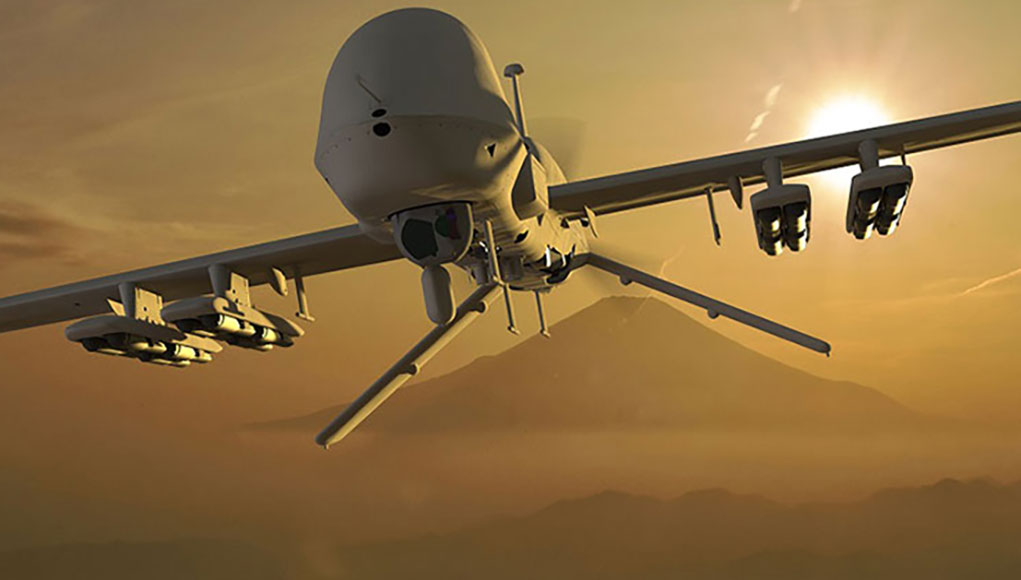
NOTE: The General Atomics MQ-1C Gray Eagle (previously the Warrior; also called Sky Warrior and ERMP or Extended-Range Multi-Purpose) has a range of 250 miles or more.

*(Image credit: An Army “Gray Eagle” Unmanned Aircraft System flies over the U.S. Army Dugway Proving Ground in Dugway, Utah, on Dec. 10, 2020. Photo: Becki Bryant/U.S. Army Dugway Proving Ground)


Democratic and Republican Senators Demand Transfer of Gray Eagle Drone to Ukraine

Joe Manchin, Lindsey Graham, and 14 other U.S. senators demand that Biden give Ukraine a top-tier U.S. drone.

"In their November 22 letter, the senators — including Republicans Lindsey Graham and Chuck Grassley as well as Democrats Richard Blumenthal and Mark Kelly — wrote, “Most importantly, armed [drones] could find and attack Russian warships in the Black Sea, breaking its coercive blockade and alleviate dual pressures on the Ukrainian economy and global food prices.” 

✓ The senators asserted, “A Russian victory over Ukraine would significantly damage American security and prosperity.”

As The Intercept noted on November 18, the proliferation of drone warfare in Ukraine has been fueled by both sides — with Russia utilizing Iranian-made Shahed drones in swarm attacks against Ukrainian targets, including civilian infrastructure. The U.S. and other NATO countries have given Kyiv some 2,500 Switchblade and Phoenix Ghost “suicide” drones, which effectively function as small, remote-controlled cruise missiles. Ukraine has also been using larger Turkish-manufactured Bayraktar TB-2 drones, which are a cheaper and less powerful version of the premiere U.S. drones used widely in “counterterrorism” operations in the Middle East and Africa.*

* BLOGGER INSERTS 


www.militarytimes.com

US Africa Command says one of its drones, an apparently armed Gray Eagle, malfunctioned in Niger 


By Howard Altman Jan 24, 2021
2 - 3 minutes

When asked about this photo, of an MQ-1C Gray Eagle drone, apparently armed with a Hellfire missile, on the ground in Niger, AFRICOM officials said one of their drones malfunctioned in the area.
"When asked about this photo, of an MQ-1C Gray Eagle drone, apparently armed with a Hellfire missile, on the ground in Niger, AFRICOM officials said one of their drones malfunctioned in the area. (via Twitter)

An MQ-1C Gray Eagle drone, operated by U.S. Africa Command made an emergency landing near Agadez, Niger, on Saturday, a U.S. Africa Command spokesman told Military Times.

“The aircraft experienced a mechanical malfunction while conducting a routine mission in support of operations in the region,” Air Force Col. Christopher Karns told Military Times.

An investigation into the cause of the malfunction will take place, he said.


RELATED

“The aircraft is under observation by U.S. forces with host nation cooperation and assistance,” Karns said. “Assessment and the process of recovery of the aircraft and safeguarding the site is underway. Due to force protection and operational considerations this is about all I can say. Early indications reflect a mechanical issue but an investigation is underway.”

Karns told Military Times the drone is an MQ-1C Gray Eagle, a multipurpose drone that “provides reconnaissance, surveillance, target acquisition, command and control, communications relay, signals intelligence, electronic warfare, attack, battle damage assessment, and manned-unmanned teaming capabilities,” according to the Defense Department.

AFRICOM’s Twitter account confirmed the loss of the aircraft after being asked about social media postings of what appear to be an armed Gray Eagle drone, with a Hellfire missile still under its wing.


RELATED

“We continue to work with African partners providing a range of assistance in the region to include a valuable threat detection capability via aerial overwatch,” said Karns.

About Howard Altman

Howard Altman is an award-winning editor and reporter who was previously the military reporter for the Tampa Bay Times and before that the Tampa Tribune, where he covered USCENTCOM, USSOCOM and SOF writ large among many other topics. 


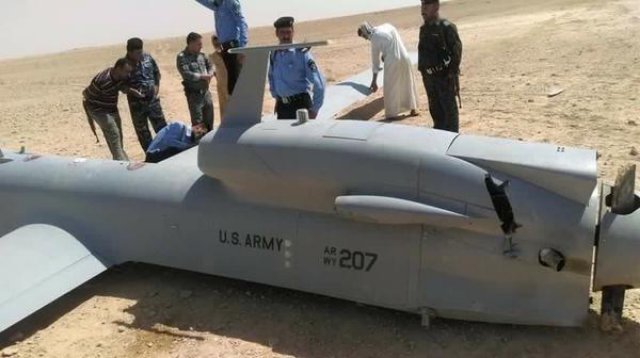
Gray Eagle Crash in Southern Iraq

Gray Eagle Iraq

Photos posted on Jul. 21 on Twitter show a crashed (largely intact) MQ-1C Gray Eagle with U.S. Army markings.

The 160th Special Operations Aviation Regiment (Airborne) is known to operate 12 Gray Eagles (along with a fleet of smaller RQ-11B Raven and RQ-7 Shadow RPAS, that are used for ISR (Intelligence Surveillance Reconnaissance) task in support to Special Ops.


defense-update.com

US Army Upgrades Gray Eagle to Support Multi-Domain Operations - Defense Update:

Tamir Eshel
5 - 6 minutes


The Gray Eagle ER (MDO) is upgraded to operate Air Launched Effects (ALE) that can operate individually or as a swarm, monitored and managed by the GE-ER acting as a 'mothership'. Illustration: GA-ASI

"General Atomics-Aeronautical Systems, Inc. (GA-ASI) began the first installation of factory upgrades to a Gray Eagle-Extended Range (GE-ER) Unmanned Aircraft System to enhance its capabilities to support Multi-Domain Operations (MDO). The MDO upgrade follows a series of demonstrations that showcased GE-ER’s persistent stand-off survivability with stand-in capabilities and up to 40 hours of endurance. Under the current program, the U.S. Army-funded program includes two aircraft. Flight tests and qualifications will start later this year.

Modernization efforts focus on increased capability and survivability in a large-scale combat operations environment. The modernization efforts ensure that the Army’s MQ-1C GE-ER (MDO) can operate and thrive in a degraded navigation environment and provide high fidelity situational awareness through a suite of long-range sensors.

According to Don Cattell, vice president for Army Programs at GA-ASI, the upgrades ensure Gray Eagle’s support of advanced teaming operations with manned and other unmanned platforms. “We are fully committed to our Army partners to make sure our proven GE-ER is equipped for its role as the designated platform for long-range sensors and Air-Launched Effects (ALEs),” Cattell said. Deploying ALE over the area under surveillance, the Gray Eagle ER (MDO) will serve as the “ALE Mothership” and enable joint forces to maintain situational awareness deep into the battlefield.


Gray Eagle ER undergoing testing at the Yuma Proving Ground. Photo: GA-ASI

GA-ASI worked with the Army to demonstrate MDO capabilities on the Gray Eagle ER at Yuma Proving Grounds, which included fully integrated, internally mounted long-range sensors, ALEs, and laptop-based and handheld control interfaces. The Modernized GE-ER (MDO) incorporates open architecture aircraft and ground systems, advanced datalinks, and an upgraded propulsion system, significantly enhancing the ability to add new capabilities, provide resilience to electronic threats, and expeditionary employment to austere locations.

The upgraded variant utilizes the open architecture design to operate through a scalable command and control (SC2) interface. The SC2 system enables soldiers to operate the GE-ER (MDO) through a laptop or handheld devices. Advancements in artificial intelligence and machine learning help streamline the system’s operation and reduce operator workload.


The SC2 system enables soldiers to operate the GE-ER (MDO) through a laptop or handheld devices. Photo: GA-ASI

Demonstrations focused on enabling a Joint Terminal Attack Controller (JTAC) to control the Electro-optical/Infrared (EO/IR) sensor on a Gray Eagle Extended Range UAS, and rapidly call for direct and indirect fire on an array of targets. The JTAC was able to see GE-ER video, aircraft location, and sensor field of regard utilizing an Android Team Awareness Kit (ATAK) and a TrellisWare TW-950 TSM Shadow Radio. Utilizing the GE-ER’s open architecture, the JTAC was able to send a digital ‘Call for Fires’ to request artillery support and a digital 9-line for Close Air Support with the push of a few buttons. The GE-ER, configured for Multi-Domain Operations, autonomously re-routed its flight path to provide the sensor data that the JTAC requested without commands from the GE-ER operator.


GA-ASI has demonstrated the feasibility of operating a Self-Protection Pod (SPP) on the MQ9, enhancing the survivability of the drone when operating in contested airspace. Photo: GA-ASI

✓ Under another demonstration, GA-ASI demonstrated the use of self-protection pod (SPP) capabilities of the MQ-9 UAS, as part of a Cooperative Research and Development Agreement (CRADA) with U.S. Special Operations Command (USSOCOM), and with the support of the Air National Guard (ANG), the U.S. Navy (USN), and industry partners. 

✓ SPP leverages mature Aircraft Survivability Equipment (ASE) to provide full-spectrum awareness and countermeasures. The pod uses Raytheon’s AN/ALR-69A(V) Radar Warning Receiver (RWR) set and Leonardo DRS AN/AAQ-45 Distributed Aperture Infrared Countermeasure (DAIRCM) System that utilizes a single sensor for both 2-color IR missile warning and wide field-of-view gimbal for threat countermeasures. 

✓ Both sensors support threat warnings.

✓ In addition, the pod features BAE Systems’ ALE-47 countermeasures dispenser System to release airborne flares, chaff, and the BriteCloud Expendable Active Decoy (EAD), which is a small, expendable self-contained Digital Radio Frequency Memory (DRFM)-based expendable decoy. 

✓ The ECM suite is managed by the Terma AN/ALQ-213 Electronic Warfare Management System, which provides the interface, health, status, and command and control for the various systems installed in the pod. that functions as the ASE manager that coordinates between the various threat warning and dispensing systems to automatically dispense the appropriate sequencing pattern and expendables to protect the drone." READ MORE 

www.autoevolution.com

Soldier Controls MQ-1C Gray Eagle Drone Via Tablet in Latest GA-ASI Demo 


Florina Spînu
2 - 3 minutes

Defense contractor General Atomics Aeronautical Systems (GA-ASI) successfully demonstrated enhanced situational awareness and targeting capability of an MQ-1C Gray Eagle in a recent exercise. The Extended Range drone was remotely controlled via an Android-powered tablet by a soldier on ground.

Widely used by the U.S. Army, the Gray Eagle can operate for about 36 hours at altitudes up to 25,000 feet (7,600 m). The aircraft's nose fairing is enlarged to support a synthetic aperture radar or ground moving target indicator (SAR/GMTI) system.

It has a payload capacity of 800 pounds (360 kg) and can be armed with AGM-114 Hellfire missiles and GBU-44/B Viper Strike guided bombs. Its sensors can detect changes in terrain such as tire tracks, footprints, and buried improvised explosive devices by fusing infrared imagery.

GA-ASI latest demonstration took place on April 23rd at Yuma Proving Grounds, Arizona


There are indications that the U.S. is considering modifying some of the components on the Gray Eagle and swapping them out for less sensitive technologies in order to move forward with supplying the drones to Ukraine. In their letter, the senators noted that AGM-114 Hellfire missiles “have been reviewed and exported to over twenty-five U.S. partners.” Last week, a Pentagon spokesperson said that “nothing has been ruled out.” The senators asked the White House to respond to their letter no later than November 30.
As The Intercept noted on November 18, the proliferation of drone warfare in Ukraine has been fueled by both sides — with Russia utilizing Iranian-made Shahed drones in swarm attacks against Ukrainian targets, including civilian infrastructure. The U.S. and other NATO countries have given Kyiv some 2,500 Switchblade and Phoenix Ghost “suicide” drones, which effectively function as small, remote-controlled cruise missiles. Ukraine has also been using larger Turkish-manufactured Bayraktar TB-2 drones, which are a cheaper and less powerful version of the premiere U.S. drones used widely in “counterterrorism” operations in the Middle East and Africa". 

.

NEWS: LeMonde in English | Sunday, January 25, 2026 Time: 10:46 pm (Paris)

Le Monde.fr https://www.lemonde.fr › ...   France's leading newspaper brings you the latest coverage from France, Europe, and all aro...